




주요 요점
- 풀러렌 C60 (순수), 99.95% 순도, 금속 잔류물이 없어야 하며, 순도, 배치 일관성, 문서 및 적용 적합성을 기준으로 평가되어야 합니다.
- 공식 견적 전에 COA, MSDS/SDS, 포장, 보관, 수량 및 도착 국가를 확인해야 합니다.
- 연구 및 산업용으로 사용 시, 풀러렌 등급은 의도된 재료 시스템 및 테스트 요구 사항과 일치해야 합니다.
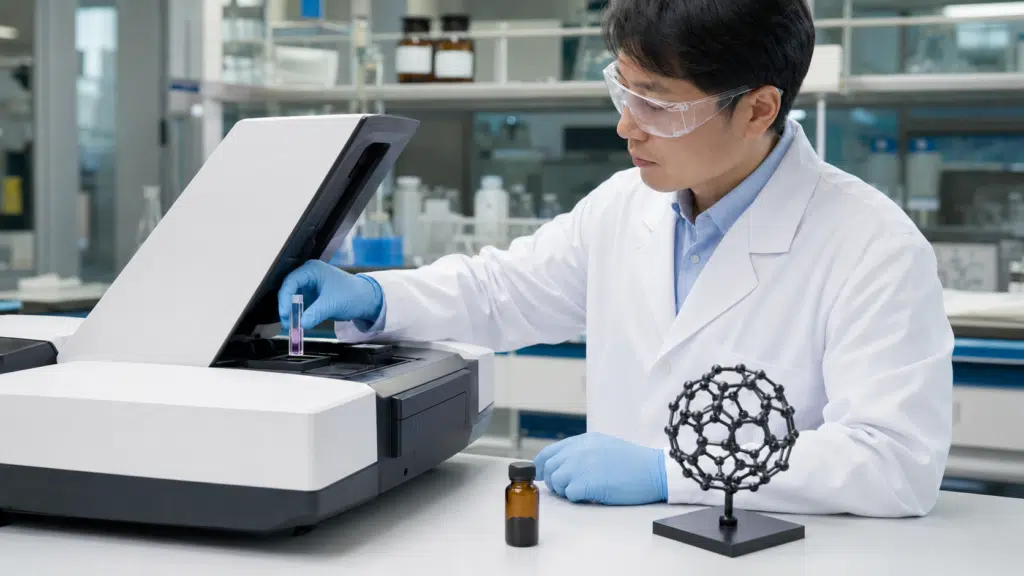
C60 UV-Vis 분광법은 용액, 분산액, 필름 또는 재료 블렌드에서 버크민스터풀러렌이 자외선 및 가시광선을 흡수하는 방식을 신속하게 조사하는 방법을 제공합니다. 이 측정은 분자 식별을 지원하고, 농도 의존적 거동을 밝혀내며, 처리 조건을 비교하고, 용매, 응집, 기판 또는 주변 물질에 의해 도입된 변화를 추적할 수 있습니다.
결과 스펙트럼은 분자 식별만으로 결정되지 않습니다. 용매, 농도, 광학 경로 길이, 시료 준비, 산란, 기기 베이스라인, 필름 두께 및 다른 성분과의 상호작용이 모두 관찰된 곡선을 변화시킬 수 있습니다. 따라서 신뢰할 수 있는 해석은 시료의 물리적 상태와 측정이 답변하고자 하는 정확한 질문에서 시작됩니다.
UV-Vis 분광법은 C60에서 무엇을 측정합니까?
UV-Vis 분광법은 선택된 파장 범위에서 입사광이 얼마나 흡수되거나 투과되는지를 측정합니다. 분자 C60에서 흡수는 공액 탄소 케이지와 관련된 전자 전이로 인해 발생합니다. 분자의 높은 대칭성은 어떤 전이가 강하게 허용되고 어떤 전이가 더 약한 특징으로 나타나는지에 영향을 미칩니다.
초기 기체상 연구는 386 nm 부근에서 좁은 C60 자외선 흡수 특징을 보고했습니다.[1] 이후 용액 측정에서는 스펙트럼이 주변 용매에 의존한다는 것을 보여주었습니다. 15가지 유기 용매에서 C60에 대한 연구는 약 330 nm 및 405 nm 영역 부근의 밴드에서 상당한 용매 의존적 이동을 발견했습니다.[2]
이러한 값은 문헌상의 영역으로 취급되어야 하며, 보편적인 허용 한계가 아닙니다. 방향족 용매에서 수집된 스펙트럼은 서로 다른 분자 환경을 고려하지 않고 기체상, 고체 필름, 수성 콜로이드 또는 고분자 블렌드 스펙트럼과 수치적으로 비교될 수 없습니다.
C60 흡수 스펙트럼 인식하기
순수한 분자 C60은 일반적으로 가시광선 영역까지 확장되는 더 약한 구조와 함께 강한 자외선 흡수를 생성합니다. 일반적으로 사용되는 유기 용매에서 연구자들은 종종 다음을 조사합니다:
- 자외선 영역에서의 강한 흡수;
- 300 nm 저영역에서의 두드러진 전이;
- 약 400 nm 영역 부근의 더 약한 특징;
- 가시광선 범위까지 더 확장되는 광범위하고 낮은 강도의 흡수.
정확한 피크 위치, 상대적 강도 및 가시광선 구조의 양은 용매, 농도, 스펙트럼 대역폭, 기기 응답 및 시료 상태에 따라 달라집니다. 따라서 발표된 피크 목록은 실험 방법을 일치시키지 않고 사양에 복사하기보다는 비교 보조 자료로 사용되어야 합니다.
특징적인 스펙트럼이 수치적 순도를 확립하지 못하는 이유
C60과 일치하는 스펙트럼은 예상되는 전자 흡수체의 존재를 뒷받침합니다. 이것만으로 시료가 질량 또는 크로마토그래피 면적 기준으로 특정 백분율의 C60임을 확립하지는 않습니다.
미량 불순물은 약한 흡수를 가지거나, C60 밴드와 중첩되거나, 스캔 영역 밖에 있거나, 측정의 실질적 감도 이하로 남을 수 있습니다. 반대로, 베이스라인 드리프트, 용매 흡수, 산란 및 높은 흡광도는 순수 시료의 스펙트럼을 왜곡할 수 있습니다.
결정이 가용성 풀러렌 성분의 상대적 풍부도에 관한 것일 때, HPLC가 해당 질문에 더 직접적으로 부합합니다. 질량 분석법은 분자 조성을 뒷받침할 수 있는 반면, 라만 분광법은 특징적인 케이지 진동을 조사할 수 있습니다. XCT의 가이드는 C60 특성 분석 방법 이러한 방법들이 어떻게 서로 다른 분석적 질문에 답변하는지 설명합니다.
UV-Vis 측정을 위한 C60 용액 준비
시료 준비는 측정된 스펙트럼이 재현 가능한 분자 용액을 나타내는지, 아니면 용해되지 않은 입자와 응집체의 영향을 받는 혼합물을 나타내는지를 결정합니다.
적합한 용매 선택
순수한 C60은 물과의 상용성이 매우 낮지만 선택된 유기 용매에는 용해됩니다. 톨루엔과 같은 방향족 용매는 육안으로 균질한 C60 용액을 생성할 수 있기 때문에 용액 분광법에 자주 사용됩니다. 다른 용매는 용해 거동, 자외선 차단 파장, 안전 요구 사항 및 풀러렌 케이지와의 상호작용이 다를 수 있습니다.
용매는 재료와 선택된 파장 범위 모두에 적합해야 합니다. 용매가 목표 전이와 동일한 영역에서 강하게 흡수하는 경우, 사용 가능한 스펙트럼 창이 제한되고 블랭크 차감이 작은 불일치에 더 민감해집니다.
용매 선택은 스펙트럼 자체에도 영향을 미칩니다. Gallagher와 동료들은 지방족 용매, 방향족 용매 및 이황화탄소 간의 차이를 포함하여 일련의 유기 용매에 걸친 용매변색 이동을 보고했습니다.[2] 따라서 시료 간 비교는 용매 효과가 실험의 주제가 아닌 한 동일한 용매를 사용해야 합니다.
농도 계열 준비
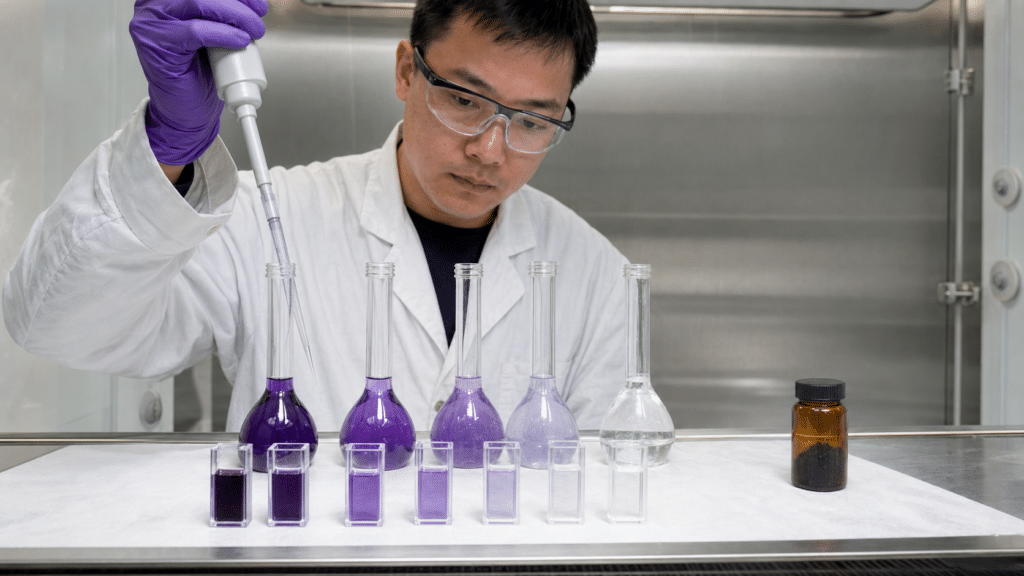
단일 고흡수 용액은 제한적인 진단 정보를 제공합니다. 희석 계열이 더 유용한데, 이는 흡광도가 농도에 비례하여 변화하는지와 스펙트럼 모양이 안정적으로 유지되는지를 테스트하기 때문입니다.
Beer-Lambert 관계가 적용되는 조건에서 흡광도는 몰 농도 및 광학 경로 길이에 비례합니다:
A A = εb c
여기서 A A는 흡광도, ε는 선택된 파장에서의 몰 흡광 계수, b b는 광학 경로 길이, 그리고 c c는 농도입니다.
흡광도가 선형적으로 증가하지 않는 경우, 가능한 원인으로는 과도한 흡광도, 응집, 불완전 용해, 산란광, 농도 오류, 큐벳 불일치 또는 시료의 화학적 변화가 포함됩니다. 더 낮은 농도에서 측정을 반복하면 기기 범위 문제와 실제 농도 의존적 거동을 구분하는 데 도움이 됩니다.
일치하는 용매 블랭크 사용
기준 큐벳에는 시료에 사용된 것과 동일한 용매 및 의도적으로 첨가된 매트릭스 성분이 포함되어야 합니다. 다른 용매 배치 또는 조성으로 준비된 블랭크는 인위적인 기울기와 오프셋을 도입할 수 있습니다.
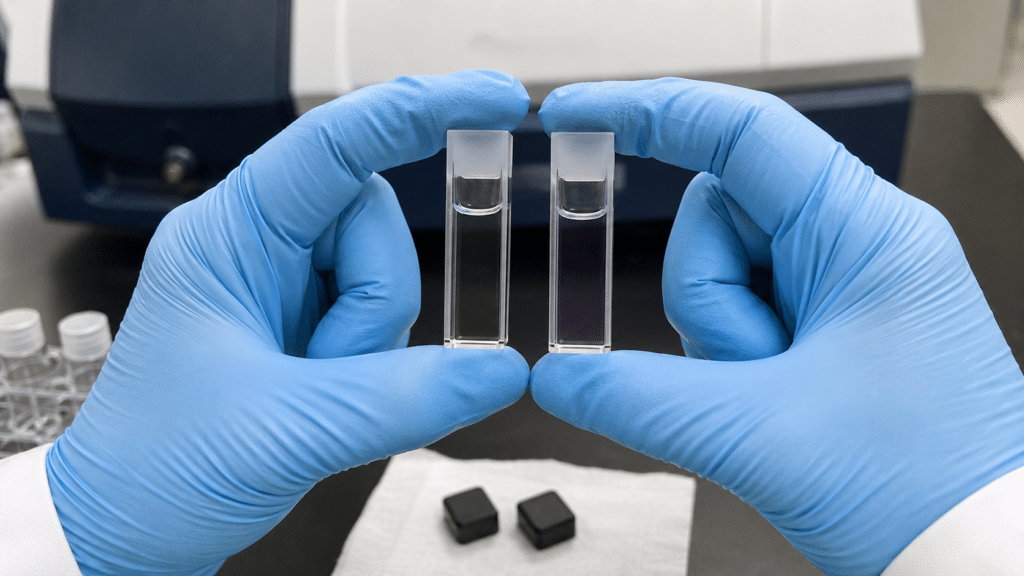
스캔이 자외선 영역까지 확장되는 경우 일반적으로 석영 큐벳이 필요합니다. 광학면은 깨끗하고, 일관되게 정렬되어야 하며, 지문, 액적, 긁힘 및 기포가 없어야 합니다. 큐벳을 비광학 상부 표면으로 취급하면 피할 수 있는 변동이 줄어듭니다.
용매 효과, 응집 및 산란
C60 UV-Vis 스펙트럼의 변화가 자동으로 화학적 분해를 나타내는 것은 아닙니다. 동일한 분자 물질이라도 환경이나 물리적 상태가 변하면 다른 스펙트럼을 생성할 수 있습니다.
용매 의존적 이동
용매 분극성 및 용질-용매 상호작용은 전이 에너지를 이동시키고 밴드 모양을 변화시킬 수 있습니다. 이러한 효과는 서로 다른 매체에서 얻은 발표된 피크 위치를 비교할 때 특히 중요합니다.
용매의 종류, 등급, 제조 방법, 농도, 온도, 큐벳 경로 길이 및 스캔 매개변수를 기록하십시오. 이 정보 없이는 작은 파장 차이를 분자 구조의 변화로 확실하게 할당할 수 없습니다.
응집 및 콜로이드성 C60
응집되거나 입자상인 C60은 스펙트럼 특징을 넓히고 광 산란을 통해 파장 의존적 배경을 추가할 수 있습니다. 수성 nC60에 대한 연구는 UV-Vis 거동이 콜로이드 현탁액을 제조하는 데 사용된 방법과 결과적인 입자 시스템에 의존함을 보여주었습니다.[3]
짧은 파장 쪽으로 꾸준히 상승하는 베이스라인, 미세 구조의 손실, 육안으로 보이는 탁도, 또는 여과 및 침강 시간에 대한 의존성은 산란이 측정에 기여하고 있음을 나타낼 수 있습니다. 이러한 관찰은 시스템이 분산액으로 의도된 경우 입자 크기 또는 현미경 데이터와 함께 조사되어야 합니다.
Filtration must also be interpreted carefully. A filter may remove dust and large aggregates, but it can adsorb fullerene material or selectively change the population being measured. Record the membrane material, pore size, and whether the sample spectrum changed after filtration.
For a fuller discussion of molecular solution versus dispersion behavior, see XCT’s guide to the 유기 용매에서의 순수 풀러렌 용해도.
Interpreting Peak Position, Intensity, Width, and Baseline
| Observation | Possible explanations | Useful next check |
|---|---|---|
| Small wavelength shift | Solvent effect, calibration, temperature, matrix interaction, or chemical modification | Measure a reference under matched conditions |
| Lower absorbance than expected | Dilution error, incomplete transfer, adsorption, precipitation, path-length difference, or degradation | Prepare an independent dilution from the original sample |
| Nonlinear absorbance with concentration | Excessive absorbance, stray light, aggregation, incomplete dissolution, or concentration error | Extend the dilution series into a lower range |
| Broadening or loss of structure | Aggregation, matrix interaction, film-state effects, mixed species, or limited resolution | Compare solution, filtered sample, and complementary spectra |
| Sloping background | Scattering, blank mismatch, dirty cuvette, bubbles, or baseline drift | Repeat the blank and inspect the sample visually |
| New absorption feature | Derivative formation, oxidation, photochemical change, contaminant, or surrounding material | Use HPLC, MS, Raman, or another structure-sensitive method |
The interpretation should follow the observation rather than assume one cause. For example, a lower absorbance after storage could reflect precipitation onto the container wall rather than destruction of the carbon cage. Examining the container, redissolving the sample under controlled conditions, and comparing an independently prepared solution can distinguish these possibilities.
C60 UV–Vis Spectroscopy in Thin Films
A C60 film does not reproduce the spectrum of a dilute molecular solution. In a solid layer, molecules interact with neighboring C60 cages, the substrate, and adjacent materials. Film thickness, morphology, crystallinity, deposition conditions, annealing, oxidation, and optical interference can all affect the observed response.
For a film measurement, the reference should normally include an equivalent uncoated substrate. When C60 is deposited on a multilayer stack, the baseline may need to account for every underlying layer that contributes absorption, reflection, or interference.
Transmission alone is not always equivalent to absorption. Reflection and scattering can be significant, particularly for rough, thick, porous, or composite films. If an absorption coefficient is required, the optical model should match the actual sample geometry and include thickness information rather than treating raw absorbance as an intrinsic material constant.
UV–Vis can be valuable for comparing films produced under controlled process variations, but it does not independently identify the cause of every change. C60 라만 분광법 can examine molecular vibrations and some processing-induced structural changes, while C60 XRD evaluates long-range crystalline organization. Surface-sensitive questions may require C60 XPS analysis.

Can UV–Vis Be Used for C60 Quantification?
UV–Vis can be used to estimate C60 concentration when the system has been validated for that purpose. The measurement requires an appropriate wavelength, known path length, verified concentration standards or a suitable absorption coefficient, a stable solvent system, and a concentration range that follows Beer–Lambert behavior.
The calibration should be specific to the solvent, sample form, and instrument conditions. Applying an absorption coefficient reported in another solvent or for a different spectral feature can introduce systematic error. Likewise, a calibration developed for molecular C60 solution should not be applied directly to an aggregate dispersion or thin film.
For routine quantitative work, prepare multiple standards independently where practical, measure a solvent blank, inspect residuals from the calibration, and include a quality-control sample that is not one of the calibration standards.
A Reproducible C60 UV–Vis Reporting Checklist
- Identify the material as pristine C60, a defined derivative, a blend, or a dispersion.
- Record the solvent or complete matrix composition.
- State the sample concentration and preparation method.
- Identify the cuvette material and optical path length.
- Describe the blank and baseline procedure.
- Record the wavelength range, spectral bandwidth, scan speed, and data interval.
- Report whether dilution linearity was evaluated.
- Note visible particles, haze, precipitation, filtration, or sonication.
- For films, record substrate, film preparation, thickness information, and reference substrate.
- Retain raw spectra rather than only a normalized figure.
Using UV–Vis When Evaluating a C60 Material
UV–Vis is most informative when it answers a defined material or process question. A synthesis laboratory may use it to follow depletion or formation of absorbing species. A coating team may compare solutions before deposition and films after processing. A quality laboratory may use a matched reference to detect an unexpected optical difference between samples.
Researchers requiring 高纯度富勒烯C60 should specify the intended sample state, solvent or deposition method, required quantity, and analytical objective. XCT can review available material and analytical information for research and industrial evaluation without treating UV–Vis as a substitute for every composition, surface, or device-level measurement.
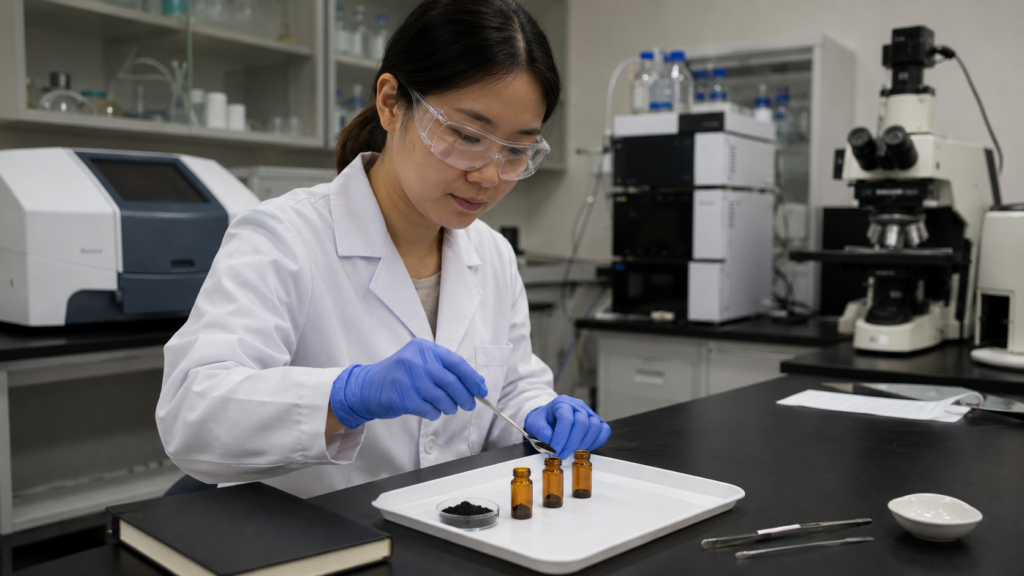
To discuss a material requirement, use the XCT 요청 양식 and include the target C60 grade, quantity, application, destination, processing route, and analytical information needed by the project.
자주 묻는 질문
C60 UV-Vis 스펙트럼에서 주요 흡수 영역은 무엇인가요?
C60은 일반적으로 강한 자외선 흡수를 나타내며, 300nm 저영역에서 뚜렷한 전이, 약 400nm 부근에서 약한 특징, 그리고 가시광선 영역까지 이어지는 낮은 강도의 흡수를 보입니다. 정확한 위치와 형태는 용매, 농도, 시료 상태 및 측정 조건에 따라 달라집니다.
UV-Vis 분광법이 C60의 순도를 증명할 수 있습니까?
아니요. UV-Vis 분광법은 C60 함유 시료의 식별 및 비교를 지원할 수 있으나, 독립적으로 수치적 순도를 확립하지는 않습니다. 평가 대상이 되는 불순물 또는 규격에 따라 HPLC, 질량 분석법, 원소 분석법 또는 기타 분석법을 선택해야 합니다.
C60의 UV-Vis 스펙트럼이 용매에 따라 변화하는 이유는 무엇인가?
용매의 분극성과 용질-용매 상호작용은 C60의 전자 전이를 이동시키고 띠 형태를 변화시킬 수 있습니다. 따라서 용매 효과가 실험의 대상이 아닌 경우, 동일한 용매와 일치된 측정 조건을 사용하여 의미 있는 비교를 수행해야 합니다.
응집이 C60 UV-Vis 스펙트럼에 어떤 영향을 미칠 수 있습니까?
응집은 흡수 특징을 넓히고, 상대 강도를 변화시키며, 광산란을 통해 경사진 배경을 추가할 수 있습니다. 희석, 육안 검사, 여과 조절 및 입자 민감성 방법은 응집을 분자 또는 화학적 변화와 구별하는 데 도움이 될 수 있습니다.
UV-Vis 분광법이 C60의 농도를 측정할 수 있습니까?
네, 용매, 파장, 광로 길이, 검량선 및 농도 범위가 검증되었고 시료가 Beer-Lambert 법칙을 따르는 경우에 가능합니다. 분자 상태의 C60 용액에 대한 검량선은 분산액이나 박막에 직접 전이되어서는 안 됩니다.
참고문헌
- Heath, J. R.; Curl, R. F.; Smalley, R. E. “The UV Absorption Spectrum of C60 (Buckminsterfullerene): A Narrow Band at 3860 Å.” 화학 물리학 저널, 1987, 87, 4236–4238. https://doi.org/10.1063/1.452879
- Gallagher, S. H.; Armstrong, R. S.; Lay, P. A.; Reed, C. A. “Solvent Effects on the Electronic Spectrum of C60.” Journal of Physical Chemistry, 1995. https://hero.epa.gov/reference/7735097/
- Fortner, J. D. et al. “UV–Vis Spectroscopic Properties of nC60 Produced via Extended Mixing.” Environmental Science & Technology, 2011. https://doi.org/10.1021/es201229a
- Bansal, S.; Kapoor, S.; Dhawan, S. K. “C60 and C70 Electronic Absorption Spectra in Different Solvents.” Spectrochimica Acta Part A, 2011. https://pubmed.ncbi.nlm.nih.gov/21485869/
- Malaspina, T.; Fileti, E. E.; Rivelino, R. “Structure and UV–Vis Spectrum of C60 Fullerene in Ethanol.” Journal of Physical Chemistry B, 2007. https://doi.org/10.1021/jp0746244
조달 인사이트
풀러렌 C60 (순수), 순도 99.95%, 금속 잔류물 없음 제품의 B2B 조달 시, 구매자는 공식 견적을 요청하기 전에 목표 순도, 필요 수량, 용도, 도착 국가, COA, MSDS/SDS, 포장, 보관 조건 및 배송 요구 사항을 확인해야 합니다.
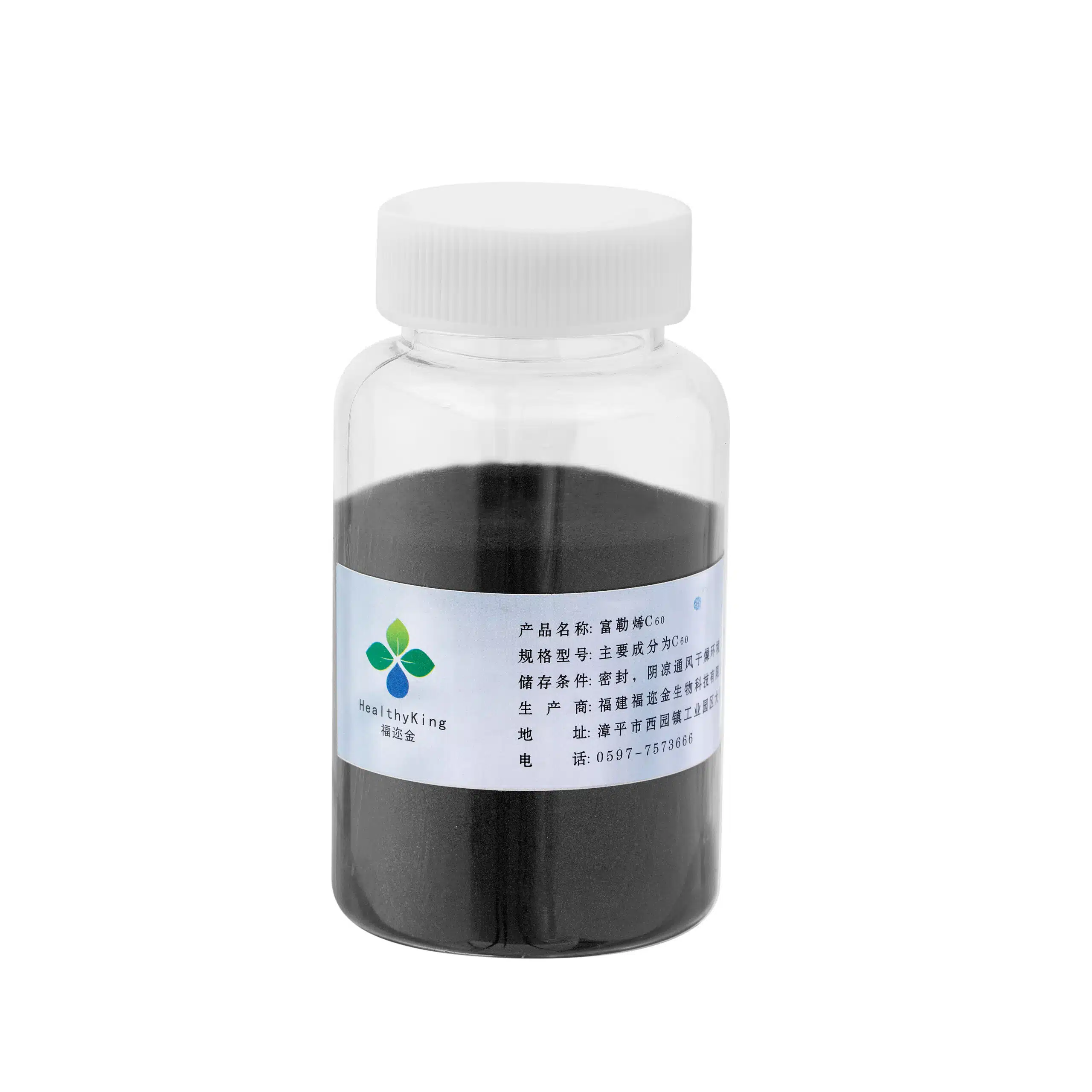
COA 또는 MSDS/SDS가 필요하십니까?
주문을 확인하기 전에 제품 사양, 배치별 COA, MSDS/SDS, 샘플 가용성, 포장 세부 사항 및 국제 배송 정보를 요청하십시오.
문서 요청견적 요청 전 구매자 체크리스트
- 제품명 및 CAS 번호(알고 있는 경우)
- 목표 순도
- 필요 수량
- 샘플 또는 대량 주문
- 용도 또는 의도된 사용 목적
- 목적 국가
- 필요 문서
- 포장 선호 사항
관련 기술 문서


고순도 풀러렌을 조달할 준비가 되셨습니까?
제품, 순도, 수량, 용도, 도착 국가 및 문서 요구 사항을 제출하십시오. 당사 팀이 가용성, COA, MSDS/SDS, 포장 및 견적 세부 사항을 확인하는 데 도움을 드릴 것입니다.