





技术
C60 Lubricant Additives: Dispersion, Tribology Testing, and Verified Performance Claims

关键要点
- 富勒烯C60(纯品),纯度99.95%,不应仅通过纯度评估,还需结合批次一致性、文件记录及应用适用性进行综合考量,且不得含有金属残留。.
- 在正式报价前,应确认分析证书(COA)、安全数据表(MSDS/SDS)、包装方式、储存条件、数量及目的国信息。.
- 用于科研及工业用途时,富勒烯的等级应与目标材料体系及测试要求相匹配。.
Fullerene C60 is investigated as a lubricant additive because it introduces a defined molecular carbon material into a tribological system. Published studies have reported changes in friction or wear when C60-containing formulations were tested under particular conditions, but those results do not establish one universal treatment rate or performance benefit. The outcome depends on the base oil, additive package, C60 concentration, dispersion method, contact geometry, load, speed, temperature and test duration.
A useful C60 lubricant additive program therefore begins with formulation control, not with a promised percentage reduction in friction. Researchers must first establish what material was added, whether it remained distributed in the oil, how the control and test samples were prepared, and whether the selected tribometer represents the intended lubrication regime.
This guide explains how to evaluate C60 in liquid lubricant research, interpret published studies and progress from laboratory screening to an application-relevant validation program.
Why C60 Is Investigated as a Lubricant Additive
C60, also called buckminsterfullerene or Carbon 60, is a closed carbon cage composed of 60 carbon atoms. Its molecular identity is distinct from graphite, graphene, carbon nanotubes and carbon black. PubChem associates fullerene C60 with CID 123591 and the commonly used CAS number 99685-96-8.[1]
In tribology research, C60 has attracted attention because its size, cage geometry and surface interactions differ from those of conventional dissolved friction modifiers or larger carbon particles. Proposed explanations for observed behavior include entry into the contact region, third-body motion, surface polishing, adsorption and participation in tribofilm formation. These are possible mechanisms, not automatic properties of every C60-containing oil.
A lower measured friction coefficient does not, by itself, prove that intact C60 molecules acted as nanoscale ball bearings. Establishing a mechanism requires evidence from the formulation and the worn surfaces, such as particle or aggregate characterization, microscopy, profilometry, spectroscopy or chemical mapping.
What Published C60 Tribology Studies Actually Show
Ku and colleagues tested C60 nanoparticles in mineral lubricants with different viscosities and normal loads. They reported that the difference between the reference oil and C60-containing oil was more apparent for lower-viscosity oil under higher normal load in their experimental system.[2] The important result is not a universal reduction value; it is evidence that base-oil viscosity and load materially changed the observed response.
Huang and colleagues investigated C60 nanomicrosphere additives in an HM32 anti-wear lubricating fluid and evaluated dispersion stability alongside friction characteristics.[3] This pairing is methodologically important. A tribology result is difficult to interpret when the additive concentration at the contact is changing because of settling or aggregation.
In a separate oscillating-tribometer study, Tóth-Nagy and Szabó reported a reduction in friction for C60-containing engine-oil samples under their defined conditions. They also observed a concentration-dependent response rather than a simple “more is better” relationship.[4] The reported concentration and friction change belong to that oil, preparation method and test configuration; they are not general specifications for C60 or finished lubricants.
Together, these studies support further formulation research. They do not establish that adding C60 to an arbitrary engine oil, hydraulic fluid, grease or industrial oil will improve fuel economy, extend drain intervals or increase equipment life.
Start with the Lubricant System, Not a Universal Dosage
A C60 lubricant formulation should be defined as a complete system. At minimum, the experimental plan should identify:
- base-oil chemistry and viscosity grade;
- existing detergent, dispersant, anti-wear, antioxidant and friction-modifier package;
- C60 material identity, batch and concentration;
- mixing order, temperature, time and applied shear or sonication;
- storage time between preparation and testing;
- contact materials, surface finish and specimen geometry;
- load, speed, temperature, duration and lubrication regime;
- number of replicates and method used to treat outliers.
Mineral oil, polyalphaolefin, ester, glycol, silicone and bio-based oils differ in polarity, viscosity and solvency. A dispersion method that works in one fluid may produce settling or aggregation in another. Fully formulated lubricants add another level of complexity because C60 may coexist or compete with dispersants, detergents, ZDDP-type anti-wear agents, antioxidants and other surface-active components.
Concentration should therefore be screened across a controlled range. The study should include a blank base oil or reference formulation, matched preparation controls and multiple C60 concentrations. If a dispersant or carrier solvent is used, a control containing the same dispersant or solvent without C60 is necessary to separate its effect from the effect attributed to C60.
Dispersion Stability Comes Before Friction and Wear Claims
Pristine C60 is generally insoluble in water and shows strongly solvent-dependent behavior in organic media. Additional information on solvent selection is available in XCT’s guide to 原始C60和C70溶解度的指南. In a lubricant, the term “dispersed” may describe molecularly dissolved material, small aggregates, larger suspended particles or a mixture of these states. These are not interchangeable.
Visual inspection is useful for early screening but cannot establish particle size or molecular dispersion. A clear-looking oil can contain aggregates below the resolution of the eye, while a dark formulation may still be stable enough for a defined experiment. The method should be selected according to the development stage and may include timed sedimentation observations, centrifugation, optical absorbance, microscopy, particle-size analysis, filtration checks and temperature cycling.

Stability must also be measured over a relevant period. A sample that remains homogeneous for the duration of a short tribometer run may be useful for mechanism screening but unsuitable for a lubricant expected to remain stable during storage and repeated service. Record when the formulation was mixed, when it was tested and whether it was remixed before each measurement.
A Practical C60 Tribology Test Matrix
| Stage | Primary question | Useful measurements | Decision supported |
|---|---|---|---|
| Material control | Was the intended C60 batch used? | Identity, batch record, purity method and storage history | Whether experiments can be traced and repeated |
| Dispersion screening | Does C60 remain sufficiently distributed? | Timed observation, microscopy, absorbance, centrifugation or particle analysis | Whether tribology testing is meaningful |
| Concentration screening | Is the response concentration-dependent? | Matched control and several C60 levels | Whether an experimental window exists |
| Tribometer testing | How does the formulation behave in a defined contact? | Friction trace, wear scar, temperature and repeatability | Whether further development is justified |
| Surface analysis | What changed at the worn interface? | Microscopy, profilometry, spectroscopy or chemical mapping | Whether a proposed mechanism is supported |
| Application validation | Does the result transfer to the intended equipment? | Component, rig or field testing under relevant conditions | Whether an end-use claim can be considered |
Reviews of nanolubricant research consistently identify concentration, dispersion, particle characteristics, surface interaction and lubrication regime as major variables.[5][6] The purpose of a test matrix is to isolate these variables instead of attributing every change to the fullerene cage.

How to Interpret Friction and Wear Results
Friction and wear are related but separate outputs. A formulation can reduce average friction without proportionally reducing material loss, or reduce wear while producing a similar steady-state friction coefficient. Report the friction trace over time, not only its lowest point, and examine the variability between repeated runs.
Wear-scar diameter, wear volume, mass loss, surface roughness and microscopy answer different questions. A single image of a selected wear track should not replace quantitative comparison across replicate specimens. Surface preparation, cleaning and measurement position should remain consistent between the reference and C60-containing samples.
Temperature also matters. A change in friction can alter contact heating, while viscosity changes with temperature can alter the lubrication regime. If temperature is not controlled or recorded, it becomes difficult to determine whether the observed response came from C60, viscosity drift or both.

When a promising result is found, repeat it with independently prepared formulation batches. This distinguishes a repeatable formulation effect from an unusually favorable specimen, mixing event or instrument run.
Separate Material Identity from Formulation Performance
Raw-material analysis and lubricant testing have different jobs. HPLC may help assess the relative composition of soluble fullerene species, while mass spectrometry supports molecular identity and ICP-MS can investigate selected elemental impurities. XCT’s guide to C60表征方法 explains these analytical boundaries.
None of those measurements establishes that a finished lubricant will reduce friction. Conversely, a favorable tribometer result does not establish the purity or molecular composition of the C60 batch. A reproducible development program connects both evidence layers:
- material records establish what entered the formulation;
- dispersion measurements establish the condition of the prepared sample;
- tribology tests describe behavior in a defined contact;
- surface analysis investigates the mechanism;
- component or field tests evaluate application transfer.
For projects that require a defined lubricant grade, review the available Fullerene C60 for lubricant research and request the analytical information relevant to the planned experiment.
From Laboratory Evidence to Responsible Claims
Claims should match the stage of evidence. At the raw-material stage, appropriate wording includes “studied as a lubricant additive,” “evaluated in friction and wear research,” or “available for formulation screening.”
After controlled formulation testing, a result can be reported with its base oil, C60 concentration, test method, load, temperature, duration and comparison group. The statement should remain tied to that formulation and method.
Claims involving fuel economy, drain intervals, equipment lifetime, engine protection or emissions require product-level and application-relevant evidence. Results from a four-ball, ball-on-disc or reciprocating laboratory test should not be converted directly into those claims.
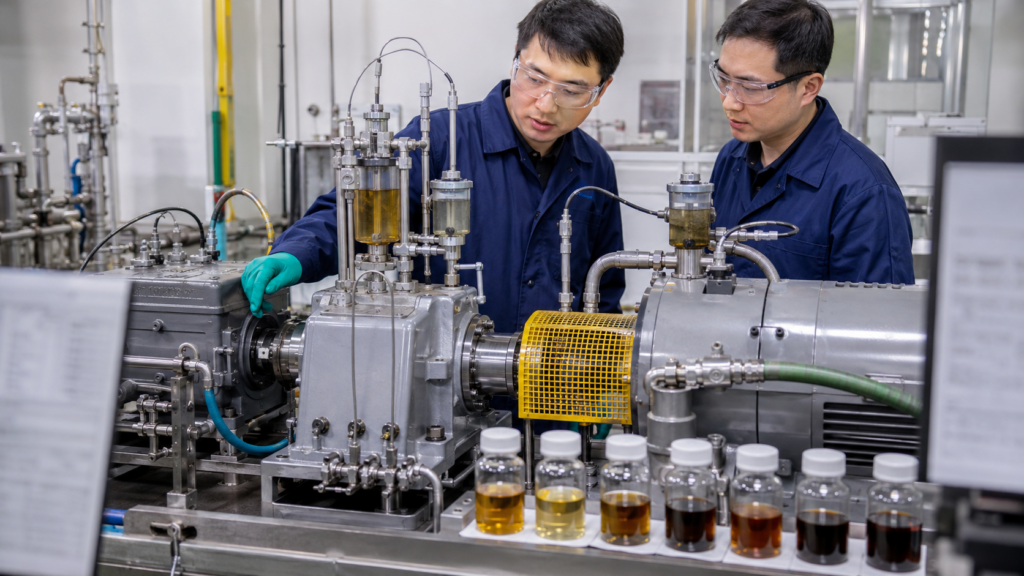
This evidence chain gives lubricant engineers a more useful conclusion than a universal performance percentage: C60 is a technically credible screening candidate whose value must be established within a controlled formulation and validation program.
Planning a C60 Lubricant Formulation Study
Before requesting material, define the base oil, existing additive package, intended concentration range, test method, required quantity and analytical requirements. Also identify whether the project is exploratory laboratory research, a pilot formulation or an established product-development program.
XCT can review available C60 material options and batch documentation against a defined research requirement. Submit the application, quantity, target purity, destination and requested analytical information through the XCT request form.
常见问题解答
C60被用作润滑添加剂吗?
Fullerene C60 is studied as a lubricant additive in tribology and formulation research. Published studies have evaluated C60-containing oils for friction, wear and dispersion behavior under defined laboratory conditions.
Does C60 always reduce friction and wear?
No. Results depend on the base oil, additive package, concentration, dispersion method, contact materials, load, speed, temperature and test method. A result from one formulation should not be applied automatically to another lubricant.
Why is dispersion stability important in a C60 lubricant?
Poor dispersion can cause settling, changing concentration and inconsistent test results. Researchers should establish whether the prepared formulation remains sufficiently homogeneous for the intended experiment before interpreting friction or wear data.
What concentration of C60 should be added to lubricant?
There is no universal C60 concentration for lubricants. A controlled screening program should compare a reference formulation with several concentrations because the useful range depends on the oil, additive package, preparation method and contact conditions.
Can a tribometer result support fuel-economy or equipment-life claims?
A laboratory tribometer result can support a statement about the tested formulation and conditions. Fuel economy, drain interval, equipment lifetime and similar end-use claims require product-level and application-relevant validation.
参考文献
- National Center for Biotechnology Information. “Fullerenes, CID 123591.” PubChem. https://pubchem.ncbi.nlm.nih.gov/compound/Fullerenes
- Ku, B. C. et al. “Tribological Effects of Fullerene (C60) Nanoparticles Added in Mineral Lubricants According to Its Viscosity.” [2] 景山 H. 等人,“富勒烯纳米颗粒作为HM32抗磨润滑油添加剂的分散稳定性及摩擦特性研究”,2021年。该论文研究了富勒烯纳米颗粒在HM32抗磨润滑油中的分散稳定性和摩擦行为。, 2010. https://doi.org/10.1007/s12541-010-0070-8
- Huang, J. S. et al. “Study on Dispersion Stability and Friction Characteristics of C60 Nanomicrosphere Lubricating Additives for Improving Cutting Conditions in Manufacturing Process.” 《数学工程问题》, 2021. https://doi.org/10.1155/2021/2724743
- Tóth-Nagy, C.; Szabó, Á. I. “Experimental Investigation of the Friction Modifying Effects of Graphene and C60 Fullerene Used as Nanoadditives in Engine Lubricating Oil Performed on an Oscillating Tribometer.” Periodica Polytechnica Transportation Engineering, 2023. https://doi.org/10.3311/PPtr.20594
- Zhao, J. et al. “Nanolubricant Additives: A Review.” 用于钙钛矿太阳能电池的高纯度C60:为何商业化提高了材料要求, 2021. https://doi.org/10.1007/s40544-020-0450-8
- Jiang, Z. et al. “Research Progresses of Nanomaterials as Lubricant Additives.” 用于钙钛矿太阳能电池的高纯度C60:为何商业化提高了材料要求, 2024. https://doi.org/10.1007/s40544-023-0808-9
采购洞察
对于富勒烯 C60(纯品,纯度 99.95%,无金属残留)的 B2B 采购,买方在请求正式报价前应确认目标纯度、所需数量、应用、目的国、COA、MSDS/SDS、包装、存储条件及运输要求。.
需要 COA 或 MSDS/SDS?
在确认订单前,请索取产品规格、批次特定 COA、MSDS/SDS、样品可用性、包装详情及国际运输信息。.
索取文件询价前买方检查清单
- 产品名称及 CAS 号(如已知)
- 目标纯度
- 所需数量
- 样品或批量订单
- 应用或预期用途
- 目的国
- 所需文件
- 包装偏好
相关技术文章

准备采购高纯度富勒烯?
提交您的产品、纯度、数量、应用、目的国及文件要求。我们的团队将协助确认可用性、COA、MSDS/SDS、包装及报价详情。.