





주요 요점
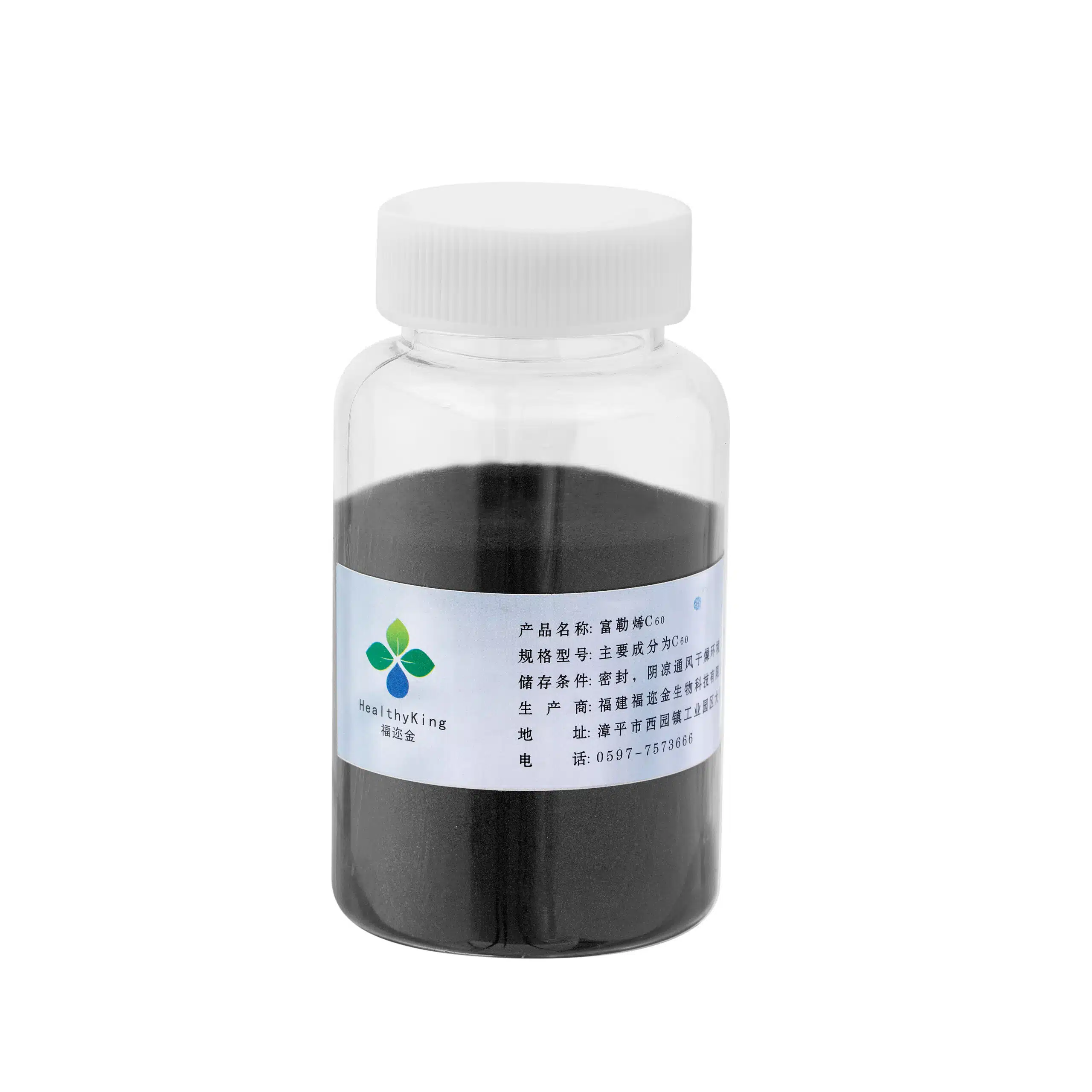
- 풀러렌 C60 (순수), 99.95% 순도, 금속 잔류물이 없어야 하며, 순도, 배치 일관성, 문서 및 적용 적합성을 기준으로 평가되어야 합니다.
- 공식 견적 전에 COA, MSDS/SDS, 포장, 보관, 수량 및 도착 국가를 확인해야 합니다.
- 연구 및 산업용으로 사용 시, 풀러렌 등급은 의도된 재료 시스템 및 테스트 요구 사항과 일치해야 합니다.
Why Is Fullerene Good for Medicine?
풀러렌은 하나의 탄소 기반 분자 구조에 여러 독특한 특성을 결합하고 있기 때문에 의학 관련 연구에서 가치 있는 물질로 간주됩니다. C60 풀러렌 60개의 탄소 원자로 이루어진 폐쇄형 케이지 구조, 고도로 공액된 π-전자 시스템, 강한 화학적 안정성, 그리고 다양한 기능화 유도체를 형성할 수 있는 능력을 가지고 있습니다. 이러한 특성으로 인해 풀러렌과 그 유도체는 약물 전달, 광역학 연구, 항산화 관련 연구, 항균 광역학 불활성화, 영상 연구, 나노의학 재료 설계와 같은 생의학 연구 분야에서 유용하게 활용됩니다.
중요한 점은 순수한 C60 분말이 일반적으로 최종 의료용 재료가 아니라는 것입니다. 많은 생의학 연구에서 연구자들은 원료 C60 대신 변형된 풀러렌 유도체를 사용하는데, 이는 생물학적 환경이 종종 수용성 적합성, 작용기, 세포와의 제어된 상호작용, 그리고 신중하게 설계된 안전성 프로파일을 요구하기 때문입니다. 예시로는 풀러롤, 카르복실화 풀러렌, C60의 말론산 유도체, 양이온성 풀러렌, 그리고 기타 수용성 또는 기능화된 풀러렌 시스템이 있습니다.
In simple terms, fullerene is interesting for medicine because it can behave as a molecular carbon scaffold, a radical-active material, a photosensitizer platform, and a functional carrier after chemical modification.
Fullerene Has a Unique Molecular Structure
The biomedical interest in fullerene starts with its structure. C60 is a spherical carbon cage, often described as a soccer-ball-like molecule. Unlike carbon black, graphite, or ordinary carbon powder, C60 is a defined molecule with a consistent cage structure. This makes it easier to study, modify, and design for specific research functions.
For basic chemical identity, readers can refer to the PubChem record for C60 fullerene.
The surface of the fullerene cage can be chemically modified. Researchers can add hydroxyl groups, carboxyl groups, amino groups, malonic acid groups, or other functional groups to change how the molecule behaves in water, biological media, or material systems. This is one reason fullerene derivatives are more common than pristine C60 in biomedical research.
For medical research, this tunability matters. A material that is too hydrophobic may aggregate and become difficult to use in biological systems. By introducing suitable functional groups, researchers can improve dispersion, water compatibility, molecular targeting, or interaction with biological structures.
Fullerene Can Be Modified for Water Compatibility
Pristine C60 is generally insoluble in water, which limits its direct use in biological environments. Medicine and biology usually involve aqueous systems, so fullerene needs chemical modification before it can be studied effectively in many biomedical settings.
This is why water-soluble fullerene derivatives are important. Fullerols, carboxylated fullerenes, and C60 malonic acid derivatives are examples of fullerene-based structures designed to improve water compatibility. These derivatives allow researchers to evaluate fullerene behavior in cell culture systems, biological fluids, drug delivery models, and photodynamic studies.
Water compatibility is not just a convenience. It affects dispersion, aggregation, cellular interaction, transport behavior, and experimental reproducibility. In biomedical research, the chemical form of fullerene is often more important than the word “fullerene” itself.
Fullerene in Drug Delivery Research
Fullerene derivatives are studied in drug delivery research because the fullerene cage can act as a nanoscale molecular platform. Its surface can be functionalized with groups that improve solubility, attach active molecules, or influence interaction with cells.
Fullerene derivatives have been reviewed as research materials for drug delivery and related nanomedicine systems in 기능화된 풀러렌 기반 나노물질의 생의학적 응용.
In drug delivery research, fullerene-based systems may be explored for carrying small molecules, improving molecular transport, or building targeted delivery concepts. Some studies also examine fullerene derivatives as carriers for genes, DNA-related systems, or other bioactive molecules.
The key advantage is design flexibility. Researchers can modify the fullerene surface to change how the material behaves. Hydrophilic groups can improve water compatibility. Charged groups can influence biological interaction. Targeting groups may be introduced in experimental systems to study selective delivery concepts.
However, fullerene drug delivery remains a research field. A fullerene material is not automatically a drug carrier simply because it has a nanoscale structure. Its usefulness depends on derivative design, solubility, toxicity evaluation, dosage model, biological target, and regulatory pathway.
Fullerene in Photodynamic Research
Fullerene is also studied in photodynamic research because it can generate reactive oxygen species under suitable light irradiation. This property makes certain fullerene derivatives interesting as photosensitizer materials.
Photodynamic research usually involves three components: a photosensitizer, light, and oxygen. When the photosensitizer is activated by light, it may transfer energy or electrons to surrounding oxygen molecules and generate reactive oxygen species. These reactive species are then studied for their effects in biological or antimicrobial systems.
Fullerenes are relevant here because their conjugated carbon cage can absorb light and form excited states. Under appropriate conditions, fullerene derivatives may generate singlet oxygen or other reactive oxygen species. This is why they are investigated in photodynamic therapy research and antimicrobial photodynamic inactivation research.
The use of fullerenes as photosensitizer platforms is discussed in the review Fullerenes as Photosensitizers in Photodynamic Therapy.
The application should be described carefully. Fullerene photodynamic research does not mean raw C60 powder is a cancer treatment or an approved antimicrobial product. It means functionalized fullerene systems are studied as photosensitizer platforms under controlled experimental conditions.
Fullerene in Antimicrobial Photodynamic Inactivation Research
Antimicrobial photodynamic inactivation, often shortened as aPDI, is another medicine-related research area where fullerene derivatives are studied. The mechanism is similar to photodynamic research: a photosensitizer is activated by light and generates reactive oxygen species that can affect microbial cells.
Cationic fullerene derivatives are especially relevant in this area because charged functional groups can improve interaction with microbial surfaces. Researchers study these materials to understand how fullerene-based photosensitizers interact with bacteria, fungi, or other microorganisms under light exposure.
This field is attractive because antimicrobial resistance has increased interest in non-traditional antimicrobial strategies. Fullerene-based aPDI is not simply a chemical disinfectant approach. It is a light-activated material strategy that depends on molecular design, irradiation conditions, oxygen availability, and microbial target.
For biomedical material suppliers and researchers, the important requirement is material definition. The fullerene derivative, charge, purity, solubility, and batch consistency can all influence the research result.
Fullerene in Antioxidant-Related Research
Fullerene and some fullerene derivatives are also investigated for antioxidant-related behavior. C60 has often been described in research as a “radical sponge” because its π-conjugated structure can interact with free radicals under certain conditions.
This radical-related behavior is one reason fullerene derivatives are studied in oxidative stress models, skin-related research, and broader biological material research. The same material family may show different behavior depending on functionalization, solvent, concentration, light exposure, and biological environment.
This point matters because fullerene can be discussed in both reactive oxygen species generation and radical-scavenging research. These are not contradictions. Under light activation, certain fullerene derivatives may generate reactive oxygen species. Under other conditions, some fullerene derivatives may show radical-scavenging or antioxidant-related behavior.
For medicine-related research, this dual behavior is one of the reasons fullerene is scientifically interesting. It can be designed and studied in different directions depending on its chemical modification and experimental environment.
Fullerene in Cancer Research
Fullerene derivatives are studied in cancer-related research mainly through two directions: drug delivery research and photodynamic research.
In drug delivery studies, fullerene-based systems may be explored as carriers or molecular platforms for delivering active molecules. In photodynamic studies, fullerene derivatives may be studied as photosensitizers that generate reactive oxygen species under light irradiation.
Some laboratory and preclinical studies have examined fullerene derivatives in tumor-related models. However, this does not mean fullerene should be described as a cancer treatment in commercial material content. Cancer therapy requires clinical evidence, regulatory approval, dosage control, safety evaluation, formulation design, and medical supervision.
A precise statement is: fullerene derivatives are investigated in cancer-related biomedical research, especially in drug delivery and photodynamic research.
Fullerene in Skin and Cosmetic-Related Biomedical Research
Fullerene is also studied in skin-related and cosmetic formulation research because of its antioxidant-related behavior and interest in reactive oxygen species control. Skin is frequently exposed to ultraviolet radiation, which can generate oxidative stress. This has led researchers to study fullerene derivatives in skin models, keratinocyte research, and cosmetic formulation systems.
In this field, fullerene is usually discussed as an antioxidant-related material or advanced formulation ingredient candidate. The research may focus on dispersion, stability, interaction with oils or carriers, and behavior under light or oxidative conditions.
The correct commercial wording should remain cautious. Fullerene should not be claimed to prevent aging, reverse wrinkles, prevent skin cancer, or guarantee UV protection unless supported by appropriate regulatory and clinical evidence. For B2B sourcing, the more accurate framing is: C60 and fullerene derivatives are studied in cosmetic formulation research and skin-related oxidative stress models.
Fullerene in Imaging and Diagnostic Research
Some fullerene-based materials, especially metallofullerenes, are studied in imaging and diagnostic research. Metallofullerenes are fullerene cages that contain metal atoms or clusters inside the carbon cage. This structure can give them properties relevant to imaging contrast, magnetic behavior, or biomedical material design.
For example, gadolinium-containing fullerene systems have been investigated in MRI contrast research. The fullerene cage can help isolate and organize metal species while functional groups can be added to improve water compatibility and biological behavior.
This is a more specialized field than C60 powder supply. It usually involves engineered fullerene derivatives or metallofullerene materials rather than standard pristine C60. Still, it shows why the fullerene cage is useful as a biomedical platform: it can be modified externally and, in some cases, can host atoms or clusters internally.
Fullerene in Gene Delivery Research
Fullerene derivatives have also been studied in gene delivery and nucleic acid delivery research. Because the fullerene surface can be modified with charged or functional groups, researchers can design fullerene-based materials that interact with DNA, RNA, or cell membranes.
Gene delivery research requires careful material design. The delivery material must interact with nucleic acids, protect or transport them, and release them under suitable conditions. Fullerene derivatives are studied because they offer a compact molecular scaffold that can be chemically functionalized.
As with drug delivery, this is a research direction rather than a finished medical claim. The performance and safety of any fullerene-based gene delivery material depend on its structure, charge, solubility, toxicity profile, and biological system.
Why Functionalized Fullerenes Matter More Than Raw C60 in Medicine
A common misunderstanding is to treat “C60 fullerene” and “medical fullerene material” as the same thing. They are not always the same.
Pristine C60 is important as a starting material and research material, but biomedical systems often require fullerene derivatives. Functionalization can improve water solubility, reduce aggregation, introduce targeting groups, change surface charge, and modify biological interaction.
This is why many medicine-related studies use terms such as functionalized fullerene, fullerol, carboxyfullerene, cationic fullerene, fullerene derivative, or metallofullerene. These materials are based on the fullerene cage, but their practical behavior can be very different from pristine C60 powder.
For researchers and procurement teams, the exact chemical form should always be confirmed before ordering. If the project requires water-soluble fullerene, drug delivery research material, or photodynamic research material, standard C60 powder may not be sufficient.
Key Properties That Make Fullerene Useful in Medicine-Related Research
Fullerene is valuable in medicine-related research because several properties overlap:
First, it has a defined nanoscale carbon cage structure. This gives researchers a stable molecular platform.
Second, it has rich surface chemistry. The fullerene cage can be functionalized to change solubility, charge, targeting behavior, or compatibility.
셋째, 광역학적 거동을 나타냅니다. 일부 풀러렌 유도체는 광활성화 하에 활성산소종을 생성할 수 있습니다.
넷째, 라디칼 관련 화학적 특성을 가집니다. 풀러렌 유도체는 항산화 관련 또는 산화 스트레스 모델에서 연구될 수 있습니다.
다섯째, 적절한 변형 후 생물학적 시스템과 상호작용할 수 있습니다. 이는 약물 전달, 유전자 전달, 광역학 연구 및 생체재료 설계와 관련성을 갖게 합니다.
이러한 특성들은 풀러렌이 단순한 또 다른 탄소 물질이 아닌 이유를 설명합니다. 그 가치는 분자 구조와 화학적 조정 가능성의 결합에서 비롯됩니다.
의학 관련 연구를 위해 풀러렌을 구매하기 전 연구자가 확인해야 할 사항
용매 거동에 대해서는 고전적인 ACS 논문을 참조하십시오. 유기 용매에서의 C60 용해도.
생물의학 연구에서 가장 중요한 질문은 해당 물질이 단순히 “C60”인지 여부만이 아닙니다. 정확한 유도체, 순도, 용해도, 문서화 및 의도된 연구 용도가 중요합니다.
연구자는 다음 사항을 확인해야 합니다:
- 프로젝트에 순수 C60이 필요한지, 기능화된 풀러렌 유도체가 필요한지 여부
- 목표 순도
- 수용해도 또는 용매 적합성
- 배치별 COA
- MSDS/SDS
- 가능한 경우 분자식 및 CAS 번호
- 보관 조건
- 포장 형식
- 시료 수량
- 의도된 연구 응용 분야
- 목적지 국가 요구 사항
순수 풀러렌 C60의 경우, 공급업체와 배치에 따라 99.0%, 99.5%, 99.9%, 99.95% 등의 순도 등급을 이용할 수 있습니다. 민감한 생물의학 재료 연구에는 더 높은 순도가 종종 선호되지만, 적절한 등급은 연구 설계 및 분석 요구 사항에 따라 달라집니다.
결론
풀러렌은 화학적으로 조정 가능한 분자 탄소 플랫폼이기 때문에 의학 관련 연구에 적합합니다. 닫힌 탄소 케이지, 광역학적 활성, 라디칼 관련 거동 및 수용성 유도체를 형성하는 능력은 약물 전달 연구, 광역학 연구, 항균 연구, 항산화 관련 연구, 이미징 재료 개발, 유전자 전달 연구 및 화장품 제형 연구에 관련성을 부여합니다.
가장 중요한 차이점은 순수 C60과 기능화된 풀러렌 유도체 사이에 있습니다. 순수 C60은 귀중한 출발 물질이자 연구 재료이지만, 많은 생물의학 응용 분야에서는 개선된 수분 적합성과 설계된 생물학적 상호작용을 갖춘 변형된 풀러렌이 필요합니다.
풀러렌은 규제 및 임상적 증거 없이 승인된 의약품 또는 입증된 치료법으로 제시되어서는 안 됩니다. 현재 가장 강력한 가치는 생물의학 재료 개발을 위한 연구용 나노물질 플랫폼으로서의 역할입니다.
FAQ
풀러렌이 의학 분야에서 유용한 이유는 무엇입니까?
풀러렌은 안정적인 탄소 케이지, 풍부한 표면 화학, 광역학적 거동 및 라디칼 관련 활성을 가지고 있기 때문에 의학 관련 연구에 유용합니다. 이러한 특성은 약물 전달 연구, 광역학 연구, 항산화 관련 연구 및 생체재료 설계에 관련성을 부여합니다.
C60 풀러렌이 의약품으로 직접 사용됩니까?
순수 C60은 검증된 규제 승인 없이 의약품으로 설명되어서는 안 됩니다. 생물의학 연구에서 풀러렌 유도체는 종종 연구 재료, 운반체, 광감작제 또는 기능성 나노물질로 연구됩니다.
수용성 풀러렌 유도체가 중요한 이유는 무엇입니까?
생물학적 시스템은 일반적으로 수성 환경입니다. 순수 C60은 물에 대한 용해도가 낮기 때문에 연구자들은 생물의학 연구를 위해 풀러롤 또는 기능화된 C60 화합물과 같은 수용성 유도체를 자주 사용합니다.
풀러렌을 약물 전달에 사용할 수 있습니까?
풀러렌 유도체는 용해도를 개선하거나, 작용기를 부착하거나, 생물학적 시스템과 상호작용하기 위해 표면을 화학적으로 변형시킬 수 있기 때문에 약물 전달 연구에서 연구됩니다.
풀러렌을 광역학 치료 연구에 사용할 수 있습니까?
네. 특정 풀러렌 유도체는 광 조사 하에 활성산소종을 생성할 수 있기 때문에 광감작제로 연구됩니다. 이는 연구 방향이며 완성된 치료법 주장으로 취급되어서는 안 됩니다.
풀러렌은 항산화제입니까?
일부 풀러렌 유도체는 항산화 관련 또는 라디칼 소거 거동에 대해 연구됩니다. 그 효과는 화학 구조, 기능화, 용매, 농도, 광 노출 및 실험 조건에 따라 달라집니다.
생물의학 연구에는 어떤 유형의 풀러렌이 필요합니까?
응용 분야에 따라 다릅니다. 일부 프로젝트는 순수 C60을 출발 물질로 사용하는 반면, 다른 프로젝트는 수용성 풀러렌 유도체, 양이온성 풀러렌, 풀러롤, 카르복시풀러렌 또는 금속풀러렌을 필요로 합니다.
조달 인사이트
풀러렌 C60 (순수), 순도 99.95%, 금속 잔류물 없음 제품의 B2B 조달 시, 구매자는 공식 견적을 요청하기 전에 목표 순도, 필요 수량, 용도, 도착 국가, COA, MSDS/SDS, 포장, 보관 조건 및 배송 요구 사항을 확인해야 합니다.
COA 또는 MSDS/SDS가 필요하십니까?
주문을 확인하기 전에 제품 사양, 배치별 COA, MSDS/SDS, 샘플 가용성, 포장 세부 사항 및 국제 배송 정보를 요청하십시오.
문서 요청견적 요청 전 구매자 체크리스트
- 제품명 및 CAS 번호(알고 있는 경우)
- 목표 순도
- 필요 수량
- 샘플 또는 대량 주문
- 용도 또는 의도된 사용 목적
- 목적 국가
- 필요 문서
- 포장 선호 사항
관련 기술 문서


고순도 풀러렌을 조달할 준비가 되셨습니까?
제품, 순도, 수량, 용도, 도착 국가 및 문서 요구 사항을 제출하십시오. 당사 팀이 가용성, COA, MSDS/SDS, 포장 및 견적 세부 사항을 확인하는 데 도움을 드릴 것입니다.