



What is Fullerene C60
What Is Fullerene C60? Structure, Properties and Uses
Fullerene C60 is a discrete molecule composed of 60 carbon atoms arranged in a closed, highly symmetrical cage. It is also known as buckminsterfullerene, Carbon 60 or a C60 buckyball. Unlike graphite, graphene or diamond, which form extended carbon networks, C60 exists as an individual molecular cage. This distinction explains much of its unusual chemical, electronic and processing behavior.
C60 is the archetypal member of the fullerene family. The International Union of Pure and Applied Chemistry defines fullerenes as closed carbon cages built from five- and six-membered rings, with C60 as the characteristic truncated-icosahedral example.[1] Its combination of molecular symmetry, electron-accepting behavior and chemical functionalization potential has made it an important research material in molecular chemistry, electronics, photovoltaics, thin films and advanced-material development.
What Does “C60” Mean?
The molecular formula C60 means that each molecule contains exactly 60 carbon atoms. PubChem identifies buckminsterfullerene under CID 123591 and records the widely used CAS Registry Number 99685-96-8.[2] Its molar mass is approximately 720.64 g/mol, although a quoted value can vary slightly with the atomic-weight convention and rounding method used.
The term “fullerene” describes a family rather than a single product. C60, C70, higher fullerenes, endohedral fullerenes and chemically functionalized derivatives belong to related but distinct material categories. They should not be treated as interchangeable. Adding functional groups to the C60 cage can change solubility, polarity, molecular packing, biological interaction and electronic behavior.
Buckminsterfullerene takes its name from architect R. Buckminster Fuller because the molecular framework resembles the geometry of a geodesic dome. The molecule is often compared with a football, but the comparison describes its connectivity rather than a literal smooth sphere.
How Is the C60 Molecule Structured?
The C60 cage has the topology of a truncated icosahedron. Its 60 carbon atoms occupy the vertices of a framework containing 12 pentagons and 20 hexagons. Each carbon atom is bonded to three neighboring carbon atoms, creating a closed network with icosahedral symmetry.
The pentagons are essential. A sheet made only from hexagons tends toward a flatter graphitic geometry, whereas the inclusion of pentagons introduces the curvature needed to close the carbon framework. In C60, the pentagons are isolated from one another by surrounding hexagons, a structural arrangement associated with the molecule’s exceptional kinetic stability.
The bonds within C60 are not all equivalent. Bonds shared between two hexagons differ from those shared between a pentagon and a hexagon. This bond pattern contributes to the molecule’s addition chemistry: reagents can attach to the carbon cage without necessarily destroying the entire framework. That reactivity enables researchers to create fullerene derivatives with properties that differ substantially from pristine C60.
For a more detailed treatment of cage geometry and bonding, see the guide to buckminsterfullerene structure.
How Was Fullerene C60 Discovered?
C60 was identified in 1985 by Harold Kroto, James Heath, Sean O’Brien, Robert Curl and Richard Smalley during experiments involving laser vaporization of graphite. Their mass spectra showed an unusually strong cluster containing 60 carbon atoms, leading the researchers to propose the closed truncated-icosahedral structure.[3]
The discovery transformed carbon chemistry by demonstrating that carbon could form stable, closed molecular cages. Robert Curl, Harold Kroto and Richard Smalley were jointly awarded the 1996 Nobel Prize in Chemistry for the discovery of fullerenes.[4]
The first experiments detected C60 in molecular beams, but did not immediately provide practical quantities of isolated material. A major advance followed in 1990, when Krätschmer, Lamb, Fostiropoulos and Huffman reported the preparation and characterization of macroscopic solid C60 from carbon soot.[5] This development made systematic chemical, spectroscopic and solid-state investigation possible.
Fullerene C60 Molecular Architecture
The C60 molecule consists of 20 hexagons and 12 pentagons arranged in a highly symmetrical carbon cage. In the C60 structure, no two pentagons share an edge, which follows the Isolated Pentagon Rule and contributes to the molecule’s structural stability.
Each carbon atom in Fullerene C60 is sp²-hybridized, forming a delocalized π-electron system across the cage-like molecular framework. This structure is one reason C60 is widely studied in advanced materials, organic electronics, photovoltaic research, coatings, lubricants, and nanomaterial systems.
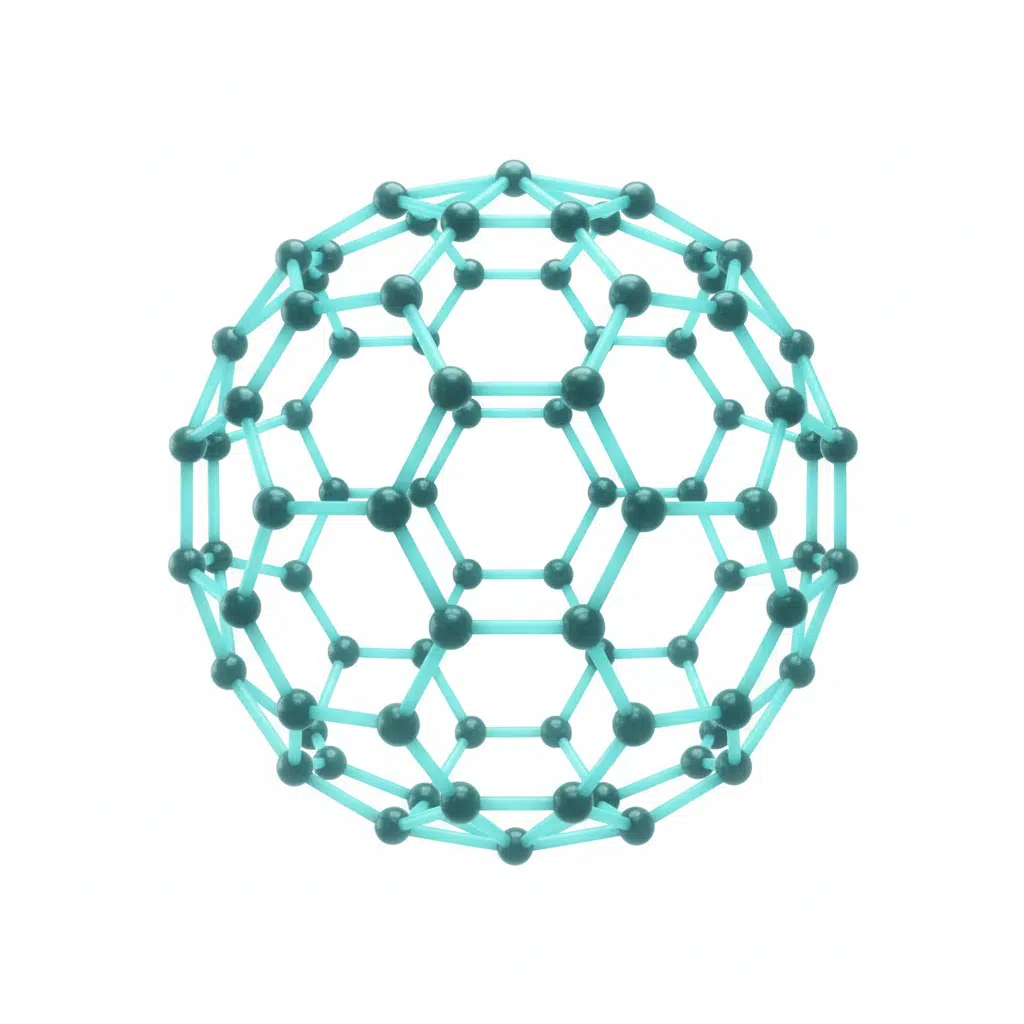
C60 Geometric Structure
Molecular Structure Illustration
How Is Fullerene C60 Produced and Purified?
Fullerene production generally begins by generating carbon vapor or a carbon-rich flame under controlled conditions. Depending on the process, the resulting soot can contain C60, C70, higher fullerenes, non-fullerene carbon and other process-related components. Production therefore does not end when fullerene-containing soot is formed.
The fullerene fraction must be extracted and separated. Solvent extraction can transfer soluble fullerene species from soot into a liquid phase, after which chromatography, selective precipitation, crystallization, sublimation or combinations of purification methods may be used. The appropriate sequence depends on the starting material, target purity, impurity profile, intended scale and final application.
No production method should automatically be described as “metal-free,” “zero residue” or suitable for medical or electronic use without product- and batch-specific evidence. The absence of a catalyst in one production stage does not by itself demonstrate that every relevant metal, inorganic residue, solvent or carbonaceous impurity is absent from the final product.
Similarly, an HPLC result measures components resolved and detected by the selected chromatographic method. It does not independently establish the absence of metals, residual solvents, moisture, ash or compounds that the detector does not adequately measure. The separate guide to C60 HPLC purity analysis explains how to interpret chromatograms and reported area percentages.
Analytical Data Sets
Important Properties of Fullerene C60
Molecular rather than extended structure
C60 is a molecular carbon material. Molecules can pack into a solid crystal, but the forces between neighboring cages differ from the strong covalent bonds within each cage. It is therefore misleading to describe solid C60 as if it were simply a small piece of graphite, graphene or diamond.
Electron-accepting behavior
C60 can accept electrons and participate in charge-transfer interactions. This property has supported extensive investigation in molecular electronics, organic semiconductors and photovoltaic devices. However, electron acceptance is not the same as metallic conductivity. Pristine C60 powder does not conduct electricity like copper, graphite or graphene.
Electronic values such as HOMO level, LUMO level and effective energy gap should always be accompanied by the measurement or calculation method. Results can vary with molecular environment, film morphology, substrate, interface, temperature and experimental technique. A single set of energy values should not be presented as a universal batch specification unless it has been measured for that material under defined conditions.
Solubility and dispersion
Pristine C60 is effectively insoluble in water under ordinary handling conditions, although aggregates or specially prepared dispersions can behave differently from molecularly dissolved C60. It is soluble to varying degrees in selected organic solvents, particularly some aromatic and halogenated systems.
Solubility is not one fixed property independent of conditions. Temperature, solvent purity, crystal form, equilibration time and analytical method can affect a reported value. Researchers should consult application-specific data rather than assuming that a literature number guarantees the same concentration in a production formulation. See the detailed guide to C60 and C70 solubility in organic solvents.
Chemical functionalization
The conjugated carbon cage can participate in addition reactions, allowing chemists to attach functional groups and create fullerene derivatives. Functionalization may improve solution processability, introduce molecular recognition or alter electronic and interfacial behavior. It also creates a new compound: evidence obtained for a derivative cannot automatically be attributed to pristine C60, and evidence for pristine C60 cannot automatically be transferred to every derivative.
Fullerene C60 vs C70 Comparison
Compare key molecular and application-related differences between Fullerene C60 and Fullerene C70 for research, advanced materials, organic electronics, photovoltaic studies, and B2B material selection.
720.67 g/mol
Fullerene C60840.78 g/mol
Fullerene C70Spherical Cage
Fullerene C60Elongated Cage
Fullerene C7060
Fullerene C6070
Fullerene C70Ih
Fullerene C60D5h
Fullerene C70Broad Research Use
Materials, coatings, lubricants, electronicsOptoelectronic Research
Organic electronics and photovoltaic studiesPurity & Batch COA
Fullerene C60Optical/Electronic Needs
Fullerene C70Where Is Fullerene C60 Used or Studied?
Photovoltaics and electronic materials
C60 is used as an electron-accepting or electron-transport-related material in selected device architectures. In inverted perovskite solar cells, thermally evaporated C60 is widely used as an electron-transport layer. A 2024 study in Nature Communications also demonstrated that source-material purification could affect repeated evaporation behavior and device reproducibility in the system examined.[6]
This does not mean that every photovoltaic design requires C60 or that one purity grade guarantees device performance. Deposition method, interface design, source handling, film morphology and the complete device stack remain important.
Organic electronics and molecular research
C60 and its derivatives have been studied in organic photovoltaics, photodetectors, transistors, molecular junctions and charge-transfer systems. In many modern organic photovoltaic systems, non-fullerene acceptors have replaced classical fullerene derivatives, but C60 remains valuable as a reference molecule, interface material and research tool.
Chemical synthesis
The C60 cage serves as a defined molecular starting material for fullerene chemistry. Researchers use it to prepare mono-adducts, multi-adducts, polymers, donor–acceptor compounds and other functionalized structures. Precursor purity can influence reaction analysis and downstream purification, but the necessary purity should be determined by the actual synthetic route.
Coatings, composites and tribology research
C60 has been investigated as a component in coatings, polymers, composites and lubricant formulations. Reported behavior depends strongly on dispersion, concentration, base material, surface chemistry and test conditions. Laboratory friction or wear results should not be converted into universal performance guarantees for every oil, coating or mechanical system.
Biomedical and photochemical research
Pristine C60 and fullerene derivatives have been investigated in antioxidant, photodynamic, drug-delivery and other biological research. These subjects must remain research-oriented. Experimental activity does not establish clinical efficacy, regulatory approval, suitability for ingestion or safety in a finished medical or cosmetic product. Material identity, functionalization, formulation, dose, exposure route and biological model can all change the observed result.
Fullerene C60 vs C70
C60 and C70 are related carbon cages, but they are not interchangeable. C60 contains 60 carbon atoms and has a highly symmetrical, near-spherical cage. C70 contains 70 carbon atoms and has a more elongated structure. The difference affects molecular symmetry, optical absorption, packing and application selection.
C60 is generally the broader reference material for fullerene chemistry and is widely studied in thin films, perovskite interfaces, synthesis, coatings and tribology. C70 and its derivatives are frequently selected when their different optical or electronic behavior is relevant. The correct choice depends on the experimental system rather than a universal ranking of one fullerene over another.
Researchers requiring a detailed comparison can review the Fullerene C70 technical overview.
References
- IUPAC Gold Book. “Fullerenes.” https://goldbook.iupac.org/terms/view/F02547/plain
- PubChem, National Library of Medicine. “Fullerenes | C60 | CID 123591.” https://pubchem.ncbi.nlm.nih.gov/compound/Fullerenes
- Kroto, H. W., et al. “C60: Buckminsterfullerene.” Nature, 318, 162–163, 1985. https://www.nature.com/articles/318162a0
- Nobel Prize. “The Nobel Prize in Chemistry 1996.” https://www.nobelprize.org/prizes/chemistry/1996/summary/
- Krätschmer, W., et al. “Solid C60: A New Form of Carbon.” Nature, 347, 354–358, 1990. https://www.nature.com/articles/347354a0
- Said, A. A., et al. “Sublimed C60 for Efficient and Repeatable Perovskite-Based Solar Cells.” Nature Communications, 15, 708, 2024. https://www.nature.com/articles/s41467-024-44974-0
FAQ
What is Fullerene C60?
Fullerene C60 is a carbon cage molecule composed of 60 carbon atoms arranged in a spherical structure. It is also known as Carbon 60 or Buckminsterfullerene.
What is the CAS number of Fullerene C60?
The CAS number of Fullerene C60 is 99685-96-8.
Is Fullerene C60 soluble in water?
Fullerene C60 is insoluble in water. It is commonly dissolved in selected organic solvents such as toluene, chlorobenzene, or carbon disulfide depending on the application and handling requirements.
What purity grades are available for Fullerene C60?
Available C60 purity grades may include 99.00%, 99.50%, 99.90%, and 99.95%. Buyers should select purity based on application requirements, test method, COA, and batch availability.
What documents should buyers request before ordering C60?
B2B buyers should request batch-specific COA, MSDS/SDS, product specification, packaging information, and shipping documentation when relevant.
Request Fullerene C60 Documentation
Get sample COA reference, MSDS/SDS support, purity options, packaging information, sample availability, and quotation details for research or industrial procurement.