
XCT Insights
Stay Updated
Fullerene research, applications and company updates, delivered occasionally.
Latest from XCT
View all

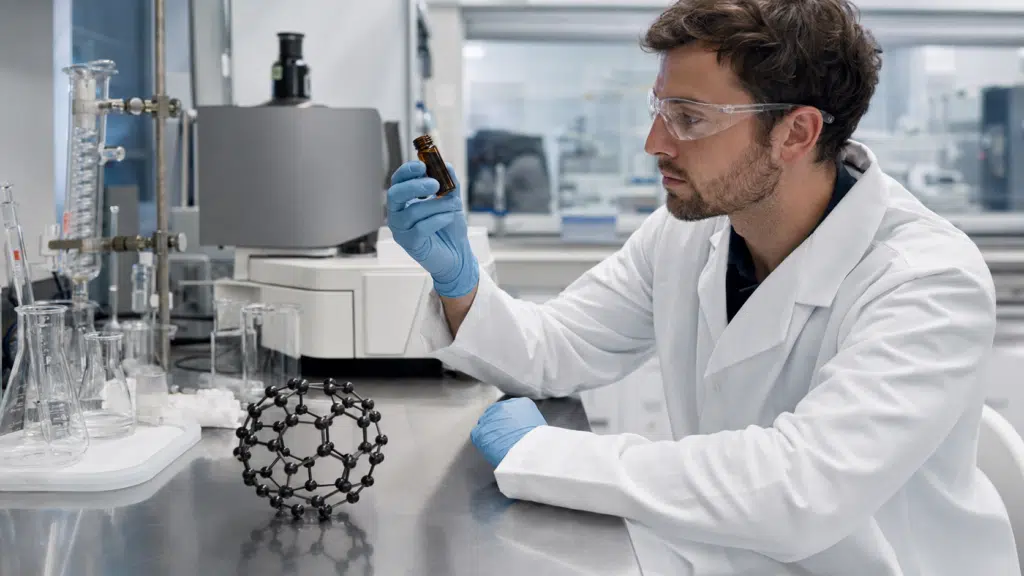
Fullerene biomedical research begins with a materials question: which carbon cage, derivative or dispersion is actually being tested? Pristine Fullerene C60, C70, polyhydroxylated fullerenols and covalently functionalized fullerene derivatives have different solubility, aggregation, optical and biological behavior. A result obtained with one of these materials should therefore be interpreted using its specific molecular identity and preparation method.
Researchers have investigated fullerene systems in radical-related chemistry, cellular oxidative-stress models, photochemistry, delivery platforms, antimicrobial studies and biomaterial development. These fields remain active because the conjugated carbon cage can participate in electron-transfer and excited-state processes, while chemical functionalization provides a way to change compatibility with aqueous media, biomolecules and carrier systems.
XCT supplies high-purity Fullerene C60 and Fullerene C70 for research and advanced-material projects. The appropriate starting material depends on the chemistry the laboratory intends to perform, the test medium and the analytical evidence needed to follow the material through the experiment.
Pristine C60 is a discrete molecule composed of 60 carbon atoms in a highly symmetrical closed cage. It is soluble in selected organic solvents but has very low compatibility with water. C70 contains 70 carbon atoms in a more elongated cage and has a different electronic and optical profile. Neither material should be treated as equivalent to a water-soluble fullerene derivative.
Fullerenols carry multiple hydroxyl groups attached to a fullerene cage. Carboxylated, amino-functionalized and other covalent derivatives introduce different polar or reactive groups. Non-covalent systems may combine C60 with polymers, surfactants, lipids or other carriers without creating the same molecular structure as a covalent derivative.
These distinctions influence much more than solubility. Surface charge, aggregate size, protein association, cellular uptake, photochemical response and biodistribution can all change when the fullerene surface is modified. A study using a tris-malonic acid C60 derivative, for example, examines a chemically defined derivative rather than unmodified C60 powder.1
The first stage of a research program should therefore record the starting fullerene, functional groups, synthesis or dispersion route, purification history and analytical methods used to establish identity.
Pristine C60 does not form a molecular aqueous solution simply because dark material is visible in water. Sonication, solvent exchange, surfactants and carrier polymers can produce dispersions or aggregates, but each method creates a different experimental system.
For biological testing, the preparation record should capture the fullerene concentration, solvent or carrier composition, sonication conditions, filtration, storage time and final test medium. Aggregate size should be measured in the medium used for the experiment because salts, serum proteins and pH can change the dispersion after it leaves the stock vial.
The OECD’s 2025 guidance for manufactured-nanomaterial testing highlights dispersion preparation and dose definition as central parts of nanomaterial experiments.2 For fullerene systems, useful measurements may include particle-size distribution, zeta potential, UV–Vis behavior, concentration stability and microscopy appropriate to the sample.
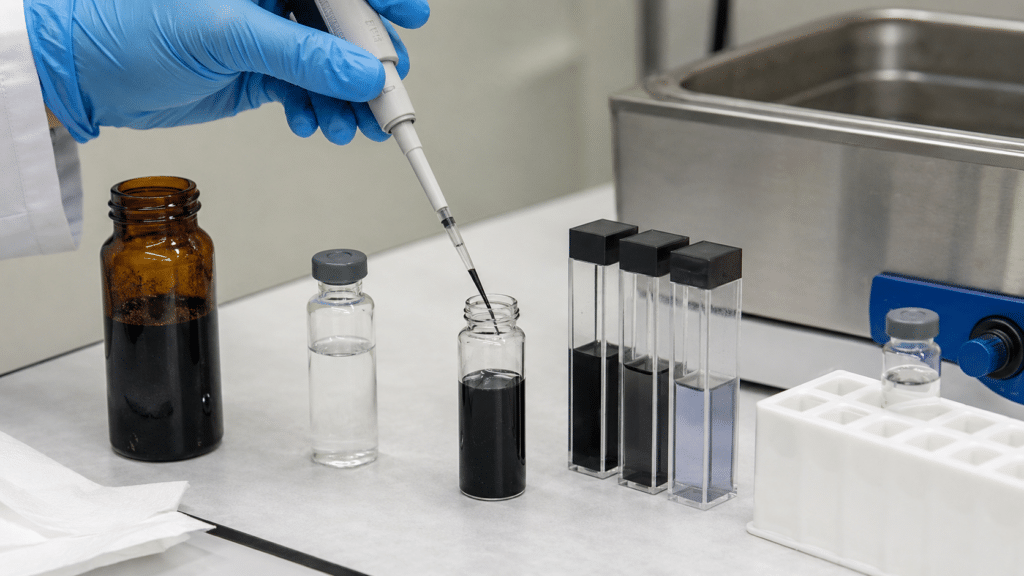
A nominal mass concentration alone does not describe whether the material is molecularly dissolved, present as stable nanoscale aggregates or settling during exposure. Linking the preparation method to the measured dispersion state makes cell and material comparisons more informative.
Fullerene derivatives have been studied in radical-scavenging experiments because their conjugated cage can accept electrons and participate in radical reactions. Early work with polyhydroxylated C60 derivatives reported reduced excitotoxic and apoptotic death in cell models.3 A separate study measured superoxide reactivity for a tris-malonic acid C60 derivative and compared its kinetic behavior with biological superoxide dismutases.1
These experiments show why the molecular derivative and assay design belong in the same interpretation. Radical-scavenging activity measured in a chemical system does not fully describe behavior in a cell culture containing proteins, membranes and competing redox reactions.
Fullerene systems can also display pro-oxidant behavior under other conditions. Light exposure, oxygen availability, aggregation and surface chemistry can change the dominant reaction pathway. Cell studies have reported oxidative effects for particular nano-C60 preparations, illustrating how preparation chemistry can reverse the apparent biological response.4
A well-designed oxidative-stress study therefore compares the complete preparation under matched dark and illuminated conditions, includes the carrier or solvent control, and measures more than a single fluorescent endpoint. This separates fullerene-related effects from medium chemistry, assay interference and the preparation method itself.
Functionalized fullerenes have been explored as components of molecular and nanoscale delivery systems. The carbon cage offers multiple positions for chemical modification, allowing researchers to attach polar groups, targeting ligands or cargo-related components.
Water-soluble C60 derivatives have also been evaluated as nonviral gene-delivery vectors. In one study, positively charged fullerene vectors differed in their ability to complex DNA, support gene expression and affect cell viability.5 The result was controlled by the full derivative structure and charge distribution rather than the C60 cage alone.
Delivery research should define the conjugation chemistry, ligand density, cargo-to-carrier ratio, free-cargo removal and stability in the selected biological medium. Uptake imaging should be able to distinguish intact fullerene-associated material from a fluorescent tag that may have separated from the carrier.
For formulation development, the next experimental questions are practical: does the complex remain dispersed at the working concentration, retain its cargo during handling, release it under the intended condition and produce a measurable response relative to carrier-only and cargo-only controls?
The excited-state chemistry of fullerenes is another major research direction. After absorbing light, a fullerene-related photosensitizer can undergo intersystem crossing and participate in energy- or electron-transfer reactions. Depending on molecular structure, oxygen concentration and the surrounding medium, these reactions can generate reactive species.
Researchers have used this behavior in experimental photodynamic systems, including studies of fullerene–drug combinations and antimicrobial materials.6 The relevant test material is normally a defined fullerene derivative or formulated complex selected for its optical absorption and compatibility with the experimental environment.
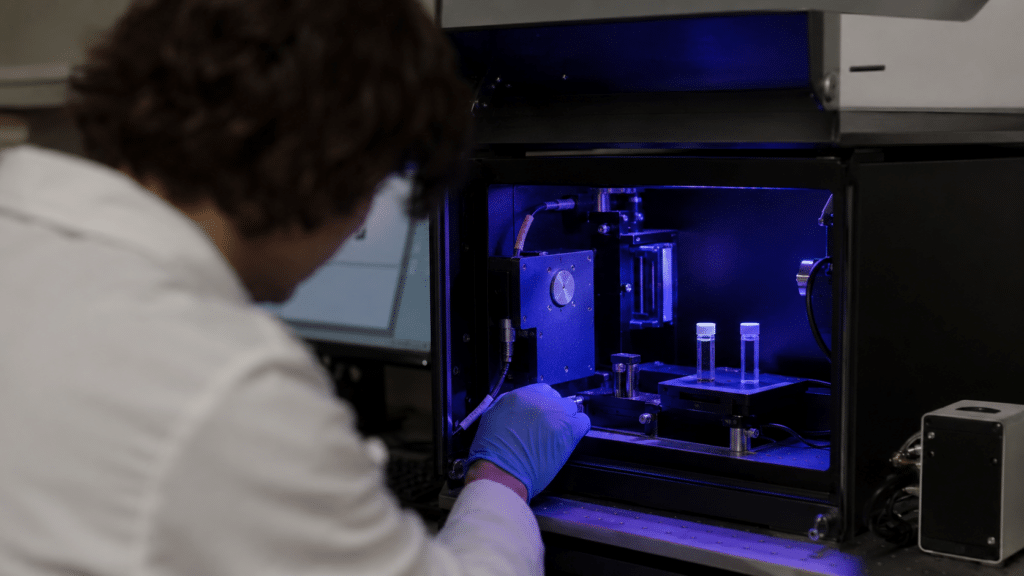
Photochemical studies should report the illumination wavelength, irradiance, exposure time, total delivered energy, oxygen conditions and sample absorbance. Dark controls and light-only controls reveal whether the response requires both the fullerene preparation and illumination.
Aggregation also matters because it can change optical absorption, excited-state lifetime and contact with the biological target. Measuring the dispersion before and after illumination helps distinguish a photochemical response from precipitation or light-induced material change.
A cell experiment typically exposes several systems at once: cells, culture medium, fullerene material, carrier or residual solvent and the analytical assay. Each can interact with the others.
Fullerene particles may absorb or scatter light at wavelengths used by colorimetric and fluorescence assays. They may also adsorb proteins, dyes or assay reagents. An apparent change in fluorescence should therefore be checked against cell-free wells containing the same fullerene preparation and assay chemistry.
A useful experimental layout includes untreated cells, vehicle-only controls, fullerene preparation without cells, concentration-matched exposures and, where relevant, dark and illuminated groups. Replicate dispersion measurements can show whether the administered material remains stable during the exposure period.
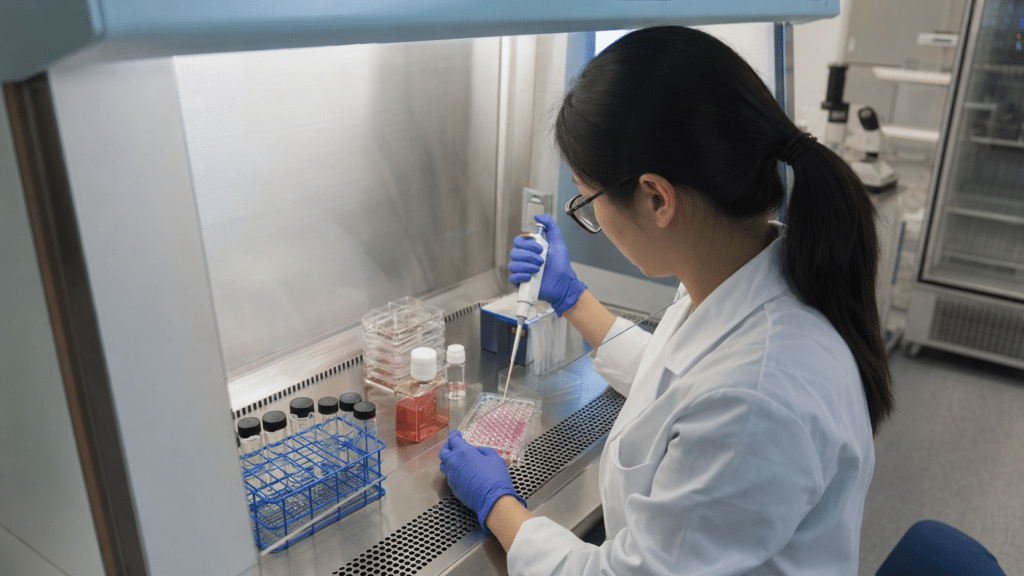
The dose should be described using the concentration placed in the well and the preparation state at exposure. For settling dispersions, the amount reaching the cell layer may differ from the nominal concentration in the total medium. Recording plate geometry, exposure duration and medium depth improves comparisons between laboratories.
No single analytical method follows every aspect of a fullerene biomedical research material. The method set should match the question at each stage.
For pristine material, XCT’s C60 characterization guide explains how different methods answer different composition and stability questions. Laboratories working with derivatives should add structural methods appropriate to the functional group and reaction route.
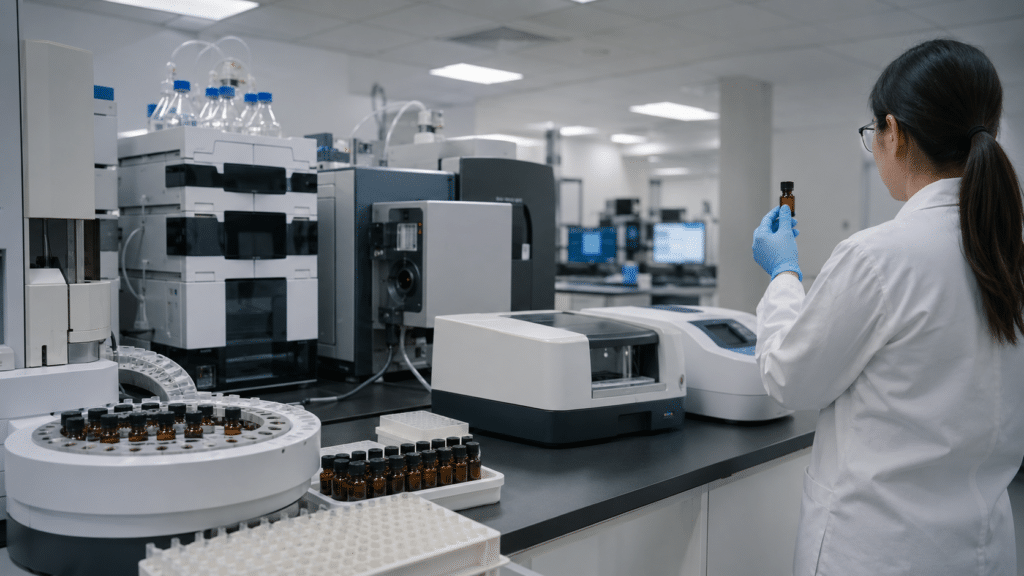
A coherent development sequence keeps the material identity connected to every later result.
This sequence allows a biological observation to be traced back to a characterized test material. It also makes later comparison with another derivative, carrier or laboratory more meaningful.
C60 is the most common starting cage in fullerene biomedical literature and offers extensive functionalization chemistry. C70 has a lower-symmetry elongated structure and different optical absorption, making it relevant to selected photochemical and molecular-material studies.
The choice should follow the intended reaction or photophysical property. A laboratory planning to reproduce a published C60 derivative should normally begin with the same cage identity. Substituting C70 creates a new material with different isomers, purification requirements and optical behavior.
Purity selection should also follow the analytical objective. A synthetic program may prioritize fullerene-component purity and reproducible reaction behavior, while a sensitive cell or photochemical study may additionally examine residual solvents, trace elements and preparation-derived species.
Research teams can send XCT the intended fullerene identity, target derivative or formulation, working quantity and planned analytical or biological model. This information helps determine whether an available C60 or C70 grade is aligned with the first stage of the project.
Review the available Fullerene C60 options, explore Fullerene C70, or submit your research-material requirements for a quotation. For a method or application question, contact XCT with the experimental context.
Pristine C60 has very low compatibility with water. Aqueous experiments generally use a documented dispersion method, carrier system or chemically functionalized fullerene, and the resulting material should be characterized in the actual test medium.
No. C60 and C70 have different cage structures and optical behavior, while fullerenols contain hydroxyl groups that change surface chemistry and water compatibility. Reproducing a study requires matching the fullerene identity and preparation as closely as possible.
Salts, proteins and pH can change aggregate size, surface interactions and settling behavior. Measuring only the stock dispersion may not describe the material that reaches the cells during exposure.
Research has reported both radical-scavenging and photo-induced reactive behavior. The dominant response depends on fullerene structure, functionalization, aggregation, oxygen, light exposure and the surrounding chemical or biological medium.
The most useful information includes the required cage identity, intended functionalization or formulation, working quantity, target purity, solvent or dispersion plan, analytical methods and experimental model.
Submit your product, purity, quantity, application, destination country, and documentation requirements. Our team will help confirm availability, COA, MSDS/SDS, packaging, and quotation details.