
XCT Insights
Stay Updated
Fullerene research, applications and company updates, delivered occasionally.
Latest from XCT
View all

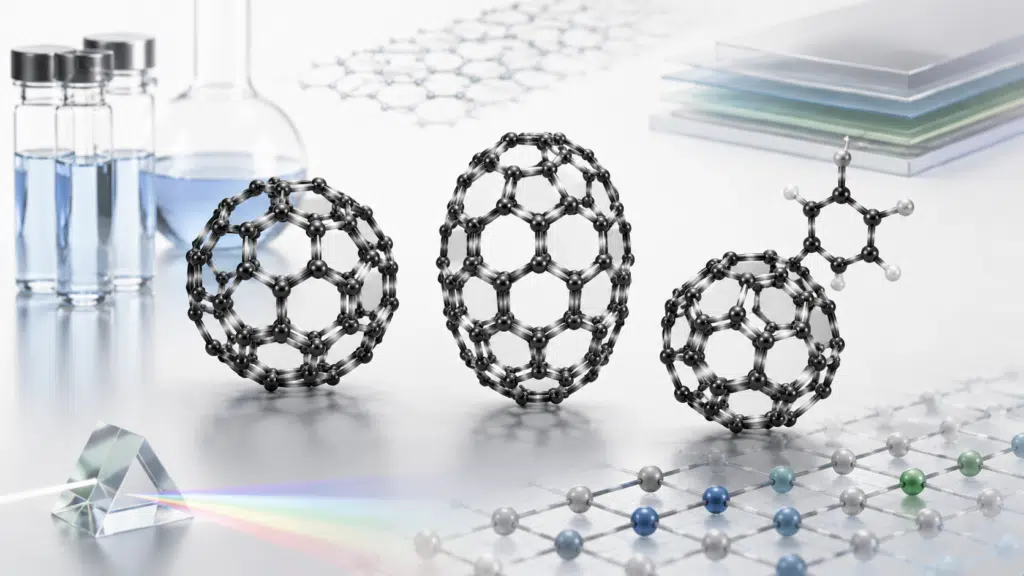
Fullerene properties come from one unusual structural fact: fullerenes are molecular carbon cages. Unlike graphite, graphene, carbon black, or diamond, fullerene molecules have closed hollow structures made only from carbon atoms. This gives them distinctive molecular geometry, electron-accepting behavior, optical response, solubility patterns, and application potential in advanced materials.
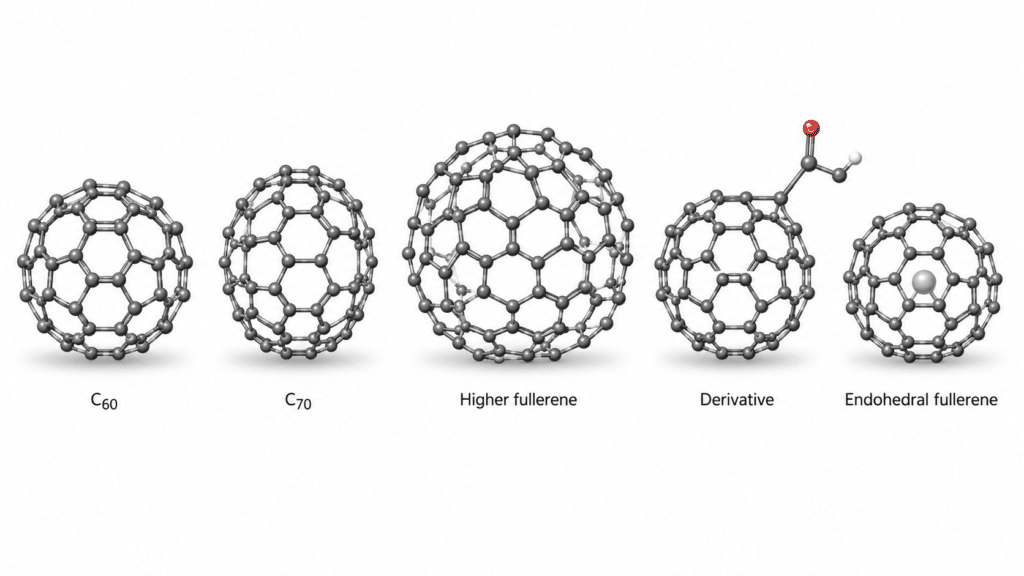
The most widely known fullerene is Fullerene C60, also called buckminsterfullerene or Carbon 60. It contains 60 carbon atoms arranged in a highly symmetrical cage. Fullerene C70 contains 70 carbon atoms and has a more elongated molecular geometry. Higher fullerenes, fullerene derivatives, and endohedral fullerenes expand the fullerene family into more specialized research areas.
This guide explains the most important properties of fullerenes, with special attention to C60 and C70. It covers structure, molecular weight, appearance, solubility, electrical behavior, optical characteristics, chemical reactivity, thermal and storage considerations, application relevance, and what technical buyers should evaluate before selecting fullerene materials.
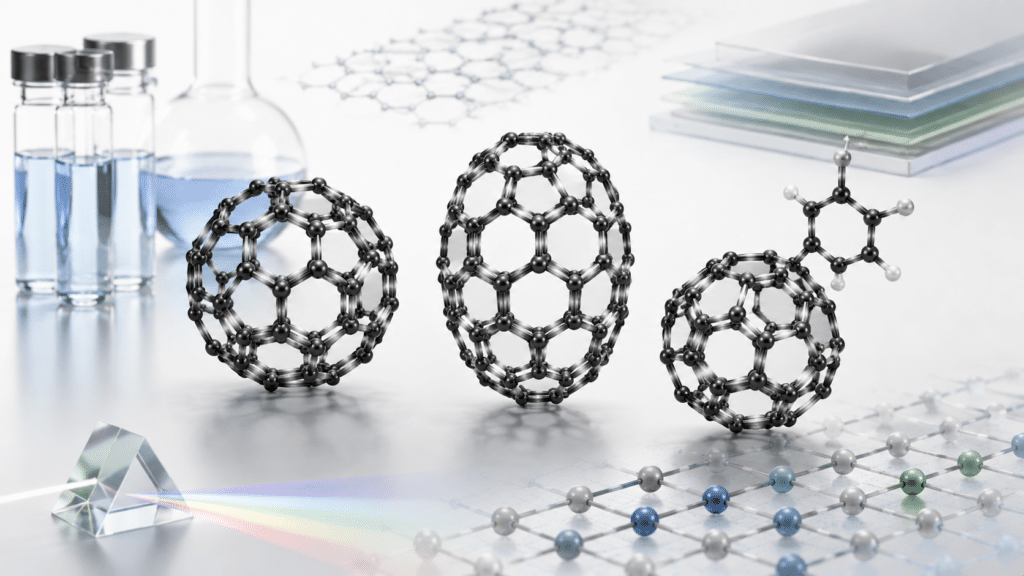
Fullerenes are carbon molecules with hollow cage-like structures. They are one of the major structural forms of carbon, alongside diamond, graphite, graphene, and carbon nanotubes. While graphite and graphene form extended carbon networks, fullerenes exist as discrete molecules.
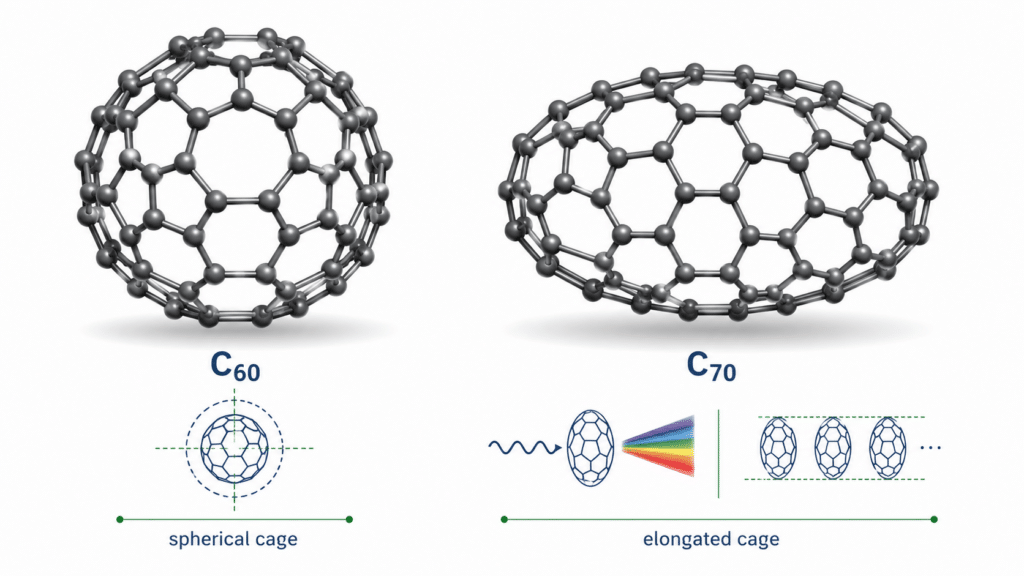
Fullerene C60 is the reference molecule for most fullerene discussions. It has the formula C60 and molecular weight 720.6420 according to the NIST Chemistry WebBook.[1] Its structure is often compared to a soccer ball because it contains pentagonal and hexagonal carbon rings arranged into a closed sphere.
Fullerene C70 has the formula C70, molecular weight 840.7490, and CAS Registry Number 115383-22-7 according to NIST.[2] Compared with C60, C70 has a more elongated structure, which can lead to different optical and electronic behavior.
At a basic level, fullerenes are valuable because they are not random carbon powders. They are defined molecular structures with repeatable geometry, nanoscale dimensions, and tunable chemistry.
| Property Category | Typical Fullerene Behavior | Why It Matters |
|---|---|---|
| Structure | Closed hollow carbon cage | Creates nanoscale molecular geometry and high surface interaction potential |
| Composition | Made only of carbon atoms | Places fullerenes within the carbon nanomaterial family |
| Electronic behavior | Electron-accepting molecular systems | Important in organic electronics, photovoltaics, and molecular electronics research |
| Solubility | Insoluble in water; soluble in selected organic solvents | Important for formulation, purification, coating, and thin-film processing |
| Optical behavior | Characteristic absorption and color in solution | Relevant to analysis, photophysical research, and material selection |
| Chemical reactivity | Can be functionalized into derivatives | Important for solubility modification and application-specific materials |
| Thermal and storage behavior | Requires controlled storage away from light, moisture, and contamination | Important for purity, batch stability, and research reproducibility |
| Application relevance | Used in research across electronics, energy, coatings, lubricants, and biomedical-related studies | Connects molecular properties to industrial and research interest |
The most important fullerene property is structure. Fullerenes are not flat carbon sheets or extended crystals. They are curved molecular cages. This curvature changes how electrons are distributed and how the molecule interacts with other materials.
C60 has a highly symmetrical cage structure made from 60 carbon atoms. It contains pentagonal and hexagonal rings and is often described as a truncated icosahedron. Each carbon atom is bonded to three neighboring carbon atoms.
C70 contains 70 carbon atoms and has a more elongated cage. This shape difference matters because molecular geometry can affect packing, solubility, optical absorption, and electronic interaction with donor materials or device interfaces.
Higher fullerenes such as C76, C78, C84, and others have larger and often more complex cage structures. Some may have multiple isomers, making purification and characterization more difficult. Endohedral fullerenes contain atoms, ions, or clusters inside the carbon cage, creating highly specialized materials for advanced research.
High-purity fullerene materials are commonly supplied as fine powders or crystalline solids. Fullerene C60 and C70 are often described as yellow-brown to black crystals with metallic luster, depending on purity, form, particle condition, and lighting.
Appearance alone should not be used to confirm quality. A fullerene sample may look visually similar across different purity grades, but batch composition, residual impurities, and analytical purity may differ. For research or industrial use, product identity and quality should be confirmed through documentation such as batch-specific COA and appropriate analytical methods.
For buyers, this means visual inspection is not enough. The practical evaluation should include product name, CAS number, molecular formula, purity, batch number, test method, storage condition, and MSDS/SDS review.
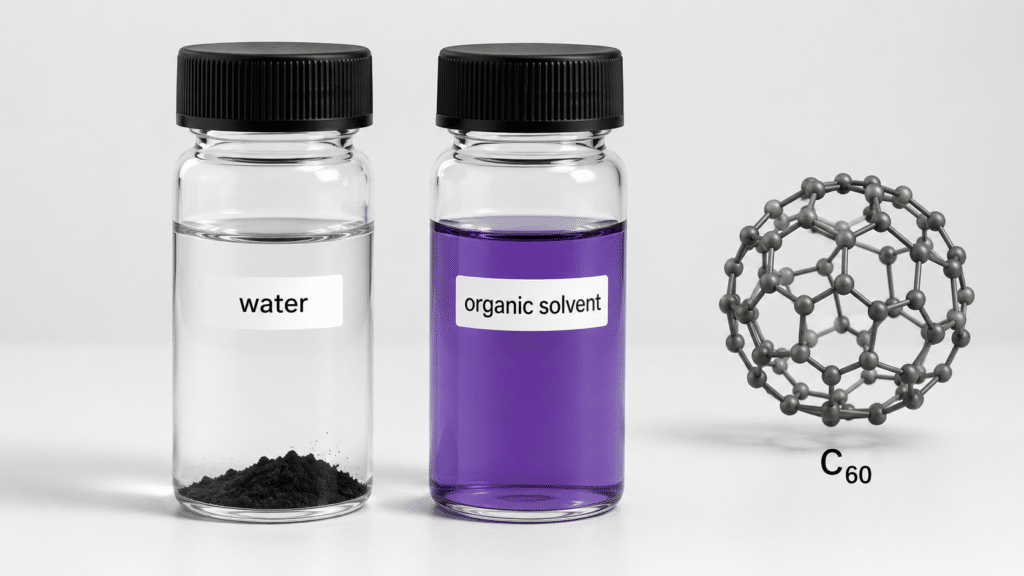
Fullerenes are generally insoluble in water. This is one of the most important practical properties for researchers and formulators. Pristine C60 and C70 are typically handled in selected organic solvents rather than aqueous systems.
Fullerene C60 is commonly dissolved in aromatic solvents such as toluene and chlorobenzene, and in selected non-aromatic solvents such as carbon disulfide. Fullerene C70 shows similar water insolubility and is also typically handled using organic solvent systems.
Solubility affects many fullerene applications. In organic electronics and photovoltaic research, solvent choice influences film formation, morphology, crystallization, and interface quality. In coatings or lubricant formulation research, solubility and dispersion behavior influence whether the material can be integrated consistently into the target system.
Many fullerene derivatives were developed partly to improve solubility or compatibility. For example, functionalized fullerene derivatives may be easier to process in solution than pristine C60 or C70. However, the derivative is not identical to the parent fullerene. Functionalization changes molecular properties, so buyers and researchers should confirm the exact material required.
Fullerenes are electronically interesting because they can accept electrons. This electron-accepting behavior is one of the main reasons C60, C70, and fullerene derivatives are studied in organic electronics and photovoltaic research.
However, it is important to avoid a common misunderstanding: pure fullerene powder is not a metal-like conductor. Pure C60 is generally a poor electrical conductor or molecular semiconductor because it consists of separate molecular cages. Electrons may be delocalized within each molecule, but there is no continuous covalent network like graphite or graphene for electrons to move through easily.
In device structures, this changes. Thin C60 layers can function as electron-transporting or electron-accepting materials under appropriate conditions. In perovskite solar cell research, thermally evaporated C60 has been described as a widely used electron transport layer in p-i-n perovskite-based solar cells.[3]
This distinction is essential. C60 is not valuable because it conducts like copper, graphite, or graphene. It is valuable because its molecular energy levels and electron-accepting behavior can support charge transport or charge separation in specific material systems.
Fullerenes have characteristic optical absorption behavior. C60 and C70 differ in their optical properties because their molecular shapes and electronic structures are different. C70 is often discussed in organic photovoltaic and organic electronics research partly because its elongated structure can lead to different light absorption and electronic behavior compared with C60.
In solution, purified C60 in toluene is commonly associated with a purple or reddish-purple appearance, depending on concentration and purity. C70 solutions can show different coloration and absorption behavior. These visible differences are useful reminders that fullerene structure influences optical response.
Optical properties matter in research fields such as organic photovoltaics, photodetectors, photodynamic research, spectroscopy, and molecular electronics. But optical activity should not be translated into unsupported product claims. For example, if a fullerene is discussed in photodynamic research, the correct language is “studied” or “investigated,” not “approved for treatment.”
Fullerenes can undergo chemical modification. This is one of their most useful properties. The carbon cage can be functionalized to create fullerene derivatives with different solubility, compatibility, electronic behavior, or biological research relevance.
Functionalization is important because pristine C60 and C70 have limited water solubility and may not be ideal for every formulation or device process. By attaching chemical groups to the fullerene cage, researchers can modify how the material behaves in solvents, polymers, thin films, or biological models.
Examples of fullerene-related material types include pristine C60, pristine C70, soluble fullerene derivatives, fullerols, PCBM-type materials, and endohedral fullerenes. These materials should not be treated as interchangeable. A C60 derivative may behave differently from pristine C60, and a C70 derivative may not behave exactly like pristine C70.
For technical communication, the exact material identity matters. Buyers should specify whether they need Fullerene C60, Fullerene C70, a fullerene derivative, hydroxylated fullerene, PCBM-type material, or another specialized fullerene product.
Fullerenes are molecular materials rather than bulk structural materials like diamond or carbon fiber. Their mechanical value usually appears through surface interaction, dispersion, or integration into another material system.
For example, C60 is studied in lubricant and coating research because of its nanoscale cage structure and potential interaction with surfaces. In these contexts, performance depends on dispersion, concentration, base oil or matrix compatibility, test method, load, temperature, and formulation design.
It is not accurate to say that C60 automatically reduces friction or improves every coating. A responsible statement is that C60 is studied in lubricant additive and coating formulation research, and results depend on the tested system.
For composites and coatings, fullerene dispersion is often more important than the molecule itself. Poor dispersion can cause aggregation, inconsistent performance, or processing problems. Good material design requires compatibility testing, not just adding fullerene powder to a formulation.
Fullerene materials are often considered chemically stable carbon molecules, but storage and handling still matter. C60 and C70 should generally be stored in sealed containers in a cool, dry place away from light. Protection from moisture, light, dust, and contamination is important for research consistency.
Storage is especially relevant for high-purity fullerene materials used in electronics, photovoltaics, analytical studies, or formulation development. Even if the molecule itself is stable, contamination, poor packaging, repeated exposure to air, or improper handling can affect experimental reproducibility.
For B2B procurement, storage guidance should be reviewed together with MSDS/SDS, packaging format, product specification, and batch COA. Buyers should confirm whether the packaging is suitable for small-scale laboratory use, repeated opening, or bulk supply.
C60 and C70 are the two most important fullerene materials for many research and supply discussions. They share the same carbon cage family but differ in shape, molecular weight, optical behavior, and application relevance.
| Property | Fullerene C60 | Fullerene C70 |
|---|---|---|
| Molecular formula | C60 | C70 |
| Molecular weight | About 720.64–720.67 g/mol | About 840.75–840.78 g/mol |
| CAS number | 99685-96-8 | 115383-22-7 |
| Molecular shape | Highly symmetrical spherical cage | More elongated carbon cage |
| Common research role | Reference fullerene, electron acceptor, ETL research, coatings, lubricants, advanced materials | Organic photovoltaics, organic electronics, molecular electronics, optical and electronic comparison studies |
| Solubility | Insoluble in water; soluble in selected organic solvents | Insoluble in water; soluble in selected organic solvents |
| Selection rule | Good starting material for many fullerene applications | Useful when C70-specific optical or electronic behavior is relevant |
C70 is not universally better than C60. Selection depends on the intended application, device design, formulation system, purity requirement, and test objective.
Fullerene properties are especially important in photovoltaic and organic electronic research. C60, C70, and fullerene derivatives have been studied as electron acceptors, electron transport materials, interfacial layers, and molecular semiconductors.
In organic photovoltaics, fullerene derivatives historically played an important role as acceptor materials. In perovskite solar cells, C60 is widely studied as an electron transport layer. In organic electronics, C60 and C70 may be considered in n-type semiconductor systems, thin films, and molecular electronic studies.
For these applications, purity and batch consistency matter. Trace impurities, mixed fullerene content, residual solvents, or inconsistent evaporation behavior may affect device reproducibility. This is why buyers working in electronics or energy materials often request high-purity C60 or C70, batch-specific COA, and application-specific technical communication.
In lubricants, coatings, and formulation research, fullerene properties are evaluated through dispersion behavior, surface interaction, stability, and compatibility with the formulation matrix.
C60 is the fullerene most often discussed in lubricant additive research. Its spherical nanoscale cage makes it interesting for friction and wear studies. However, performance is system-dependent. A C60-containing formulation must be tested under relevant load, speed, temperature, contact material, base oil, concentration, and dispersion conditions.
For coatings and polymer systems, fullerenes may be studied as advanced carbon nanomaterial additives. Their effect depends on compatibility, aggregation, concentration, and processing method. A well-dispersed fullerene material may behave very differently from an aggregated powder.
Formulators should evaluate fullerene properties in the actual system rather than relying only on general material descriptions.
Fullerenes are also investigated in biomedical and cosmetic formulation research. This area requires especially careful wording. Fullerenes may be studied in drug delivery concepts, photodynamic research, antioxidant-related models, nanomedicine-related studies, or skincare formulation research. These are research contexts, not proof of approved medical or consumer benefits.
Pristine C60 and C70 have limited water solubility, so many biomedical-related studies use functionalized fullerenes or formulated systems. The safety and behavior of these materials depend on the exact fullerene type, functional groups, purity, particle state, dose, exposure route, and test model.
For cosmetic research, fullerene materials may be explored for antioxidant-related formulation concepts. However, it is not acceptable to claim that C60 reverses aging, treats skin conditions, guarantees antioxidant benefits in humans, or is approved for cosmetic use unless verified by regulatory evidence.
This article is for research and industrial procurement reference only. It does not provide medical advice, therapeutic claims, or regulatory approval guidance. Buyers should review COA, MSDS/SDS, application requirements, and local regulations before purchasing or using fullerene materials.
Purity can strongly affect how fullerene materials behave in research and application testing. A lower-purity fullerene sample may contain mixed fullerenes, residual solvents, impurities, or other carbon byproducts. These may influence color, solubility, electronic behavior, thin-film morphology, formulation compatibility, and repeatability.
For less demanding exploratory research, standard purity grades may be sufficient. For sensitive electronics, photovoltaic, optical, or advanced material research, higher purity and better batch consistency may be required.
Available C60 and C70 purity grades may include 99.00%, 99.50%, 99.90%, and 99.95%, depending on product availability and buyer requirements. Buyers should not assume that the highest purity is always necessary, but they should match purity to the application and confirm it through batch-specific documentation.
If you are selecting fullerene materials for research, formulation, distribution, or industrial evaluation, confirm the following properties before ordering:
| Property or Document | Why It Matters |
|---|---|
| Product identity | Confirms whether the material is C60, C70, a derivative, mixed fullerene, or another fullerene material |
| CAS number | Supports chemical identification and procurement documentation |
| Molecular formula | Confirms the basic molecule, such as C60 or C70 |
| Purity grade | Affects suitability for electronics, photovoltaics, formulation, and research reproducibility |
| Test method | Clarifies how purity was measured, such as HPLC or another suitable method |
| Batch-specific COA | Connects quality information to the actual supplied batch |
| MSDS/SDS | Supports handling, storage, transport, and safety review |
| Solubility or dispersion behavior | Important for films, coatings, lubricants, solvents, and formulation work |
| Packaging | Protects material from light, moisture, and contamination |
| Storage recommendation | Supports material stability and repeatable use |
| Application fit | Prevents choosing C60, C70, or derivatives based only on name rather than performance requirements |
Fullerenes and graphene are both carbon nanomaterials, but they have different structures. Graphene is a two-dimensional sheet. Fullerenes are closed molecular cages. Their properties and applications are not the same.
C70 has different optical and electronic behavior, but it is not universally better. C60 may be more suitable for many applications, while C70 may be preferred for specific organic electronics or photovoltaic research questions.
Pure C60 and C70 are not metal-like conductors. They are molecular materials with electron-accepting behavior. Their value in electronics comes from molecular energy levels and thin-film behavior, not copper-like conductivity.
No single fullerene property guarantees performance. Results depend on purity, formulation, concentration, processing method, test conditions, and application design.
Research interest does not equal medical or cosmetic approval. Claims involving health, skin, photodynamic activity, drug delivery, or human use require careful evidence and regulatory review.
Fullerene properties matter because fullerenes are not ordinary carbon powders. They are molecular carbon cages with defined structure, nanoscale geometry, electron-accepting behavior, organic-solvent compatibility, optical activity, and chemical tunability.
C60 remains the reference fullerene because of its symmetrical cage structure and broad research history. C70 adds a more elongated geometry and different optical and electronic behavior. Derivatives and endohedral fullerenes expand the family into specialized research areas.
For students, fullerene properties explain why structure controls material behavior. For researchers, they explain why C60, C70, and derivatives are useful in advanced materials, electronics, energy research, and formulation studies. For B2B buyers, they show why purity, documentation, batch consistency, solubility, packaging, and application fit must be confirmed before purchasing.
The main fullerene properties include hollow carbon cage structure, nanoscale molecular size, electron-accepting behavior, limited water solubility, solubility in selected organic solvents, optical absorption, chemical functionalization potential, and application relevance in advanced materials.
The most important property of Fullerene C60 is its highly symmetrical hollow carbon cage structure. This structure gives C60 distinctive electronic, optical, and chemical behavior.
Pristine C60 and C70 are generally insoluble in water. They are typically handled using selected organic solvents such as toluene, chlorobenzene, or carbon disulfide in research contexts.
Pure fullerene materials such as C60 are generally poor electrical conductors compared with metals, graphite, or graphene. However, they can show electron-accepting and electron-transport behavior in suitable thin-film or device systems.
C60 has a highly symmetrical spherical cage, while C70 has a more elongated cage. This difference can affect optical behavior, molecular packing, electronic interaction, and application selection.
Fullerenes are important in solar cell research because they can act as electron acceptors or electron-transport-related materials in certain organic photovoltaic and perovskite solar cell systems.
Yes. Fullerene properties can be modified through chemical functionalization, derivative formation, doping, blending, dispersion control, and integration into different material systems.
Buyers should check product identity, CAS number, formula, purity grade, test method, batch-specific COA, MSDS/SDS, packaging, storage conditions, solubility or dispersion needs, and application suitability.
Need Fullerene C60 or Fullerene C70 for research, electronics, energy materials, coatings, lubricants, formulation development, or distribution?
The Fullerene can support inquiries for high-purity Fullerene C60 and Fullerene C70, including purity options, batch-specific COA, MSDS/SDS, sample availability, packaging information, storage guidance, and international shipping support.
Submit your fullerene requirement with product name, target purity, quantity, application, destination country, and required documents.
[1] NIST Chemistry WebBook, “Buckminsterfullerene.” NIST lists buckminsterfullerene with formula C60 and molecular weight 720.6420. Source
[2] NIST Chemistry WebBook, “c70-Fullerene.” NIST lists c70-Fullerene with formula C70, molecular weight 840.7490, and CAS Registry Number 115383-22-7. Source
[3] Ahmed A. Said et al., “Sublimed C60 for efficient and repeatable perovskite-based solar cells,” Nature Communications, 2024. The paper describes thermally evaporated C60 as a widely used electron transport layer in p-i-n perovskite-based solar cells and discusses source-material quality. Source
[4] AQA, “GCSE Chemistry 8462: Bonding, structure, and the properties of matter.” AQA describes fullerenes as hollow molecules of carbon atoms whose structures are based on carbon rings. Source
[5] PubChem, “Fullerene-C70.” PubChem provides chemical identity and property information for Fullerene C70. Source
For B2B procurement of Fullerene C60 (Pure), 99.95% Purity, No metallic residue, buyers should confirm target purity, required quantity, application, destination country, COA, MSDS/SDS, packaging, storage conditions, and shipping requirements before requesting a formal quotation.
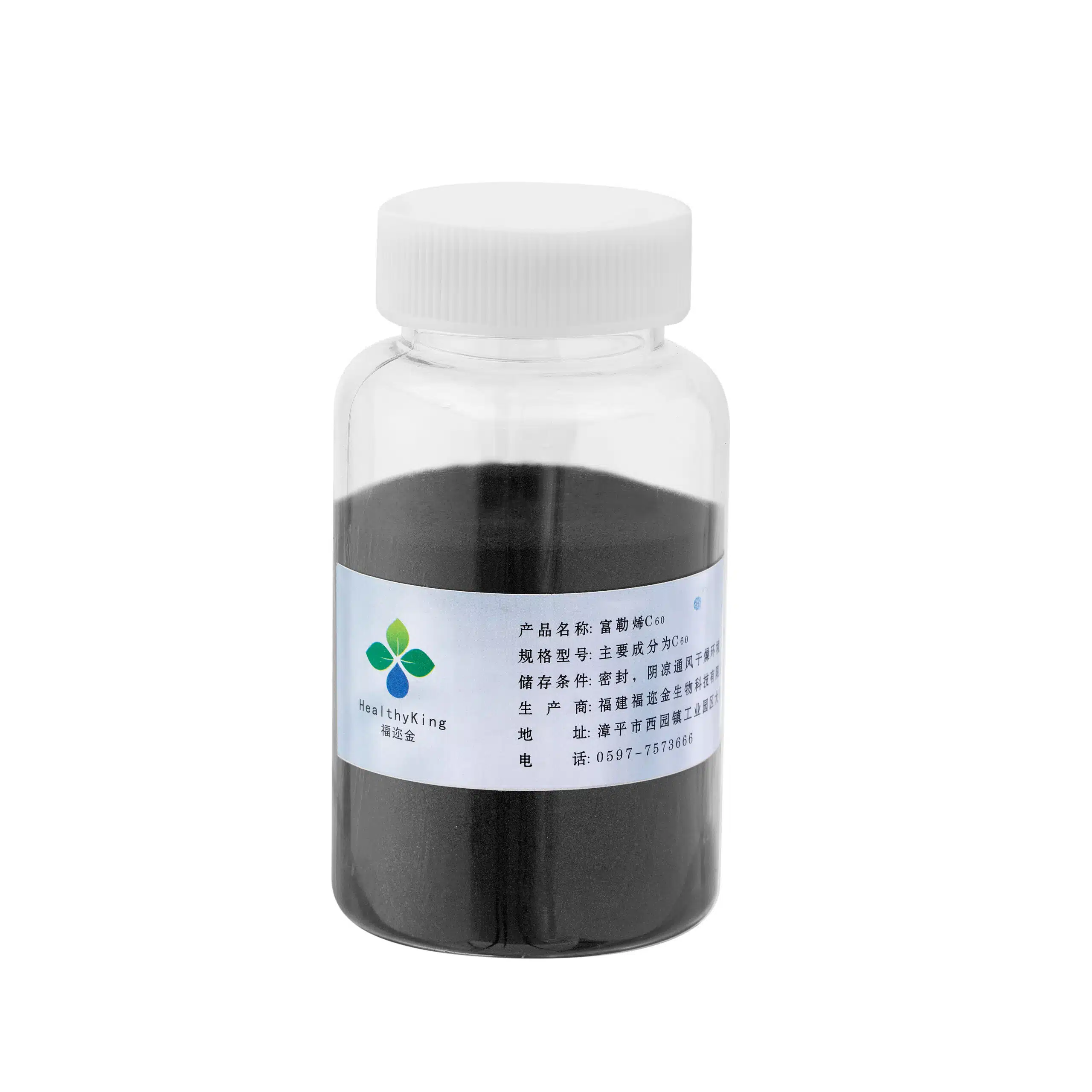
High-purity fullerene C60 is a highly refined nanomaterial designed specifically for the most demanding scientific and industrial applications. This ultra-pure form ensures…
Request product specifications, batch-specific COA, MSDS/SDS, sample availability, packaging details, and international shipping information before confirming your order.
Request DocumentsSubmit your product, purity, quantity, application, destination country, and documentation requirements. Our team will help confirm availability, COA, MSDS/SDS, packaging, and quotation details.