



주요 요점
- 현재 풀러렌 크림이 방사선 피부염에 대한 확립된 치료법임을 입증하는 검증된 임상 출처는 없습니다.
- 순수 C60, 기능화된 풀러렌 및 완성된 크림은 각각 별도의 안정성, 동일성 및 안전성 평가가 필요합니다.
- 원료의 순도만으로는 방사선 조사, 염증 또는 장벽 손상 피부에 대한 효능이나 안전성을 입증할 수 없습니다.
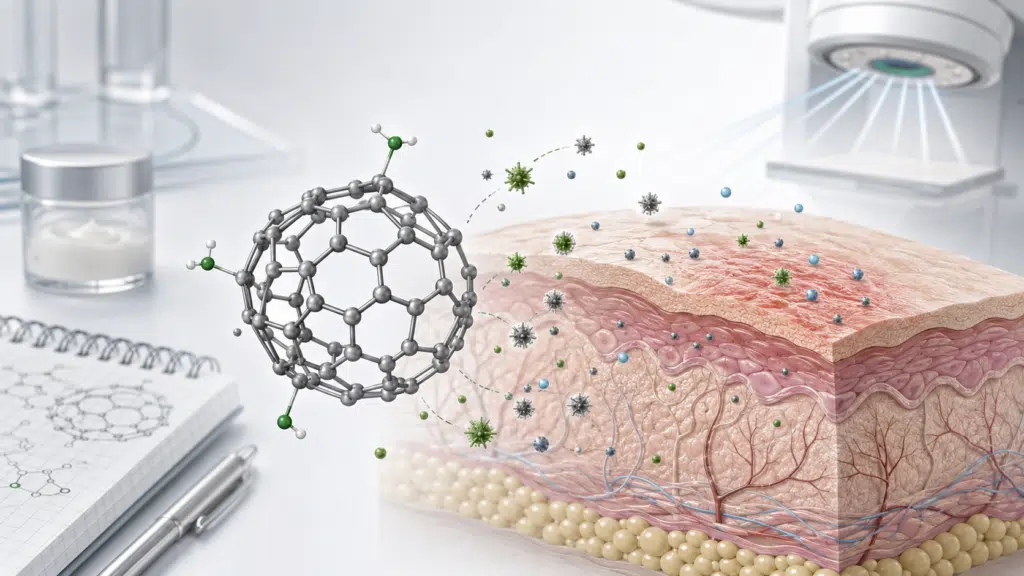
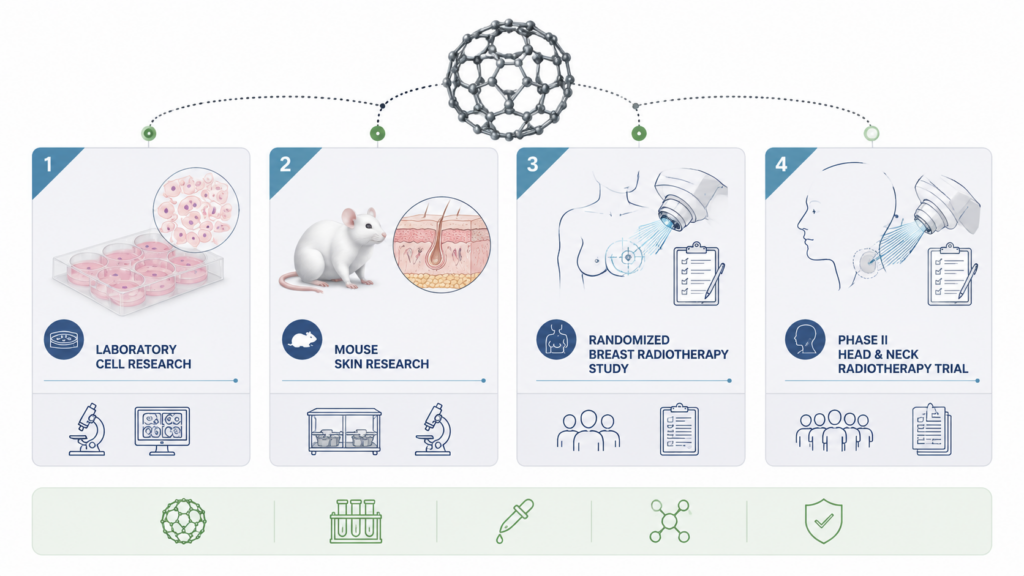
방사선 피부염에서의 풀러렌에 대한 연구는 실험실 이론을 넘어섰습니다. 전임상 연구에서는 방사선 조사된 세포와 동물 피부에서 수산화 풀러렌 또는 풀러레놀을 조사했으며, 2025년과 2026년에 발표된 무작위 임상 연구에서는 방사선 치료를 받는 환자에게 풀러렌 함유 국소 크림을 평가했습니다.
결과는 유망합니다. 보고된 연구에서 풀러렌 함유 제제는 급성 방사선 피부염의 낮은 등급 또는 발병률, 피부 반응의 지연된 발현, 통증 감소 또는 임상적으로 유의미한 피부염 기간 단축과 관련이 있었습니다.
그러나 이러한 발견이 모든 원료 풀러렌 C60, 모든 풀러렌 유도체 또는 모든 상업용 풀러렌 크림이 방사선 조사 피부에 안전하고 효과적이라는 것을 입증하지는 않습니다. 증거는 특정 완성 제제, 투여 일정, 환자 집단, 비교 대상 및 연구 프로토콜에 적용됩니다.
따라서 핵심 과학적 질문은 단순히 풀러렌이 활성 종을 제거할 수 있는지 여부가 아닙니다. 정밀하게 특성화된 풀러렌 물질이 방사선 조사 또는 장벽 손상 피부에 추가적인 위험을 생성하지 않으면서 안정적이고, 내약성이 있으며, 임상적으로 평가된 국소 제품으로 제형화될 수 있는지 여부입니다.
이 기사는 현재 증거를 검토하고, 순수 C60을 풀러레놀 및 완성된 크림과 구별하며, 가장 중요한 제형 변수를 조사하고, 연구자, 제형업체, 공급업체 및 환자가 넘지 말아야 할 경계를 정의합니다.
의학적 고지: 이 기사는 과학적, 제형 및 조달 참고용으로만 제공됩니다. 의학적 조언을 제공하거나 자가 치료를 권장하지 않습니다. 방사선 치료를 받는 환자는 방사선 종양학 팀이 제공하는 피부 관리 프로토콜을 따라야 합니다.
방사선 피부염이란 무엇입니까?
방사선 피부염은 방사선 치료 중 전달되는 이온화 방사선에 의해 발생하는 피부 반응입니다. 급성 방사선 피부염은 치료 중 또는 직후에 발생할 수 있으며 홍반, 건조, 가려움증, 불편감, 벗겨짐, 통증 또는 습성 박리로 나타날 수 있습니다. 중증도는 방사선량, 분할 방식, 치료 부위, 병용 요법, 환자 특성, 피부 주름, 마찰 및 기타 임상적 요인에 따라 달라집니다.
이온화 방사선은 세포 DNA와의 직접적인 상호작용과 활성 산소 종을 포함하는 간접적인 과정을 통해 피부를 손상시킬 수 있습니다. 분할 방사선 치료 중 반복적인 노출은 기저 각질형성세포, 염증 신호 전달, 혈관 구조, 모낭 및 피부 장벽에 영향을 미칠 수 있습니다.[1]
현재 지지 요법 전략에는 치료 부위, 피부염 등급, 기관 프로토콜 및 임상의 평가에 따라 선택된 부드러운 세척, 보습, 국소 코르티코스테로이드, 장벽 필름, 드레싱 및 기타 중재가 포함될 수 있습니다.[2]
모든 환자 또는 방사선 피부염의 모든 단계에 적합한 단일 중재는 없습니다. 이것이 풀러렌 함유 제제가 연구되고 있는 임상적 맥락입니다.
풀러렌이 연구되는 이유는 무엇입니까?
과학적 근거는 산화 스트레스에 중점을 둡니다. 풀러렌 물질의 공액 탄소 케이지는 전자 전달 및 라디칼 관련 반응에 참여할 수 있습니다. 수산화 풀러렌 유도체는 실험실 시스템에서 활성 산소 및 질소 종의 제거제로 조사되었습니다.
풀러레놀은 특히 관련성이 있는데, 풀러렌 케이지에 부착된 수산기가 순수 C60에 비해 수용성을 향상시킬 수 있기 때문입니다. 이를 통해 연구자들은 생물학적 테스트에 더 실용적인 수성 또는 유화 기반 시스템을 준비할 수 있습니다.
세포 및 동물 연구에서 풀러레놀 제제는 방사선 조사 후 세포 내 활성 산소 종, DNA 손상, 세포사멸, 표피 비후, 콜라겐 침착 및 피부 부속기 손상을 감소시키는 것으로 보고되었습니다.[3][4]
이러한 발견은 추가 연구를 위한 그럴듯한 메커니즘을 제공합니다. 모든 국소 풀러렌 제제가 환자에게 동일한 효과를 나타낼 것임을 증명하지는 않습니다.
실험실 분석에서 분자의 라디칼 소거 활성은 제품 성능의 한 부분일 뿐입니다. 임상 결과는 또한 관련 피부층으로의 전달, 농도, 체류 시간, 제형 비히클, 안정성, 내약성, 방사선 일정, 환자 순응도 및 피부 장벽 상태에 따라 달라집니다.
“풀러렌”은 상호 교환 가능한 하나의 물질이 아닙니다.
가장 중요한 안전성 및 해석 문제 중 하나는 용어입니다. 연구 논문 및 상업 페이지는 “풀러렌”을 사용하여 실질적으로 다른 물질을 설명할 수 있습니다.
| 물질 유형 | 기본 설명 | 제형 관련성 |
|---|---|---|
| 순수 풀러렌 C60 | 60개의 탄소 원자로 구성된 변형되지 않은 탄소 케이지 | 물에 불용성이며 적절한 용매, 분산제, 담체 또는 가공 방법이 필요함 |
| 풀러렌 C70 | 70개의 탄소 원자로 구성된 길쭉한 탄소 케이지 | C60과 다른 분자, 광학 및 제형 특성 |
| 풀러레놀 | 여러 수산기를 가진 수산화 풀러렌 | 일반적으로 수용성이 더 높으며 방사선 보호 연구에 널리 사용됨 |
| 캡슐화 또는 담체 결합 풀러렌 | 지질, 폴리머, 계면활성제 또는 기타 담체 시스템에 통합된 풀러렌 | 담체 조성물은 안정성, 침투성 및 내약성을 제어할 수 있음 |
| 완성된 풀러렌 크림 | 풀러렌 관련 물질 및 부형제를 포함하는 다성분 국소 제제 | 임상 증거는 풀러렌 성분 단독이 아닌 완전히 테스트된 제품에 적용됨 |
수산화 풀러레놀의 증거는 순수 C60 분말에 자동으로 적용될 수 없습니다. 하나의 완성된 크림의 증거는 다른 풀러렌 화학, 농도, 유화제, 보습제, 방부제 또는 침투 증진제를 가진 다른 크림에 자동으로 적용될 수 없습니다.
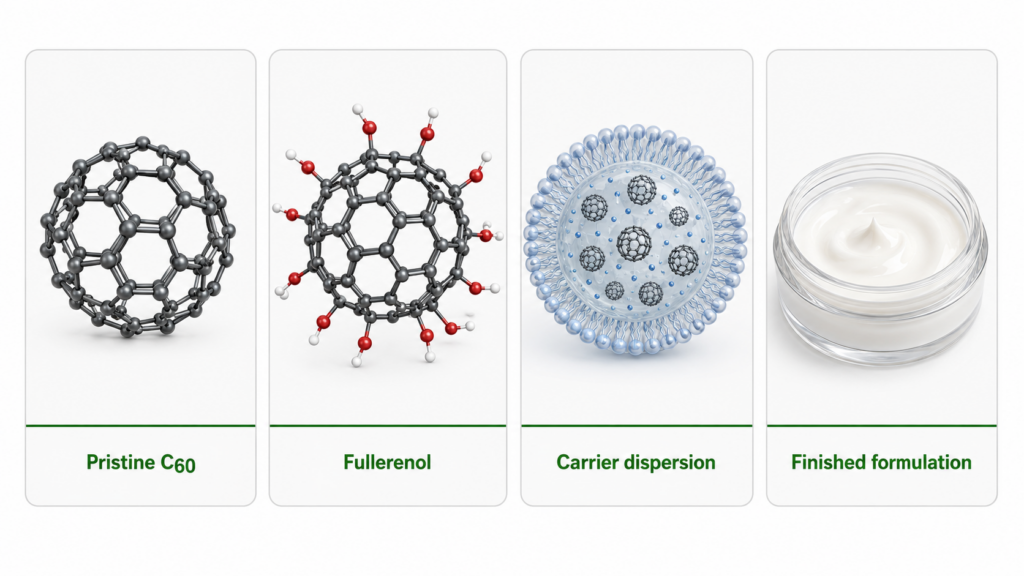
이러한 구별은 과학 출판물, 마케팅 자료, 조달 논의 및 규제 제출 전반에 걸쳐 유지되어야 합니다.
현재 증거 개요
| 증거 단계 | 연구 | 주요 결과 | 중요한 제한 사항 |
|---|---|---|---|
| 세포 및 물질 연구 | Zhao et al., 2021 | 확장 가능한 풀러레놀 물질이 실험 시스템에서 라디칼 소거 및 피부 방사선 보호 가능성을 보여줌 | 전임상 증거는 임상적 효능을 입증하지 않음 |
| 세포 및 마우스 연구 | Yin et al., 2023 | 국소 풀러레놀이 마우스에서 방사선 유발 피부 손상의 여러 징후를 감소시킴 | 동물 피부와 인간 방사선 치료는 동등하지 않음 |
| 무작위 유방암 연구 | Wang et al., 2025 | 풀러렌 크림은 더 낮은 ARD 등급, 발병 지연, 통증 감소 및 더 나은 삶의 질 보고와 관련됨 | 소규모, 단일 센터, 비맹검 연구; 최종 분석에 81명의 환자 포함 |
| 2상 두경부암 임상시험 | Liu et al., 2026 | 풀러렌 크림이 트롤라민과 비교하여 2등급 이상 및 3등급 이상 ARD를 감소시킴 | 단일 센터 및 제품 특이적; 더 광범위한 반복 및 장기적 증거가 여전히 필요함 |
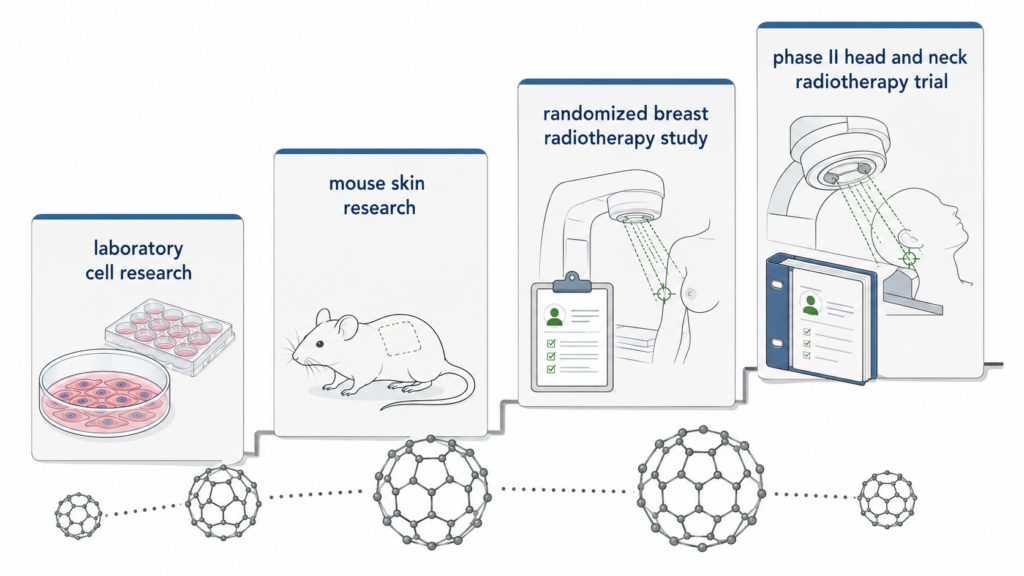
전임상 증거가 보여주는 것
2021년 연구는 자유 라디칼 소거 활성을 가진 풀러레놀의 확장 가능한 생산 경로를 설명하고 피부 방사선 보호 가능성을 조사함.[3]
이후 2023년 연구는 방사선 조사된 각질세포, 섬유아세포 및 방사선 피부염 마우스 모델에서 국소 적용된 풀러레놀을 평가함. 연구자들은 세포 모델에서 세포 내 활성산소 종 감소, DNA 손상 및 세포사멸 감소, 마우스에서 여러 피부 손상 지표 개선을 보고함.[4]
마우스 연구는 또한 표피 두께 증가, 콜라겐 침착 및 피부 부속기 손상 감소를 보고함. 이러한 결과는 국소 풀러레놀 연구의 생물학적 타당성을 뒷받침함.
그럼에도 불구하고, 전임상 결과에는 몇 가지 한계가 있음:
- 마우스 피부는 두께, 모발 밀도, 면역 반응, 치유 및 노출 조건에서 인간 피부와 다름.
- 실험적 방사선 선량 및 치료 영역은 임상 분할 일정을 재현하지 못할 수 있음.
- 풀러렌 유도체, 농도, 비히클 및 적용 프로토콜은 이후 임상 제품과 다를 수 있음.
- 조직학적 개선이 환자 보고 이점 또는 장기적 안전성을 자동으로 입증하지는 않음.
전임상 결과는 임상 연구를 정당화함. 이는 그 자체로 임상적 증거로 제시되어서는 안 됨.
2025년 유방암 무작위 연구
2025년에 발표된 무작위 대조 연구는 유방암 수술 후 방사선 치료를 받는 여성에서 국소 풀러렌 보습 및 재생 크림을 평가함.[5]
88명의 참가자가 풀러렌 크림군과 트롤라민 함유 비교군에 동등하게 무작위 배정됨. 중도 탈락 및 불완전 치료 후, 최종 분석에 81명의 참가자가 포함됨: 풀러렌군 41명, 비교군 40명.
제품은 방사선 치료 시작부터 치료 완료까지 하루 세 번 적용됨. 방사선 치료 종료 시, 풀러렌군은 다음과 같음:
- 0등급 ARD 환자 11명;
- 1등급 ARD 환자 28명;
- 2등급 ARD 환자 2명;
- 3등급 또는 4등급 ARD 보고 없음.
비교군에서는 0등급 환자 3명, 1등급 25명, 2등급 ARD 환자 12명이었음. 연구는 또한 피부염의 첫 발현 지연, 이후 치료 주차의 낮은 통증 점수, Skindex-16 삶의 질 결과 차이를 보고함.
결과는 임상적으로 흥미롭지만, 연구에는 중요한 제한 사항이 있음. 참가자와 연구자는 제품의 시각적 차이로 인해 맹검이 이루어지지 않음. 임상시험은 한 기관에서 수행되었고, 표본 크기가 상대적으로 작았으며, 하나의 명명된 최종 제형을 평가함. 저자는 또한 제안된 항산화 메커니즘을 확인하는 환자 수준의 생물학적 증거 부재와 장기적 평가의 필요성을 언급함.
따라서 이 연구는 추가 연구를 뒷받침함. 이는 시험된 제품과 다른 풀러렌 크림 간의 동등성을 입증하지 않음.
2026년 2상 두경부암 임상시험
2026년에 보고된 2상 이중 맹검 무작위 임상시험은 비전이성 두경부암에 대한 근치적 또는 보조 방사선 치료를 받는 132명의 환자에서 풀러렌 크림과 트롤라민 크림을 평가함.[6]
참가자는 방사선 치료 3일 전부터 치료 후 14일까지 하루 세 번 할당된 제품을 적용함. 1차 평가변수는 2등급 이상 급성 방사선 피부염 발생률이었음.
보고된 결과는 다음과 같음:
- 2등급 이상 ARD는 풀러렌군에서 34.8%, 트롤라민군에서 83.3% 발생함.
- 조정된 상대 위험도는 0.34였음.
- 2등급 이상 ARD의 중앙 지속 기간은 풀러렌군에서 14일, 트롤라민군에서 28일이었음.
- 3등급 이상 ARD는 풀러렌군에서 6.1%, 트롤라민군에서 40.9% 발생함.
경미한 알레르기 반응이 풀러렌 크림을 사용한 3명의 환자와 트롤라민을 사용한 2명의 환자에서 보고됨. 치료 관련 심각한 이상 반응은 보고되지 않음.
이 임상시험은 동물 연구 또는 공개 라벨 파일럿 연구보다 더 강력한 임상 증거를 제공함. 그러나 여전히 모든 질문에 답하지는 않음. 이는 단일 센터에서 수행되었고, 하나의 특정 제형을 하나의 비교군과 평가했으며, 특정 두경부암 환자 집단에 초점을 맞춤.
추가 다기관 임상시험, 독립적 반복, 다른 증거 기반 중재와의 비교, 더 긴 추적 관찰 및 투명한 제형 특성화가 증거 기반을 강화할 것임.
임상 증거가 입증하는 것과 입증하지 않는 것
The two clinical studies support a careful conclusion:
Specific fullerene-containing topical formulations have shown promising results for reducing or delaying acute radiation dermatitis in randomized studies.
They do not establish the following claims:
- All fullerene creams prevent radiation dermatitis.
- Pristine C60 powder can be applied directly to irradiated skin.
- Fullerene is superior to every guideline-supported intervention.
- Fullerene creams are approved medical treatments in every market.
- A raw-material purity percentage establishes finished-product safety.
- A cosmetic fullerene cream is suitable for oncology patients.
- Fullerene can be used on open or moistly desquamated skin without clinician assessment.
Clinical evidence is product-specific. If the exact fullerene material, concentration, carrier system, excipient composition, manufacturing controls, and application protocol are not equivalent, the results cannot be assumed to transfer.
Why Fullerene Formulation Matters
Formulation is not a secondary issue. It determines whether the fullerene material remains dispersed, reaches the target layer, changes during storage, causes irritation, or penetrates beyond the intended site.
Pristine C60 is not water-soluble
Unmodified C60 does not readily dissolve in water. A topical product containing pristine C60 therefore requires a carrier, solvent, oil phase, surfactant, encapsulation system, or controlled dispersion strategy.
A dark cream or suspension does not prove that the molecules are uniformly distributed. Aggregation can affect dose consistency, skin contact, stability, and biological behavior.
Fullerenols are chemically different
Hydroxylation increases water compatibility, but it also changes molecular composition, surface chemistry, size distribution, aggregation, and biological interactions.
“Fullerenol” should not be treated as a single fixed substance. The number and distribution of hydroxyl groups, residual salts, synthesis by-products, molecular heterogeneity, and analytical characterization can vary.
The vehicle affects penetration
A 2017 ex vivo study using pig skin and Franz diffusion cells found that C60 dispersed in a transcutol/isopropyl myristate system could permeate skin.[7]
This does not prove harmful systemic exposure or clinical benefit. It demonstrates that penetration is formulation-dependent. A material that remains primarily on the surface in one vehicle may penetrate differently in another.
This becomes particularly important when irradiated skin has an impaired barrier.
The complete cream may influence the outcome
A finished cream contains more than the named active ingredient. Humectants, occlusives, emulsifiers, polymers, preservatives, lipids, penetration enhancers, and other ingredients may affect hydration, irritation, wound environment, product adherence, and clinical outcome.
A trial comparing two finished creams therefore tests the formulations as complete systems. It does not isolate the effect of the fullerene molecule unless the study design and formulation controls specifically permit that conclusion.
What a Research-Grade Formulation Program Should Define
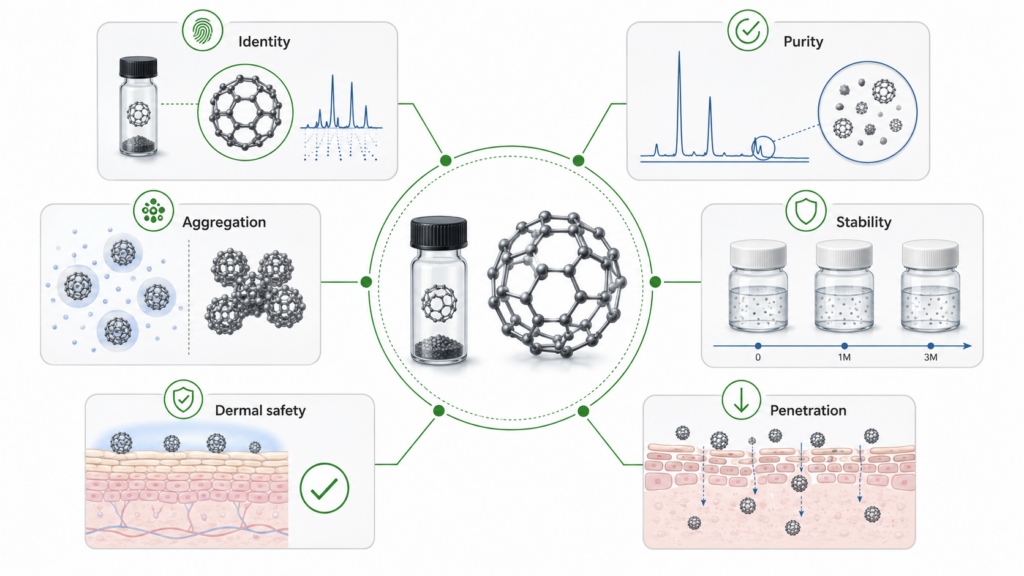
A credible fullerene topical-development program should define and control at least the following variables.
| Development Area | Questions to Resolve |
|---|---|
| 물질 식별 | Is the material pristine C60, C70, fullerenol, a derivative, or a carrier-bound fullerene? |
| Chemical characterization | What is the molecular composition, hydroxylation degree, functional-group profile, and fullerene distribution? |
| Purity and impurities | Which analytical methods are used, and what residual solvents, metals, salts, carbon by-products, or synthesis reagents remain? |
| Particle and aggregate behavior | What are the size distribution, aggregation state, morphology, and stability in the finished formulation? |
| Concentration | What concentration is present, how is it verified, and does it remain uniform throughout storage and use? |
| Vehicle composition | Which oils, surfactants, emulsifiers, polymers, or penetration enhancers are present? |
| Product stability | Does light, oxygen, temperature, radiation exposure, or packaging alter the formulation? |
| Microbiological quality | Is the preservative system suitable for the container, use pattern, and intended skin condition? |
| Dermal safety | Have irritation, sensitization, photoreactivity, penetration, genotoxicity, and damaged-skin exposure been evaluated? |
| Clinical workflow | When is the product applied relative to radiotherapy, cleansing, dressings, and other topical treatments? |
Raw-material documentation is necessary, but it is only the beginning. Finished-product safety and efficacy require formulation-specific testing.
Safety Boundaries for Fullerene Radiation-Dermatitis Research
Do not equate “antioxidant” with universally safe
Antioxidant activity in a chemical assay does not establish dermal safety, clinical benefit, appropriate dose, or long-term outcome. Fullerene materials can behave differently depending on functionalization, aggregation, impurities, light exposure, and biological environment.
Do not extrapolate from intact skin to damaged skin
Radiated skin may become inflamed, dry, fissured, or desquamated. Barrier damage can change ingredient penetration and local tolerability. Testing performed on intact skin cannot automatically justify use on open or severely damaged areas.
Do not apply raw fullerene material directly
Laboratory Fullerene C60 powder is not a finished topical medical product. A COA and MSDS/SDS do not establish sterility, microbiological suitability, skin compatibility, dosing, or clinical efficacy.
Do not replace clinical skin-care protocols
Current radiation-dermatitis management includes evidence-based and consensus-supported interventions selected by clinical teams. Fullerene research should be interpreted within that supportive-care framework, not as a reason to discontinue prescribed skin care.[2][8]
Do not ignore allergic reactions
The 2026 trial reported mild erythema, pruritus, or rash in some participants receiving fullerene cream. The absence of serious treatment-related adverse events in one trial does not prove that reactions cannot occur in broader populations.
Do not use “medical grade” without a defined basis
“Medical grade,” “pharmaceutical grade,” “oncology grade,” and similar descriptions should not be used unless they correspond to a verified specification, regulated product category, validated manufacturing standard, and intended-use framework.
High-purity C60 raw material is not automatically a medical-grade finished ingredient or an approved radiation-dermatitis treatment.
How Current Guidelines Should Be Interpreted
The 2023 MASCC systematic review and consensus recommendations evaluated a wide range of interventions for preventing and managing acute radiation dermatitis.[1][2]
Fullerene was not included as a recommended standard intervention because the major human trials discussed in this article were published later. This creates an evidence-timing issue: newer trials may be promising, but guideline incorporation normally requires expert review, replication, comparison with existing interventions, feasibility assessment, and ongoing safety evaluation.
It is therefore inaccurate to say either that fullerene has no clinical evidence or that fullerene has already become universal standard care.
The defensible position in 2026 is:
Fullerene-containing topical formulations represent an emerging radiation-dermatitis research direction supported by preclinical work and two encouraging randomized clinical studies, but broader clinical validation and guideline evaluation are still required.
Implications for Researchers and Formulation Developers
The available results create a credible case for further development, particularly in the following areas:
- multicenter randomized trials;
- independent replication outside the original research groups;
- comparison with topical corticosteroids, barrier films, dressings, and other guideline-supported strategies;
- dose-response and application-frequency studies;
- standardized fullerene and fullerenol characterization;
- damaged-skin penetration and systemic-exposure evaluation;
- long-term safety and late skin-reaction follow-up;
- analysis by radiation site, dose, concurrent chemotherapy, skin type, and patient risk factors;
- identification of which formulation components contribute to clinical effects;
- regulatory classification in different markets.
Future publications should report the fullerene chemistry and finished formulation in enough detail to support scientific reproduction. Simply stating that a product “contains fullerene” is not sufficient.
Implications for Raw-Material Procurement
Research teams sourcing fullerene for formulation development should separate raw-material qualification from finished-product qualification.
Raw-material evaluation may include:
- product identity;
- molecular formula and CAS number where applicable;
- purity and analytical method;
- batch-specific COA;
- MSDS/SDS;
- residual solvent and impurity information when available;
- storage and packaging conditions;
- batch consistency;
- sample availability.
These documents do not establish that the material is suitable for direct use on patients. The formulation developer remains responsible for selecting the fullerene form, preparing the delivery system, conducting toxicology and stability studies, defining the intended use, and following the appropriate clinical and regulatory pathway.
결론
Research on fullerene in radiation dermatitis has advanced substantially. Fullerenol studies established a preclinical rationale based on oxidative-stress mitigation, and randomized studies published in 2025 and 2026 reported meaningful reductions in acute radiation-dermatitis outcomes with specific fullerene-containing creams.
The evidence is promising but still bounded. It is based on particular products, patient groups, application schedules, and study centers. It does not justify treating raw C60, fullerenol, cosmetic fullerene products, and clinically tested creams as interchangeable.
The decisive issue is not the fullerene name alone. It is the complete chain of material identity, chemical characterization, purity, dispersion, vehicle design, stability, skin penetration, tolerability, clinical evidence, manufacturing quality, and regulatory control.
For researchers, fullerene represents a credible emerging platform for topical radioprotection research. For patients, use should remain under the direction of the radiation oncology team. For suppliers and formulators, careful documentation and evidence boundaries are more important than aggressive medical claims.
FAQ
풀러렌이 방사선 피부염에 대한 임상적 증거가 있습니까?
네. 2025년과 2026년에 발표된 무작위 연구에서는 특정 풀러렌 함유 크림이 급성 방사선 피부염의 중증도, 발생률, 발병 지연 또는 지속 기간 단축을 보고했습니다. 해당 증거는 제품별로 특화되어 있으며, 보다 광범위한 재현이 필요합니다.
풀러렌이 현재 방사선 피부염에 대한 표준 가이드라인 치료법입니까?
아니오. 풀러렌은 2023년 MASCC 가이드라인에서 표준 권장 중재로 포함되지 않았습니다. 이후 중요한 풀러렌 임상 시험 결과가 발표되었으며, 이는 여전히 더 광범위한 검토와 검증이 필요합니다.
풀러레놀은 순수한 풀러렌 C60과 동일한 물질인가요?
아니요. 풀러레놀은 수산화된 풀러렌 유도체로, 수용성 및 표면 화학적 특성이 다릅니다. 풀러레놀을 통해 얻은 증거를 순수 C60에 자동으로 적용해서는 안 됩니다.
원료 풀러렌 C60 분말을 방사선 조사된 피부에 적용할 수 있습니까?
아니요. 원료 풀러렌 C60은 연구용 또는 산업용 물질로, 완성된 국소용 제품이 아닙니다. 이는 조사된 피부에 직접 적용하기 위해 제형화, 용량 설정, 보존 처리 또는 임상 평가가 이루어지지 않았습니다.
풀러렌 임상 시험에서 이상 반응이 보고되었습니까?
2026년 2상 임상시험에서 홍반, 소양증 또는 발진을 포함한 경미한 알레르기 반응이 여러 참가자에게서 발생했습니다. 치료와 관련된 중대한 이상 반응은 보고되지 않았으나, 이는 광범위한 사용 시 반응 가능성을 배제하지 않습니다.
풀러렌의 항산화 활성이 방사선 피부염을 예방한다는 것을 증명합니까?
아니요. 항산화 및 활성종 제거 활성은 기전적 근거를 제공하지만, 임상적 성과는 제형, 용량, 침투력, 안정성, 환자 요인 및 방사선 치료 조건에도 의존합니다.
풀러렌 국소 제제는 무엇을 공개해야 하는가?
신뢰할 수 있는 개발 프로그램은 풀러렌 유형, 화학적 특성, 순도, 농도, 응집 상태, 담체, 부형제, 안정성, 미생물학적 품질, 피부 안전성, 침투 거동 및 의도된 적용 프로토콜을 정의해야 합니다.
배치별 COA가 C60의 임상적 안전성을 입증합니까?
아니요. COA는 원료의 동일성과 배치 품질을 입증할 뿐입니다. 이는 완제품의 피부 안전성, 무균성, 임상적 효능, 규제 승인 또는 손상된 피부에 적용하기 위한 적합성을 확립하지 않습니다.
CTA
Developing a fullerene formulation for controlled laboratory, preclinical, or formulation research?
The Fullerene can provide research-use Fullerene C60 information, available purity options, batch-specific COA, MSDS/SDS, sample availability, packaging details, and storage guidance.
Raw Fullerene C60 is not supplied as a finished radiation-dermatitis treatment and should not be applied directly to patients or irradiated skin.
Review Fullerene C60 material information 또는 submit your research material requirement with target purity, quantity, formulation context, destination country, and required documentation.
참고문헌
[1] Behroozian T, Goldshtein D, Ryan Wolf J, et al. “MASCC clinical practice guidelines for the prevention and management of acute radiation dermatitis: part 1, systematic review.” EClinicalMedicine. 2023;58:101886. 출처
[2] Behroozian T, Bonomo P, Patel P, et al. “Multinational Association of Supportive Care in Cancer clinical practice guidelines for the prevention and management of acute radiation dermatitis: international Delphi consensus-based recommendations.” The Lancet Oncology. 2023;24:e172–e185. 출처
[3] Zhao M, Wang C, Xie J, Ji C, Gu Z. “Eco-Friendly and Scalable Synthesis of Fullerenols with High Free Radical Scavenging Ability for Skin Radioprotection.” Small. 2021;17:e2102035. 출처
[4] Yin H, Gao Y, Chen W, et al. “Topically applied fullerenols protect against radiation dermatitis by scavenging reactive oxygen species.” Discover Nano. 2023;18:101. 출처
[5] Wang Q, Shi X, Guo J, et al. “Topical EOSSKY fullerene moisturizing and repairing cream for preventing acute radiation dermatitis in breast cancer patients undergoing radiotherapy: a randomized controlled trial.” Frontiers in Medicine. 2025;12:1604012. 출처
[6] Liu Z, et al. “Fullerene for Reducing Acute Radiation Dermatitis in Patients Undergoing Radiotherapy for Head and Neck Cancer: A Phase II, Double-Blind, Randomized Controlled Trial.” Journal of Clinical Oncology. 2026. 출처
[7] Martins M, Azoia NG, Melle-Franco M, Ribeiro A, Cavaco-Paulo A. “Permeation of skin with C60 fullerene dispersions.” Engineering in Life Sciences. 2017;17:732–738. 출처
[8] eviQ. “Radiation-induced dermatitis.” Clinical guidance on preventive skin care and management of radiation-induced skin reactions. 출처
[9] Kazmierska-Grebowska P, et al. “Nanotechnology meets radiobiology: Fullerenols and metallofullerenols as nano-shields in radiotherapy.” Biomedicine & Pharmacotherapy. 2025;117915. 출처
Radiation dermatitis is a clinically important adverse effect of radiotherapy, but that fact does not make every antioxidant-related topical material an established treatment. Fullerene C60 and functionalized fullerene materials have been investigated in skin, oxidative-stress and photobiology research. These studies provide hypotheses for further investigation; they do not by themselves establish that a C60 cream prevents or treats radiation dermatitis.
A defensible evaluation must separate four different questions: whether a fullerene material shows an effect in a chemical or cell model, whether a finished topical formulation is stable and biologically appropriate, whether controlled clinical research demonstrates patient benefit, and whether the finished product meets the regulatory requirements for its intended market and claims. Evidence at one level cannot replace evidence at the others.
방사선 피부염이란 무엇입니까?
Radiation dermatitis describes skin reactions that occur in connection with exposure to therapeutic ionizing radiation. Clinical appearance and severity vary with accumulated skin dose, fractionation, treatment site, field geometry, concurrent systemic therapy, patient factors and the timing of assessment.
Possible manifestations include erythema, dryness, itching, discomfort, desquamation and, in more severe cases, substantial disruption of the skin barrier. Acute and late reactions must also be distinguished. A product studied for mild erythema cannot automatically be assumed suitable for moist desquamation, ulceration, infection risk or chronic radiation injury.
The US National Cancer Institute maintains the Common Terminology Criteria for Adverse Events, or CTCAE, as a standardized framework for recording adverse events in oncology trials.[1] Any comparative study claiming to reduce radiation dermatitis should identify the grading system and define exactly which grade, time point and anatomical assessment produced the reported outcome.
Why Fullerenes Are Considered for Skin Research
Fullerene C60 is a closed molecular carbon cage with electron-accepting and photochemical properties. The cage can also be functionalized, creating derivatives with different polarity, aggregation, charge and interaction with biological systems. For background on the underlying molecule, see 풀러렌 C60이란 무엇인가.
Fullerene materials are studied in oxidative-stress research because their electronic structure can participate in radical-related chemistry. However, terms such as “antioxidant” and “radical scavenger” do not define a universal biological response. Depending on chemical structure, aggregation, solvent, oxygen, concentration and light exposure, a fullerene system may participate in different photochemical and redox processes.
This duality matters for irradiated skin. An effect observed in a cell-free radical assay does not show that the same material will penetrate appropriately, remain stable, avoid sensitization, preserve normal cellular signalling or improve a clinically meaningful outcome in patients undergoing radiotherapy.
Pristine C60 Is Not the Same as a Fullerene Cream
Pristine C60 powder, a functionalized fullerene and a formulated topical product are three different test articles. A finished cream also contains an oil or aqueous phase, emulsifiers, preservatives, antioxidants, viscosity modifiers and packaging-contact materials. These components can affect fullerene dispersion, chemical stability, skin delivery and photochemical behavior.
A statement such as “contains 99.95% C60” describes the fullerene starting material only if the percentage has been determined by an appropriate method. It does not mean that the finished cream contains 99.95% C60, that all particles have a defined size, or that the formulation has been shown to be safe on damaged skin.
Topical fullerene research should define at least:
- the exact fullerene or derivative;
- the analytical method used to establish identity and purity;
- the concentration in the finished formulation;
- whether the material is dissolved, molecularly associated, dispersed or aggregated;
- particle or aggregate characteristics where relevant;
- the complete vehicle and preservation system;
- light, oxygen and temperature stability; and
- the intended condition of the skin barrier.
Without this information, results cannot be reproduced reliably or transferred to another product.
Why the Existing Clinical Statistics Should Be Removed
The previous version of this page reported that a fullerene cream reduced Grade 2 or higher acute radiation dermatitis from 83.3% to 34.8%, reduced Grade 3 reactions from 40.9% to 6.1%, and shortened severe symptoms from 28 days to 14 days. During the present review, no original peer-reviewed paper, registered trial record or authoritative clinical report supporting these exact comparisons could be verified.
Precise percentages create the appearance of high-quality clinical evidence, but the numbers are not interpretable without their source and study design. Necessary information would include participant numbers, cancer and treatment sites, radiation regimens, allocation method, blinding, comparator composition, baseline risks, attrition, grading criteria, assessment schedule, adverse events and statistical analysis.
Until a primary source containing those data is available and reviewed, the figures should not appear in The Fullerene’s public content. They also should not be used in sales presentations, product descriptions, social media posts or distributor materials.
What Evidence Would Support a Clinical Claim?
A credible clinical-development pathway begins with a chemically defined and stable finished formulation. Nonclinical testing should reflect the proposed use, including topical exposure and the condition of the skin barrier. A formulation intended for intact skin cannot automatically be applied to moist desquamation or open lesions.
A controlled clinical study would then need a prespecified protocol, an appropriate comparator and validated outcome assessment. Radiation dermatitis should be graded using an identified system such as CTCAE or another established oncology scale. Patient-reported pain, itching, quality of life, treatment interruption and infection may also be relevant, but endpoints must be defined before results are examined.
Evidence-based radiation-dermatitis guidance evaluates interventions through systematic review rather than assuming that an antioxidant mechanism predicts clinical efficacy.[2] A new fullerene formulation would have to demonstrate benefits and risks within that clinical context.
Why a before-and-after comparison is insufficient
Skin reactions change during and after radiotherapy. Apparent improvement may reflect the treatment schedule, natural recovery, changes in skin care, dose distribution or differences between patients. Without an appropriate control group and consistent assessment, improvement cannot confidently be attributed to the fullerene formulation.
Why formulation-specific evidence is necessary
Even if one fullerene cream eventually demonstrates a clinical effect, that result would apply first to the tested formulation. It would not validate every cream made from C60 powder, every fullerene derivative or every concentration. Changes in vehicle, preservative, fullerene source, particle characteristics or packaging could change performance and safety.
Skin Barrier Disruption Changes the Safety Question
Normal intact skin is an important protective barrier. Irradiated skin may become inflamed, fragile or disrupted. Consequently, exposure and tolerability data obtained on healthy intact skin may not describe use on clinically significant radiation dermatitis.
Applying a nanomaterial formulation to compromised skin raises questions involving local irritation, sensitization, penetration, systemic availability, microbial contamination and interaction with wound-care products. These questions cannot be resolved by describing the raw C60 as “high purity.”
The previous page stated that a fullerene cream could be used on open radiotherapy wounds if it contained “pharmaceutical-grade, zero heavy metal residue” C60. That statement should be deleted. No raw-material purity grade alone authorizes application to an open wound or demonstrates that a finished formulation is sterile, biocompatible, clinically effective or approved for that indication.
What the SCCS Opinion Means
In its final opinion on fullerenes, hydroxylated fullerenes and hydrated forms of hydroxylated fullerenes used as cosmetic nanomaterials, the European Commission’s Scientific Committee on Consumer Safety concluded that it could not determine safety because of substantial physicochemical, toxicokinetic and toxicological data gaps.[3]
The SCCS specifically stated that it could not exclude the genotoxic potential of C60 and C70. It also identified concerns involving impurities, organic solvents, stability, radical generation, phototoxicity, sensitization, dermal absorption, systemic availability and possible organ accumulation.
This opinion does not prove that all fullerene formulations are unsafe. It does mean that a supplier should not claim that SCCS requirements have already been satisfied simply because a fullerene raw material has a high HPLC percentage or selected metals were not detected.
The opinion also concerns cosmetic use. A product marketed to prevent or treat radiation dermatitis may fall outside an ordinary cosmetic positioning because the claim relates to a treatment-associated medical condition. Classification depends on the jurisdiction, intended use, claims, composition and mode of action.
Why “Medical-Grade” and “Pharmaceutical-Grade” Require Evidence
Terms such as “medical-grade C60” and “pharmaceutical-grade fullerene” should not be used as independent proof of suitability. A grade designation is meaningful only when connected to an actual specification, recognized compendial standard, validated manufacturing controls or a defined regulatory framework.
There is no universal fullerene specification under which any sufficiently pure C60 powder automatically becomes approved for medicines, radiation wounds or oncology skin care. The intended finished product determines which quality, nonclinical, clinical and manufacturing requirements apply.
The same applies to “zero heavy metals.” Analytical chemistry can establish that selected elements were not detected above stated limits under a defined method. It cannot establish absolute absence. More importantly, elemental analysis addresses only one part of product safety.
Why ICH Q3D Does Not Prove Topical Fullerene Compliance
ICH Q3D provides a risk-based framework for elemental impurities in drug products.[4] It does not certify fullerene raw materials, approve C60 creams or establish that an oncology skin formulation is safe for open wounds.
Using Q3D in a pharmaceutical-development program would require an assessment of the actual drug product, route of administration, sources of elemental impurities and applicable limits. A supplier cannot infer finished-product compliance from a general statement that its synthesis process avoids selected metal catalysts.
HPLC analysis of fullerene species also cannot replace elemental testing. Conversely, an elemental report cannot establish C60 identity, residual solvents, oxidation products, microbiological quality or finished-product performance. The guide to C60 HPLC 순도 분석 explains this analytical boundary in more detail.
Research Questions That Remain Scientifically Valuable
Removing unsupported treatment claims does not mean fullerene skin research lacks value. Several research questions remain appropriate:
- How do defined fullerene structures behave in skin-relevant oxidative and photochemical models?
- How do vehicle, concentration and aggregation affect skin interaction?
- Does ionizing-radiation exposure alter the fullerene or the finished formulation?
- What degradation products form during realistic storage and use?
- How does intact-skin exposure differ from barrier-disrupted models?
- Which analytical methods can track fullerene identity in complex creams?
- Can a fully characterized formulation demonstrate benefit in a controlled clinical study without creating unacceptable risks?
These are formulation, toxicology and clinical-research questions. They should be investigated through defined materials and appropriate study systems rather than answered through general statements about C60’s molecular structure.
How Research Teams Should Specify Fullerene Starting Material
A research team developing a topical fullerene system may need to define fullerene identity, chromatographic profile, residual solvents, elemental impurities, water content, oxidation history and packaging. The necessary information depends on the formulation and development stage.
Starting-material documentation supports experimental control; it does not guarantee a therapeutic result. Finished-product testing must still evaluate how the fullerene behaves after incorporation into the complete formulation.
The Fullerene, supported by a globally respected scientific research network, supplies C60 and C70 materials representing a leading level of fullerene production in Asia. XCT can support technically defined material evaluation while maintaining a clear boundary between supplying research materials and claiming an unverified medical outcome.
Discuss a Fullerene Formulation Research Requirement
Research teams studying fullerene stability, topical formulation or skin-related material systems may contact XCT with the intended test system, fullerene identity, required purity and analytical needs. The Fullerene does not present pristine C60 powder as an approved treatment for radiation dermatitis.
자주 묻는 질문
Is fullerene cream an approved treatment for radiation dermatitis?
No verified evidence reviewed for this article establishes fullerene cream as an approved or standard treatment for radiation dermatitis. Any clinical use would require formulation-specific evidence and the applicable regulatory authorization.
Can high-purity C60 be applied directly to irradiated or open skin?
No. Raw C60 purity does not establish that a material is suitable for direct topical use, damaged skin or open wounds. A finished formulation requires separate safety, quality and clinical evaluation.
Does antioxidant activity prove that C60 will prevent radiation skin injury?
No. Chemical or laboratory antioxidant activity is mechanistic evidence, not proof of clinical prevention or treatment. Biological behavior depends on fullerene structure, formulation, concentration, light and the test system.
Does a metal test make a fullerene cream medically compliant?
No. Elemental testing addresses selected impurities only. It does not establish fullerene identity, formulation stability, sterility, biocompatibility, clinical efficacy or regulatory approval.
What is an appropriate role for C60 in radiation dermatitis research?
C60 may be investigated as a defined research material in formulation, photochemistry, toxicology and controlled preclinical studies. Any progression to clinical use must be based on the finished formulation and an appropriate development program.
참고문헌
- US National Cancer Institute. “Common Terminology Criteria for Adverse Events and CTEP Trial Resources.” NCI source.
- Behroozian, T. et al. “MASCC Clinical Practice Guidelines for the Prevention and Management of Acute Radiation Dermatitis: Systematic Review.” eClinicalMedicine, 2023. https://doi.org/10.1016/j.eclinm.2023.101886.
- Scientific Committee on Consumer Safety. “Opinion on Fullerenes, Hydroxylated Fullerenes and Hydrated Forms of Hydroxylated Fullerenes (Nano).” SCCS/1649/23, final version adopted October 26, 2023. European Commission PDF.
- International Council for Harmonisation. “ICH Q3D(R2): Guideline for Elemental Impurities.” ICH guideline.
- US Food and Drug Administration. “Is It a Cosmetic, a Drug, or Both? (Or Is It Soap?).” FDA source.
- US Food and Drug Administration. “Guidance for Industry: Safety of Nanomaterials in Cosmetic Products.” FDA guidance.
관련 기술 문서


고순도 풀러렌을 조달할 준비가 되셨습니까?
제품, 순도, 수량, 용도, 도착 국가 및 문서 요구 사항을 제출하십시오. 당사 팀이 가용성, COA, MSDS/SDS, 포장 및 견적 세부 사항을 확인하는 데 도움을 드릴 것입니다.