




关键要点
- 目前尚无经核实的临床来源支持将富勒烯乳膏作为放射性皮炎的既定治疗方法。.
- 原始 C60、功能化富勒烯以及成品乳膏需要分别进行身份、稳定性和安全性评估。.
- 原料纯度无法证明其对受辐射、发炎或屏障受损皮肤的有效性或安全性。.
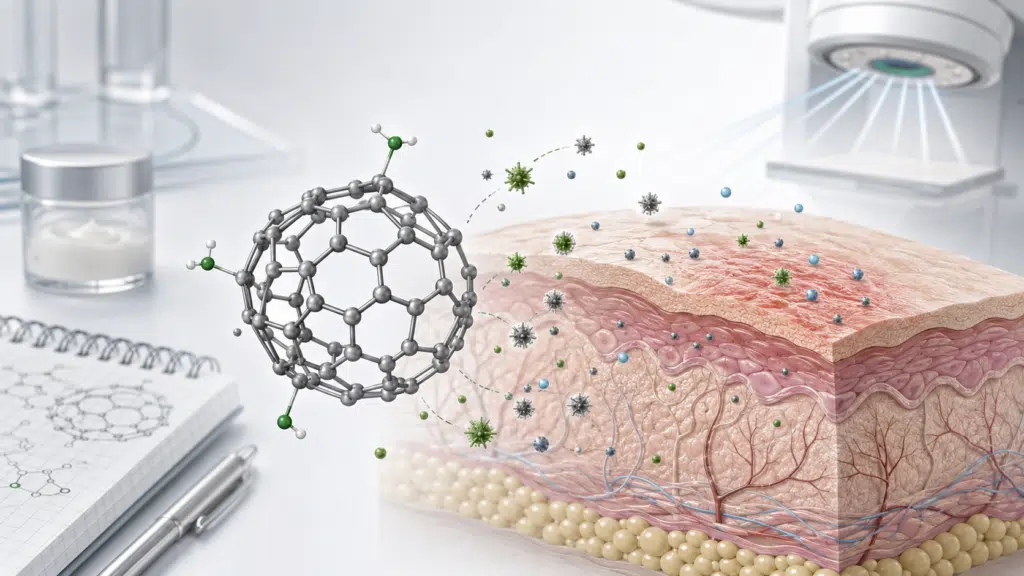
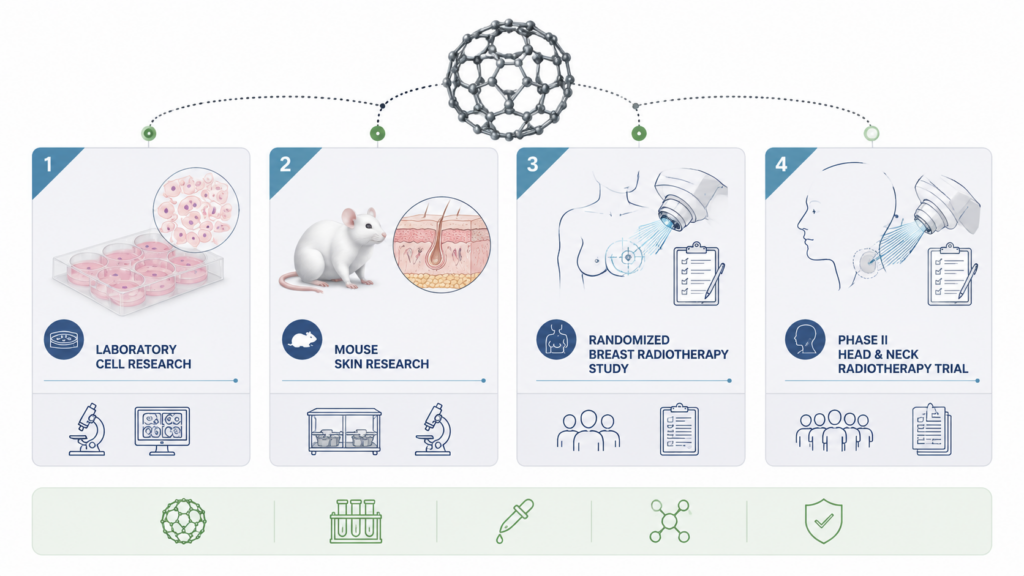
关于 富勒烯在放射性皮炎中的应用研究 已超越实验室理论阶段。临床前研究已在受辐射细胞和动物皮肤中研究了羟基化富勒烯或富勒醇,而 2025 年和 2026 年发表的随机临床研究评估了含富勒烯外用乳膏在放疗患者中的应用效果。.
结果令人鼓舞。在已报道的研究中,含富勒烯的制剂与较低的急性放射性皮炎等级或发生率、皮肤反应延迟出现、疼痛减轻或临床显著皮炎持续时间缩短相关。.
然而,这些发现并不能证明原始富勒烯 C60、每一种富勒烯衍生物或每一种商业富勒烯乳膏对受辐射皮肤是安全有效的。证据适用于特定的成品制剂、给药方案、患者群体、对照物和研究方案。.
因此,核心科学问题并不仅仅是富勒烯能否清除活性物种,而是能否将一种经过精确表征的富勒烯材料配制成稳定、可耐受、经过临床评估的外用产品,同时不对受辐射或屏障受损的皮肤造成额外风险。.
本文回顾了现有证据,区分了原始 C60、富勒醇和成品乳膏,审视了最重要的制剂变量,并界定了研究人员、配方师、供应商和患者不应逾越的界限。.
医学声明: 本文仅用于科学、配方和采购参考。它不提供医疗建议或推荐自我治疗。接受放疗的患者应遵循其放射肿瘤团队提供的皮肤护理方案。.
什么是放射性皮炎?
放射性皮炎是由放疗期间电离辐射引起的皮肤反应。急性放射性皮炎可在治疗期间或治疗后不久发生,可能表现为红斑、干燥、瘙痒、不适、脱皮、疼痛或湿性脱屑。严重程度取决于辐射剂量、分割方式、治疗部位、联合治疗、患者特征、皮肤褶皱、摩擦及其他临床因素。.
电离辐射可通过与细胞 DNA 的直接相互作用以及涉及活性氧的间接过程损伤皮肤。在分割放疗期间反复暴露会影响基底角质形成细胞、炎症信号传导、血管结构、毛囊和皮肤屏障。.[1]
当前的支持性护理策略可能包括温和清洗、保湿、外用皮质类固醇、屏障膜、敷料以及根据治疗部位、皮炎等级、机构方案和临床医生评估选择的其他干预措施。.[2]
没有一种单一的干预措施适用于所有患者或放射性皮炎的每个阶段。这是正在研究含富勒烯制剂的临床背景。.
为什么研究富勒烯?
其科学原理核心在于氧化应激。富勒烯材料的共轭碳笼可参与电子转移和自由基相关反应。羟基化富勒烯衍生物已在实验室系统中作为活性氧和氮物种的清除剂进行研究。.
富勒醇尤其相关,因为与原始 C60 相比,富勒烯笼上连接的羟基可改善其水相容性。这使得研究人员能够制备更适用于生物测试的水基或乳液基系统。.
在细胞和动物研究中,据报道富勒醇制剂可减少辐照后细胞内活性氧、DNA 损伤、细胞凋亡、表皮增厚、胶原沉积以及对皮肤附属器的损伤。.[3][4]
这些发现为进一步研究提供了合理的机制。它们并不能证明每一种外用富勒烯制剂都会在患者身上产生相同的效果。.
分子在实验室测定中的自由基清除活性只是产品性能的一部分。临床结果还取决于递送至相关皮肤层的能力、浓度、保留时间、制剂载体、稳定性、耐受性、放疗方案、患者依从性以及皮肤屏障状况。.
“富勒烯”并非一种可互换的材料
最重要的安全性和解读问题之一是术语。研究论文和商业页面可能使用“富勒烯”来描述本质不同的材料。.
| 材料类型 | 基本描述 | 制剂相关性 |
|---|---|---|
| 原始富勒烯 C60 | 由 60 个碳原子组成的未修饰碳笼 | 不溶于水,需要合适的溶剂、分散剂、载体或加工方法 |
| 富勒烯C70 | 由 70 个碳原子组成的细长碳笼 | 与 C60 具有不同的分子、光学和制剂特性 |
| 富勒醇 | 带有多个羟基的羟基化富勒烯 | 通常具有更好的水相容性,并广泛用于辐射防护研究 |
| 包封或载体结合的富勒烯 | 富勒烯被纳入脂质、聚合物、表面活性剂或其他载体系统中 | 载体组成可控制稳定性、渗透性和耐受性 |
| 成品富勒烯乳膏 | 含有富勒烯相关材料和辅料的多组分外用制剂 | 临床证据适用于经过完整测试的产品,而非单独的富勒烯成分 |
来自羟基化富勒醇的证据不能自动应用于原始 C60 粉末。来自一种成品乳膏的证据不能自动应用于另一种具有不同富勒烯化学结构、浓度、乳化剂、保湿剂、防腐剂或渗透促进剂的乳膏。.
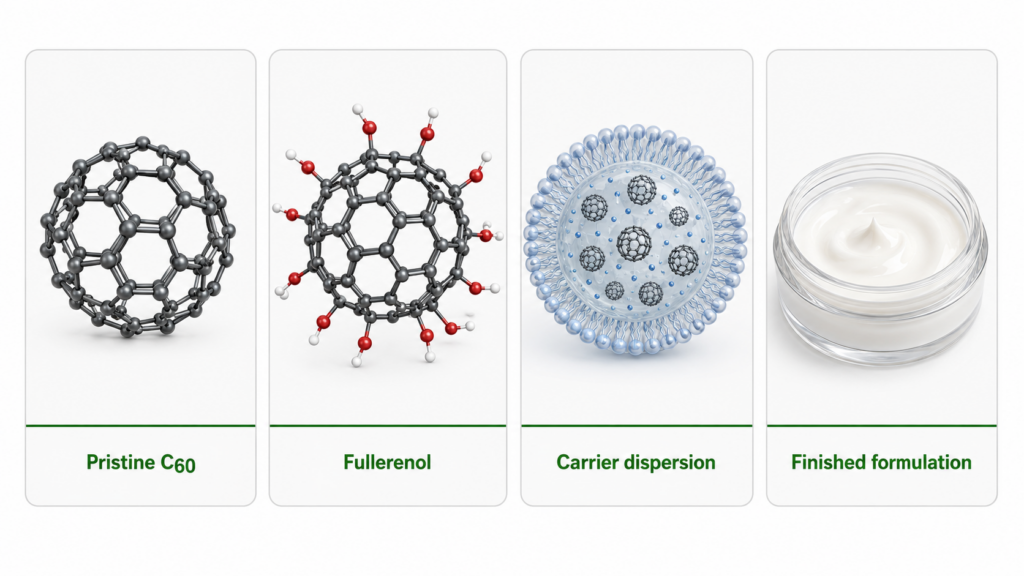
在科学出版物、营销材料、采购讨论和监管申报中应始终保持这种区分。.
当前证据概览
| 证据阶段 | 研究 | 主要发现 | 重要限制说明 |
|---|---|---|---|
| 细胞与材料研究 | Zhao 等人,2021 年 | 可规模化制备的富勒醇材料在实验系统中显示出清除自由基和皮肤辐射防护潜力 | 临床前证据并不能确立临床疗效 |
| 细胞与小鼠研究 | Yin 等人,2023 年 | 局部应用富勒醇可减轻小鼠放射性皮肤损伤的若干体征 | 动物皮肤与人体放射治疗并不等同 |
| 乳腺癌随机研究 | Wang 等人,2025 年 | 富勒烯乳膏与较低的急性放射性皮炎分级、延迟发病、减轻疼痛以及更好的报告生活质量相关 | 小型、单中心、非盲法研究;最终分析纳入 81 例患者 |
| 头颈部癌症 II 期试验 | Liu 等人,2026 年 | 与三乙醇胺相比,富勒烯乳膏降低了 2 级及以上和 3 级及以上的急性放射性皮炎发生率 | 单中心且针对特定产品;仍需更广泛的重复验证和长期证据 |
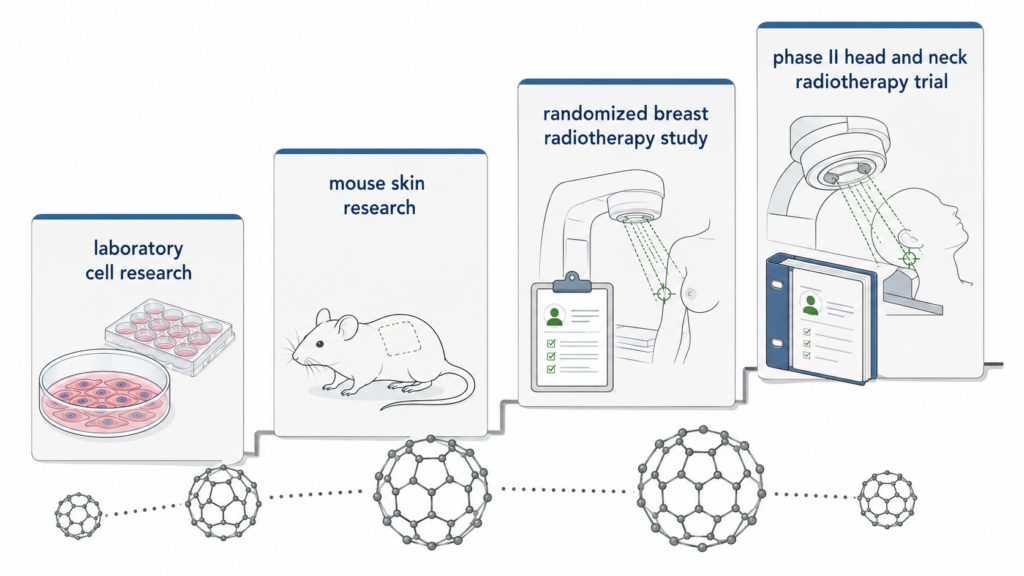
临床前证据所揭示的内容
一项 2021 年的研究描述了一种可规模化生产具有自由基清除活性的富勒醇的路线,并探讨了其在皮肤辐射防护方面的潜力。.[3]
随后一项 2023 年的研究评估了局部应用富勒醇对受照射角质形成细胞、成纤维细胞以及放射性皮炎小鼠模型的影响。研究人员报告称,细胞模型中细胞内活性氧减少,DNA 损伤和细胞凋亡减轻,小鼠的若干皮肤损伤指标也有所改善。.[4]
该小鼠研究还报告了表皮增厚、胶原沉积和皮肤附属器损伤的减轻。这些结果支持了局部应用富勒醇研究的生物学合理性。.
尽管如此,临床前研究结果存在若干局限性:
- 小鼠皮肤在厚度、毛发密度、免疫反应、愈合能力和暴露条件方面与人类皮肤存在差异。.
- 实验性辐射剂量和治疗区域可能无法重现临床分割方案。.
- 富勒烯衍生物、浓度、基质和给药方案可能与后续临床产品不同。.
- 组织学改善并不能自动确立患者报告的获益或长期安全性。.
临床前研究结果为临床研究提供了依据,但不应将其本身作为临床证据。.
2025 年乳腺癌随机研究
一项于 2025 年发表的随机对照研究评估了一种局部用富勒烯保湿修复乳膏在乳腺癌术后接受放疗的女性患者中的应用效果。.[5]
88 名参与者被随机均分至富勒烯乳膏组和含三乙醇胺的对照组。剔除退出及未完成治疗者后,最终分析纳入 81 名参与者:富勒烯组 41 人,对照组 40 人。.
从放疗开始至治疗结束,每日三次涂抹产品。放疗结束时,富勒烯组的情况为:
- 11 名患者为 0 级急性放射性皮炎;;
- 28 名患者为 1 级急性放射性皮炎;;
- 2 名患者为 2 级急性放射性皮炎;;
- 未报告 3 级或 4 级急性放射性皮炎。.
在对照组中,3 名患者为 0 级,25 名为 1 级,12 名为 2 级急性放射性皮炎。该研究还报告了皮炎首次出现时间较晚、治疗后期疼痛评分较低以及 Skindex-16 生活质量评估结果的差异。.
这些发现具有临床意义,但该研究存在重要局限性。由于产品外观特征明显不同,参与者和研究者均未设盲。该试验在单一机构进行,样本量相对较小,且仅评估了一种特定命名的成品制剂。作者还指出,缺乏患者层面的生物学证据来证实所提出的抗氧化机制,并且需要进行更长期的评估。.
因此,该研究支持进一步的研究,但并不能确立受试产品与其他富勒烯乳膏之间的等效性。.
2026 年头颈部癌症 II 期试验
一项于 2026 年报告的 II 期、双盲、随机试验,在 132 名接受根治性或辅助性放疗的非转移性头颈部癌症患者中,评估了富勒烯乳膏与三乙醇胺乳膏的效果。.[6]
参与者从放疗开始前三天起,每日三次涂抹指定产品,持续至治疗后 14 天。主要终点是 2 级及以上急性放射性皮炎的发生率。.
报告的结果如下:
- 富勒烯组 2 级及以上急性放射性皮炎发生率为 34.8%,三乙醇胺组为 83.3%。.
- 调整后的相对风险为 0.34。.
- 富勒烯组 2 级及以上急性放射性皮炎的中位持续时间为 14 天,三乙醇胺组为 28 天。.
- 富勒烯组 3 级及以上急性放射性皮炎发生率为 6.1%,三乙醇胺组为 40.9%。.
富勒烯乳膏组有 3 例患者报告轻度过敏反应,三乙醇胺组有 2 例。未报告与治疗相关的严重不良事件。.
该试验提供了比动物研究或开放标签初步研究更强的临床证据,但仍未解答所有问题。该试验在单一中心进行,评估了特定配方与一种对照品的比较,并聚焦于特定的头颈部癌症人群。.
开展多中心试验、独立重复验证、与其他有证据支持的干预措施进行比较、更长时间的随访以及透明的制剂表征,将有助于加强证据基础。.
临床证据所确立与未确立的内容
The two clinical studies support a careful conclusion:
Specific fullerene-containing topical formulations have shown promising results for reducing or delaying acute radiation dermatitis in randomized studies.
They do not establish the following claims:
- All fullerene creams prevent radiation dermatitis.
- Pristine C60 powder can be applied directly to irradiated skin.
- Fullerene is superior to every guideline-supported intervention.
- Fullerene creams are approved medical treatments in every market.
- A raw-material purity percentage establishes finished-product safety.
- A cosmetic fullerene cream is suitable for oncology patients.
- Fullerene can be used on open or moistly desquamated skin without clinician assessment.
Clinical evidence is product-specific. If the exact fullerene material, concentration, carrier system, excipient composition, manufacturing controls, and application protocol are not equivalent, the results cannot be assumed to transfer.
Why Fullerene Formulation Matters
Formulation is not a secondary issue. It determines whether the fullerene material remains dispersed, reaches the target layer, changes during storage, causes irritation, or penetrates beyond the intended site.
Pristine C60 is not water-soluble
Unmodified C60 does not readily dissolve in water. A topical product containing pristine C60 therefore requires a carrier, solvent, oil phase, surfactant, encapsulation system, or controlled dispersion strategy.
A dark cream or suspension does not prove that the molecules are uniformly distributed. Aggregation can affect dose consistency, skin contact, stability, and biological behavior.
Fullerenols are chemically different
Hydroxylation increases water compatibility, but it also changes molecular composition, surface chemistry, size distribution, aggregation, and biological interactions.
“Fullerenol” should not be treated as a single fixed substance. The number and distribution of hydroxyl groups, residual salts, synthesis by-products, molecular heterogeneity, and analytical characterization can vary.
The vehicle affects penetration
A 2017 ex vivo study using pig skin and Franz diffusion cells found that C60 dispersed in a transcutol/isopropyl myristate system could permeate skin.[7]
This does not prove harmful systemic exposure or clinical benefit. It demonstrates that penetration is formulation-dependent. A material that remains primarily on the surface in one vehicle may penetrate differently in another.
This becomes particularly important when irradiated skin has an impaired barrier.
The complete cream may influence the outcome
A finished cream contains more than the named active ingredient. Humectants, occlusives, emulsifiers, polymers, preservatives, lipids, penetration enhancers, and other ingredients may affect hydration, irritation, wound environment, product adherence, and clinical outcome.
A trial comparing two finished creams therefore tests the formulations as complete systems. It does not isolate the effect of the fullerene molecule unless the study design and formulation controls specifically permit that conclusion.
What a Research-Grade Formulation Program Should Define
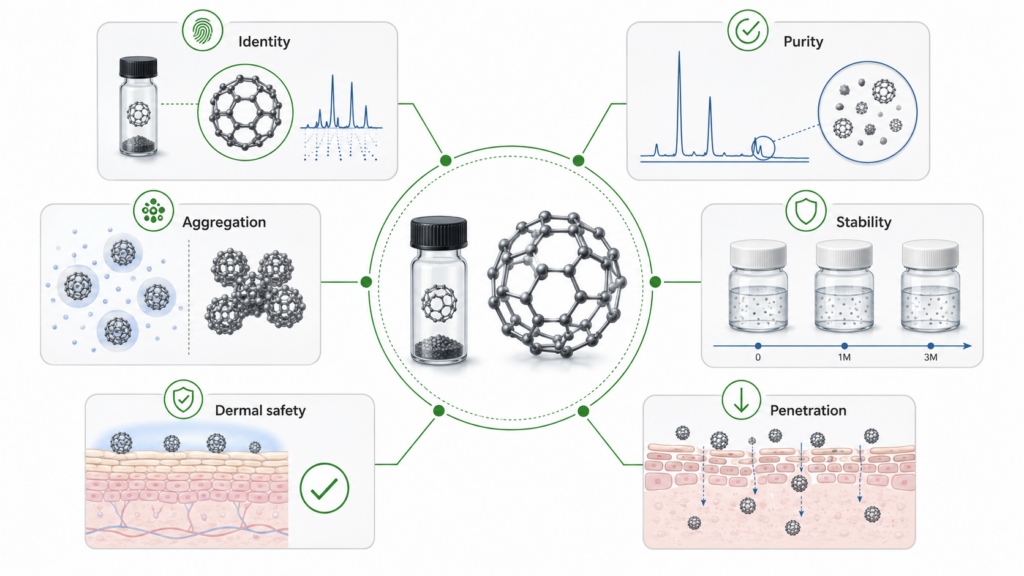
A credible fullerene topical-development program should define and control at least the following variables.
| Development Area | Questions to Resolve |
|---|---|
| 材料特性 | Is the material pristine C60, C70, fullerenol, a derivative, or a carrier-bound fullerene? |
| Chemical characterization | What is the molecular composition, hydroxylation degree, functional-group profile, and fullerene distribution? |
| Purity and impurities | Which analytical methods are used, and what residual solvents, metals, salts, carbon by-products, or synthesis reagents remain? |
| Particle and aggregate behavior | What are the size distribution, aggregation state, morphology, and stability in the finished formulation? |
| Concentration | What concentration is present, how is it verified, and does it remain uniform throughout storage and use? |
| Vehicle composition | Which oils, surfactants, emulsifiers, polymers, or penetration enhancers are present? |
| Product stability | Does light, oxygen, temperature, radiation exposure, or packaging alter the formulation? |
| Microbiological quality | Is the preservative system suitable for the container, use pattern, and intended skin condition? |
| Dermal safety | Have irritation, sensitization, photoreactivity, penetration, genotoxicity, and damaged-skin exposure been evaluated? |
| Clinical workflow | When is the product applied relative to radiotherapy, cleansing, dressings, and other topical treatments? |
Raw-material documentation is necessary, but it is only the beginning. Finished-product safety and efficacy require formulation-specific testing.
Safety Boundaries for Fullerene Radiation-Dermatitis Research
Do not equate “antioxidant” with universally safe
Antioxidant activity in a chemical assay does not establish dermal safety, clinical benefit, appropriate dose, or long-term outcome. Fullerene materials can behave differently depending on functionalization, aggregation, impurities, light exposure, and biological environment.
Do not extrapolate from intact skin to damaged skin
Radiated skin may become inflamed, dry, fissured, or desquamated. Barrier damage can change ingredient penetration and local tolerability. Testing performed on intact skin cannot automatically justify use on open or severely damaged areas.
Do not apply raw fullerene material directly
Laboratory Fullerene C60 powder is not a finished topical medical product. A COA and MSDS/SDS do not establish sterility, microbiological suitability, skin compatibility, dosing, or clinical efficacy.
Do not replace clinical skin-care protocols
Current radiation-dermatitis management includes evidence-based and consensus-supported interventions selected by clinical teams. Fullerene research should be interpreted within that supportive-care framework, not as a reason to discontinue prescribed skin care.[2][8]
Do not ignore allergic reactions
The 2026 trial reported mild erythema, pruritus, or rash in some participants receiving fullerene cream. The absence of serious treatment-related adverse events in one trial does not prove that reactions cannot occur in broader populations.
Do not use “medical grade” without a defined basis
“Medical grade,” “pharmaceutical grade,” “oncology grade,” and similar descriptions should not be used unless they correspond to a verified specification, regulated product category, validated manufacturing standard, and intended-use framework.
High-purity C60 raw material is not automatically a medical-grade finished ingredient or an approved radiation-dermatitis treatment.
How Current Guidelines Should Be Interpreted
The 2023 MASCC systematic review and consensus recommendations evaluated a wide range of interventions for preventing and managing acute radiation dermatitis.[1][2]
Fullerene was not included as a recommended standard intervention because the major human trials discussed in this article were published later. This creates an evidence-timing issue: newer trials may be promising, but guideline incorporation normally requires expert review, replication, comparison with existing interventions, feasibility assessment, and ongoing safety evaluation.
It is therefore inaccurate to say either that fullerene has no clinical evidence or that fullerene has already become universal standard care.
The defensible position in 2026 is:
Fullerene-containing topical formulations represent an emerging radiation-dermatitis research direction supported by preclinical work and two encouraging randomized clinical studies, but broader clinical validation and guideline evaluation are still required.
Implications for Researchers and Formulation Developers
The available results create a credible case for further development, particularly in the following areas:
- multicenter randomized trials;
- independent replication outside the original research groups;
- comparison with topical corticosteroids, barrier films, dressings, and other guideline-supported strategies;
- dose-response and application-frequency studies;
- standardized fullerene and fullerenol characterization;
- damaged-skin penetration and systemic-exposure evaluation;
- long-term safety and late skin-reaction follow-up;
- analysis by radiation site, dose, concurrent chemotherapy, skin type, and patient risk factors;
- identification of which formulation components contribute to clinical effects;
- regulatory classification in different markets.
Future publications should report the fullerene chemistry and finished formulation in enough detail to support scientific reproduction. Simply stating that a product “contains fullerene” is not sufficient.
Implications for Raw-Material Procurement
Research teams sourcing fullerene for formulation development should separate raw-material qualification from finished-product qualification.
Raw-material evaluation may include:
- product identity;
- molecular formula and CAS number where applicable;
- purity and analytical method;
- batch-specific COA;
- MSDS/SDS;
- residual solvent and impurity information when available;
- storage and packaging conditions;
- batch consistency;
- sample availability.
These documents do not establish that the material is suitable for direct use on patients. The formulation developer remains responsible for selecting the fullerene form, preparing the delivery system, conducting toxicology and stability studies, defining the intended use, and following the appropriate clinical and regulatory pathway.
结论
Research on fullerene in radiation dermatitis has advanced substantially. Fullerenol studies established a preclinical rationale based on oxidative-stress mitigation, and randomized studies published in 2025 and 2026 reported meaningful reductions in acute radiation-dermatitis outcomes with specific fullerene-containing creams.
The evidence is promising but still bounded. It is based on particular products, patient groups, application schedules, and study centers. It does not justify treating raw C60, fullerenol, cosmetic fullerene products, and clinically tested creams as interchangeable.
The decisive issue is not the fullerene name alone. It is the complete chain of material identity, chemical characterization, purity, dispersion, vehicle design, stability, skin penetration, tolerability, clinical evidence, manufacturing quality, and regulatory control.
For researchers, fullerene represents a credible emerging platform for topical radioprotection research. For patients, use should remain under the direction of the radiation oncology team. For suppliers and formulators, careful documentation and evidence boundaries are more important than aggressive medical claims.
常见问题解答
是否有富勒烯治疗放射性皮炎的临床证据?
是的。2025年和2026年发表的随机研究报告指出,使用特定含富勒烯乳膏可降低急性放射性皮炎的严重程度、发生率、延迟发病或缩短病程。该证据仍具有产品特异性,需进行更广泛的重复验证。.
富勒烯目前是否是放射性皮炎的标准指南治疗方法?
否。富勒烯未被纳入2023年MASCC指南作为标准推荐干预措施。此后发表的重要富勒烯临床试验仍需更广泛的审查与验证。.
富勒烯醇是否与原始富勒烯C60相同?
不。富勒烯醇是一种羟基化富勒烯衍生物,具有不同的水相容性和表面化学性质。基于富勒烯醇获得的证据不应自动适用于原始C60。.
富勒烯C60原料粉末能否用于受辐射的皮肤?
不可以。未加工的富勒烯C60属于研究或工业用材料,并非成品外用产品。该物质未经配制、剂量设定、防腐处理,也未针对直接用于受辐射皮肤进行过临床评估。.
富勒烯临床试验中是否报告了不良反应?
在2026年的II期试验中,数名参与者出现了轻度过敏反应,包括红斑、瘙痒或皮疹。未报告与治疗相关的严重不良事件,但这并不排除在更广泛使用中出现反应的可能性。.
富勒烯的抗氧化活性是否证明其能预防放射性皮炎?
否。抗氧化与活性物质清除活性提供了机制层面的理论依据,但临床效果还取决于制剂、剂量、渗透性、稳定性、患者因素及放疗条件。.
富勒烯外用制剂必须披露哪些内容?
一个可信的开发方案应明确富勒烯类型、化学表征、纯度、浓度、聚集状态、载体、辅料、稳定性、微生物质量、皮肤安全性、渗透行为及预期应用方案。.
批次特定的COA是否能证明C60在临床上安全?
不可以。COA仅支持原料的鉴别和批次质量,不能证明成品的皮肤安全性、无菌性、临床有效性、监管批准状态或适用于受损皮肤。.
CTA
Developing a fullerene formulation for controlled laboratory, preclinical, or formulation research?
The Fullerene can provide research-use Fullerene C60 information, available purity options, batch-specific COA, MSDS/SDS, sample availability, packaging details, and storage guidance.
Raw Fullerene C60 is not supplied as a finished radiation-dermatitis treatment and should not be applied directly to patients or irradiated skin.
Review Fullerene C60 material information 或 submit your research material requirement with target purity, quantity, formulation context, destination country, and required documentation.
参考文献
[1] Behroozian T, Goldshtein D, Ryan Wolf J, et al. “MASCC clinical practice guidelines for the prevention and management of acute radiation dermatitis: part 1, systematic review.” EClinicalMedicine. 2023;58:101886. 来源
[2] Behroozian T, Bonomo P, Patel P, et al. “Multinational Association of Supportive Care in Cancer clinical practice guidelines for the prevention and management of acute radiation dermatitis: international Delphi consensus-based recommendations.” The Lancet Oncology. 2023;24:e172–e185. 来源
[3] Zhao M, Wang C, Xie J, Ji C, Gu Z. “Eco-Friendly and Scalable Synthesis of Fullerenols with High Free Radical Scavenging Ability for Skin Radioprotection.” 小. 2021;17:e2102035. 来源
[4] Yin H, Gao Y, Chen W, et al. “Topically applied fullerenols protect against radiation dermatitis by scavenging reactive oxygen species.” Discover Nano. 2023;18:101. 来源
[5] Wang Q, Shi X, Guo J, et al. “Topical EOSSKY fullerene moisturizing and repairing cream for preventing acute radiation dermatitis in breast cancer patients undergoing radiotherapy: a randomized controlled trial.” Frontiers in Medicine. 2025;12:1604012. 来源
[6] Liu Z, et al. “Fullerene for Reducing Acute Radiation Dermatitis in Patients Undergoing Radiotherapy for Head and Neck Cancer: A Phase II, Double-Blind, Randomized Controlled Trial.” Journal of Clinical Oncology. 2026. 来源
[7] Martins M, Azoia NG, Melle-Franco M, Ribeiro A, Cavaco-Paulo A. “Permeation of skin with C60 fullerene dispersions.” Engineering in Life Sciences. 2017;17:732–738. 来源
[8] eviQ. “Radiation-induced dermatitis.” Clinical guidance on preventive skin care and management of radiation-induced skin reactions. 来源
[9] Kazmierska-Grebowska P, et al. “Nanotechnology meets radiobiology: Fullerenols and metallofullerenols as nano-shields in radiotherapy.” Biomedicine & Pharmacotherapy. 2025;117915. 来源
Radiation dermatitis is a clinically important adverse effect of radiotherapy, but that fact does not make every antioxidant-related topical material an established treatment. Fullerene C60 and functionalized fullerene materials have been investigated in skin, oxidative-stress and photobiology research. These studies provide hypotheses for further investigation; they do not by themselves establish that a C60 cream prevents or treats radiation dermatitis.
A defensible evaluation must separate four different questions: whether a fullerene material shows an effect in a chemical or cell model, whether a finished topical formulation is stable and biologically appropriate, whether controlled clinical research demonstrates patient benefit, and whether the finished product meets the regulatory requirements for its intended market and claims. Evidence at one level cannot replace evidence at the others.
什么是放射性皮炎?
Radiation dermatitis describes skin reactions that occur in connection with exposure to therapeutic ionizing radiation. Clinical appearance and severity vary with accumulated skin dose, fractionation, treatment site, field geometry, concurrent systemic therapy, patient factors and the timing of assessment.
Possible manifestations include erythema, dryness, itching, discomfort, desquamation and, in more severe cases, substantial disruption of the skin barrier. Acute and late reactions must also be distinguished. A product studied for mild erythema cannot automatically be assumed suitable for moist desquamation, ulceration, infection risk or chronic radiation injury.
The US National Cancer Institute maintains the Common Terminology Criteria for Adverse Events, or CTCAE, as a standardized framework for recording adverse events in oncology trials.[1] Any comparative study claiming to reduce radiation dermatitis should identify the grading system and define exactly which grade, time point and anatomical assessment produced the reported outcome.
Why Fullerenes Are Considered for Skin Research
Fullerene C60 is a closed molecular carbon cage with electron-accepting and photochemical properties. The cage can also be functionalized, creating derivatives with different polarity, aggregation, charge and interaction with biological systems. For background on the underlying molecule, see 什么是富勒烯 C₆₀.
Fullerene materials are studied in oxidative-stress research because their electronic structure can participate in radical-related chemistry. However, terms such as “antioxidant” and “radical scavenger” do not define a universal biological response. Depending on chemical structure, aggregation, solvent, oxygen, concentration and light exposure, a fullerene system may participate in different photochemical and redox processes.
This duality matters for irradiated skin. An effect observed in a cell-free radical assay does not show that the same material will penetrate appropriately, remain stable, avoid sensitization, preserve normal cellular signalling or improve a clinically meaningful outcome in patients undergoing radiotherapy.
Pristine C60 Is Not the Same as a Fullerene Cream
Pristine C60 powder, a functionalized fullerene and a formulated topical product are three different test articles. A finished cream also contains an oil or aqueous phase, emulsifiers, preservatives, antioxidants, viscosity modifiers and packaging-contact materials. These components can affect fullerene dispersion, chemical stability, skin delivery and photochemical behavior.
A statement such as “contains 99.95% C60” describes the fullerene starting material only if the percentage has been determined by an appropriate method. It does not mean that the finished cream contains 99.95% C60, that all particles have a defined size, or that the formulation has been shown to be safe on damaged skin.
Topical fullerene research should define at least:
- the exact fullerene or derivative;
- the analytical method used to establish identity and purity;
- the concentration in the finished formulation;
- whether the material is dissolved, molecularly associated, dispersed or aggregated;
- particle or aggregate characteristics where relevant;
- the complete vehicle and preservation system;
- light, oxygen and temperature stability; and
- the intended condition of the skin barrier.
Without this information, results cannot be reproduced reliably or transferred to another product.
Why the Existing Clinical Statistics Should Be Removed
The previous version of this page reported that a fullerene cream reduced Grade 2 or higher acute radiation dermatitis from 83.3% to 34.8%, reduced Grade 3 reactions from 40.9% to 6.1%, and shortened severe symptoms from 28 days to 14 days. During the present review, no original peer-reviewed paper, registered trial record or authoritative clinical report supporting these exact comparisons could be verified.
Precise percentages create the appearance of high-quality clinical evidence, but the numbers are not interpretable without their source and study design. Necessary information would include participant numbers, cancer and treatment sites, radiation regimens, allocation method, blinding, comparator composition, baseline risks, attrition, grading criteria, assessment schedule, adverse events and statistical analysis.
Until a primary source containing those data is available and reviewed, the figures should not appear in The Fullerene’s public content. They also should not be used in sales presentations, product descriptions, social media posts or distributor materials.
What Evidence Would Support a Clinical Claim?
A credible clinical-development pathway begins with a chemically defined and stable finished formulation. Nonclinical testing should reflect the proposed use, including topical exposure and the condition of the skin barrier. A formulation intended for intact skin cannot automatically be applied to moist desquamation or open lesions.
A controlled clinical study would then need a prespecified protocol, an appropriate comparator and validated outcome assessment. Radiation dermatitis should be graded using an identified system such as CTCAE or another established oncology scale. Patient-reported pain, itching, quality of life, treatment interruption and infection may also be relevant, but endpoints must be defined before results are examined.
Evidence-based radiation-dermatitis guidance evaluates interventions through systematic review rather than assuming that an antioxidant mechanism predicts clinical efficacy.[2] A new fullerene formulation would have to demonstrate benefits and risks within that clinical context.
Why a before-and-after comparison is insufficient
Skin reactions change during and after radiotherapy. Apparent improvement may reflect the treatment schedule, natural recovery, changes in skin care, dose distribution or differences between patients. Without an appropriate control group and consistent assessment, improvement cannot confidently be attributed to the fullerene formulation.
Why formulation-specific evidence is necessary
Even if one fullerene cream eventually demonstrates a clinical effect, that result would apply first to the tested formulation. It would not validate every cream made from C60 powder, every fullerene derivative or every concentration. Changes in vehicle, preservative, fullerene source, particle characteristics or packaging could change performance and safety.
Skin Barrier Disruption Changes the Safety Question
Normal intact skin is an important protective barrier. Irradiated skin may become inflamed, fragile or disrupted. Consequently, exposure and tolerability data obtained on healthy intact skin may not describe use on clinically significant radiation dermatitis.
Applying a nanomaterial formulation to compromised skin raises questions involving local irritation, sensitization, penetration, systemic availability, microbial contamination and interaction with wound-care products. These questions cannot be resolved by describing the raw C60 as “high purity.”
The previous page stated that a fullerene cream could be used on open radiotherapy wounds if it contained “pharmaceutical-grade, zero heavy metal residue” C60. That statement should be deleted. No raw-material purity grade alone authorizes application to an open wound or demonstrates that a finished formulation is sterile, biocompatible, clinically effective or approved for that indication.
What the SCCS Opinion Means
In its final opinion on fullerenes, hydroxylated fullerenes and hydrated forms of hydroxylated fullerenes used as cosmetic nanomaterials, the European Commission’s Scientific Committee on Consumer Safety concluded that it could not determine safety because of substantial physicochemical, toxicokinetic and toxicological data gaps.[3]
The SCCS specifically stated that it could not exclude the genotoxic potential of C60 and C70. It also identified concerns involving impurities, organic solvents, stability, radical generation, phototoxicity, sensitization, dermal absorption, systemic availability and possible organ accumulation.
This opinion does not prove that all fullerene formulations are unsafe. It does mean that a supplier should not claim that SCCS requirements have already been satisfied simply because a fullerene raw material has a high HPLC percentage or selected metals were not detected.
The opinion also concerns cosmetic use. A product marketed to prevent or treat radiation dermatitis may fall outside an ordinary cosmetic positioning because the claim relates to a treatment-associated medical condition. Classification depends on the jurisdiction, intended use, claims, composition and mode of action.
Why “Medical-Grade” and “Pharmaceutical-Grade” Require Evidence
Terms such as “medical-grade C60” and “pharmaceutical-grade fullerene” should not be used as independent proof of suitability. A grade designation is meaningful only when connected to an actual specification, recognized compendial standard, validated manufacturing controls or a defined regulatory framework.
There is no universal fullerene specification under which any sufficiently pure C60 powder automatically becomes approved for medicines, radiation wounds or oncology skin care. The intended finished product determines which quality, nonclinical, clinical and manufacturing requirements apply.
The same applies to “zero heavy metals.” Analytical chemistry can establish that selected elements were not detected above stated limits under a defined method. It cannot establish absolute absence. More importantly, elemental analysis addresses only one part of product safety.
Why ICH Q3D Does Not Prove Topical Fullerene Compliance
ICH Q3D provides a risk-based framework for elemental impurities in drug products.[4] It does not certify fullerene raw materials, approve C60 creams or establish that an oncology skin formulation is safe for open wounds.
Using Q3D in a pharmaceutical-development program would require an assessment of the actual drug product, route of administration, sources of elemental impurities and applicable limits. A supplier cannot infer finished-product compliance from a general statement that its synthesis process avoids selected metal catalysts.
HPLC analysis of fullerene species also cannot replace elemental testing. Conversely, an elemental report cannot establish C60 identity, residual solvents, oxidation products, microbiological quality or finished-product performance. The guide to C60 HPLC纯度分析的专用指南 explains this analytical boundary in more detail.
Research Questions That Remain Scientifically Valuable
Removing unsupported treatment claims does not mean fullerene skin research lacks value. Several research questions remain appropriate:
- How do defined fullerene structures behave in skin-relevant oxidative and photochemical models?
- How do vehicle, concentration and aggregation affect skin interaction?
- Does ionizing-radiation exposure alter the fullerene or the finished formulation?
- What degradation products form during realistic storage and use?
- How does intact-skin exposure differ from barrier-disrupted models?
- Which analytical methods can track fullerene identity in complex creams?
- Can a fully characterized formulation demonstrate benefit in a controlled clinical study without creating unacceptable risks?
These are formulation, toxicology and clinical-research questions. They should be investigated through defined materials and appropriate study systems rather than answered through general statements about C60’s molecular structure.
How Research Teams Should Specify Fullerene Starting Material
A research team developing a topical fullerene system may need to define fullerene identity, chromatographic profile, residual solvents, elemental impurities, water content, oxidation history and packaging. The necessary information depends on the formulation and development stage.
Starting-material documentation supports experimental control; it does not guarantee a therapeutic result. Finished-product testing must still evaluate how the fullerene behaves after incorporation into the complete formulation.
The Fullerene, supported by a globally respected scientific research network, supplies C60 and C70 materials representing a leading level of fullerene production in Asia. XCT can support technically defined material evaluation while maintaining a clear boundary between supplying research materials and claiming an unverified medical outcome.
Discuss a Fullerene Formulation Research Requirement
Research teams studying fullerene stability, topical formulation or skin-related material systems may contact XCT with the intended test system, fullerene identity, required purity and analytical needs. The Fullerene does not present pristine C60 powder as an approved treatment for radiation dermatitis.
常见问题解答
Is fullerene cream an approved treatment for radiation dermatitis?
No verified evidence reviewed for this article establishes fullerene cream as an approved or standard treatment for radiation dermatitis. Any clinical use would require formulation-specific evidence and the applicable regulatory authorization.
Can high-purity C60 be applied directly to irradiated or open skin?
No. Raw C60 purity does not establish that a material is suitable for direct topical use, damaged skin or open wounds. A finished formulation requires separate safety, quality and clinical evaluation.
Does antioxidant activity prove that C60 will prevent radiation skin injury?
No. Chemical or laboratory antioxidant activity is mechanistic evidence, not proof of clinical prevention or treatment. Biological behavior depends on fullerene structure, formulation, concentration, light and the test system.
Does a metal test make a fullerene cream medically compliant?
No. Elemental testing addresses selected impurities only. It does not establish fullerene identity, formulation stability, sterility, biocompatibility, clinical efficacy or regulatory approval.
What is an appropriate role for C60 in radiation dermatitis research?
C60 may be investigated as a defined research material in formulation, photochemistry, toxicology and controlled preclinical studies. Any progression to clinical use must be based on the finished formulation and an appropriate development program.
参考文献
- US National Cancer Institute. “Common Terminology Criteria for Adverse Events and CTEP Trial Resources.” NCI source.
- Behroozian, T. et al. “MASCC Clinical Practice Guidelines for the Prevention and Management of Acute Radiation Dermatitis: Systematic Review.” eClinicalMedicine, 2023. https://doi.org/10.1016/j.eclinm.2023.101886.
- Scientific Committee on Consumer Safety. “Opinion on Fullerenes, Hydroxylated Fullerenes and Hydrated Forms of Hydroxylated Fullerenes (Nano).” SCCS/1649/23, final version adopted October 26, 2023. 欧盟委员会PDF.
- International Council for Harmonisation. “ICH Q3D(R2): Guideline for Elemental Impurities.” ICH guideline.
- US Food and Drug Administration. “Is It a Cosmetic, a Drug, or Both? (Or Is It Soap?).” FDA来源.
- US Food and Drug Administration. “Guidance for Industry: Safety of Nanomaterials in Cosmetic Products.” FDA guidance.
相关技术文章


准备采购高纯度富勒烯?
提交您的产品、纯度、数量、应用、目的国及文件要求。我们的团队将协助确认可用性、COA、MSDS/SDS、包装及报价详情。.