
XCT Insights
Stay Updated
Fullerene research, applications and company updates, delivered occasionally.
Latest from XCT
View all

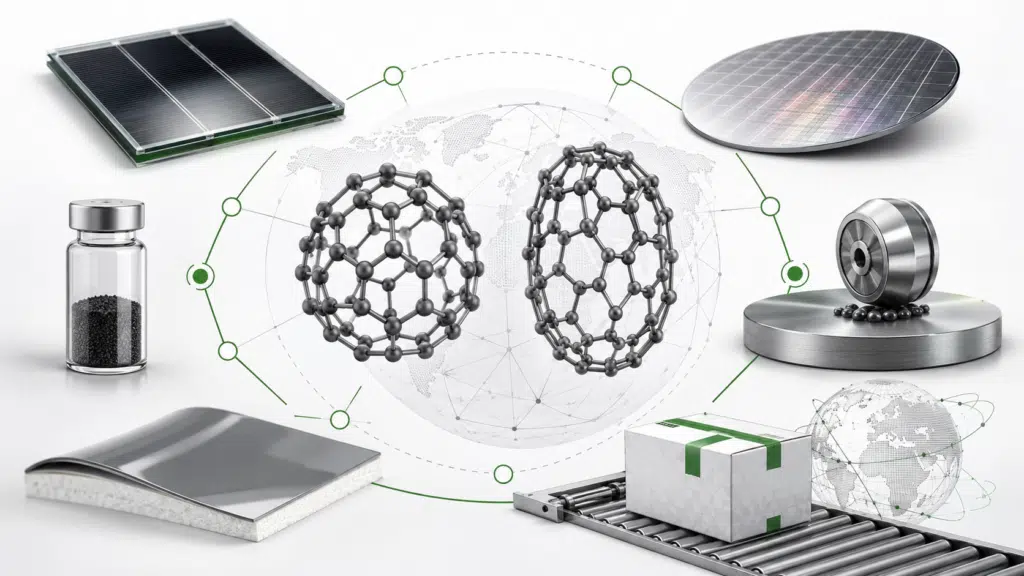
The fullerene market is best understood as a specialized advanced-materials sector rather than a conventional bulk-chemical market. Fullerene C60 and C70 are sold into research, electronic materials, photovoltaic development, formulation studies, coatings, tribology, molecular synthesis, and other high-value technical programs. Demand exists across multiple industries, but commercial maturity varies sharply from one application to another.
This distinction matters because many market reports combine pristine C60, C70, fullerene derivatives, cosmetics, biomedical research, carbon nanotubes, supplements, and other nanomaterials in a single forecast. The resulting market values and growth rates are often not directly comparable. A credible assessment must begin by defining what is actually included.
This 2026 analysis therefore focuses on the observable structure of the B2B fullerene market: the materials being purchased, the applications creating technical demand, the barriers limiting scale-up, and the quality requirements influencing supplier selection. It does not treat speculative medical uses, consumer supplementation, or laboratory findings as established commercial demand.
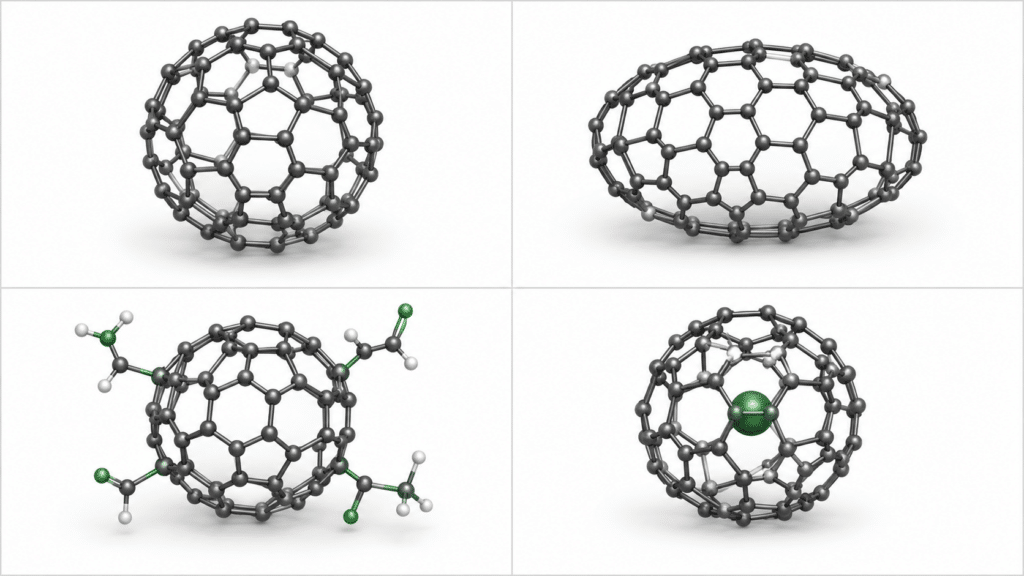
Fullerenes are closed carbon cages composed of pentagonal and hexagonal rings. C60, also known as buckminsterfullerene or Carbon 60, is the most widely recognized member of the family. C70 has an elongated cage and different optical and electronic behavior. The wider commercial category may also include higher fullerenes, endohedral fullerenes, fullerenols, PCBM-type compounds, functionalized derivatives, and fullerene-containing formulations.
These materials should not be counted as if they were interchangeable. Pristine C60 powder, a photovoltaic fullerene derivative, a water-dispersible fullerenol and an endohedral fullerene may differ by orders of magnitude in production difficulty, price, available quantity, documentation, and application.
For market analysis, at least four categories should be separated:
| Material category | Typical commercial form | Primary demand pattern |
|---|---|---|
| Pristine C60 and C70 | Purified powder or crystals | Research, electronics, photovoltaics, synthesis, coatings and formulation trials |
| Functionalized fullerene derivatives | Application-specific molecular compounds | Organic electronics, interfaces, sensors and specialized research |
| Fullerenols and polar derivatives | Hydroxylated or otherwise functionalized materials | Aqueous-system, biomedical and formulation research |
| Endohedral and higher fullerenes | Low-volume research materials | Spectroscopy, quantum materials, molecular electronics and frontier research |
Market estimates that include all four categories will naturally be larger than estimates limited to high-purity pristine C60. Estimates that also incorporate finished cosmetic products or unrelated carbon nanomaterials measure a different market again.
Publicly advertised market forecasts assign significantly different values and growth rates to the fullerene sector. The differences are too large to be treated as minor statistical variation. They reflect inconsistent definitions, proprietary methodologies, different base years, and different assumptions about which research applications will become commercial products.
Some reports count only fullerene materials. Others use broader terms such as “fullerene-based specialty chemicals.” Some emphasize cosmetics and biomedical products, while others emphasize electronics, energy or research demand. Forecast periods and regional coverage also differ.
For this reason, XCT does not treat a single third-party market-size number as an independently verified measure of global fullerene sales. Market forecasts may still be useful for observing how analysts segment applications, but they should not be presented as audited industry revenue.
A more reliable B2B analysis asks narrower questions:
C60 occupies a central position because it combines scientific familiarity, established purification routes, broad research use and availability across multiple purity grades. It is also used as a precursor for derivatives and other molecular materials.
This does not mean C60 is automatically the best material for every application. C70 may be preferred when its optical absorption or elongated molecular structure fits a specific device or research system. Functionalized derivatives may be required when pristine fullerenes have unsuitable solubility or interface behavior.
Nevertheless, C60 remains the reference point against which many fullerene materials are evaluated. Its commercial importance is supported by its continuing use in contemporary photovoltaic, thin-film, molecular, coating and tribological research.
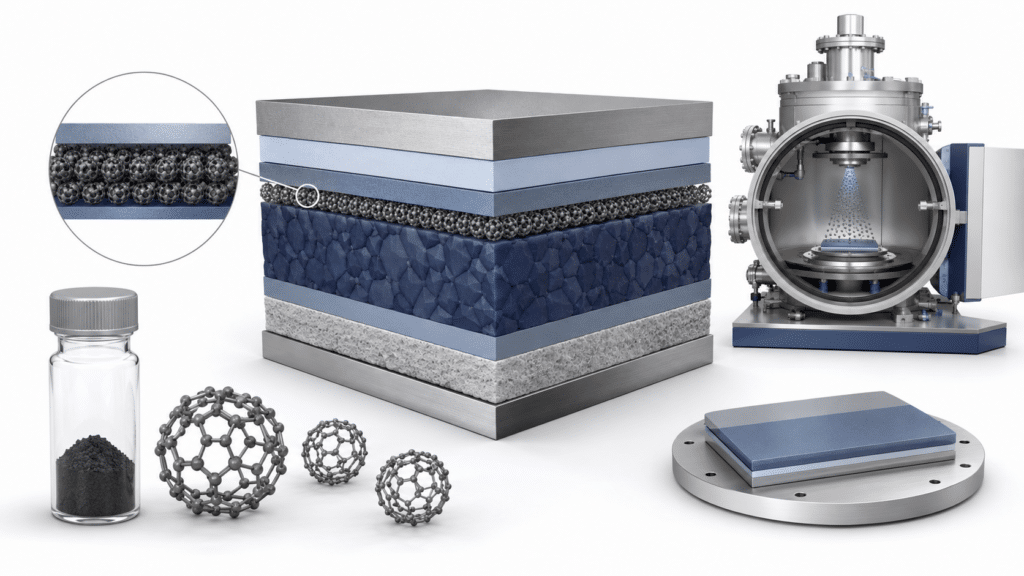
Photovoltaic research is one of the clearest high-value demand channels for high-purity C60. In inverted p–i–n perovskite solar cells, thermally evaporated C60 is widely used as an electron-transport material. Its role is not based on broad consumer demand; it comes from a specific function inside a carefully engineered device stack.
A 2024 Nature Communications study described thermally evaporated C60 as a near-ubiquitous electron-transport layer in state-of-the-art p–i–n perovskite devices. The researchers also found that commercial as-received C60 source material could coalesce during repeated evaporation, creating reproducibility problems. Further purification improved repeatable processing in the system studied.[1]
This finding is commercially important because it connects material quality with manufacturing behavior. As photovoltaic programs move from isolated laboratory cells toward repeated deposition, larger devices and pilot production, buyers become more concerned with:
Recent perovskite research continues to use evaporated C60 layers in device architectures, including larger-area tandem cells and all-vacuum-deposited systems.[2] This supports continued technical demand, but it does not prove that every perovskite design will use C60 or that laboratory consumption has already become a mass-volume commodity market.
Fullerenes and their derivatives have a long history as electron-accepting materials in organic electronic research. The rise of non-fullerene acceptors has changed parts of the organic photovoltaic landscape, but it has not removed C60 and C70 from molecular electronics, interface studies, thin-film research, electron-transport systems, photodetectors and fundamental device physics.
Commercial opportunity in this area is specification-sensitive. Buyers may need material for vacuum deposition, solution processing, derivative synthesis or reference experiments. These workflows do not necessarily require the same grade or analytical package.
The market therefore rewards suppliers that can distinguish between an advertised purity percentage and a material specification suitable for a defined process. HPLC purity may be relevant, but electronic-material evaluation may also require information about metals, residual solvents, thermal behavior and repeated deposition performance.
Fullerene C60 has been studied as a lubricant additive because of its molecular geometry, surface interaction and potential behavior under friction and wear conditions. Tribology research continues to evaluate fullerenes alongside other nanoscale additives.[3]
However, the lubricant market should not be described as if adding C60 automatically reduces friction in every oil. Results depend on the base oil, concentration, dispersion method, contact geometry, surface material, temperature, load, speed and test protocol.
This makes the commercial path formulation-driven. A lubricant manufacturer typically requires:
The addressable demand is therefore linked to successful formulation programs rather than to the theoretical properties of the C60 molecule alone. Suppliers should support technically controlled evaluation instead of making universal anti-wear claims.
C60 has also been investigated in epoxy coatings, polymer nanocomposites, membranes and other material systems. These applications explore how a low concentration of fullerene material may influence barrier properties, mechanical behavior, optical response, dielectric performance or surface interaction.
In one experimental study, C60-loaded epoxy coatings were tested for corrosion resistance and mechanical behavior. The results depended strongly on concentration: some tested formulations improved performance, while higher loading could introduce aggregation and material degradation.[4]
This concentration-dependent behavior illustrates why commercial demand develops slowly. A promising result in one resin system cannot be transferred directly to another. Fullerene dispersion, compatibility, aggregation, curing behavior, color, viscosity and processing conditions must all be evaluated.
For the fullerene supply chain, coatings and composites represent a technically credible opportunity, but one governed by formulation validation rather than simple material availability.
C60 is not only a functional additive; it is also a molecular starting material. Its carbon cage can undergo addition reactions and other controlled functionalization, allowing research groups and specialty chemical developers to create fullerene derivatives with altered solubility, polarity, electronic behavior or molecular recognition.
This segment generates demand for well-characterized precursor material. The required purity depends on the reaction pathway, purification strategy and sensitivity of the final derivative. Unknown fullerene species or residual processing material can complicate reaction analysis and downstream purification.
Unlike finished-product markets, synthesis demand may involve relatively small quantities with high documentation and consistency requirements. It is therefore commercially meaningful even when tonnage is limited.
Fullerenes and their derivatives are investigated in biomedical, photodynamic, antioxidant-related and formulation research. Recent literature also discusses experimental dental resins, coatings, antimicrobial models and other biomaterial concepts.[5]
Research activity is not equivalent to regulatory approval, clinical efficacy or established consumer safety. Pristine C60, a functionalized fullerene, a fullerenol and a formulated finished product can have very different physicochemical and biological behavior.
For market analysis, biomedical research should therefore be described as a source of laboratory and development demand. It should not be used to imply that C60 treats disease, extends life, produces a “detox” response or is universally safe for human consumption.
The previous version of this report included consumer-supplement language and side-effect claims. Those statements have been removed because they do not meet the evidence and positioning standards of a professional B2B advanced-materials supplier.
The economics of fullerenes are strongly affected by purification. C60 and C70 may be produced together with other carbon species, after which extraction, separation, purification and analytical verification are required.
A lifecycle study of fullerene production found that purification contributed substantially to the material and energy burden of C60 and C70 production, with higher purity and fullerene type affecting the result.[6] Although production technology has continued to develop, the central economic lesson remains relevant: a high-purity fullerene product cannot be evaluated only by the cost of generating carbon soot.
Commercial pricing may be influenced by:
This is why the fullerene market behaves more like a specialty-material market than a bulk carbon market.
Many fullerene projects begin with gram-scale evaluation. Small samples allow researchers to test solubility, deposition, formulation, reaction behavior or device compatibility before committing to larger quantities.
The transition from a sample to repeated supply is a critical commercial threshold. A technically successful sample does not create a sustainable market unless the buyer can obtain comparable material again. Scale-up therefore depends on batch documentation, retained inventory, quality agreements and communication between the supplier and technical team.
For XCT, the more useful market signal is not the number of publications mentioning C60. It is the number of programs progressing from exploratory purchase to repeatable material requirements.
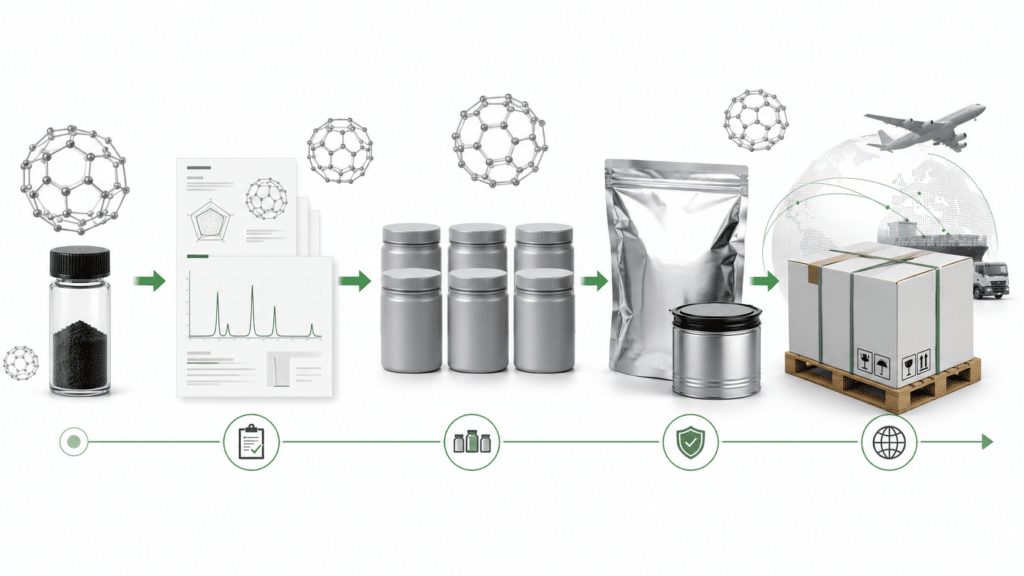
The fullerene market is global, but different regions contribute different capabilities. Asia has substantial advanced-materials manufacturing and electronics infrastructure. The United States, Europe, Japan and South Korea contain major university, semiconductor, photovoltaic, chemical and nanotechnology research networks.
Cross-border supply requires more than international courier access. Buyers may need product identity, batch-specific analytical documentation, SDS information, packaging details and destination-specific shipping review. The precise requirements depend on product form, destination and intended use.
Regional market claims should be treated cautiously unless supported by a transparent dataset. The existence of strong research or manufacturing activity in a region does not automatically establish a precise fullerene revenue share.
The fullerene market is unlikely to be shaped by one universal application. Growth will depend on whether several specialized pathways overcome their individual commercialization barriers.
In photovoltaics and electronics, the decisive issues include device stability, scalable processing, material consistency and cost. In lubricants, coatings and composites, formulation reproducibility and performance under application-specific testing are central. In synthesis, the priorities are precursor quality and reliable purification. In biomedical research, safety, structure-specific evidence and regulatory assessment remain essential.
Across these sectors, five factors are particularly important:
The evidence supports a measured conclusion. Fullerenes are established research and specialty materials with credible demand in photovoltaic development, electronic materials, chemical synthesis, tribology, coatings, composites and other advanced-material systems. C60 remains the central commercial reference material, while C70 and derivatives address more specialized requirements.
At the same time, the market should not be described as uniformly mature. Many applications remain in research, pilot evaluation or formulation development. Public market-size forecasts vary too widely to serve as a single verified measure of industry revenue.
The strongest commercial opportunities are likely to arise where a fullerene performs a specific technical function, where that function survives scale-up testing, and where suppliers can deliver consistent material with an analytical package appropriate to the application.
For buyers, this means evaluating fullerene materials through specifications, evidence and repeatability. For suppliers, it means building a market through credible technical support rather than exaggerated forecasts.
Published estimates vary substantially because reports use different definitions, base years and application categories. Some include pristine C60 and C70, while others include derivatives, finished formulations or broader nanomaterial categories. No single public estimate should be treated as independently audited global fullerene revenue.
C60 is the most established commercial reference fullerene because it is widely studied, available in multiple purity grades and used in photovoltaics, electronics, synthesis, coatings, lubricants and other material research. C70 and fullerene derivatives serve more specialized requirements.
C60 is used or investigated in photovoltaic devices, organic electronics, molecular synthesis, lubricant formulations, coatings, polymer composites, sensors and biomedical research. Commercial maturity differs significantly between applications.
No. Biomedical and photodynamic studies generate research demand, but laboratory findings do not establish clinical efficacy, regulatory approval or universal safety. Material structure, formulation, dose, test system and intended use must be evaluated separately.
Cost is influenced by production yield, extraction, separation, repeated purification, analytical testing, batch size, packaging and the consistency required by the application. Purification can represent a substantial part of the material and energy burden.
Important drivers include photovoltaic and electronic-material research, repeated thermal deposition, derivative synthesis, advanced coatings, tribological formulation studies and the need for reproducible material supply.
For B2B procurement of Fullerene C60 (Pure), 99.95% Purity, No metallic residue, buyers should confirm target purity, required quantity, application, destination country, COA, MSDS/SDS, packaging, storage conditions, and shipping requirements before requesting a formal quotation.
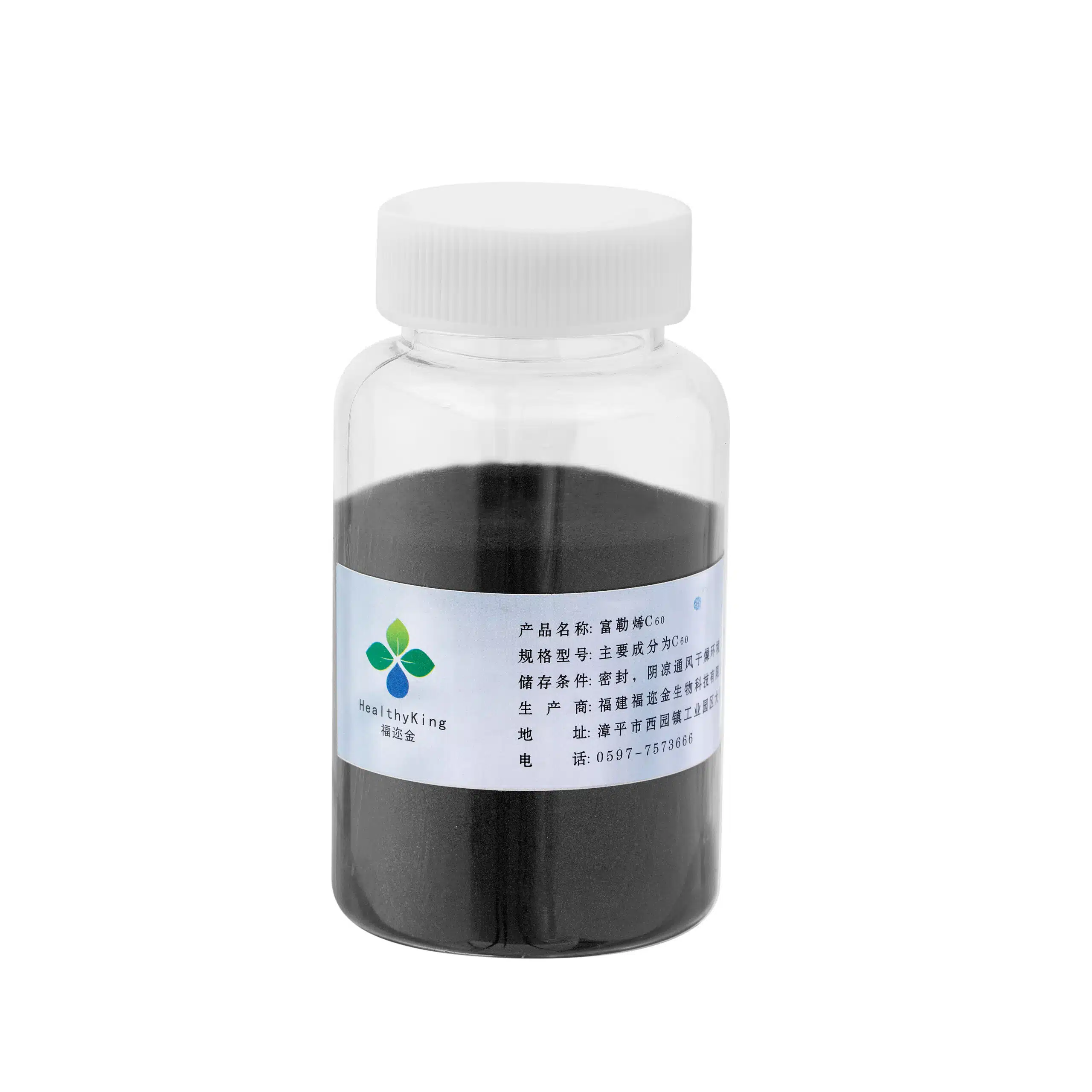
High-purity fullerene C60 is a highly refined nanomaterial designed specifically for the most demanding scientific and industrial applications. This ultra-pure form ensures…
Request product specifications, batch-specific COA, MSDS/SDS, sample availability, packaging details, and international shipping information before confirming your order.
Request DocumentsSubmit your product, purity, quantity, application, destination country, and documentation requirements. Our team will help confirm availability, COA, MSDS/SDS, packaging, and quotation details.