
XCT Insights
Stay Updated
Fullerene research, applications and company updates, delivered occasionally.
Latest from XCT
View all

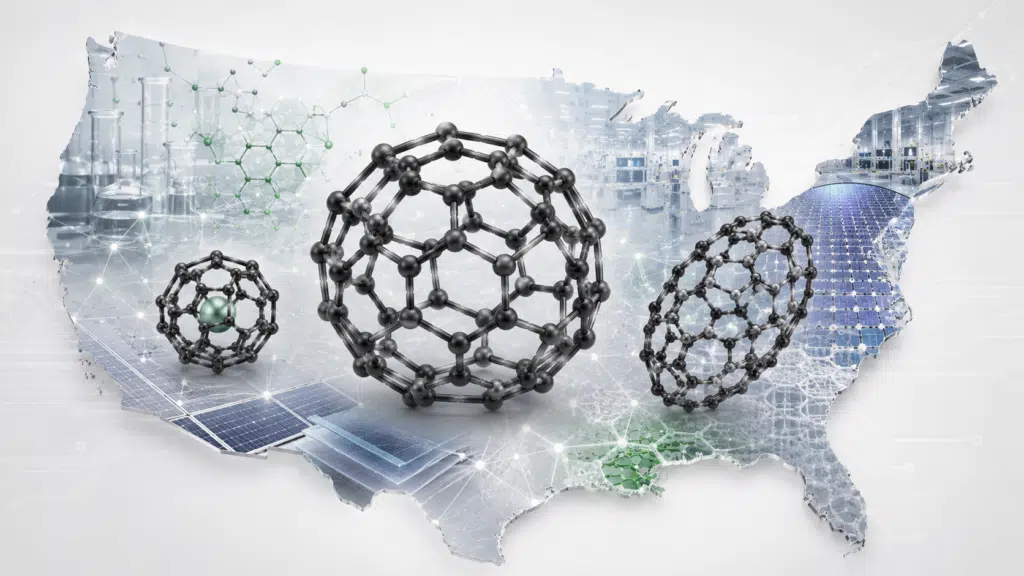
The US fullerene market stands at the intersection of advanced carbon chemistry, nanotechnology commercialization, energy material research, organic electronics, biomedical investigation, and specialty chemical supply. Although fullerenes were once treated mainly as academic curiosities, Fullerene C60, Fullerene C70, fullerene derivatives, and endohedral fullerenes are now part of a broader strategic conversation around high-performance carbon nanomaterials.
From 2024 to 2030, the US fullerene market is expected to be shaped by three connected forces. First, the scientific value of fullerene molecules remains unusually strong. Their closed carbon cage structures, electron-accepting behavior, tunable chemistry, and nanoscale symmetry make them relevant to fields such as organic photovoltaics, perovskite solar cells, molecular electronics, spin-based quantum research, lubricant formulation, coatings, and biomedical research.
Second, the United States has a mature research and commercialization environment for nanotechnology. The National Science Foundation participates in the National Nanotechnology Initiative, a federal effort supporting nanoscale science, engineering, and technology. This research ecosystem supports continued exploration of carbon nanomaterials, including fullerenes. [3]
Third, the market is still specialized and technically demanding. The US fullerene market is not a simple commodity market. Purity, purification method, batch consistency, documentation, solubility, formulation compatibility, and regulatory context can all influence commercial adoption.
For companies, laboratories, distributors, and investors watching the US fullerene market, the central question is no longer whether fullerenes are scientifically interesting. The more important question is where fullerenes can move from research value to repeatable industrial value.
The US fullerene market matters because the United States combines several conditions that are favorable for advanced nanomaterial development: strong academic research, federal science funding, private R&D investment, aerospace and defense-related materials research, semiconductor and electronics development, energy technology programs, biomedical research, and a large specialty chemical distribution network.
Fullerenes are a class of carbon allotropes with hollow cage-like molecular structures. The most famous member is Fullerene C60, also known as buckminsterfullerene or Carbon 60. Fullerene C70, higher fullerenes, fullerene derivatives, and endohedral fullerenes expand the material family into more specialized applications.
Unlike bulk carbon materials such as graphite or carbon black, fullerenes are molecular carbon structures. Their value comes from defined geometry, nanoscale dimensions, electron behavior, and chemical tunability. This makes the US fullerene market different from conventional carbon material markets. It is smaller, more technical, and more application-specific.
In practical terms, demand in the US fullerene market is driven by two layers. The first layer is scientific exploration. Universities, research laboratories, and technology developers continue to study fullerenes in electronics, solar materials, quantum research, biomedical research, and advanced material systems. The second layer is commercial translation. Specialty chemical buyers, formulation developers, distributors, and industrial R&D teams look for fullerene materials that can be tested, documented, packaged, shipped, and repeatedly supplied with consistent specifications.
The US fullerene market should be analyzed within the broader global fullerene market. Publicly available market reports differ in their estimates because they use different definitions, product scopes, regional assumptions, and forecast models.
Strategic Market Research estimates the global fullerene market at USD 615 million in 2024 and projects it to reach nearly USD 980 million by 2030, with a CAGR of 8.1%. SkyQuest estimates the market at USD 503.65 million in 2024 and projects USD 754.94 million by 2033 at a 4.6% CAGR. Spherical Insights estimates the global market at USD 458.8 million in 2023 and USD 898.5 million by 2033 at a 6.95% CAGR. Maximize Market Research estimates USD 618.88 million in 2024 and projects USD 971.62 million by 2032 at a 5.8% CAGR. [1]
Comparison of market size estimates from Strategic Market Research, SkyQuest, Spherical Insights, and Maximize Market Research. Values are shown in USD million.
These forecasts should not be treated as identical. They point to different absolute values and growth rates. A credible reading is that the fullerene market is expected to grow steadily, but it remains a specialized advanced-materials market rather than a mass-volume commodity sector. [2]
For the US fullerene market, this means growth is likely to come from high-value applications rather than broad-volume adoption alone. The most important areas include organic electronics, semiconductor-related research, organic photovoltaics, perovskite solar cell research, advanced coatings, lubricant formulation research, biomedical research, cosmetic formulation research, quantum and spin-based materials research, chemical distribution, and specialty material supply.
The US fullerene market may also benefit from broader American interest in domestic advanced manufacturing, strategic materials, clean energy technologies, and nanotechnology-enabled innovation. However, it is important not to overstate this point. Fullerenes are not yet a universal industrial material. Their market depends on specific use cases where their molecular properties justify their cost and handling requirements.
The commercial logic of the US fullerene market begins with molecular structure. Fullerenes are not valuable merely because they are carbon. They are valuable because carbon atoms are arranged into closed, curved, nanoscale cages with distinctive electronic and chemical behavior.
Fullerene C60 is the best-known fullerene. It contains 60 carbon atoms arranged in a truncated icosahedron structure, often compared to a soccer ball. The structure consists of pentagonal and hexagonal rings, creating a highly symmetrical cage. [4]
This geometry gives C60 several features relevant to the US fullerene market: defined molecular structure, high symmetry, electron-accepting behavior, chemical functionalization potential, relevance in organic electronics and solar research, and use as a reference material in fullerene science.
C60 is commonly discussed in the United States because it is more widely studied and more commercially available than many higher fullerenes. For researchers and industrial teams, the practical question is not only whether C60 is scientifically interesting, but whether the available purity, documentation, and batch consistency are suitable for the intended application.
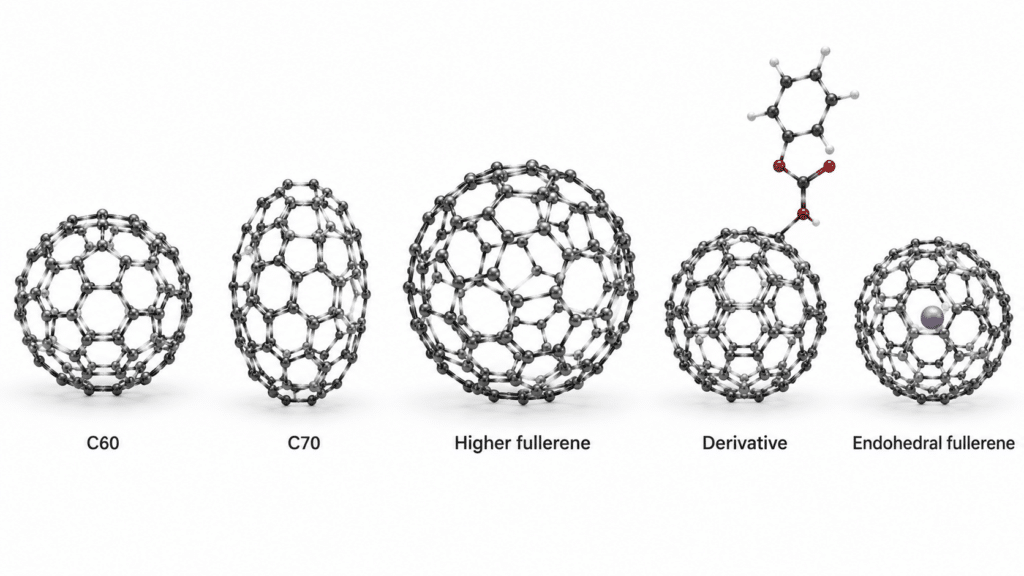
Fullerene C70 contains 70 carbon atoms and has a more elongated cage geometry. Compared with C60, C70 can show different optical and electronic behavior. This makes C70 relevant to application areas where light absorption, charge transport, or molecular packing are important. [5]
In the US fullerene market, C70 is often discussed in relation to organic photovoltaics, organic electronics, molecular electronics, and advanced materials research.
Higher fullerenes such as C76, C78, C84, and others represent more specialized research markets. Their structures may offer unique electronic or chiral behavior, but they are generally more difficult to separate and purify. Fullerene derivatives, especially functionalized C60 and C70 molecules, are important in solar cell research and solution-processing contexts.
Fullerene derivatives have been used as acceptor materials in organic solar cells for more than two decades, although non-fullerene acceptors have also become important in newer photovoltaic research. This creates a more complex competitive landscape: fullerenes remain scientifically and commercially relevant, but they must compete with alternative advanced materials. [6]
Endohedral fullerenes are fullerene cages that contain an atom, ion, or cluster inside the carbon cage. Examples include nitrogen-doped endohedral fullerenes such as N@C60 and metallofullerenes such as Sc, Y, or La-based fullerene systems. [8]
These materials are not mainstream commodity products, but they represent one of the most technically advanced segments of the US fullerene market. Research groups have explored endohedral fullerenes in spin-based quantum information and molecular qubit concepts. For market analysis, this segment should be treated as high-value and research-intensive, not as a large near-term volume market. [9]
The US fullerene market can be divided into several product segments. Each segment has different technical requirements, pricing logic, and application potential.
| Segment | Scientific Role | Market Character |
|---|---|---|
| Fullerene C60 | Standard reference fullerene; electron acceptor; advanced material building block | Most commercially recognized segment |
| Fullerene C70 | Elongated cage with different optical and electronic behavior | Important for photovoltaics and organic electronics research |
| Higher fullerenes | Larger carbon cages with specialized properties | Smaller, research-oriented segment |
| Fullerene derivatives | Functionalized molecules for solubility and device processing | Important in organic electronics and solar research |
| Endohedral fullerenes | Guest atoms or clusters inside fullerene cages | High-value research segment, including quantum-related studies |
This segmentation is important because the US fullerene market is not driven by one single material. C60 may dominate general awareness, but C70, derivatives, and endohedral fullerenes can be more relevant in specific high-value research fields.
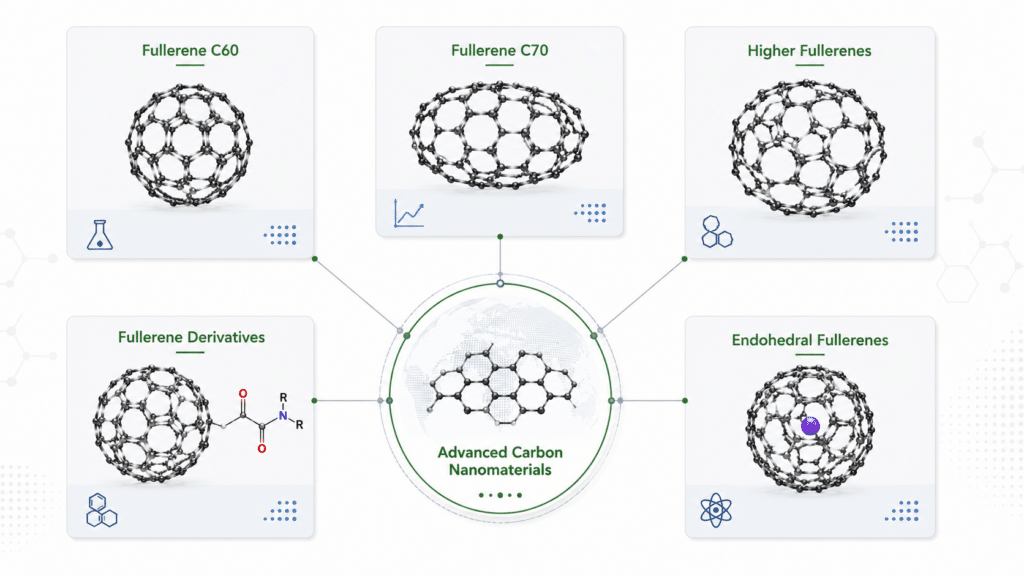
The US fullerene market is shaped by several application verticals. Some are closer to commercial use, while others remain mostly research-driven.
Fullerenes are relevant in organic electronics because of their electron-accepting behavior. C60 and fullerene derivatives have been used in organic electronic systems, thin-film devices, and interface layers.
For semiconductor-related research, the appeal of fullerenes lies in their molecular precision and electronic properties. However, fullerene materials do not replace silicon in mainstream semiconductor manufacturing. Their role is more specialized, often connected to organic electronics, molecular electronics, thin-film architectures, and research-stage device concepts.
The US fullerene market benefits from American strength in electronics R&D, but adoption depends on whether fullerene materials can meet performance, purity, processing, and cost requirements.
Energy materials are one of the most important scientific drivers in the US fullerene market. Fullerenes and fullerene derivatives have long been studied as electron-accepting materials in organic photovoltaics. More recently, fullerene-based materials have attracted attention as electron-transporting or electron-extraction layers in perovskite solar cells. [7]
This does not mean that fullerenes are always the best solution in every photovoltaic system. The solar materials field is highly competitive, and non-fullerene acceptors have become important in organic solar cell research. However, fullerenes remain relevant because of their electron-transport properties, molecular tunability, and established research history. [6]
For the US fullerene market, photovoltaic research creates demand for high-purity C60, C70, fullerene derivatives, and consistent batches suitable for controlled experiments.
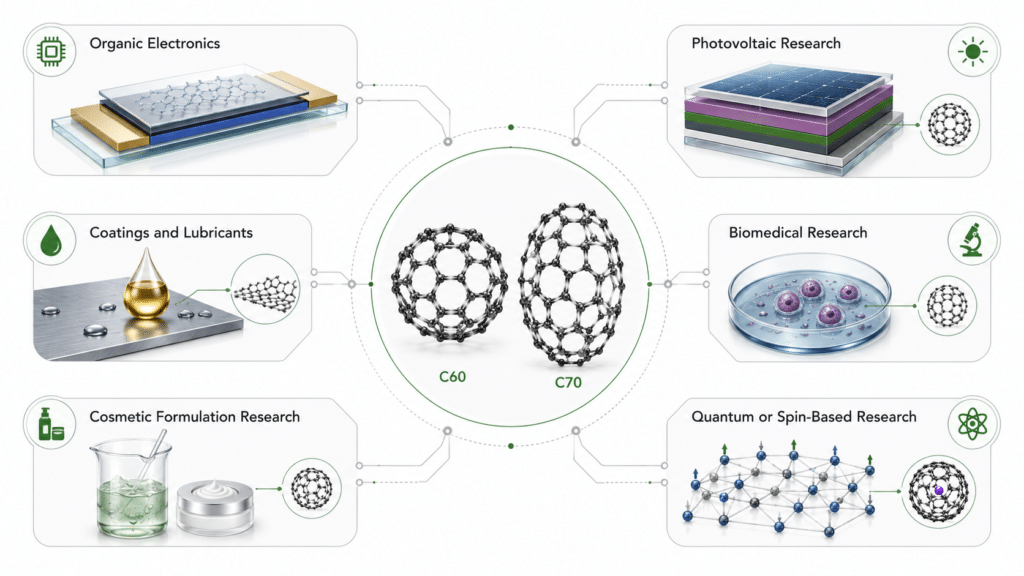
Fullerene C60 is studied in coatings and lubricant formulation research because of its nanoscale structure, surface behavior, and potential relevance to friction and wear studies. In the United States, this segment is attractive because industrial formulation companies often explore additives that may improve performance under specific test conditions.
This area should be described with restraint. C60 should not be presented as a universal anti-wear solution or guaranteed lubricant additive. A more credible statement is that C60 is studied in formulation research related to friction, wear, surface interaction, and advanced coating systems.
The US fullerene market may expand in this area if fullerene materials become easier to disperse, more affordable, and more consistently supplied for formulation development.
Fullerenes have been investigated in biomedical research, including drug delivery concepts, photodynamic research, antioxidant-related models, and nanomedicine-related studies. This research interest contributes to the US fullerene market, but it must be treated carefully. [11]
A more accurate approach is to say that fullerenes are investigated in laboratory and preclinical research contexts, and that biomedical use requires careful review of purity, formulation, toxicology, exposure conditions, regulatory requirements, and intended use.
Cosmetic formulation research is another segment sometimes connected to fullerene demand, especially around antioxidant-related concepts.
Fullerene C60 has been studied in cosmetic formulation research and antioxidant-related material systems, but cosmetic developers should confirm ingredient status, safety requirements, product claims, and regulatory obligations in the target market. [12]
Endohedral fullerenes represent a small but technically important part of the US fullerene market. In these materials, the fullerene cage can isolate an internal atom or cluster from the external environment. This makes them scientifically interesting for spin dynamics and quantum information research.
Research into N@C60 and related systems has explored how endohedral fullerenes may function as molecular spin systems or qubit candidates. This is not a large commodity market, but it is strategically important because it connects fullerene chemistry to frontier research in quantum technologies. [9]
From a market perspective, the endohedral segment is likely to remain specialized, high-value, and research-oriented through 2030.
The US fullerene market includes producers, specialty chemical suppliers, catalog chemical companies, distributors, and international suppliers. The competitive landscape is shaped by synthesis capability, purification quality, product availability, technical documentation, and application-specific support.
Fullerene production is technically demanding. Common production routes include combustion synthesis, arc discharge, and other carbon vaporization or synthesis methods. The commercial challenge is not only producing fullerene-containing soot, but separating and purifying specific fullerene species such as C60 and C70.
For the US fullerene market, purification quality matters because different applications have different tolerance levels for impurities, mixed fullerene content, residual solvents, and batch variation.
Historically, many fullerene materials were purchased as research chemicals. As application interest expands, the market increasingly requires application-specific material support.
This does not necessarily mean “medical grade” or “semiconductor grade” unless those terms are clearly defined and verified. A more precise way to describe the trend is research-grade C60 and C70 for laboratory studies, high-purity C60 and C70 for electronic and photovoltaic research, formulation-oriented C60 for coatings and lubricants research, derivatives or specialty fullerenes for device-oriented studies, and endohedral fullerenes for advanced research applications.
This shift toward application-specific material selection is one of the major changes in the US fullerene market.
The United States has strong research demand, but many fullerene buyers still evaluate international supply options. This creates a globalized supply chain where documentation, packaging, purity, and shipping communication matter.
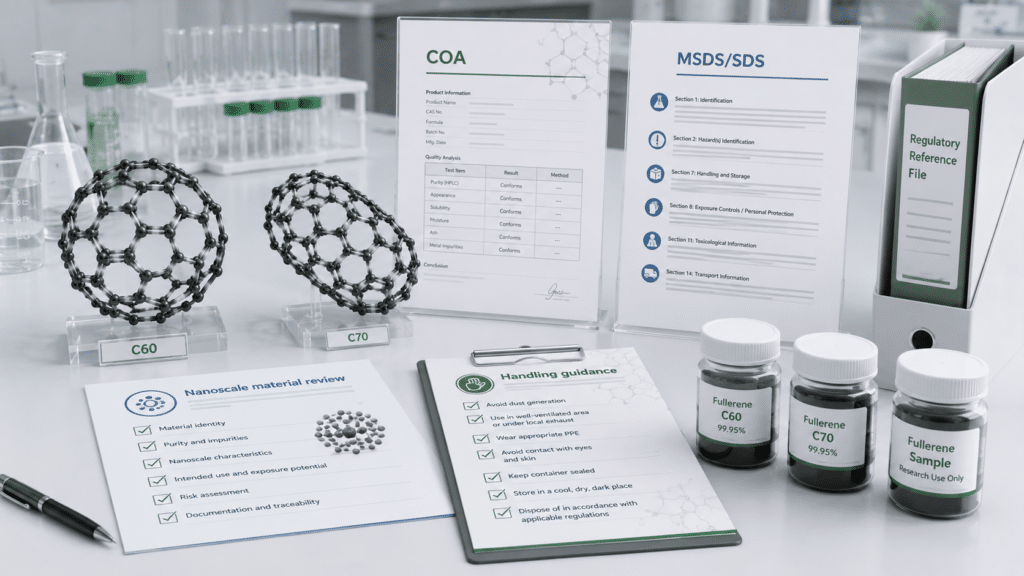
Market participants that can provide clear product specifications, batch-specific COA, MSDS/SDS, purity options, sample availability, and reliable communication may be better positioned to serve US buyers. In a specialized market, documentation and reliability can be as important as unit price. [13]
Regulatory and safety considerations are important in the US fullerene market because fullerenes are nanoscale chemical substances. Companies working with nanoscale materials should not rely on generic assumptions.
The US EPA has published guidance on nanoscale materials under the Toxic Substances Control Act. EPA’s fact sheet states that reporting requirements for chemical substances manufactured at the nanoscale involve one-time reporting for existing nanoscale materials and for new discrete nanoscale materials before they are manufactured or processed. The Federal Register rule on chemical substances manufactured or processed as nanoscale materials also describes reporting and recordkeeping requirements for certain nanoscale materials under TSCA Section 8(a). [10]
For the US fullerene market, this does not mean every fullerene use case has the same regulatory burden. It means companies should evaluate product identity, intended use, import status, safety data, worker exposure, environmental exposure, and documentation requirements with qualified compliance professionals when needed.
The US fullerene market has strong scientific promise, but several challenges may limit faster commercialization.
Fullerenes are more expensive than many conventional carbon materials. Their cost reflects synthesis, separation, purification, testing, and yield limitations. Even if prices decline over time, cost will remain important for coatings, lubricants, composites, and other industrial sectors where additive economics matter.
High-value applications often require high-purity and reproducible materials. Electronics, photovoltaics, biomedical research, and analytical studies may be sensitive to impurities. If suppliers cannot maintain consistent specifications, the adoption of fullerene materials becomes harder.
The US fullerene market also faces competition from graphene, carbon nanotubes, carbon dots, non-fullerene acceptors, metal-organic frameworks, conductive polymers, and other advanced materials. Fullerenes must justify their use based on specific advantages, not general nanomaterial appeal. [14]
For biomedical, cosmetic, and consumer-facing applications, regulatory uncertainty can slow adoption. Claims must be carefully managed, and safety evaluation depends on material form, exposure route, formulation, concentration, and application.
Many fullerene applications are scientifically promising but difficult to commercialize. Moving from journal publications to repeatable industrial products requires material consistency, supply reliability, cost control, processing know-how, and customer-specific testing.
These challenges do not weaken the US fullerene market. They define its realistic growth path.
Despite these challenges, the US fullerene market has several strategic opportunities.
High-purity C60 and C70 will remain central to the market. Research laboratories and industrial R&D groups need well-characterized materials for controlled studies. Suppliers that can support multiple purity grades, batch-specific documentation, and sample orders may capture demand from universities, startups, and corporate research teams.
Organic photovoltaics, perovskite solar cells, and electron-transport materials will continue to support demand for C60, C70, and fullerene derivatives. While the solar materials field is competitive, fullerene chemistry remains an established part of the research landscape.
Lubricants, coatings, composites, and advanced formulations may create selective industrial opportunities. These markets will require not only fullerene powder, but also dispersion knowledge, compatibility testing, and application-specific formulation development.
Endohedral fullerenes are unlikely to become a large-volume segment by 2030, but they may remain a high-value research frontier. Their relevance to spin systems, molecular qubits, and advanced spectroscopy makes them strategically important in the US fullerene market.
As the market matures, suppliers that provide clear specifications, COA, MSDS/SDS, packaging details, and technical communication will have an advantage. In a specialized market, documentation and reliability can be as important as unit price.
The US fullerene market is likely to remain a specialized but strategically important segment of the broader carbon nanomaterials industry through 2030.
The strongest near-term demand will likely come from research laboratories, energy materials, organic electronics, coatings, lubricants, and specialty chemical distribution. Longer-term opportunities may emerge from endohedral fullerenes, quantum technologies, biomedical research, and advanced device architectures.
The market’s growth will depend on whether fullerene materials can move beyond scientific possibility into repeatable application value. That transition requires more consistent high-purity supply, better application-specific material selection, improved cost-performance balance, and responsible documentation and regulatory communication.
The US fullerene market will not be defined only by market-size forecasts. It will be defined by the ability of fullerene materials to solve specific problems in electronics, energy, advanced materials, and research-intensive industries.
For stakeholders watching the carbon nanomaterial frontier, fullerenes remain a technically rich and commercially selective opportunity. C60 remains the reference molecule. C70 continues to matter in optical and electronic research. Endohedral fullerenes represent a high-value frontier. Fullerene derivatives maintain relevance in solution-processed and device-oriented studies.
From 2024 to 2030, the most successful participants in the US fullerene market will likely be those that combine scientific understanding, quality control, application awareness, and supply-chain reliability. [15]
The US fullerene market refers to demand for Fullerene C60, Fullerene C70, fullerene derivatives, higher fullerenes, and endohedral fullerenes in the United States. It includes research, electronics, energy materials, coatings, lubricants, biomedical research, cosmetic formulation research, and specialty chemical distribution.
The US fullerene market is important because the United States has strong nanotechnology research, advanced materials development, electronics R&D, energy technology programs, biomedical research, and specialty chemical distribution. These conditions support demand for high-purity fullerene materials.
Published global fullerene market estimates vary, but several reports project continued growth through 2030 or 2033. Forecasts differ in market size and CAGR, but they generally point toward long-term demand in nanotechnology, electronics, energy, healthcare research, and advanced materials.
Fullerene C60 and Fullerene C70 are the most widely discussed fullerene materials. C60 is the standard reference molecule and is broadly studied across many applications. C70 is important in organic electronics, photovoltaics, and molecular electronics research. Fullerene derivatives and endohedral fullerenes serve more specialized markets.
Demand is driven by nanotechnology R&D, organic electronics, photovoltaic research, advanced coatings, lubricant formulation research, biomedical research, cosmetic formulation research, and specialty chemical distribution.
Yes. Fullerenes and fullerene derivatives have been studied in organic photovoltaics and perovskite solar cells, especially as electron-accepting or electron-transport-related materials.
Fullerenes are investigated in biomedical research contexts such as drug delivery concepts, photodynamic research, antioxidant-related models, and nanomedicine-related studies. However, this does not mean Fullerene C60 treats disease, is approved for medical use, or is safe for human consumption.
Endohedral fullerenes are fullerene cages containing an atom, ion, or cluster inside the carbon cage. They are studied in advanced research areas such as spin dynamics, molecular electronics, and quantum information concepts.
Major challenges include high production and purification cost, batch consistency, competition from alternative nanomaterials, regulatory uncertainty, application translation, and the need for reliable documentation.
Industrial buyers should consider product type, purity, batch consistency, COA, MSDS/SDS, packaging, storage conditions, application compatibility, supplier reliability, and total cost-performance balance.
Need Fullerene C60 or Fullerene C70 for research, electronics, energy materials, coatings, lubricants, formulation development, or distribution?
Contact The Fullerene to request product specifications, available purity options, COA, MSDS/SDS, sample availability, packaging details, and international shipping support.
For B2B procurement of Fullerene C60 (Pure), 99.95% Purity, No metallic residue, buyers should confirm target purity, required quantity, application, destination country, COA, MSDS/SDS, packaging, storage conditions, and shipping requirements before requesting a formal quotation.
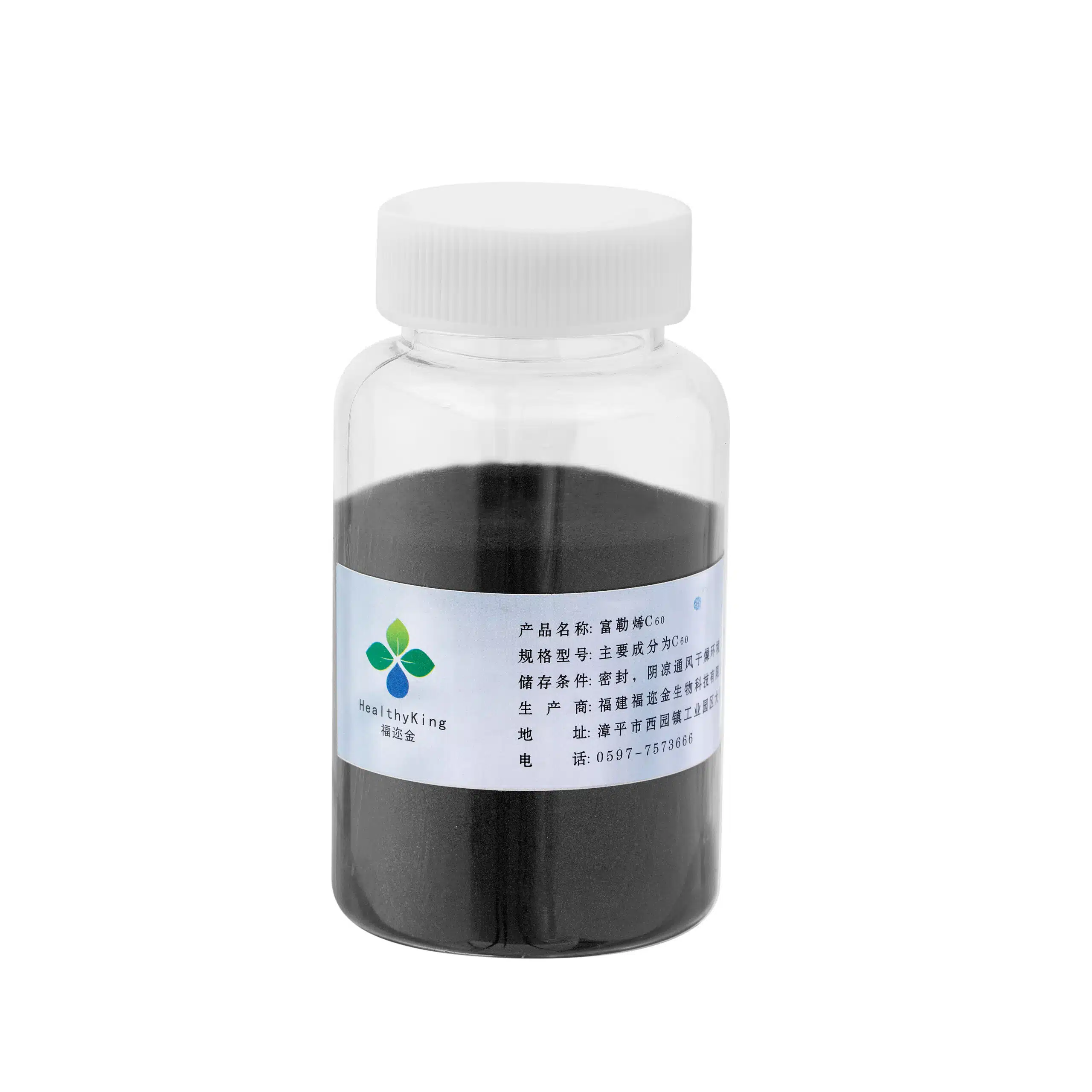
High-purity fullerene C60 is a highly refined nanomaterial designed specifically for the most demanding scientific and industrial applications. This ultra-pure form ensures…
Request product specifications, batch-specific COA, MSDS/SDS, sample availability, packaging details, and international shipping information before confirming your order.
Request DocumentsSubmit your product, purity, quantity, application, destination country, and documentation requirements. Our team will help confirm availability, COA, MSDS/SDS, packaging, and quotation details.