XCT Insights
Stay Updated
Fullerene research, applications and company updates, delivered occasionally.
Latest from XCT
View all

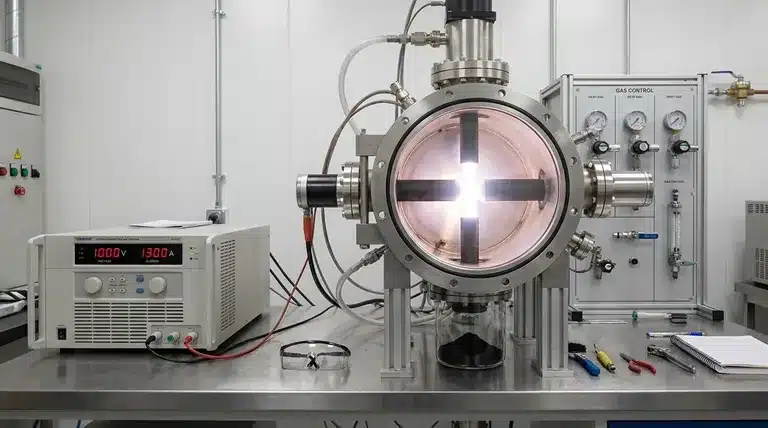
Arc-discharge synthesis played a decisive role in turning C60 from a mass-spectrometric observation into a material that chemists could isolate and study in macroscopic quantities. The process uses an electrical discharge to vaporize carbon in a controlled atmosphere. As the carbon vapour cools, part of it reorganizes into closed fullerene cages, while much of it becomes other forms of carbonaceous soot.
The important qualification is that an arc reactor does not directly produce a vial of purified C60. It produces a heterogeneous carbon material from which soluble fullerenes must be extracted, separated, purified and characterized. Reactor design affects the crude product, but the final identity and suitability of a C60 or C70 batch depend equally on downstream processing and analytical control.
C60 was first identified in 1985 during laser-vaporization experiments designed to examine carbon clusters. The unusually strong signal associated with a 60-carbon species led Kroto, Heath, O’Brien, Curl and Smalley to propose the closed, truncated-icosahedral cage now known as buckminsterfullerene.[1] That experiment established the molecular concept, but it did not initially provide the quantities required for conventional chemical and structural analysis.
The major practical breakthrough came in 1990, when Krätschmer, Lamb, Fostiropoulos and Huffman reported the production and isolation of solid C60 from carbon soot generated by vaporizing graphite in a helium atmosphere.[2] The availability of extractable material allowed infrared, ultraviolet-visible, nuclear magnetic resonance, crystallographic and chemical studies to confirm the proposed cage structure.
The historical method is often described as the Krätschmer–Huffman or contact-arc process. Equipment implementations have since varied, including resistively heated graphite arrangements and direct-current or alternating-current plasma-discharge reactors. “Arc discharge” therefore describes a process family rather than one standardized machine or one fixed recipe.
A typical system contains carbon electrodes in a chamber filled with a controlled gas, commonly helium. An electrical discharge between the electrodes supplies enough energy to ablate or vaporize carbon from the feed electrode. The resulting environment contains carbon atoms, ions, small clusters, larger fragments, electrons and excited gas species.
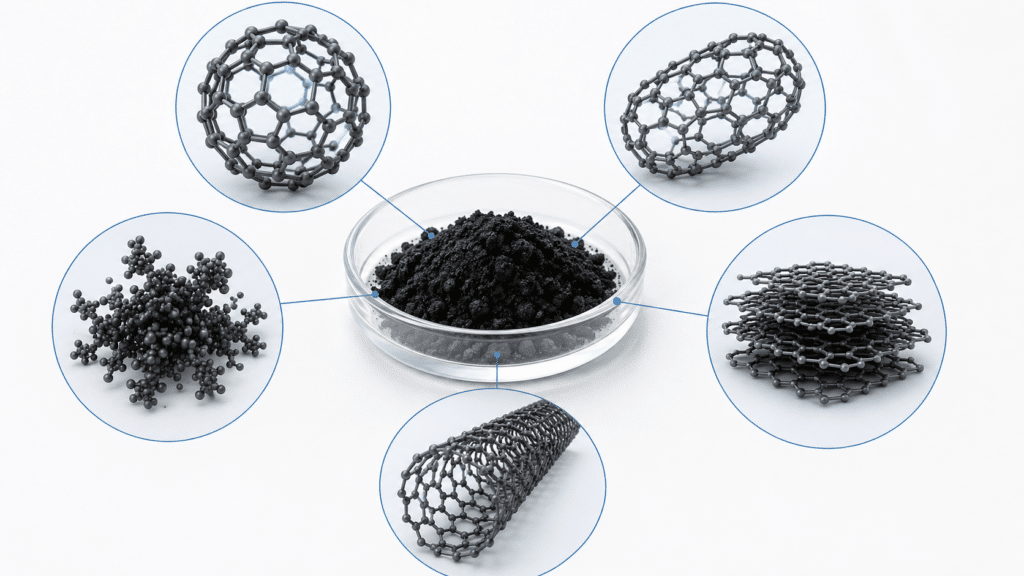
As carbon-containing species leave the hottest region and cool, competing processes occur. Some structures close into fullerene cages. Other carbon condenses as amorphous material, graphitic particles, onions, nanotubes or related nanostructures. The distribution depends on the reactor, local temperature history, carbon concentration, gas flow and residence time.
Fullerene formation is not adequately described by saying that individual atoms simply assemble into a soccer-ball structure at one precise temperature. Experiments investigating cage growth indicate that both atomic carbon and C2 units can be incorporated into closed networks under suitable conditions.[3] Other conditions may favour the shrinkage and annealing of larger carbon structures. No single simplified mechanism should be presented as universally proven for every arc reactor.
The material collected from the chamber is not chemically equivalent to purified fullerene. Depending on collection location and operating conditions, it may contain amorphous carbon, graphitic particles, C60, C70, higher fullerenes and other carbon nanostructures.
This distinction also prevents confusion between fullerene and carbon-nanotube production. Multiwalled carbon nanotubes were identified in carbon material associated with arc evaporation, but a nanotube-rich cathode deposit and fullerene-containing chamber soot are not interchangeable products.[4] They may form within related equipment while requiring different collection, purification and characterization strategies.
A statement such as “arc discharge produces highly crystalline material” is therefore incomplete. Crystallinity may be relevant to a separated nanotube fraction, but it does not describe the percentage of C60 in raw soot, the C60/C70 ratio or the purity of an isolated fullerene product.
Arc-discharge outcomes are sensitive to several coupled variables. Studies of gram-scale plasma-discharge production identified absolute pressure, gas flow, electrical current and arc gap as important controls.[5] Electrode composition, dimensions, polarity, chamber geometry, cooling surfaces, collection position and run duration may also affect the result.
The gas influences heat transfer, plasma properties, carbon-species collisions and cooling. Helium became historically important because it supported the formation of extractable fullerene soot, but that does not justify a universal claim that helium always produces a fixed multiple of the yield obtained with argon.
A yield comparison is meaningful only when reactor geometry, pressure, power, carbon consumption, collection method and the definition of “yield” are held constant. Some studies report fullerene content relative to soot; others report extractable mass relative to consumed graphite or total collected carbon. Those quantities cannot be compared without normalization.
The discharge must deliver sufficient energy to sustain carbon ablation, but a higher current does not automatically improve fullerene yield. Electrical conditions also change electrode consumption, plasma dimensions, heat distribution and arc stability. The working voltage is partly a result of the gas, pressure, electrode spacing and reactor design rather than an independent universal setting.
Consequently, values such as “20 V, 100 A and a 1 mm gap” should be presented only as conditions from a specified apparatus—not as the required recipe for commercial C60 production.
Fullerene cages must survive the transition from a high-energy carbon vapour to cooler collection regions. Cooling that is too rapid or too slow may change the competition among cages, soot and graphitic structures. The relevant variable is not merely the peak plasma temperature but the time-dependent thermal history of carbon species throughout the reactor.
Metal catalysts are not inherently required to generate empty C60 and C70 cages from graphite. This is an important correction to descriptions that treat all arc-discharge carbon materials as catalyst-derived.
Metal-containing graphite electrodes may be used deliberately when the target is a single-walled carbon nanotube or an endohedral metallofullerene. In those cases, the selected metal is part of a different synthesis objective. A metal-doped arc run cannot be treated as equivalent to an empty-fullerene run using undoped graphite.
Conversely, using nominally pure graphite does not prove that every metal is absent from the final product. Elemental composition depends on electrode specifications, reactor components, handling equipment, purification materials and the analytical detection limits used. Claims such as “metal-free” or “zero metal residue” require defined elements, validated methods and reported limits.
The first practical isolation studies demonstrated that fullerene-containing soot could be extracted with suitable organic solvents and that C60 and C70 could subsequently be separated.[6] This extractability was critical: most of the surrounding carbonaceous matrix is not soluble under the same conditions.
A generalized downstream workflow may include:
Each step can change both yield and impurity profile. Extraction solvent affects which fullerene species are recovered. Chromatographic loading affects resolution. Drying and sublimation conditions can affect residual volatile compounds, recovery and thermal history.
Vacuum sublimation can be a useful purification technique for suitable fullerene materials, but the word “sublimed” does not independently prove a particular purity or the absence of every solvent, metal or decomposition product. Those conclusions require analytical evidence from the final batch.
Two arc-discharge producers may deliver materials with different compositions because their feedstock, reactor, collection, extraction, separation and finishing processes differ. Likewise, two products manufactured through different carbon-vapour routes may meet the same application-specific specification after appropriate purification.
HPLC can help quantify C60 relative to detectable fullerene-related components under a defined chromatographic method. It does not detect every possible inorganic, insoluble or volatile impurity. Mass spectrometry supports molecular identity, elemental methods address selected metals, gas chromatography can investigate residual solvents, and thermal or spectroscopic methods answer additional questions.
The article on C60 characterization methods explains how these techniques complement one another. For procurement, the relevant question is not simply “Was this made by arc discharge?” but “Which test results establish suitability for the intended process?”
Laser vaporization was central to the discovery of C60 and remains valuable for cluster and mechanism research, but it is not normally selected solely to produce routine commercial quantities. Arc-based carbon vaporization became historically important because it enabled recoverable macroscopic material.
Combustion provides a different route. Howard and colleagues demonstrated C60 and C70 formation in hydrocarbon flames and showed that their amounts and ratios depend on parameters including temperature, pressure, carbon-to-oxygen ratio and residence time.[7] Flame formation proves that fullerene cages are not exclusive to graphite arcs.
Neither route should be declared universally superior without defining the comparison. Relevant metrics may include fullerene yield per unit of carbon feedstock, energy consumption, continuous-operation potential, solvent use, impurity profile, C60/C70 ratio, batch consistency, purification recovery and total production cost.
Claims that a route is carbon-neutral, uniquely scalable or free of selected contaminants require process-specific data. A production-method article should not convert a company’s preferred route into an unsupported universal scientific conclusion.
ESS60 is a commercial or proprietary designation, not the chemical name of a separate fullerene cage. Arc discharge may produce soot containing C60, but it does not directly produce an “ESS60 molecule.”
Any material marketed under a proprietary designation must still be defined through composition, preparation, formulation and analytical results. The designation alone cannot establish pharmaceutical grade, freedom from residual solvents, suitability for oral consumption, a human dose or a health benefit.
For that reason, discussions of supplements, longevity, mitochondrial effects and human consumption should be removed from an educational page about arc-discharge synthesis. Those questions require separate, formulation-specific toxicological and regulatory evidence.
Production route can provide useful process context, but it should be evaluated alongside the final material specification. A technical buyer may need to confirm:
The application should determine the analytical emphasis. Organic synthesis may be sensitive to fullerene-related components and reactive impurities. Repeated vacuum deposition may require attention to volatility and nonvolatile residue. Solution processing may require consistent dissolution and filtration behavior.
No production route can guarantee performance in every downstream system. Qualification should be based on the actual batch, process conditions and failure modes relevant to the buyer.
Arc discharge is best described as a historically important carbon-vaporization route capable of generating soot containing C60, C70 and other carbon species. Its results depend on equipment and operating conditions, while usable fullerene products require substantial downstream extraction, separation and analytical control.
The method should neither be dismissed as inherently obsolete nor promoted as a universal quality standard. It remains relevant to fullerene history, laboratory production and specialized carbon-material research. Commercial suitability must be assessed through measurable process performance and final-product data.
No. Arc discharge produces heterogeneous carbon soot containing C60, C70 and other carbon species. C60 must be extracted, separated, purified and tested before it becomes a defined material.
No universal ratio applies. Gas effects depend on reactor geometry, pressure, power, flow, collection method and how yield is calculated. Comparisons are valid only under clearly defined experimental conditions.
No. Empty C60 and C70 can be generated from graphite without intentionally added metal catalysts. Metals may be introduced for other targets such as single-walled nanotubes or endohedral metallofullerenes.
No. Final purity depends on soot composition, extraction, separation, finishing and analytical control. Production route alone cannot establish fullerene composition, residual solvents or elemental impurities.
No. ESS60 is a commercial or proprietary designation rather than the chemical name of a separate molecule. Arc discharge may produce C60-containing soot, but the designation does not establish composition, safety or regulatory status.
Submit your product, purity, quantity, application, destination country, and documentation requirements. Our team will help confirm availability, COA, MSDS/SDS, packaging, and quotation details.