XCT Insights
Stay Updated
Fullerene research, applications and company updates, delivered occasionally.
Latest from XCT
View all

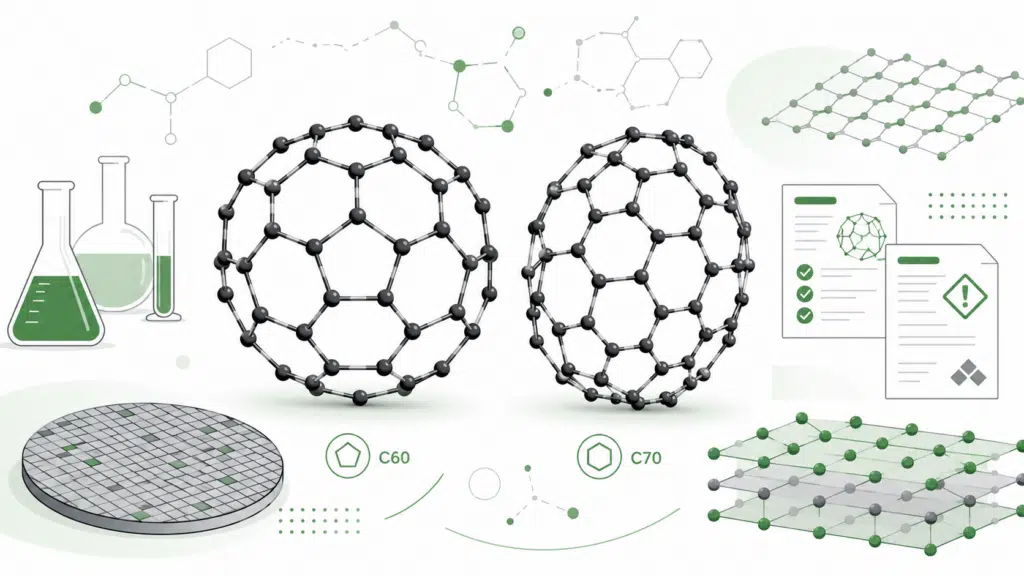
Buckminsterfullerene-type structures are carbon cage molecules built from networks of carbon atoms arranged into closed, hollow frameworks. The most widely recognized example is Fullerene C60, also known as C60 fullerene, Carbon 60, or buckminsterfullerene. Its spherical molecular geometry is often compared to a soccer ball because the carbon atoms are arranged in a highly symmetrical cage formed by pentagonal and hexagonal rings.
For scientists, this structure is important because it helps explain the distinctive electronic, optical, and chemical behavior of fullerene materials. For B2B buyers, it is equally important because structure affects material selection, purity requirements, documentation needs, packaging expectations, and application suitability.
This article explains buckminsterfullerene-type structures from a practical procurement perspective. It covers what these structures are, why C60 is the reference molecule, how C70 and other fullerene cages differ, and what laboratories, distributors, formulation developers, electronics companies, and industrial buyers should check before ordering fullerene materials.
A buckminsterfullerene-type structure refers to a closed carbon cage structure similar to Fullerene C60. These structures belong to the broader fullerene family, a class of carbon allotropes in which carbon atoms form hollow molecular cages, tubes, or related curved frameworks.
In the strictest sense, “buckminsterfullerene” usually refers to Fullerene C60. However, the phrase “buckminsterfullerene-type structures” is often used more broadly to describe fullerene-like cage structures that share similar geometric principles: curved carbon networks, closed molecular shells, and alternating ring patterns.
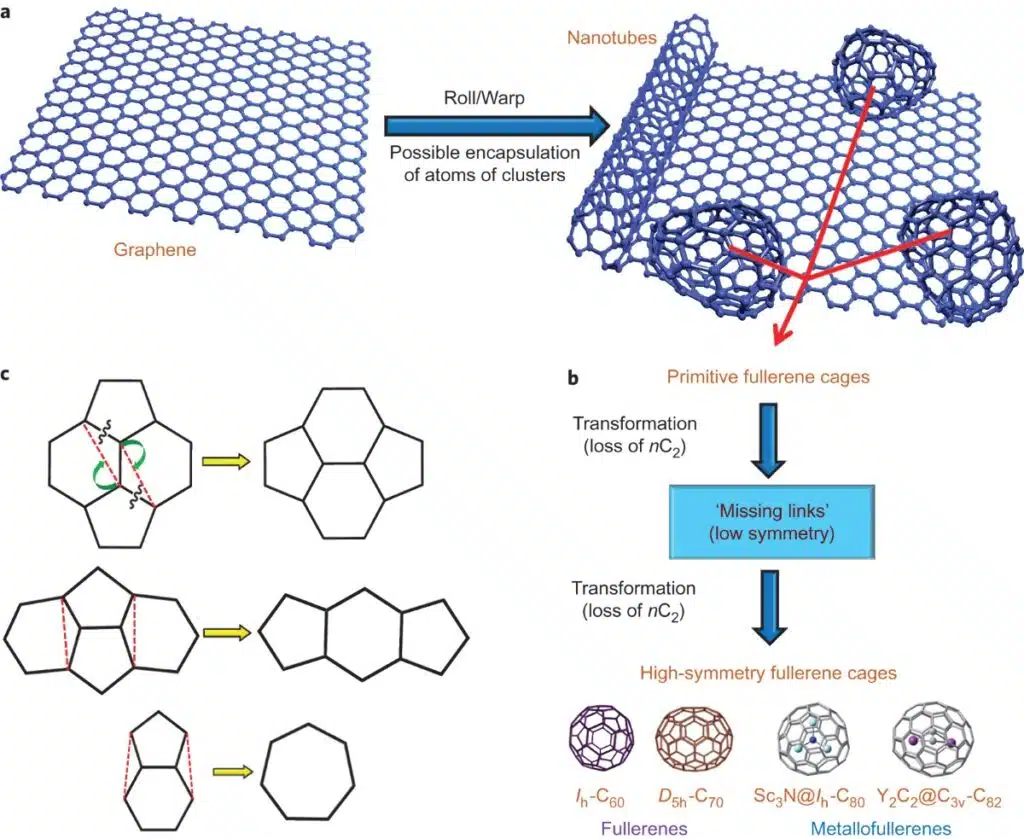
The key idea is curvature. Graphite is flat because its carbon atoms form extended planar sheets. Fullerenes are curved because pentagonal rings are inserted into the carbon network. These pentagons help bend the structure into a closed cage. In C60, the result is a stable, highly symmetrical molecule composed entirely of carbon.
For buyers, this matters because “fullerene” is not one single material. C60, C70, higher fullerenes, and fullerene derivatives may differ in molecular geometry, purity availability, solubility behavior, electronic properties, price, and application relevance. A buyer searching for a “buckminsterfullerene-type structure” should confirm whether the actual material needed is Fullerene C60, Fullerene C70, a higher fullerene, or a specific derivative.
Fullerene C60 is the best-known buckminsterfullerene-type molecule because of its high symmetry and clear structural identity. It contains 60 carbon atoms arranged into a spherical cage. The molecule has 12 pentagons and 20 hexagons, producing a truncated icosahedron geometry similar to a soccer ball.
This distinctive geometry makes C60 a useful reference point for understanding the fullerene family. When researchers discuss fullerene cages, molecular curvature, electron-accepting behavior, fullerene solubility, or fullerene-based materials, C60 is often the first structure considered.
From a product standpoint, Fullerene C60 is also one of the most commercially important fullerene materials. It is commonly supplied as fine powder or crystals and is studied in advanced materials, nanotechnology, organic electronics, photovoltaic research, lubricant additives, coatings, cosmetic formulation research, and biomedical research. These applications should be described carefully: C60 may be studied or investigated in these fields, but its performance depends on formulation, purity, testing method, and actual use conditions.
For procurement teams, the most important point is simple: when someone asks for buckminsterfullerene, they usually mean C60. But before purchase, the buyer should still confirm formula, CAS number, purity grade, required quantity, documentation, and intended use.
The C60 molecule is a closed carbon cage. Each carbon atom is bonded into a curved network, creating a hollow structure with no hydrogen, oxygen, metal, or heteroatom in the ideal molecule. The molecular formula is C60, and the molecule consists only of carbon atoms.
The structure is often described through three features.
First, C60 has a spherical cage-like shape. It is not a flat sheet, and it is not a carbon particle in the conventional bulk-material sense. It is a defined molecular structure.
Second, the molecule contains both pentagonal and hexagonal rings. The pentagons introduce curvature, while the hexagons help extend the carbon network. This combination allows the cage to close into a stable structure.
Third, C60 has high symmetry. This symmetry is one reason C60 became such an important molecule in fullerene chemistry and materials research. In many research contexts, a well-defined molecular structure is easier to study, compare, and reproduce than a poorly defined carbon material.
For B2B buyers, this structural precision is one of the reasons documentation matters. A supplier should be able to identify the product clearly as Fullerene C60, provide the correct CAS number when applicable, state purity, and provide batch-specific quality documentation. A vague description such as “carbon powder” is not enough for serious fullerene procurement.
Although C60 is the reference molecule, it is not the only fullerene cage. Fullerene C70 is another important material. It contains 70 carbon atoms and has a more elongated cage structure compared with the more spherical C60 molecule. Other higher fullerenes may contain even more carbon atoms, although commercial availability, purity, and application demand vary.
These structures are “buckminsterfullerene-type” in the sense that they share the same broad idea: a closed carbon cage with curved molecular geometry. However, small structural changes can create meaningful differences.
A larger cage may have different molecular dimensions. A less symmetrical cage may show different optical or electronic behavior. A different carbon count may influence solubility, separation difficulty, production cost, and application selection. In advanced material research, these differences can matter.
This is why buyers should avoid treating all fullerenes as interchangeable. C60 may be the right choice for one project, while C70 may be more relevant in another, especially in organic electronics or photovoltaic research. The proper choice depends on the application, target purity, testing protocol, formulation system, and budget.
Fullerene C60 and Fullerene C70 are closely related, but they are not the same material.
C60 contains 60 carbon atoms and has a highly symmetrical spherical structure. C70 contains 70 carbon atoms and has a more elongated cage geometry. This structural difference can influence optical absorption, electronic behavior, solubility tendencies, and how each molecule performs in research systems.
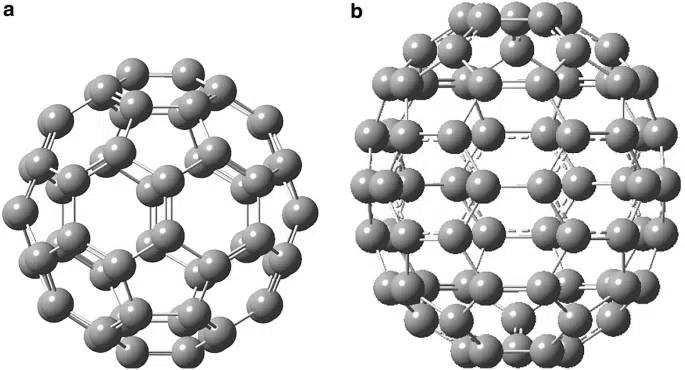
For general education and many material studies, C60 is the standard fullerene reference. For some photovoltaic, organic electronics, and molecular electronics research, C70 may also be considered because its different geometry and electronic behavior can be relevant to device-oriented studies.
A buyer should not ask, “Which one is better?” in a universal sense. A better question is: “Which fullerene structure matches my application and documentation requirements?” For lubricant formulation research, C60 is often considered. For organic photovoltaic or organic electronics research, both C60 and C70 may be evaluated. For advanced materials, coatings, and nanotechnology projects, the choice depends on performance targets, formulation compatibility, and required purity.
In procurement terms, C60 and C70 should be quoted separately. Buyers should specify the product name, target purity, quantity, application, destination country, and required documents such as COA and MSDS/SDS.
The value of buckminsterfullerene-type structures comes from their molecular architecture. The closed cage, curved π-electron system, and defined carbon framework make fullerenes relevant to several research and industrial fields.
In advanced materials, C60 and C70 may be studied as nanoscale carbon building blocks. Their molecular structure can be relevant to composites, coatings, thin films, and functional material systems.
In organic electronics and semiconductor research, fullerene materials are studied because of their electron-accepting behavior and molecular electronic characteristics. Purity and batch consistency are especially important in these sensitive applications because small differences in impurity profile may affect experimental reproducibility.
In photovoltaic research, fullerenes and fullerene derivatives have been investigated in organic photovoltaics, perovskite solar cells, and electron transport material systems. Buyers working in this field often care about high purity, low impurity levels, batch consistency, and reliable documentation.
In lubricants and coatings, Fullerene C60 is studied as an additive material in formulation research related to friction, wear, and surface behavior. However, performance depends on dispersion, concentration, base system, test method, and formulation conditions. It should not be described as a guaranteed anti-wear solution.
In cosmetic formulation research and biomedical research, C60 and related materials should only be discussed with research-oriented language. They may be studied in antioxidant-related formulation concepts, drug delivery research, photodynamic research, or nanomedicine-related studies, but suppliers should not make disease treatment claims, human consumption claims, or unverified regulatory claims.
The structural identity of C60 is important, but purity is just as important for practical use. A buyer may request Fullerene C60, but if the material contains significant impurities, mixed fullerene fractions, residual solvent, metal residues, or inconsistent batches, it may not be suitable for the intended application.
The Fullerene C60 purity grades commonly used in procurement discussions may include 99.00%, 99.50%, 99.90%, and 99.95%, depending on availability and buyer requirements. Lower purity grades may be considered for less demanding exploratory or industrial research, while higher purity grades may be more relevant for sensitive electronics, photovoltaic, analytical, or high-performance material studies.
However, higher purity is not automatically necessary for every project. Buyers should select purity based on actual use. For example, an early formulation screening project may not need the same purity level as a semiconductor or photovoltaic research program. A distributor may need multiple grades to serve different customer groups. A research laboratory may prioritize purity documentation and small sample availability.
The key point is that purity should be confirmed through batch-specific documentation, not only through a product title or sales description.
For buckminsterfullerene-type materials, serious buyers should request documentation before confirming an order.
A batch-specific Certificate of Analysis, or COA, helps verify the product identity, batch number, purity, test method, appearance, and other available quality information. The COA should match the delivered batch. It should not be treated as a universal guarantee for every application, but it is a basic document for quality review.
MSDS/SDS is also important. It provides safety, handling, storage, hazard, and transportation information. Buyers should review MSDS/SDS before storing, handling, shipping, or using fullerene powder in a laboratory or industrial setting.
For sensitive applications, buyers should also ask about the test method used to determine purity, such as HPLC or another appropriate analytical method. Do not rely only on a general purity claim. The analytical basis matters.
A practical buyer documentation checklist should include product name, CAS number, formula, target purity, actual batch purity, test method, batch number, appearance, storage conditions, packaging, COA, MSDS/SDS, and shipping documents when needed.
Fullerene C60 is typically supplied as a powder or crystalline material. Because fullerene materials may be sensitive to light, moisture, and contamination during handling, packaging should be confirmed before ordering.
For standard C60 products, common packaging options may include small laboratory quantities such as 1 g and 5 g, as well as larger quantities depending on product grade and order requirements. Custom packaging may be available on request. Packaging may include sealed, moisture-protected, light-shielding aluminum foil bags or plastic bottles, depending on quantity and shipping needs.
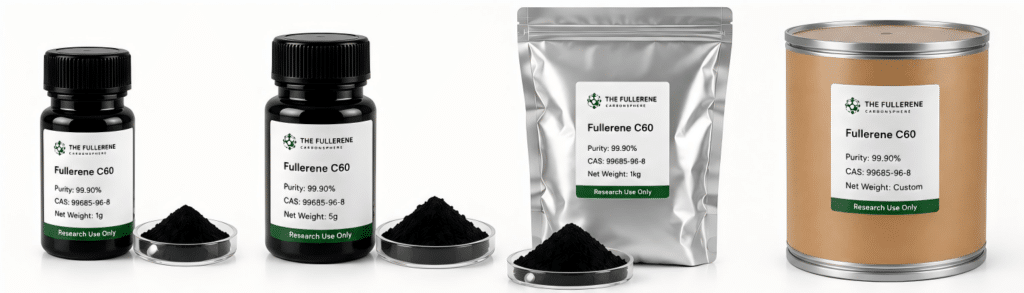
Storage conditions should also be confirmed. A practical storage recommendation for Fullerene C60 is to keep it in a sealed container in a cool, dry place away from light. Buyers should review the MSDS/SDS and supplier recommendations before use.
For international procurement, packaging should also support shipping stability and customs review. Labels, batch information, COA, MSDS/SDS, commercial invoice, packing list, and product specifications may be required depending on the destination country and buyer’s import process.
Before purchasing C60, C70, or related fullerene cage materials, buyers should confirm the following information:
| Item | What to Check | Why It Matters |
|---|---|---|
| Product identity | C60, C70, higher fullerene, or derivative | Avoids ordering the wrong structure |
| CAS number | Confirm if applicable | Supports documentation and import review |
| Formula | C60, C70, or other | Confirms molecular identity |
| Target purity | 99.00%, 99.50%, 99.90%, 99.95%, or custom requirement | Matches application sensitivity |
| Test method | HPLC or other appropriate method | Clarifies how purity is measured |
| COA | Batch-specific COA | Supports quality review |
| MSDS/SDS | Handling and safety document | Supports safe storage and transportation |
| Quantity | Sample or bulk order | Affects price, packaging, and lead time |
| Packaging | Bottle, foil bag, custom format | Protects material during storage and shipping |
| Application | Research, electronics, lubricant, coating, photovoltaic, etc. | Helps supplier recommend suitable grade |
| Destination country | USA, Japan, South Korea, France, or other | Affects shipping and documentation |
| Lead time | Current availability and dispatch schedule | Supports project planning |
This checklist is especially useful for procurement managers, laboratory researchers, chemical distributors, and manufacturers comparing multiple fullerene suppliers.
There is no single fixed price for fullerene cage materials. Price can vary depending on product type, purity, quantity, batch availability, testing requirements, packaging format, destination country, shipping method, and documentation needs.
C60 is generally more widely available than many higher fullerenes, but price still depends heavily on purity and quantity. C70 may have a different cost structure because of separation, purification, and demand factors. Fullerene derivatives or special grades may require separate confirmation.
Buyers should avoid making purchasing decisions based only on the lowest quoted price. A lower price may not be useful if the supplier cannot provide clear purity information, batch-specific COA, MSDS/SDS, suitable packaging, or consistent follow-up supply.
A more reliable RFQ should include product name, target purity, required quantity, sample or bulk order status, destination country, application, required documents, packaging preference, and expected delivery timeline.
To request buckminsterfullerene-type materials effectively, buyers should prepare a clear inquiry. A vague message such as “Please quote fullerene” is not enough. The supplier will still need to know which fullerene, which purity, and what quantity.
A better inquiry would include:
Product: Fullerene C60
Target purity: 99.90% or 99.95%
Quantity: 5 g sample or bulk quantity
Application: organic electronics research, lubricant formulation research, coating development, or other use
Destination country: United States, Japan, South Korea, France, or another destination
Documents required: COA, MSDS/SDS, product specification, export documents if needed
Packaging preference: standard lab packaging or custom packaging
Timeline: expected delivery schedule or project deadline
This level of detail helps the supplier confirm availability, quote more accurately, recommend suitable purity, and prepare the right documentation.
One common misunderstanding is that buckminsterfullerene and fullerene are always identical terms. In practice, buckminsterfullerene usually refers to C60, while fullerene is a broader category that includes C60, C70, higher fullerenes, and derivatives.
Another misunderstanding is that all carbon nanomaterials behave similarly. C60 is not the same as graphene, carbon nanotubes, graphite, carbon black, or carbon fiber. These materials are all carbon-based, but their structures, properties, and uses differ significantly.
A third misunderstanding is that high purity automatically guarantees application performance. It does not. Higher purity may support reproducibility and reduce impurity-related uncertainty, but final performance depends on the system, formulation, processing method, testing protocol, and application conditions.
A fourth misunderstanding is that fullerene materials can be marketed with health or medical claims. For responsible B2B communication, biomedical, cosmetic, antioxidant, and photodynamic topics should be framed as research areas only. Buyers should confirm regulatory requirements and avoid unsupported therapeutic or consumer safety claims.
A buckminsterfullerene-type structure is a fullerene-like closed carbon cage structure. The best-known example is Fullerene C60, a molecule composed of 60 carbon atoms arranged in a spherical cage.
In most contexts, yes. Buckminsterfullerene usually refers to Fullerene C60, also known as C60 fullerene or Carbon 60.
C60 contains 60 carbon atoms and has a highly symmetrical spherical structure. C70 contains 70 carbon atoms and has a more elongated cage structure. Their different geometries may lead to different optical, electronic, and application behavior.
C60 is compared to a soccer ball because its carbon atoms form a cage made from pentagonal and hexagonal rings, similar to the pattern of a traditional soccer ball.
The right purity depends on the application. Exploratory research may use a lower purity grade, while electronics, photovoltaics, or high-performance material research may require higher purity. Buyers should confirm the target purity and request batch-specific COA.
Yes. Buyers should request batch-specific COA before ordering, especially for research, industrial, electronic, photovoltaic, or formulation applications.
Yes. MSDS/SDS should be reviewed before handling, storing, transporting, or using Fullerene C60, C70, or related materials.
C60 has been studied in biomedical and cosmetic formulation research, but suppliers should not make treatment, cure, anti-aging, human consumption, or regulatory approval claims unless such claims are verified. Buyers should review local regulations and use research-oriented evaluation.
Fullerene C60 should generally be stored in a sealed container in a cool, dry place away from light. Buyers should confirm storage recommendations and review the MSDS/SDS before use.
Submit the product name, target purity, quantity, application, destination country, required documents, and packaging preference. This helps the supplier prepare a more accurate quotation.
For B2B procurement of Fullerene C60 (Pure), 99.95% Purity, No metallic residue, buyers should confirm target purity, required quantity, application, destination country, COA, MSDS/SDS, packaging, storage conditions, and shipping requirements before requesting a formal quotation.
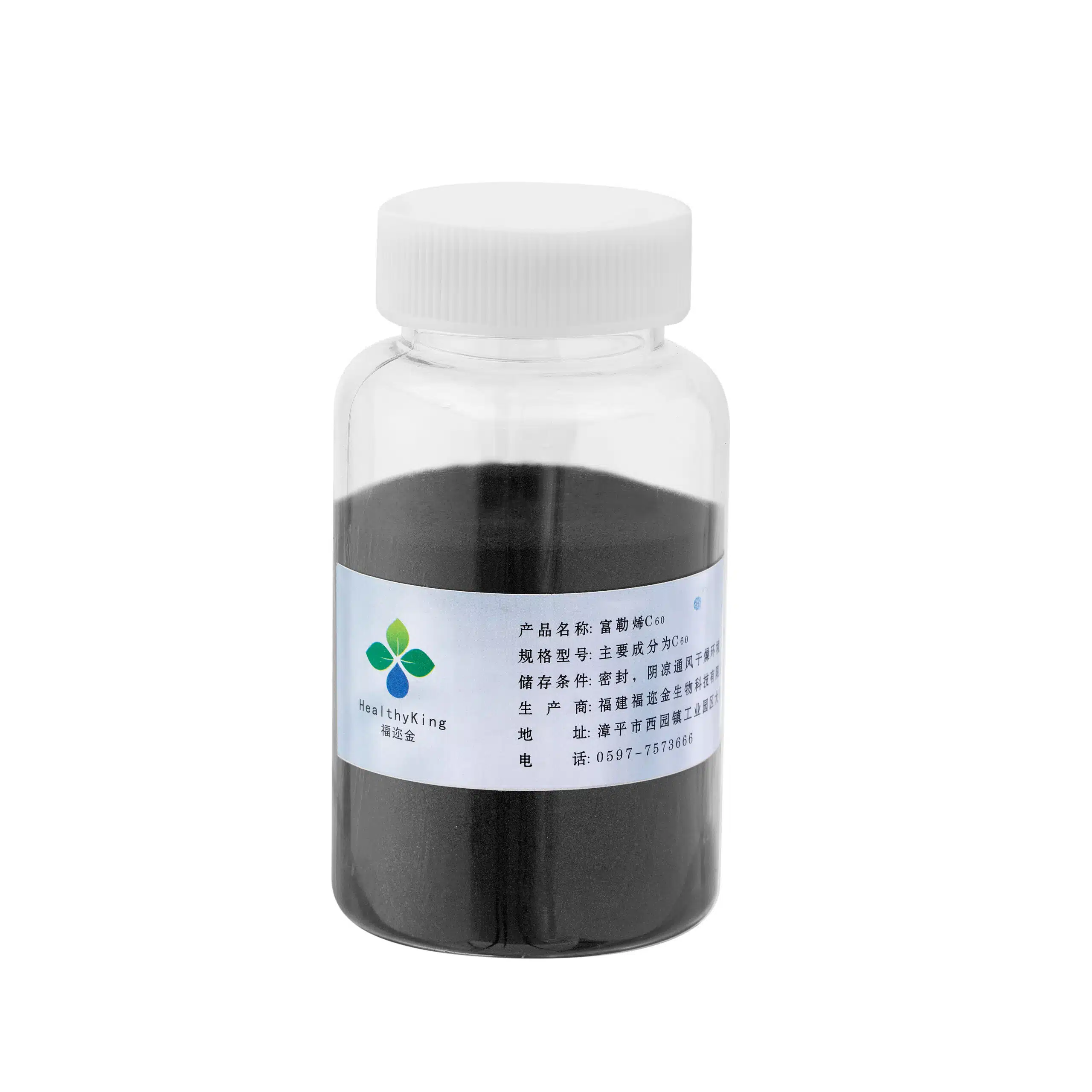
High-purity fullerene C60 is a highly refined nanomaterial designed specifically for the most demanding scientific and industrial applications. This ultra-pure form ensures…
Request product specifications, batch-specific COA, MSDS/SDS, sample availability, packaging details, and international shipping information before confirming your order.
Request DocumentsSubmit your product, purity, quantity, application, destination country, and documentation requirements. Our team will help confirm availability, COA, MSDS/SDS, packaging, and quotation details.