



Choosing a reliable Fullerene C60 supplier is not only about finding a low price. For laboratories, chemical raw material distributors, formulation companies, electronics manufacturers, photovoltaic researchers, and industrial buyers, the real purchasing risk usually comes from unclear purity, incomplete documentation, unstable batch quality, unsuitable packaging, slow communication, or uncertain international shipping.
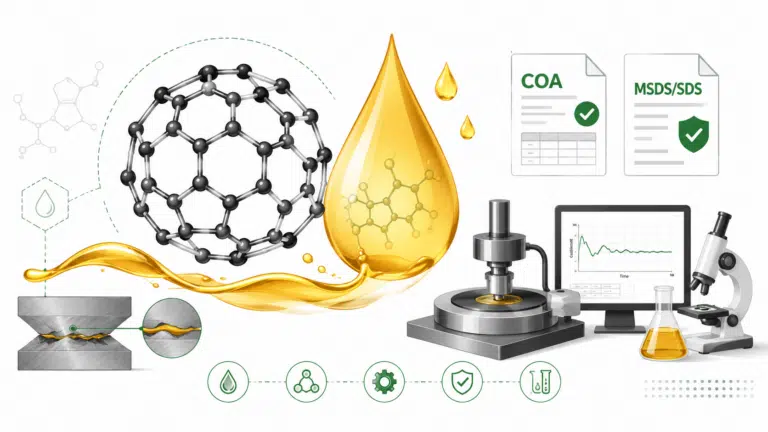
Fullerene C60, also known as C60 fullerene, Carbon 60, buckminsterfullerene, or simply C60, is a spherical carbon nanomaterial composed of 60 carbon atoms. Its formula is C60, its molecular weight is 720.67 g/mol, and its CAS number is 99685-96-8. The material is commonly supplied as fine powder or yellow-brown to black crystals with metallic luster. These verified product details matter because a reliable supplier should be able to identify the material clearly and consistently.
This guide explains how B2B buyers can evaluate a Fullerene C60 supplier before placing a sample order or bulk order. It focuses on practical procurement factors: purity grade, batch-specific COA, MSDS/SDS, packaging, MOQ, shipping, batch consistency, technical communication, and quotation accuracy.
Why Supplier Selection Matters for Fullerene C60
Fullerene C60 is not a generic carbon powder. It is a defined molecular material used in advanced material research, nanotechnology, organic electronics, photovoltaic research, lubricant formulation research, coatings, cosmetic formulation research, and biomedical research. In many of these fields, small differences in purity, impurity profile, storage condition, or batch consistency may affect research reproducibility or formulation evaluation.
For procurement teams, the supplier is part of the technical risk. A supplier who cannot provide clear product specifications may create downstream problems for quality review, customs clearance, internal approval, formulation testing, or repeated purchasing. A supplier who overpromises application results may also create compliance risk, especially in biomedical, cosmetic, or health-related contexts.
A reliable Fullerene C60 supplier should provide more than a product list. The supplier should help buyers confirm product identity, purity options, batch documentation, packaging format, sample availability, international shipping conditions, and application-related purchasing considerations.
Start by Confirming Product Identity
The first step is to confirm that the supplier is offering the correct material. Fullerene C60 should not be confused with mixed fullerenes, C70, graphene, carbon nanotubes, carbon black, graphite, or undefined carbon nanomaterials.
A reliable supplier should be able to state the following clearly:
| Item | Expected Information |
|---|---|
| Product name | Fullerene C60 |
| Alternative names | C60 fullerene, Carbon 60, buckminsterfullerene |
| Formula | C60 |
| CAS number | 99685-96-8 |
| Molecular weight | 720.67 g/mol |
| Product form | Fine powder or crystalline material |
| Appearance | Yellow-brown or black crystals with metallic luster |
If a supplier cannot clearly provide product identity, the buyer should pause. For research, electronics, photovoltaics, lubricants, coatings, or distribution, an unclear product identity can create major quality and documentation problems.
Check Available Purity Grades
Purity is one of the most important criteria when choosing a Fullerene C60 supplier. According to verified product knowledge for The Fullerene, available C60 purity grades include 99.00%, 99.50%, 99.90%, and 99.95%, with application suitability depending on the buyer’s use case.
A practical way to think about purity is not “the highest purity is always best,” but “which purity is appropriate for my application?”
For less demanding exploratory research or early industrial trials, 99.00% may be considered. For analytical work or formulation development, 99.50% may be more suitable. For electronics, photovoltaics, high-performance research, or precision material systems, 99.90% or 99.95% may be more relevant. However, buyers should always confirm suitability based on their own protocol, target market, and internal quality requirements.
A reliable supplier should explain purity options without forcing every buyer toward the most expensive grade. The supplier should also avoid claiming that a purity grade is suitable for medical, pharmaceutical, food, or regulated consumer use unless such claims are verified.
Ask for Batch-Specific COA
A Certificate of Analysis, or COA, is one of the most important documents in Fullerene C60 procurement. A reliable supplier should provide batch-specific COA, not only a generic product sheet.
A useful COA may include product name, batch number, manufacturing or release date, purity, test method, appearance, impurity profile when available, and supplier or quality department information. The key word is batch-specific. The COA should correspond to the actual batch being shipped.
Buyers should check whether the COA answers these questions:
Does the product name match Fullerene C60?
Does the CAS number match the quoted product?
Is the purity clearly stated?
Is the test method shown?
Is there a batch number?
Does the COA match the invoice, label, or shipment?
Can the supplier explain the COA if the buyer has questions?
A supplier who cannot provide COA may not be suitable for serious B2B procurement. This is especially important for laboratories, distributors, electronics companies, photovoltaic researchers, and industrial manufacturers.
Review MSDS/SDS Before Ordering
MSDS/SDS is another basic document buyers should request before confirming an order. It supports safe handling, storage, transportation, and internal compliance review.
Fullerene C60 should be handled according to the applicable MSDS/SDS, laboratory safety procedures, and destination-market regulations. It should not be described simply as “safe” or “non-toxic.” Verified safety wording for C60 includes handling precautions such as avoiding dust inhalation and using appropriate protective equipment.
A reliable Fullerene C60 supplier should be able to provide MSDS/SDS for review before shipment. Buyers should use it to check storage requirements, handling precautions, transport considerations, and internal safety approval needs.
This is especially important for international buyers. Customs brokers, logistics providers, laboratories, or internal compliance teams may request MSDS/SDS before approving shipment or use.
Evaluate Batch Consistency
Batch consistency is a major issue in advanced material procurement. A buyer may receive a good first sample, but if the supplier cannot support consistent repeated orders, the material may not be suitable for ongoing research, distribution, or industrial testing.
For Fullerene C60, batch consistency may affect research reproducibility, formulation comparison, electronic material testing, photovoltaic experiments, lubricant additive trials, and coating development. A reliable supplier should be able to explain whether repeated batches can be supplied with comparable specifications.
Buyers should ask:
Can you provide batch-specific COA for every shipment?
Can repeated orders be supplied from the same batch if needed?
Can you confirm expected batch availability before bulk order?
How do you handle quality differences between sample and bulk orders?
What happens if the delivered material does not match the agreed specification?
A serious supplier does not need to promise impossible uniformity. But they should communicate clearly and document each batch properly.
Confirm MOQ and Sample Availability
Sample availability is important because many C60 buyers need small quantities for research or formulation testing before scaling. According to The Fullerene’s C60 product knowledge, standard C60 sample quantities may start from 1 g, while MOQ may vary depending on purity, batch availability, packaging requirements, and destination market.
For laboratories, a 1 g, 2 g, 5 g, or 10 g sample may be enough for early testing. For distributors or manufacturers, a sample order may be used to verify quality before bulk procurement.
A reliable supplier should clearly explain:
- Minimum order quantity
- Available sample sizes
- Purity options for samples
- Whether sample and bulk batches can be matched
- Packaging format for small quantities
- Lead time for sample dispatch
- Documents available with sample orders
If the supplier only pushes bulk orders without supporting sample evaluation, that may be a problem for research-based buyers.
Check Packaging and Storage Conditions
Fullerene C60 may be sensitive to light, moisture, and contamination during handling. Packaging matters because poor packaging can create storage, transport, and usability problems.
Known C60 packaging options may include 1 g, 5 g, 1 kg, and custom packaging on request. Product form may be sealed in moisture-proof, light-shielding aluminum foil bags or plastic bottles, depending on grade, order quantity, and shipping requirements. Buyers should confirm packaging before ordering.
A reliable supplier should answer these questions:
Is the packaging light-shielding?
Is the package sealed and moisture-protected?
Is the product labeled with product and batch information?
Can packaging be adjusted for laboratory or distributor needs?
Is custom packaging available for bulk or repeated orders?
What storage conditions should be followed after receipt?
A practical storage recommendation for Fullerene C60 is to store it in a sealed container in a cool, dry place away from light. Buyers should confirm shelf-life information and handling requirements before purchase.
Review International Shipping Support
For international B2B buyers, supplier reliability also depends on export and shipping support. A supplier may have good material, but if shipping documents are incomplete or communication is slow, the buyer may face customs delays or internal approval problems.
A reliable C60 supplier should help buyers confirm:
- Destination country
- Product quantity
- Packaging format
- MSDS/SDS availability
- COA availability
- Commercial invoice
- Packing list
- Shipping method
- Estimated lead time
- Customs documentation requirements
The target countries for The Fullerene include the United States, Japan, South Korea, and France. International buyers in these markets often care about product purity, documentation, shipping reliability, export handling, lead time, batch consistency, and application suitability.
Buyers should avoid suppliers who say “customs is always no problem” without checking the product, destination, and documentation requirements. Chemical shipments may require appropriate documentation, and import rules can vary by destination.
Understand Price Factors Beyond Unit Cost
Price matters, but it should not be the only supplier selection factor. Fullerene C60 price may vary depending on purity grade, order quantity, batch availability, packaging format, testing requirements, documentation requirements, destination country, shipping method, and market supply conditions.
A very low price may come with hidden risks: unclear purity, no COA, no MSDS/SDS, unstable batch quality, poor packaging, or uncertain delivery. A higher price may be justified if the supplier provides high-purity material, batch-specific documentation, consistent communication, and reliable sample-to-bulk support.
When comparing quotations, buyers should check whether each quote includes the same purity grade, quantity, documents, packaging, and shipping terms. Without this, price comparisons are misleading.
A serious RFQ should include the product name, target purity, quantity, application, destination country, required documents, packaging preference, and expected delivery timeline.
Check Technical Communication
Fullerene C60 buyers often need more than a price. They may need help selecting purity, comparing C60 and C70, understanding solubility, confirming storage conditions, reviewing COA, or planning sample-to-bulk procurement.
A reliable supplier should be able to communicate clearly about technical and procurement issues. This does not mean the supplier should make unsupported application claims. It means the supplier should answer practical questions in a careful, evidence-aware way.
Good supplier communication looks like this:
- “We recommend confirming your target purity based on your application and testing method.”
- “Please review the batch-specific COA before confirming the order.”
- “Packaging options may vary by quantity and destination.”
- “MSDS/SDS can be provided for handling and shipping review.”
- “For biomedical or cosmetic research, buyers should confirm regulatory requirements in the target market.”
Poor supplier communication looks like this:
- “This C60 is the best in the world.”
- “This material is safe for humans.”
- “This product is FDA approved.”
- “This purity guarantees performance.”
- “No documents are needed.”
- “Customs is guaranteed.”
The second type of language creates risk. A reliable supplier should avoid exaggerated, medical, regulatory, or performance claims unless verified.
Supplier Red Flags Buyers Should Avoid
A supplier may not be reliable if it shows several of the following problems:
| Red Flag | Why It Matters |
|---|---|
| No batch-specific COA | Quality cannot be properly verified |
| No MSDS/SDS | Handling and shipping review may be incomplete |
| Vague product identity | Buyer may receive the wrong carbon material |
| No CAS number or formula | Documentation may be weak |
| Unsupported “medical grade” claims | Regulatory and compliance risk |
| Claims of guaranteed performance | Misleading for research and industrial applications |
| No clear MOQ or sample policy | Hard to plan testing |
| No packaging details | Storage and shipping risk |
| No batch consistency discussion | Problem for repeated orders |
| Poor response time | Procurement delays |
| Price only, no documents | Higher quality risk |
| Fake or unverifiable certifications | Serious trust issue |
The most dangerous suppliers are often not the most expensive. They are the ones that make the purchasing process look simple by removing necessary quality checks.
Reliable Fullerene C60 Supplier Checklist
Use this checklist when comparing suppliers:
| Evaluation Area | What a Reliable Supplier Should Provide |
|---|---|
| Product identity | Fullerene C60, CAS 99685-96-8, formula C60 |
| Purity options | Clear available grades such as 99.00%, 99.50%, 99.90%, 99.95% |
| COA | Batch-specific Certificate of Analysis |
| MSDS/SDS | Handling, storage, and transport safety document |
| Test method | Purity testing method, such as HPLC or another appropriate method |
| Batch consistency | Clear batch information and repeated order support |
| Sample availability | Small sample quantities when available |
| MOQ | Clear minimum order quantity based on grade and destination |
| Packaging | Sealed, moisture-protected, light-shielding options where suitable |
| Storage guidance | Cool, dry, light-protected storage recommendation |
| Shipping support | International logistics and export documentation support |
| Technical communication | Practical answers without exaggerated claims |
| RFQ process | Clear quotation based on purity, quantity, destination, and documents |
A supplier does not need to claim to be the “best.” It needs to be clear, document-based, consistent, and responsive.
How to Request an Accurate C60 Quotation
To receive an accurate quotation, buyers should not send only “Please quote C60.” That is too vague. The supplier needs enough information to confirm grade, availability, packaging, and shipping requirements.
A better inquiry includes:
Product name: Fullerene C60
Target purity: 99.00%, 99.50%, 99.90%, 99.95%, or custom requirement
Required quantity: sample or bulk order
Application: research, electronics, photovoltaics, lubricant formulation, coating development, distribution, or other use
Destination country: United States, Japan, South Korea, France, or other market
Required documents: COA, MSDS/SDS, product specification, export documents if needed
Packaging preference: standard lab packaging, bottle, foil bag, or custom format
Expected timeline: target delivery schedule or project deadline
Company information: company name, contact person, email, phone or WhatsApp if applicable
This type of inquiry helps the supplier provide a more accurate response. It also reduces back-and-forth communication and improves quotation quality.
Why The Fullerene Supports Documentation-Based Procurement
The Fullerene / Carbonsphere is positioned as a B2B supplier of high-purity Fullerene C60, Fullerene C70, and advanced fullerene materials. The company’s procurement support focuses on product sourcing, quality documentation, purity selection, sample support, international logistics support, and one-stop procurement assistance for laboratories, research institutions, distributors, and industrial manufacturers.
For C60 buyers, this means the quotation process should not stop at price. Buyers can request purity options, COA, MSDS/SDS, sample availability, packaging information, and international shipping support before confirming an order.
FAQ
What should I check first when choosing a Fullerene C60 supplier?
Start with product identity. Confirm that the supplier is offering Fullerene C60, not mixed fullerenes or another carbon nanomaterial. Check the formula C60, CAS number 99685-96-8, purity grade, product form, and available documents.
What documents should a reliable C60 supplier provide?
A reliable supplier should provide batch-specific COA, MSDS/SDS, product specification, and export-related documents when applicable. For quality review, batch-specific COA is especially important.
Is the highest C60 purity always necessary?
No. The right purity depends on the application. Some exploratory or industrial research may not require the highest purity. Electronics, photovoltaic, or precision research may require higher purity. Buyers should match purity to application requirements.
Why is batch-specific COA important?
Batch-specific COA helps buyers verify the actual material being supplied. It may include product name, batch number, purity, test method, appearance, and other quality information. A generic COA is less useful for serious procurement.
Should I request MSDS/SDS before ordering Fullerene C60?
Yes. MSDS/SDS should be reviewed before handling, storing, transporting, or using Fullerene C60. Buyers should follow laboratory safety procedures and destination-market regulations.
What is a reasonable MOQ for C60?
MOQ may vary by purity, batch availability, packaging, and destination market. For standard Fullerene C60 products, sample quantities may start from 1 g, but buyers should confirm current availability before ordering.
What packaging should I ask for?
Ask whether the product is sealed, moisture-protected, light-shielded, and labeled with product and batch information. Packaging may vary by quantity, grade, and shipping requirements.
How do I compare two C60 supplier quotations?
Compare the same purity, quantity, COA availability, MSDS/SDS availability, packaging, shipping terms, lead time, and batch consistency support. Do not compare only unit price.
Can a Fullerene C60 supplier guarantee application performance?
No responsible supplier should guarantee universal application performance. Fullerene C60 performance depends on formulation, testing method, application conditions, purity, dispersion, processing, and other factors.
How can I request a quote from The Fullerene?
Submit your product name, target purity, quantity, application, destination country, required documents, and packaging preference. This helps The Fullerene confirm product availability, documentation, and quotation details.