
XCT Insights
Stay Updated
Fullerene research, applications and company updates, delivered occasionally.
Latest from XCT
View all

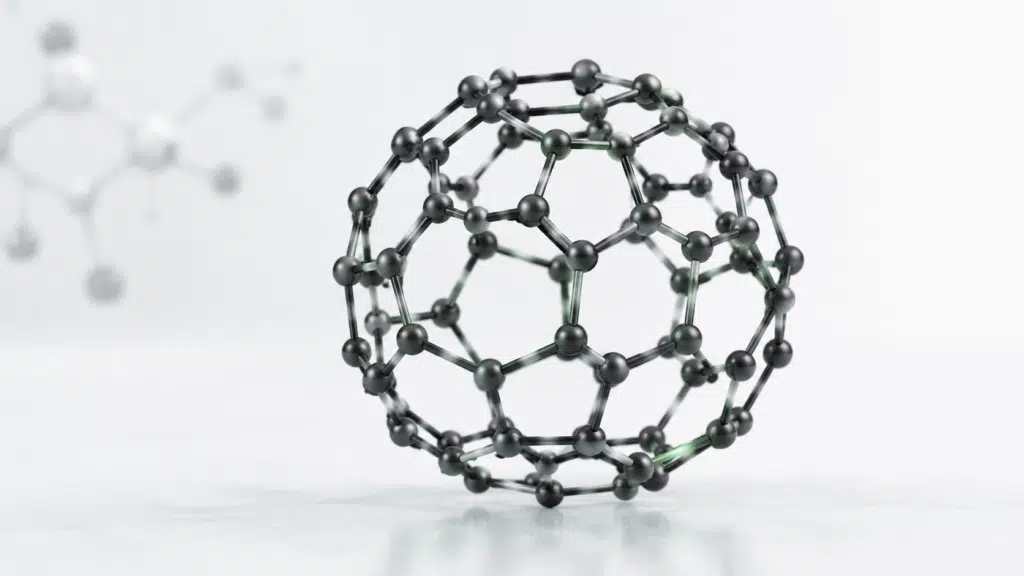
C60 molecule mass is calculated from the molar mass of Fullerene C60 and Avogadro’s constant. The short answer is:
The mass of one molecule of C60 is approximately 1.20 × 10⁻²¹ grams, or 1.20 × 10⁻²⁴ kilograms.
This value comes from a simple conversion. Fullerene C60 has the molecular formula C60, meaning one C60 molecule contains 60 carbon atoms. Its molar mass is about 720.66 g/mol, and one mole contains 6.02214076 × 10²³ molecules.[1][2]
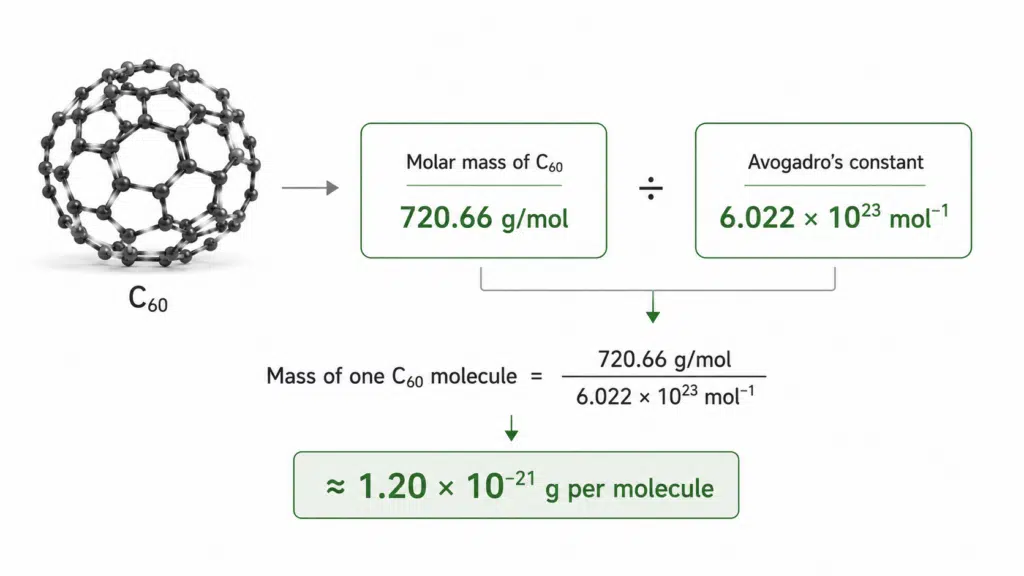
To find the mass of one C60 molecule, divide the molar mass by Avogadro’s constant:
720.66 g/mol ÷ 6.02214076 × 10²³ molecules/mol = 1.1967 × 10⁻²¹ g per molecule
Rounded to three significant figures, the answer is:
1.20 × 10⁻²¹ g per C60 molecule
| Question | Answer |
|---|---|
| What is the formula of the C60 molecule? | C60 |
| How many carbon atoms are in one C60 molecule? | 60 carbon atoms |
| What is the molar mass of C60? | Approximately 720.66 g/mol |
| What is the mass of one molecule of C60? | Approximately 1.1967 × 10⁻²¹ g |
| Rounded value | About 1.20 × 10⁻²¹ g |
| Mass in kilograms | About 1.20 × 10⁻²⁴ kg |
The exact number may differ slightly depending on rounding, but 1.20 × 10⁻²¹ grams is the standard practical answer for most chemistry explanations.
A C60 molecule is a fullerene molecule made of 60 carbon atoms arranged in a closed cage. It is also called Fullerene C60, buckminsterfullerene, Carbon 60, or buckyball.
The name “C60” comes directly from its formula: C means carbon, and 60 means there are 60 carbon atoms in one molecule.
PubChem identifies Fullerene C60 with molecular formula C60 and molecular weight around 720.6 g/mol.[3] Fisher Scientific lists Fullerene C60 under CAS number 99685-96-8, molecular formula C60, and molecular weight 720.66 g/mol.[1]
Structurally, the C60 molecule is often compared to a soccer ball. It is a spherical carbon cage made from pentagons and hexagons. This shape is why C60 is known as buckminsterfullerene, named after architect R. Buckminster Fuller, whose geodesic dome designs resemble the geometry of the molecule.
The calculation has three steps.
A C60 molecule contains 60 carbon atoms. The atomic weight of carbon is about 12.011 g/mol according to IUPAC’s standard atomic weight table.[4]
So the approximate molar mass is:
60 × 12.011 g/mol = 720.66 g/mol
This matches commonly listed Fullerene C60 molecular weight values.
Avogadro’s constant tells us how many molecules are in one mole:
6.02214076 × 10²³ molecules/mol
NIST lists this value as exact.[2]
To find the mass of one C60 molecule:
Mass of one C60 molecule = 720.66 ÷ 6.02214076 × 10²³
This gives:
1.1967 × 10⁻²¹ g
So the mass of one molecule of C60 is approximately 1.20 × 10⁻²¹ grams.
The molar mass of a C60 molecule is easy to understand once the formula is clear. C60 contains 60 carbon atoms. Each carbon atom contributes about 12.011 g/mol to the molar mass.
The calculation is:
60 × 12.011 = 720.66 g/mol
This does not mean that one C60 molecule weighs 720.66 grams. It means that one mole of C60 molecules weighs about 720.66 grams.
One mole is a very large number of particles: 6.02214076 × 10²³. That is why the mass of one individual C60 molecule is extremely small.
When discussing the C60 molecule, it is important to separate molecular mass from molar mass.
| Term | Meaning | Value for C60 |
|---|---|---|
| Molecular formula | Atoms in one molecule | C60 |
| Molecular mass | Mass of one molecule | About 1.20 × 10⁻²¹ g |
| Molar mass | Mass of one mole of molecules | About 720.66 g/mol |
| One mole | Number of molecules in one mole | 6.02214076 × 10²³ molecules |
The common mistake is to say “one C60 molecule has a mass of 720.66 g.” That is incorrect. 720.66 g is the mass of one mole of C60 molecules, not one molecule.
The mass of one C60 molecule in grams is approximately:
1.1967 × 10⁻²¹ g
To convert grams to kilograms, divide by 1000:
1.1967 × 10⁻²¹ g = 1.1967 × 10⁻²⁴ kg
Rounded to three significant figures:
1.20 × 10⁻²⁴ kg per C60 molecule
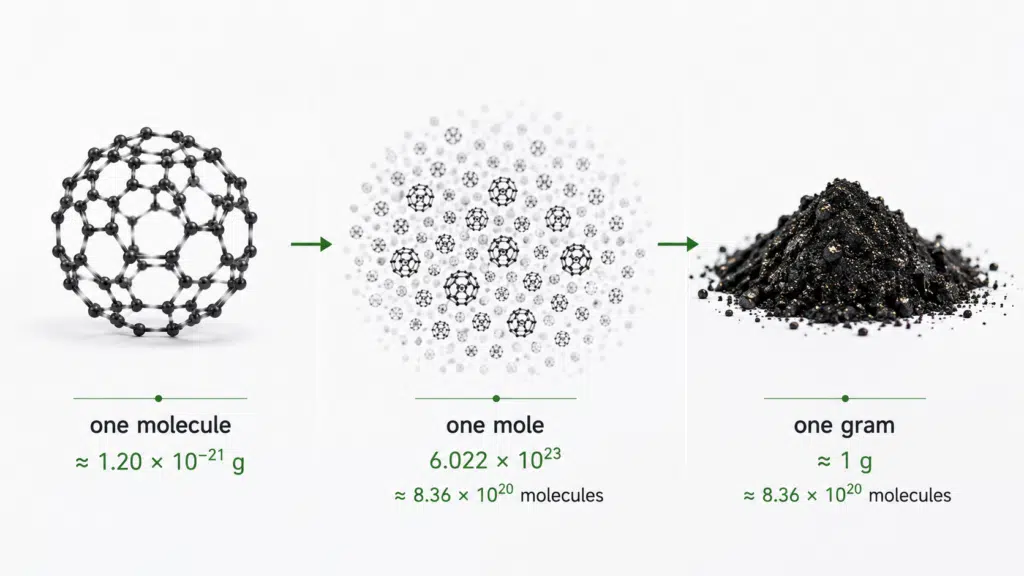
Another useful question is how many C60 molecules are in 1 gram of Fullerene C60.
First, convert 1 gram of C60 into moles:
1 g ÷ 720.66 g/mol = 0.0013876 mol
Then multiply by Avogadro’s constant:
0.0013876 × 6.02214076 × 1023 = 8.36 × 10²⁰ molecules
So, 1 gram of C60 contains approximately 8.36 × 10²⁰ C60 molecules.
This helps explain why laboratory quantities of C60 may look small by mass but still contain an enormous number of molecules.
The number of moles in 1 gram of C60 is calculated by dividing sample mass by molar mass:
1 g ÷ 720.66 g/mol = 0.0013876 mol
This is about:
1.39 × 10⁻³ mol
or:
1.39 mmol
This conversion is useful when preparing solutions, comparing molar ratios, or calculating reaction quantities involving Fullerene C60.
The mass of one C60 molecule matters because it connects molecular-scale chemistry with practical laboratory quantities. A chemist may need this value to calculate molecule numbers, molar concentration, film deposition amount, or reaction stoichiometry.
For example, if a researcher prepares a C60 solution, the mass weighed on a laboratory balance must be converted into moles or molecules. If a thin-film researcher deposits C60 onto a substrate, molecular mass and molar mass may help interpret material loading or deposition calculations.
For students, this calculation is also a clean example of how molar mass and Avogadro’s constant connect microscopic particles to measurable laboratory mass.
720.66 g/mol is the molar mass of C60. It is not the mass of one molecule. The mass of one molecule is about 1.20 × 10⁻²¹ g.
The “60” in C60 means there are 60 carbon atoms, not that the molar mass is 60 g/mol. Since each carbon atom contributes about 12.011 g/mol, the molar mass is about 720.66 g/mol.
To move from molar mass to the mass of one molecule, Avogadro’s constant must be used. Without it, the calculation stops at grams per mole rather than grams per molecule.
For most practical purposes, 1.20 × 10⁻²¹ g is enough. More digits may be used in formal calculations, but the value is still an approximation when standard atomic weights and rounded molar masses are used.
If you are comparing C60 molecule data for research or sourcing purposes, product identity should match the formula C60, CAS number 99685-96-8, and the expected molar mass of approximately 720.66–720.67 g/mol. You can review Fullerene C60 product information or contact The Fullerene for material details when needed.
The mass of one molecule of C60 is approximately 1.20 × 10⁻²¹ grams, or 1.20 × 10⁻²⁴ kilograms.
Divide the molar mass of C60 by Avogadro’s constant. Using 720.66 g/mol and 6.02214076 × 10²³ mol-1, the result is about 1.1967 × 10⁻²¹ g per molecule.
The molar mass of C60 is approximately 720.66–720.67 g/mol.
One C60 molecule contains 60 carbon atoms.
One gram of C60 contains approximately 8.36 × 10²⁰ molecules.
One gram of C60 is approximately 0.0013876 mol, or about 1.39 mmol.
Yes. C60, Fullerene C60, C60 fullerene, Carbon 60, buckminsterfullerene, and buckyball commonly refer to the same 60-carbon fullerene molecule.
C60 is called buckyball because its spherical cage structure resembles geodesic dome geometry associated with architect R. Buckminster Fuller.
[1] Fisher Scientific, “CAS RN 99685-96-8.” The page lists Fullerene C60 with CAS number 99685-96-8, molecular formula C60, and molecular weight around 720.66 g/mol. Source
[2] NIST, “CODATA Value: Avogadro constant.” NIST lists the Avogadro constant as 6.02214076 × 10²³ mol-1, exact. Source
[3] PubChem, “Fullerenes.” PubChem provides chemical identity and structure information for Fullerene C60 and lists molecular weight around 720.6 g/mol. Source
[4] IUPAC, “Atomic Weights of the Elements 2023.” IUPAC lists carbon with standard atomic weight 12.011(2). Source
For B2B procurement of Fullerene C60 (Pure), 99.95% Purity, No metallic residue, buyers should confirm target purity, required quantity, application, destination country, COA, MSDS/SDS, packaging, storage conditions, and shipping requirements before requesting a formal quotation.
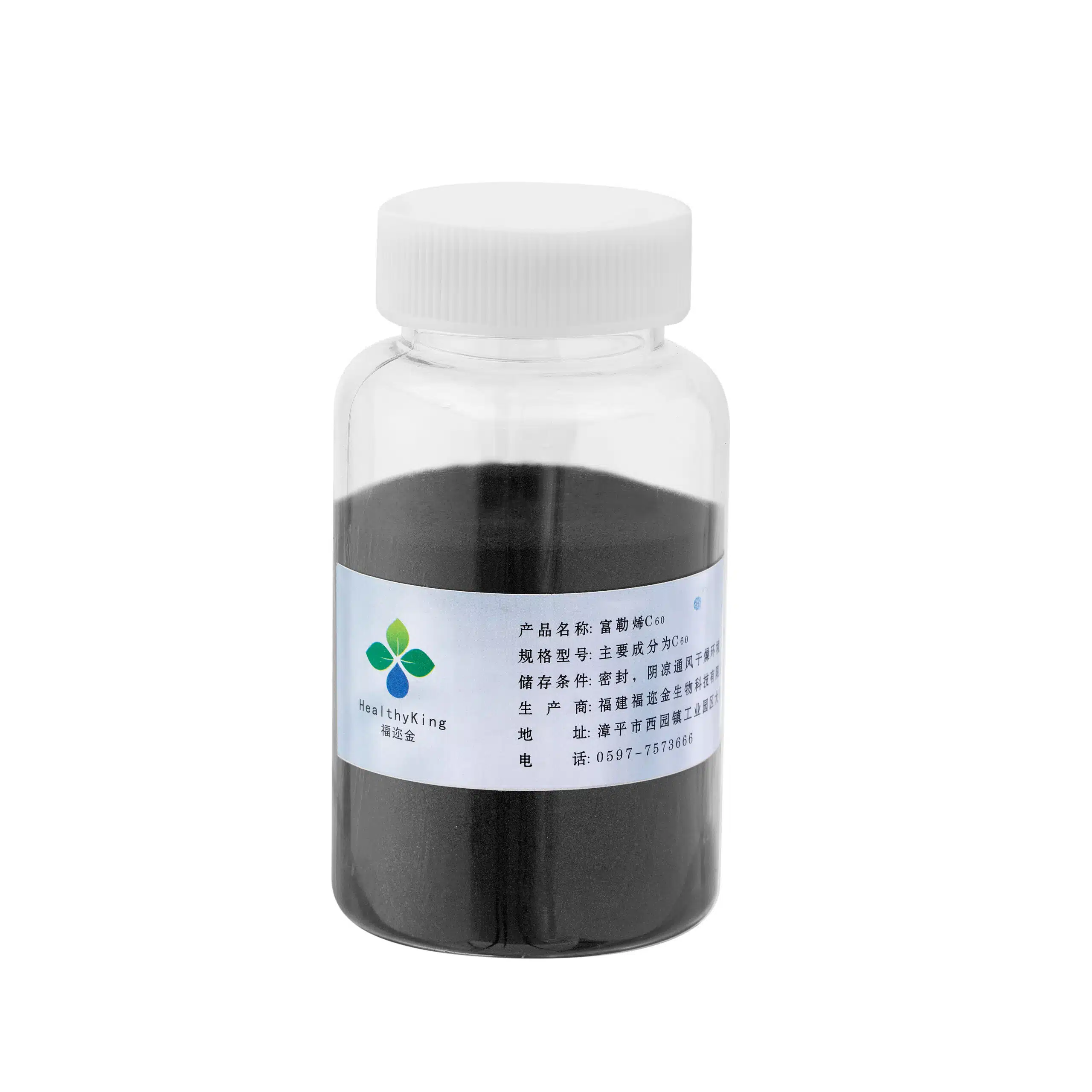
High-purity fullerene C60 is a highly refined nanomaterial designed specifically for the most demanding scientific and industrial applications. This ultra-pure form ensures…
Request product specifications, batch-specific COA, MSDS/SDS, sample availability, packaging details, and international shipping information before confirming your order.
Request DocumentsSubmit your product, purity, quantity, application, destination country, and documentation requirements. Our team will help confirm availability, COA, MSDS/SDS, packaging, and quotation details.