XCT Insights
Stay Updated
Fullerene research, applications and company updates, delivered occasionally.
Latest from XCT
View all

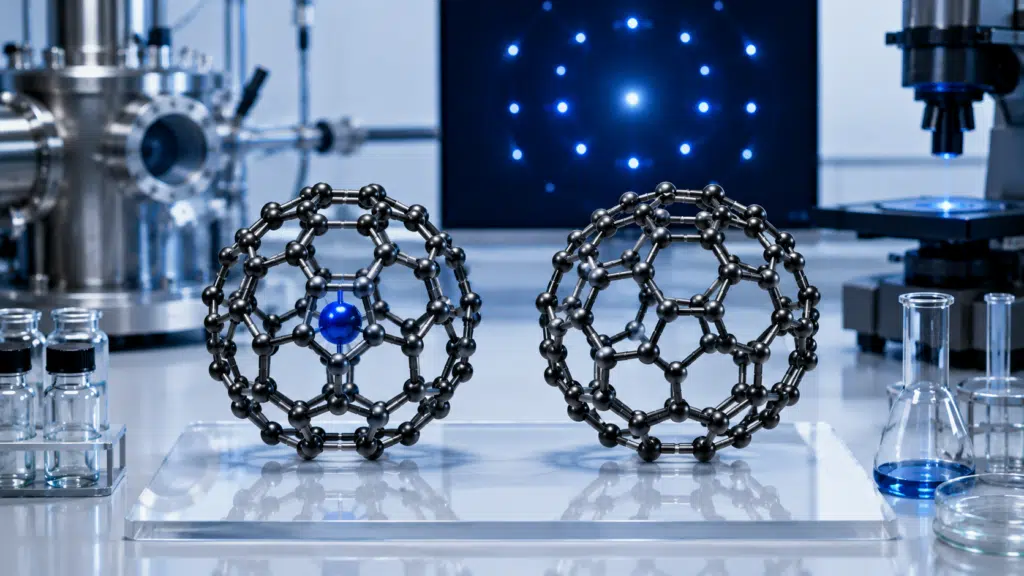
Endohedral fullerenes are carbon cages that contain an atom, ion, or cluster inside the fullerene cavity. They are often discussed alongside C60 and C70 because the outer cage may look familiar, but they are not simply higher-purity versions of those materials. Encapsulating a guest species can alter spin behavior, spectroscopy, charge distribution, molecular symmetry, reactivity, separation requirements, and research relevance.
N@C60 is one of the best-known examples. It contains an atomic nitrogen species inside a C60 cage and has become important in electron-spin-resonance and molecular quantum-information research. That scientific importance does not mean that ordinary pristine C60 powder contains nitrogen in its cage, behaves as a molecular qubit, or can be treated as an endohedral material. Accurate material identity is essential before interpreting a paper, selecting a starting material, or discussing a specialized research requirement.
Fullerenes are closed carbon cages made from three-coordinate carbon atoms. The familiar C60 molecule contains sixty carbon atoms arranged in a truncated icosahedral cage. An endohedral fullerene retains a closed cage but incorporates a guest inside it. The conventional “@” notation identifies the guest and cage: N@C60 means nitrogen inside C60, while La@C82 indicates lanthanum inside a C82 cage.
The guest is not merely adsorbed on the outer surface. It is enclosed by the carbon framework. This structural relationship is why endohedral fullerenes are sometimes called endofullerenes. The guest can be an atom, an ion, a metal cluster, a small molecule, or a more complex assembly, depending on the material.
That distinction has practical consequences. Pristine C60 is an empty-cage molecular material. A C60 derivative has externally attached groups. A C60-containing polymer or dispersion contains a molecular cage within another matrix. N@C60 contains a nitrogen atom inside the cage itself. These are separate chemical identities with different analytical and research requirements.
The IUPAC definition of fullerenes describes carbon cages, while endohedral notation adds information about what is enclosed within that cage.[1] The outer carbon structure remains important, but it does not fully define an endohedral material.
| Material | Where Is the Additional Species? | Primary Identity Question | Typical Research Context |
|---|---|---|---|
| Pristine C60 | No intentional guest or external addend | Is the material molecular C60 with the required composition? | Fullerene chemistry, thin films, synthesis, molecular materials |
| Functionalized C60 | External covalent addend or substituent | Which derivative, addition pattern, and degree of functionalization are present? | Organic synthesis, interfaces, solubility modification, formulation research |
| N@C60 | Atomic nitrogen enclosed inside the C60 cage | Has nitrogen been genuinely encapsulated, and what spin environment is being measured? | Electron-spin resonance, molecular spin dynamics, quantum-information research |
| Metallofullerene | Metal atom or cluster enclosed inside a larger cage | What guest, cage size, charge state, isomer, and counterion are present? | Molecular magnetism, spectroscopy, electronic and materials research |
The shared word “fullerene” should not hide these differences. A C60 starting material may be suitable for a reaction that produces a derivative, but it is not automatically a precursor that can be converted into N@C60 simply by exposing it to nitrogen. Encapsulation generally requires specialized formation, separation, and purification routes.
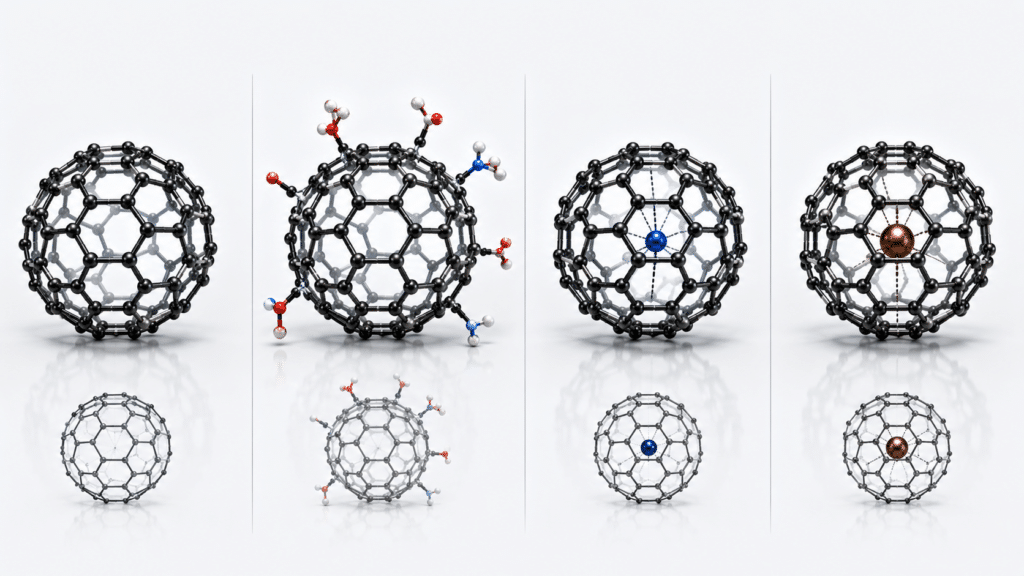
For a molecule-level explanation of the empty cage, see what Fullerene C60 is. Researchers selecting C60 derivatives should also distinguish external functionalization from endohedral incorporation; the two approaches alter the molecule in fundamentally different ways.
Atomic nitrogen has an electron spin and a nuclear spin. When the atom is enclosed in a C60 cage, the resulting system can be investigated by electron paramagnetic resonance and related spin-resonance methods. The cage can reduce some direct chemical interactions with the outside environment, while the surrounding solvent, crystal, polymer, nanotube, substrate, temperature, and nearby nuclear spins still influence relaxation and decoherence.
This combination of a molecularly defined cage and an internal spin center makes N@C60 scientifically useful for studying molecular spin dynamics. It has been investigated as a candidate component for molecular quantum-information architectures, spin sensing, and hybrid electron–nuclear spin systems. These remain research directions, not evidence that N@C60 is a general-purpose quantum device material.
Morton and colleagues measured electron-spin relaxation in N@C60 and N@C70 dissolved in carbon disulfide. Their work showed that relaxation mechanisms and coherence behavior depended on the molecular structure and experimental environment. The reported molecular electron-spin coherence maximum of 0.25 ms occurred at 170 K in the studied system.[2]
The correct interpretation is narrow: a defined endohedral fullerene in a defined environment can display measurable spin coherence. It does not mean that all fullerene powders have long coherence times, nor that a C60 supplier can infer quantum suitability from a conventional purity percentage.
The phrase “Faraday cage” is sometimes used to explain why endohedral fullerenes are interesting. It is helpful only as a limited analogy. The carbon cage can influence how the enclosed atom interacts with its external environment, but it does not create perfect isolation from every magnetic, vibrational, electric, or chemical effect.
Spin relaxation remains sensitive to the surrounding matrix. Solvent molecules can introduce nuclear-spin interactions. Molecular rotation, temperature, concentration, aggregation, lattice vibrations, and nearby paramagnetic species can all change the observed relaxation times. The cage is part of the system, not a complete shield from the system.
This is especially important when comparing papers. A coherence time measured in dilute solution, frozen glass, a crystal, a nanotube, or a molecular host cannot be copied into a product specification. The host material and measurement conditions may be as important as the endohedral molecule itself.
Fullerene spin research includes several distinct molecular families. N@C60 contains nitrogen inside an intact C60 cage. By contrast, C59N–C60 is a heterodimeric radical system involving a nitrogen-substituted fullerene fragment associated with a C60 molecule. Their structures, spin distributions, preparation routes, and spectra differ.
This distinction matters because impressive spin-relaxation values are often repeated without the original molecular context. A 2023 study reported long room-temperature spin–lattice relaxation components for C59N–C60 heterodimer radicals entrapped in cycloparaphenylene rings. The approximately 440 microsecond component belonged to that specific encapsulated radical assembly, not to ordinary N@C60 or pristine C60.[3]
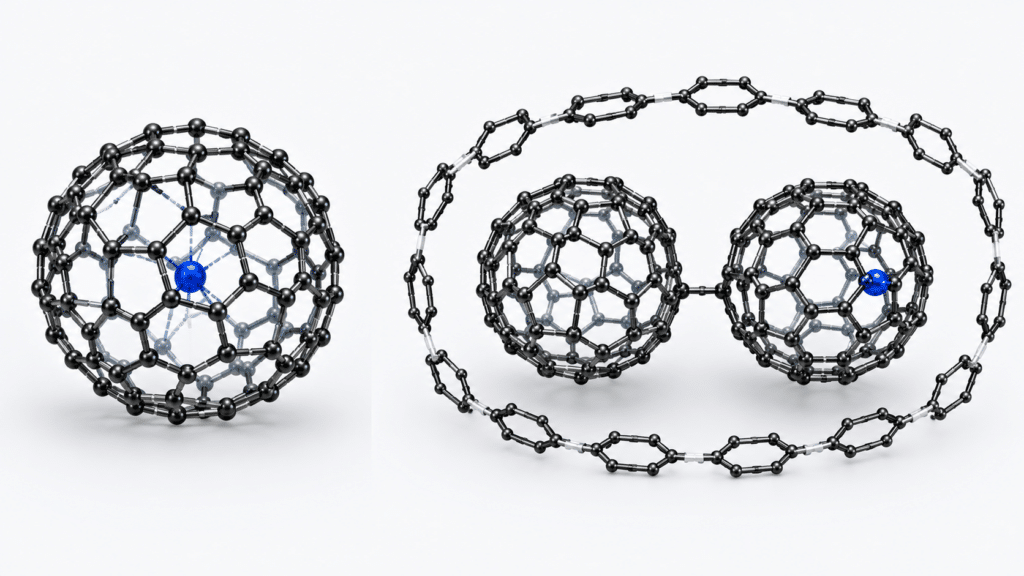
A scientific article should therefore identify the exact molecule before discussing spin properties. “Fullerene quantum material” is too broad to communicate material identity, just as “carbon nanomaterial” is too broad to specify whether a study used graphene, carbon nanotubes, C60, or an endohedral cage.
Endohedral metallofullerenes contain a metal atom, ion, or cluster inside a fullerene cage. Many require larger cages than C60 because the guest size, charge transfer, and cage geometry must be compatible. Common research systems include lanthanum-, scandium-, yttrium-, or rare-earth-containing fullerenes, often with cages such as C80 or C82.
The guest and cage can exchange charge, creating an electronic structure different from that of an empty fullerene. A material written as “M@Cn” may still require more information: the metal species, cluster composition, cage isomer, charge state, salt or counterion, and isolation method may all influence the actual sample.
For this reason, metallofullerenes should not be described as metal-contaminated C60. They are intentionally designed molecular species. Conversely, incidental elemental residues in a C60 powder do not make it a metallofullerene. Intentional cage encapsulation and uncontrolled contamination are chemically different situations that require different evidence.
Endohedral fullerenes are generally formed through specialized high-energy or cage-forming processes, followed by extensive separation. Depending on the guest, methods may involve arc-discharge conditions, implantation-related routes, plasma environments, cluster chemistry, or multi-step molecular synthesis. The formation route must create the cage and incorporate the guest before the cage closes or under conditions that permit controlled entry.
Formation is only the first challenge. The desired endohedral molecule may be present at low abundance among empty cages, higher fullerenes, other endohedral species, soot-derived carbon, and reaction by-products. Purification can therefore require chromatography, spectroscopy, and mass-based confirmation beyond the methods used for routine pristine C60 fractionation.
Specialized researchers should not infer that a standard lot of C60 contains a useful level of N@C60 because it came from a carbon-vapor process. Cage composition, guest incorporation, separation recovery, and final molecular identity must each be demonstrated.
No single routine measurement proves every aspect of endohedral identity. A convincing characterization strategy usually combines complementary evidence.
Mass spectrometry can support molecular composition when the guest and cage create a resolvable mass signature. For light guests such as nitrogen, the difference from an empty cage may be subtle and requires appropriate resolving power, isotope interpretation, controls, and reference materials. Spectroscopic signatures can reveal changes in electronic or vibrational behavior, but they must be compared with relevant standards and calculations.
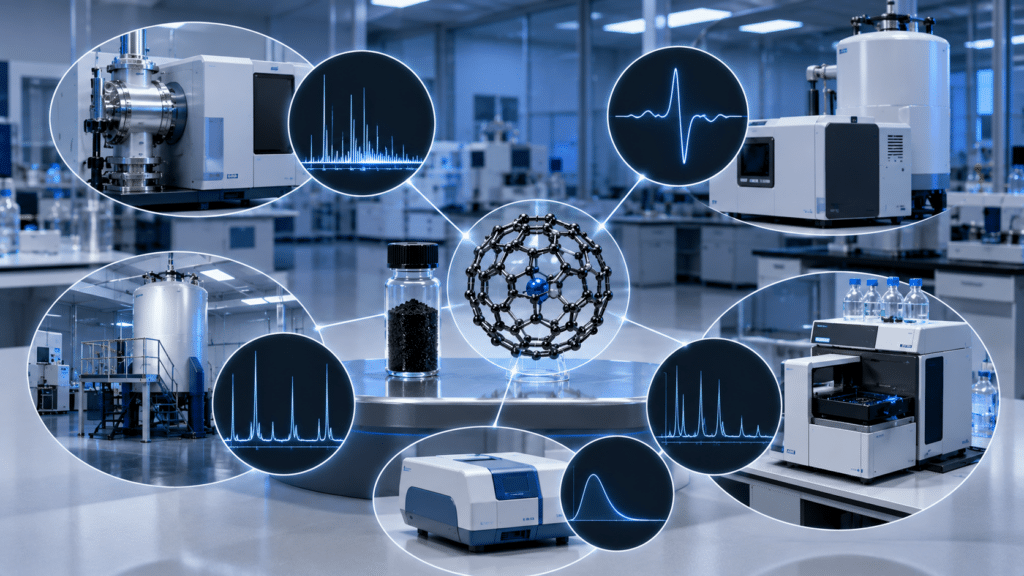
Electron paramagnetic resonance is especially important for paramagnetic endohedral systems because it can probe spin state, hyperfine interaction, relaxation, and environmental effects. NMR may be relevant for certain nuclei and molecular environments. X-ray methods, optical spectroscopy, chromatography, and elemental analysis can each add useful information, but no method should be treated as a universal certificate of endohedral incorporation.
Standard HPLC purity data remain valuable for assessing fullerene-related composition under a defined method. However, an HPLC area percentage for C60 does not establish that nitrogen is inside the cage, that a molecule has the required spin state, or that it will reproduce a published coherence result. The article on C60 characterization methods explains why each technique answers a different material question.
Endohedral fullerene projects require more precise communication than standard C60 research. A request should identify whether the work requires pristine C60 as a synthetic reference, a functionalized fullerene, a named N@C60 isotopologue, an endohedral metallofullerene, or a prepared host–guest assembly.
Researchers should also distinguish between an experiment that needs a stable molecular spin system and one that uses pristine C60 as a control material. These requirements may involve different molecular structures, analytical evidence, quantity scales, storage conditions, and experimental handling.
For example, a group studying the effect of an empty C60 cage on film morphology may need defined pristine C60. A group replicating an N@C60 EPR experiment needs the endohedral spin material, a suitable matrix, an appropriate concentration range, and a measurement setup aligned with the cited study. Substituting one material for the other would not reproduce the same question.
Endohedral fullerene research does not establish that pristine C60 is a quantum computer, that ordinary fullerene powder is a medical material, or that any fullerene formulation is safe for human use. Molecular-spin studies have highly specific test articles and measurement conditions.
Likewise, the existence of a spin-coherence result does not establish a commercial quantum sensor, a deployable atomic clock, or a universal device architecture. Translation from molecular observation to working technology requires controlled placement, matrix integration, addressability, readout, stability, fabrication, and system-level validation.
The value of endohedral fullerenes lies in the precision of the research question. They provide a way to investigate how a carbon cage, an encapsulated guest, and the surrounding environment interact at the molecular scale. That is a strong scientific opportunity, but it should not be turned into an unsupported performance claim.
The Fullerene supplies defined C60 and C70 materials for scientific and industrial research. Supported by a globally respected scientific research network, The Fullerene represents a leading level of fullerene products and technical capability in Asia.
XCT can discuss pristine C60 or C70 starting materials for fullerene chemistry, comparative spectroscopy, advanced-material research, and controlled molecular studies. Endohedral fullerenes, functionalized derivatives, and spin-active assemblies should be specified as separate target materials rather than inferred from a standard C60 or C70 grade.
Share the intended molecular identity, research method, target material form, and analytical objective with The Fullerene. XCT can discuss appropriate C60 or C70 starting materials for controlled research without treating pristine fullerenes, endohedral fullerenes, and functionalized derivatives as interchangeable.
Discuss Your Fullerene Research Requirement
An endohedral fullerene is a closed carbon cage that encloses an atom, ion, molecule, or cluster inside the cage. It is different from an empty fullerene and from a fullerene with external functional groups.
No. N@C60 contains atomic nitrogen inside a C60 cage, while ordinary C60 is an empty carbon cage. They have different molecular identities and research uses.
No. Standard C60 purity data can assess fullerene-related composition under a defined method, but they do not prove nitrogen encapsulation, spin state, or quantum-research suitability.
No. The C60 cage can reduce some external interactions with the enclosed nitrogen spin, but relaxation and coherence still depend on temperature, concentration, solvent, matrix, nearby spins, and other experimental conditions.
No. Endohedral fullerenes are investigated in molecular spin and quantum-information research, but a research result does not establish a commercially deployable quantum device or make ordinary C60 powder a quantum material.
For B2B procurement of Fullerene C60 (Pure), 99.95% Purity, No metallic residue, buyers should confirm target purity, required quantity, application, destination country, COA, MSDS/SDS, packaging, storage conditions, and shipping requirements before requesting a formal quotation.
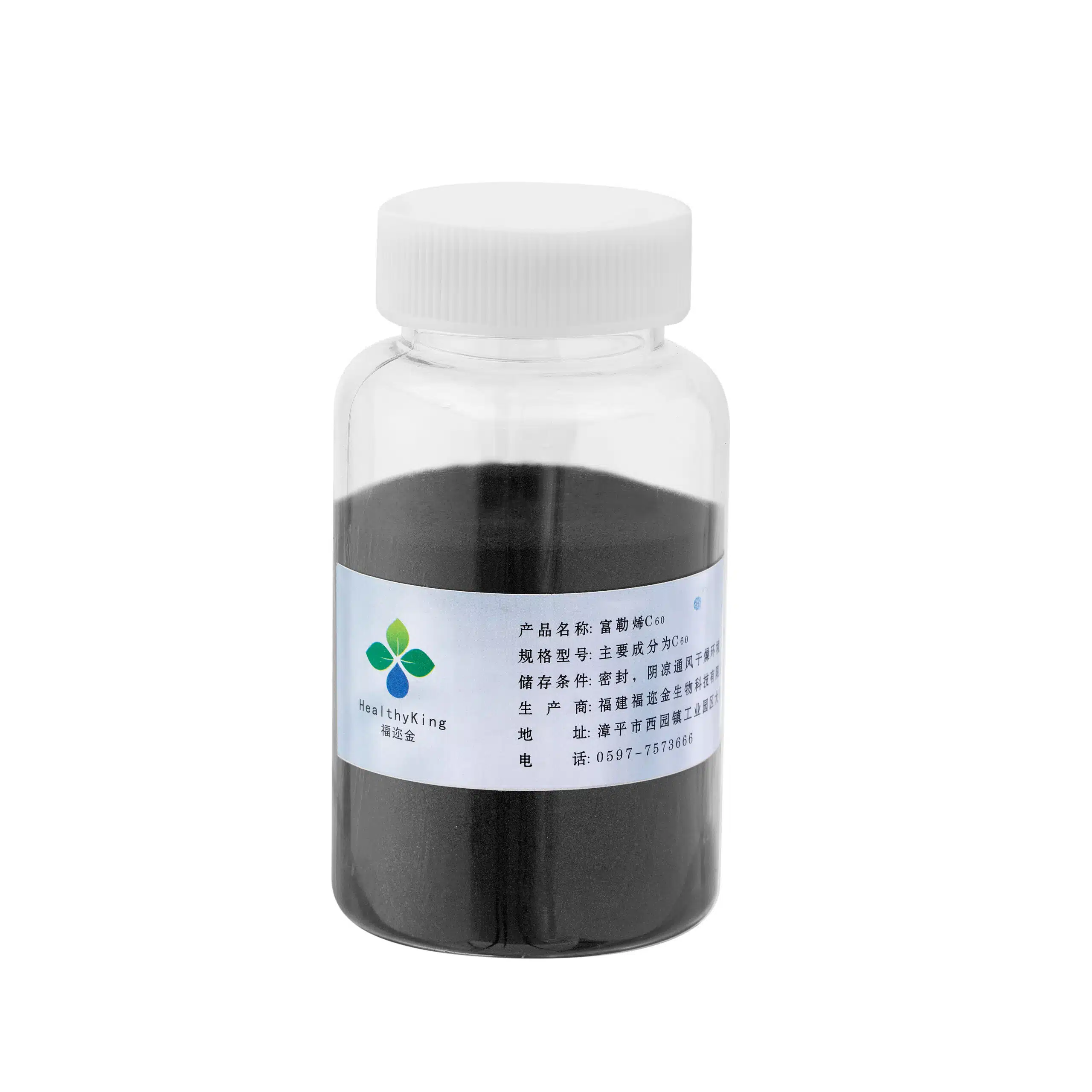
High-purity fullerene C60 is a highly refined nanomaterial designed specifically for the most demanding scientific and industrial applications. This ultra-pure form ensures…
Request product specifications, batch-specific COA, MSDS/SDS, sample availability, packaging details, and international shipping information before confirming your order.
Request DocumentsSubmit your product, purity, quantity, application, destination country, and documentation requirements. Our team will help confirm availability, COA, MSDS/SDS, packaging, and quotation details.