
XCT Insights
Stay Updated
Fullerene research, applications and company updates, delivered occasionally.
Latest from XCT
View all

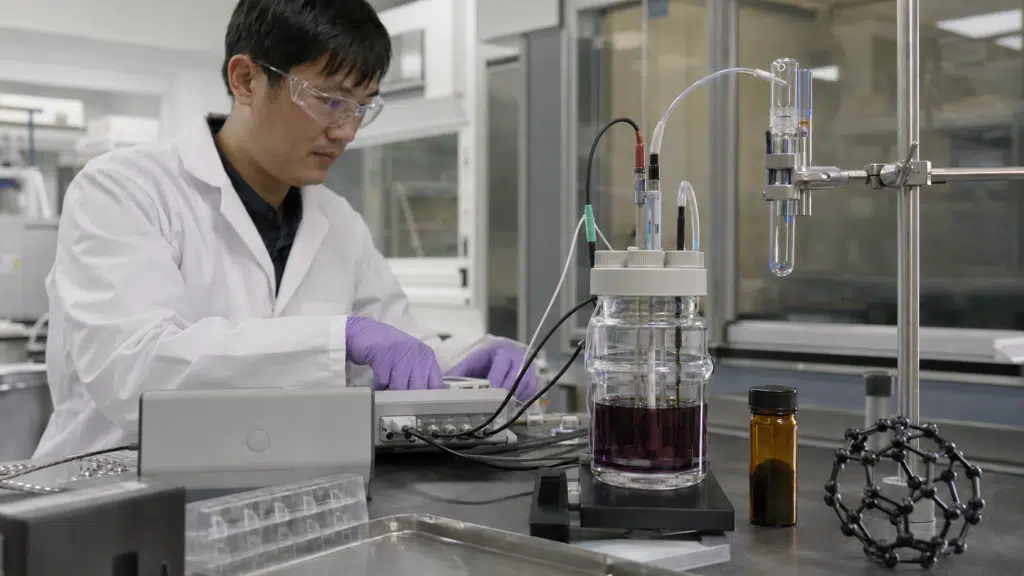
C60 cyclic voltammetry is widely used to investigate how buckminsterfullerene accepts and releases electrons in solution, thin films, molecular derivatives, and donor–acceptor material systems. The experiment can reveal a sequence of reduction processes, help compare related fullerene compounds, and show whether an electrochemical response remains stable during repeated potential scans.
A C60 voltammogram is not a fixed molecular fingerprint independent of the method. Solvent, supporting electrolyte, reference electrode, working-electrode surface, concentration, scan rate, uncompensated resistance, temperature, oxygen, water, and material state can all affect the observed potentials and peak shapes. The most useful interpretation therefore begins with the complete electrochemical system rather than a single voltage copied from a table.
In cyclic voltammetry, the potential of a working electrode is swept through a selected range relative to a reference electrode. The current generated by oxidation, reduction, charging, mass transport, and coupled chemical processes is recorded as the potential changes. After reaching a switching potential, the scan reverses direction.
For a dissolved redox-active molecule, a forward peak can represent electron transfer at the working electrode. A corresponding peak on the reverse scan can indicate that the generated species remains available for the reverse electron-transfer reaction. Peak potential, peak separation, peak-current ratio, scan-rate dependence, and behavior over repeated cycles all contribute to the interpretation.
Cyclic voltammetry does not directly image molecular orbitals or measure an isolated molecule’s electron affinity. It describes an electrode reaction in a specified solvent, electrolyte, reference system, and potential window. These distinctions become important when C60 electrochemical data are compared with photoelectron spectroscopy, optical absorption, theoretical calculations, or finished-device energy levels.
C60 contains a curved, conjugated carbon cage capable of accepting more than one electron. Early electrochemical research described a sequence of reduction waves assigned to stepwise formation of fullerene anions. Jehoulet and colleagues reported that C60 reduction in suitable nonaqueous systems can produce a series of reversible cyclic-voltammetric waves associated with successive one-electron transfers.[1]
The simplified sequence can be represented as:
C60 + e− ⇌ C60−
C60− + e− ⇌ C602−
C602− + e− ⇌ C603−
Further reduction states have been observed under suitable experimental conditions. This does not mean every routine voltammogram will resolve six clean waves. The accessible number depends on the solvent and electrolyte potential window, fullerene solubility, electrode condition, instrument range, concentration, and stability of the increasingly reduced species.
The ability to observe several reductions is one experimental expression of C60’s electron-accepting behavior. It does not independently establish charge mobility, film conductivity, electron-extraction efficiency, or device performance. Those properties also depend on molecular packing, interfaces, morphology, surrounding materials, and the complete device architecture.
Pristine C60 is poorly compatible with water and many polar solvents. Electrochemical studies have therefore used nonaqueous media or solvent mixtures capable of dissolving the fullerene while providing a sufficiently wide potential window.
The solvent must satisfy several requirements at the same time:
A solvent that dissolves C60 well may not dissolve the selected electrolyte equally well. Conversely, a highly conductive electrolyte medium may not maintain C60 as a homogeneous molecular solution. Mixed-solvent systems can address this conflict, but their complete composition must be reported because changing the ratio can alter solvation, conductivity, viscosity, and potential referencing.
XCT’s guide to the solubility of pristine fullerenes in organic solvents explains why visible clarity alone does not prove that two preparations have the same molecular state.
The supporting electrolyte carries ionic current through the solution and reduces migration-related distortion. Its cation, anion, concentration, purity, and compatibility with the solvent can affect the fullerene response.
As C60 is reduced, negatively charged fulleride species form near the working electrode. Electrolyte cations participate in maintaining local electroneutrality, while ion pairing and transport can influence the observed behavior. The supporting electrolyte should therefore be named rather than reduced to the phrase “standard electrochemical conditions.”
Dissolved oxygen is electrochemically reducible and can produce current in the same negative-potential region used for fullerene reduction. It may also react with reduced species. Water can narrow the usable potential window, affect a nonaqueous reference electrode, change electrolyte behavior, and introduce proton-coupled reactions.

When the research question requires well-resolved C60 reductions, prepare and measure the solution under an appropriately controlled inert atmosphere. Degassing method, duration, gas identity, solvent drying, cell sealing, and the time between preparation and measurement should be recorded.
A conventional C60 cyclic-voltammetry experiment uses three electrodes:
| Component | Function | Important controls |
|---|---|---|
| Working electrode | Surface where C60 reduction and reoxidation are measured | Material, area, polishing, cleanliness, pretreatment |
| Reference electrode | Provides the potential reference | Reference chemistry, solvent compatibility, junction, drift |
| Counter electrode | Completes the current path | Material, area, separation from products, cleanliness |
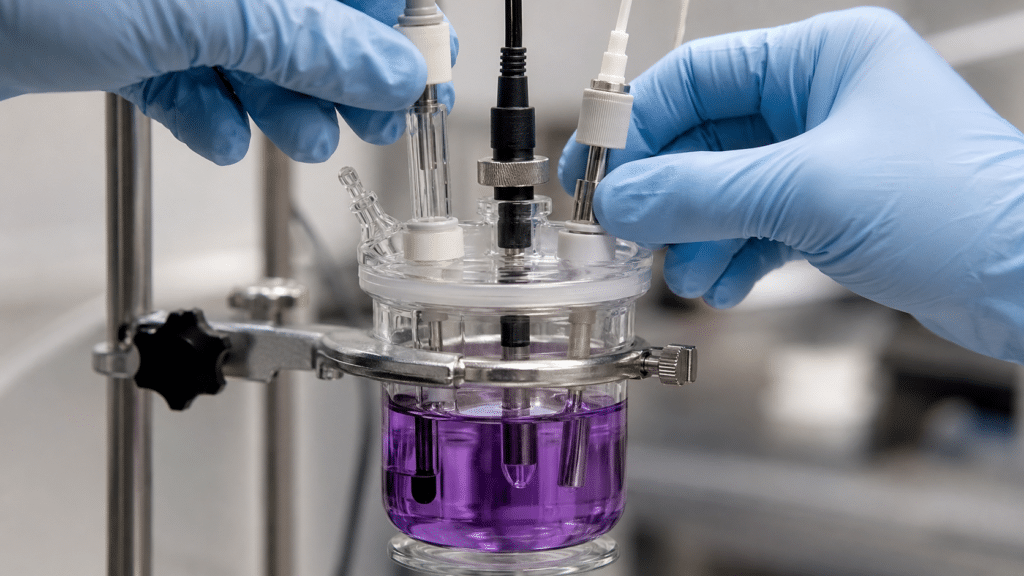
Glassy carbon, platinum, gold, and other conductive surfaces may be used depending on the experiment. Surface history matters. Residual polishing compound, adsorbed fullerene, previous electrolysis products, scratches, or an incompletely cleaned film can change background current and electron-transfer behavior.
Record the electrode material, geometric area, polishing sequence, rinsing procedure, and any electrochemical pretreatment. A blank electrolyte scan after electrode preparation can reveal unexpected background features before C60 is introduced.
A potential is meaningful only relative to a stated reference. Values reported versus Ag/AgCl, saturated calomel, silver-wire pseudoreferences, or the ferrocene/ferrocenium couple cannot be assumed to share the same zero point.
Reference potentials can also change with solvent, electrolyte, junction composition, temperature, and reference condition. Pavlishchuk and Addison showed why conversion among nonaqueous reference systems requires care rather than a universal offset copied without matching conditions.[2]
Including an appropriate internal standard such as ferrocene can provide a reference within the actual experimental solution. Report whether it was present during the C60 scan or added afterward, because an added standard can interact with the sample or alter concentration and solution composition.

The cathodic peak potential describes where the reduction current reaches a maximum under the selected scan conditions. The anodic return peak describes reoxidation of the reduced species. For a well-behaved reversible couple, a formal or midpoint potential is often estimated from the average of the cathodic and anodic peak potentials.
Do not compare a cathodic peak potential from one paper with a midpoint potential from another as if they were the same quantity. The reporting convention must be identified before numerical comparison.
The separation between forward and reverse peaks is commonly used to examine electrochemical reversibility. Larger-than-expected separation can arise from slow electron-transfer kinetics, uncompensated resistance, reference placement, adsorption, coupled chemistry, or instrument and cell limitations.
A visually symmetric pair of peaks is useful evidence, but it does not by itself prove an ideal one-electron reversible process. Examine peak separation across scan rates and compare the behavior with a suitable standard measured in the same cell.
For a stable reversible couple, the reverse peak should reflect recovery of the species produced during the forward scan. A substantially smaller return peak can indicate chemical consumption, adsorption, precipitation, movement outside the diffusion layer, electrode fouling, or an insufficient switching potential.
Baseline selection affects calculated peak current. When several fullerene reductions overlap or the background rises near the solvent limit, peak-current ratios become less certain and should not be overinterpreted.
Repeat scans at several rates rather than relying on a single voltammogram. For a diffusion-controlled dissolved species, peak current commonly changes with the square root of scan rate under the assumptions of the Randles–Ševčík relationship. An adsorbed or surface-confined species follows a different dependence.
A peak that loses its return signal at slow scan rates but appears more reversible at faster rates may involve a chemical reaction following electron transfer. A peak separation that grows with scan rate may indicate kinetic or resistance limitations. These patterns are more informative than labeling a wave “reversible” from one scan.
Diao, Li, and Zhang directly investigated the electrochemical reduction of C60 and C70 under defined conditions, demonstrating the importance of the actual experimental environment.[3] Differences among reported C60 values can arise from:
Meaningful comparison requires matching these variables or explaining how values were converted. Reporting only “C60 reduction potential” removes too much of the experimental context.
Current flowing through a resistive solution creates a potential difference between the controlled electrode potential and the effective potential at the working-electrode surface. This uncompensated resistance can shift and broaden peaks, particularly in low-conductivity media or when the reference electrode is positioned far from the working electrode.
Improve conductivity with a compatible supporting electrolyte, use appropriate cell geometry, place the reference junction reproducibly, and measure or estimate uncompensated resistance. If electronic compensation is applied, report the method and compensation level. Excessive positive feedback can create artificial oscillation or distorted peaks.
Dissolved molecular C60 reaches the electrode mainly through mass transport. A C60 film is already located at or near the electrode surface. Reduction of a film may require counterion motion into the layer, movement of solvent, electronic transport through the film, structural rearrangement, and interaction with the substrate.
Jehoulet and colleagues investigated electrochemistry in fullerene films and demonstrated that film behavior can be more complex than a sequence of freely diffusing solution couples.[1] Film thickness, deposition route, morphology, porosity, electrolyte ion size, adhesion, and cycling history can all affect the response.

A potential measured for dissolved C60 should not automatically be assigned to a thermally evaporated film, composite, or device layer. Researchers working with deposited materials can consult XCT’s guide to thermal evaporation of C60 thin films for the separate process variables governing layer formation.
Covalent functionalization changes the conjugated cage environment, molecular symmetry, solubility, steric environment, and intermolecular interactions. A C60 derivative may therefore show shifted, split, broadened, or less reversible reduction processes compared with pristine C60.
The first reduction potential alone does not completely identify a derivative. Regioisomers, addition number, residual parent C60, over-functionalized products, and electrode interactions can contribute to the voltammogram. Use structural and compositional methods alongside electrochemistry.
For the underlying reaction families, see XCT’s guide to C60 functionalization reactions.
Electrochemical onset potentials are often converted into estimated frontier-orbital energies using an empirical reference relationship. This can be useful for internally consistent comparisons, but the result is not a direct measurement of an isolated molecular orbital.
The estimated value depends on:
Report the equation, reference, calibration, onset method, and experimental conditions. Values derived by different conventions should not be presented as if they were generated on one absolute scale.
Researchers evaluating high-purity Fullerene C60 for electrochemistry should define the intended material state, solvent system, electrode format, comparison material, quantity, and complementary analytical requirements.
Use the XCT request form to provide the target C60 grade, quantity, application, destination, and planned electrochemical or thin-film workflow. XCT can review available material information without treating one supplier specification as a substitute for the complete electrochemical system.
C60 can accept electrons through successive reduction steps, producing fulleride charge states such as C60−, C602− and C603−. The number of waves resolved experimentally depends on the solvent, electrolyte, potential window, material concentration and stability of the reduced species.
A compatible nonaqueous reference or pseudoreference may be used, but its identity and calibration must be reported. An internal standard such as the ferrocene/ferrocenium couple can improve comparability within the actual experimental solution.
Reported potentials can differ because of the reference electrode, solvent, supporting electrolyte, concentration, working electrode, scan rate, uncompensated resistance, temperature and the use of peak, midpoint or onset potentials.
No. Reversible reduction supports electrochemical electron acceptance under the stated conditions. Device performance also depends on film morphology, charge transport, interfaces, surrounding materials and the complete device architecture.
No. Cyclic-voltammetry onset potentials can be converted into an estimated energy using an explicitly stated reference relationship, but the result depends on the reference scale, onset method, solvent, electrolyte and material state.
For B2B procurement of Fullerene C60 (Pure), 99.95% Purity, No metallic residue, buyers should confirm target purity, required quantity, application, destination country, COA, MSDS/SDS, packaging, storage conditions, and shipping requirements before requesting a formal quotation.
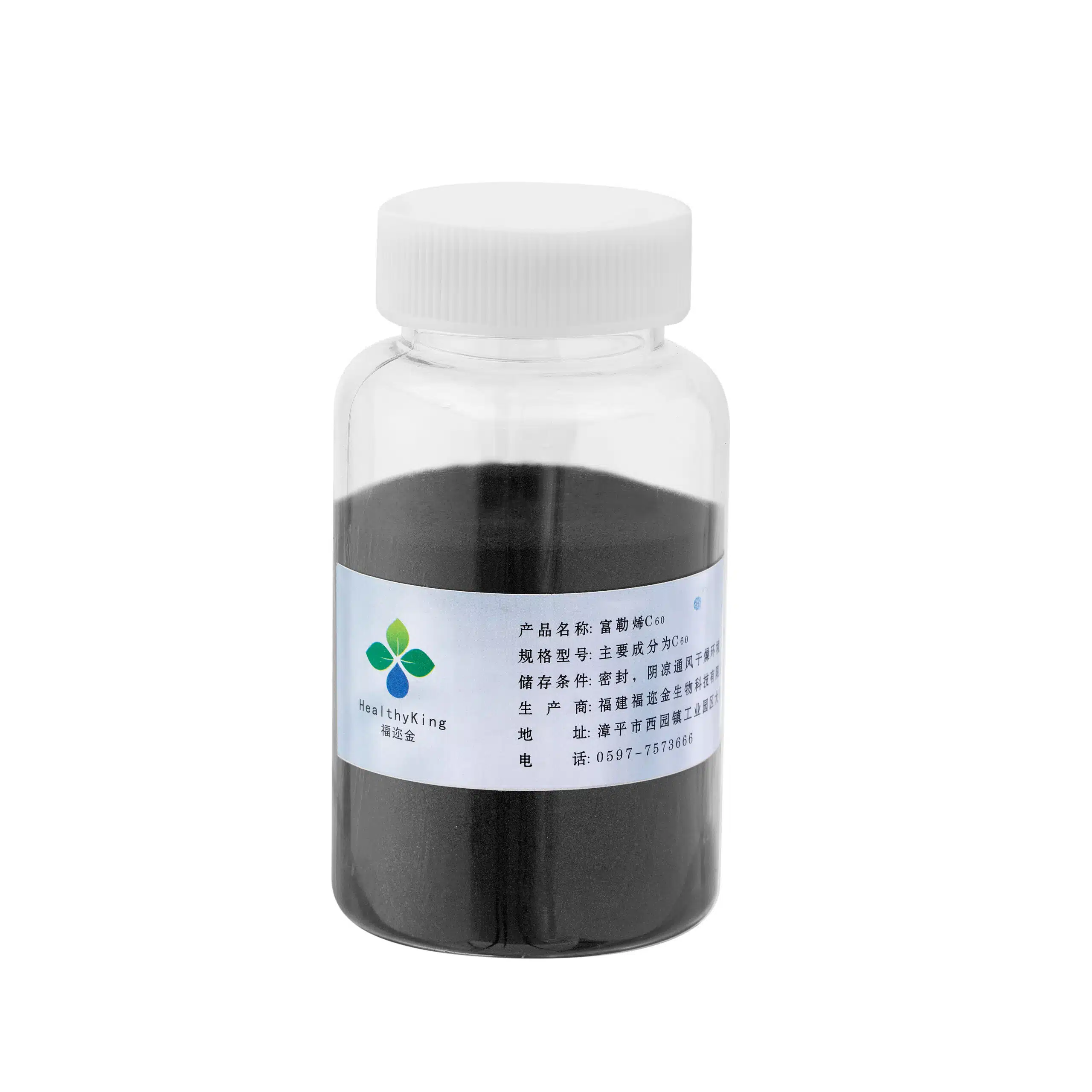
High-purity fullerene C60 is a highly refined nanomaterial designed specifically for the most demanding scientific and industrial applications. This ultra-pure form ensures…
Request product specifications, batch-specific COA, MSDS/SDS, sample availability, packaging details, and international shipping information before confirming your order.
Request DocumentsSubmit your product, purity, quantity, application, destination country, and documentation requirements. Our team will help confirm availability, COA, MSDS/SDS, packaging, and quotation details.