
XCT Insights
Stay Updated
Fullerene research, applications and company updates, delivered occasionally.
Latest from XCT
View all

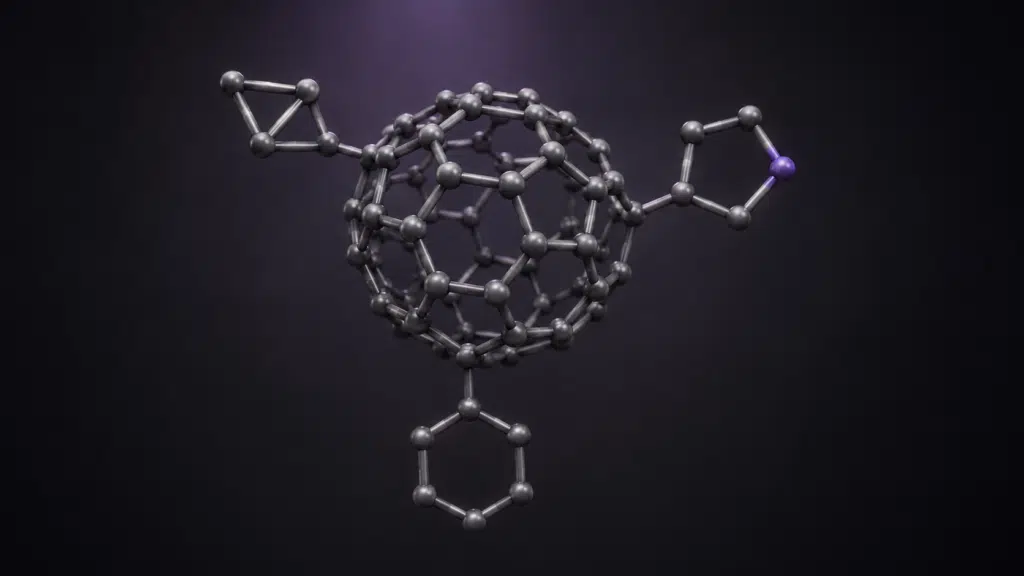
Pristine C60 is a useful electron-deficient carbon scaffold, but many research applications require more than the unmodified cage can provide. A covalently attached group can change solution behavior, provide a point of connection to another molecule, control intermolecular organization or create a fullerene building block for a larger molecular system. The challenge is that “functionalized C60” does not describe one material or one reaction. It covers a structurally diverse family of compounds whose properties depend on the attachment chemistry, addend identity, degree of addition and isomeric composition.
Three reaction platforms appear repeatedly in fullerene chemistry: Bingel or Bingel–Hirsch cyclopropanation, the Prato 1,3-dipolar cycloaddition and Diels–Alder cycloaddition. Each exploits the addition chemistry of the C60 cage, but the products are not interchangeable. Choosing a route therefore begins with the required derivative architecture—not simply with which reaction is most familiar.
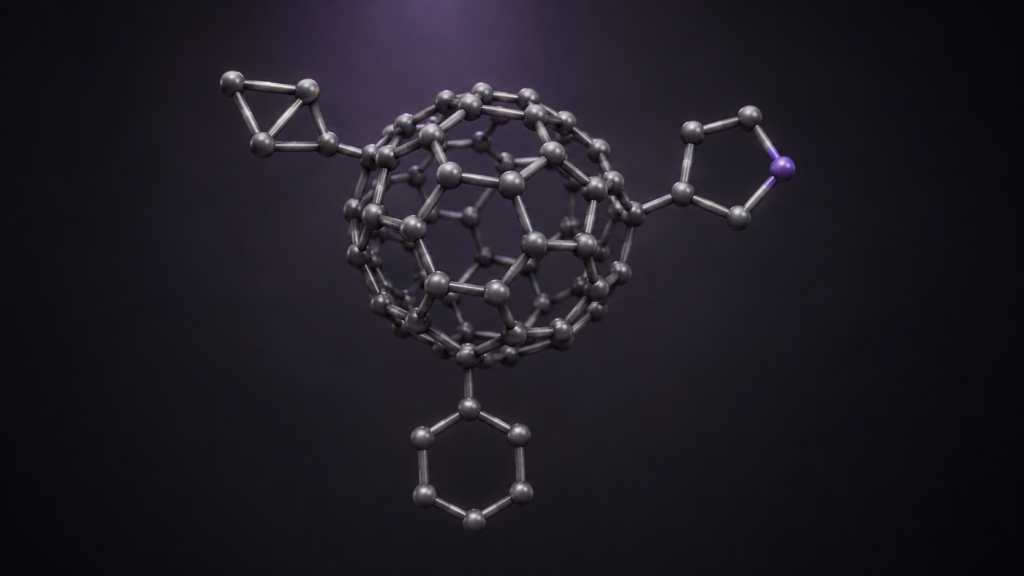
C60 contains 60 carbon atoms arranged in a closed, highly symmetrical cage. Its framework has two distinguishable bond classes: bonds shared by two six-membered rings, commonly called [6,6] bonds, and bonds shared by a five- and a six-membered ring, called [5,6] bonds. The shorter [6,6] bonds have greater alkene-like character and are frequent sites of addition chemistry. Detailed fullerene terminology and atom numbering are governed by IUPAC recommendations rather than by treating the cage as an ordinary planar polyene.[1]
The curved π-system makes C60 an effective electron acceptor and an unusually reactive partner in several cycloaddition and nucleophilic-addition sequences. Covalent addition converts cage carbons at the reaction site from a more conjugated environment into a locally saturated framework. Consequently, every addend changes more than solubility: it can alter symmetry, electronic structure, redox behavior, absorption, molecular packing and the number of remaining reactive sites.
For background on the underlying cage geometry, see what Fullerene C60 is. Researchers planning derivative synthesis should treat pristine C60 and every functionalized product as separate chemical identities.
| Route | Transformation at C60 | Characteristic product | Common design strength | Main control issue |
|---|---|---|---|---|
| Bingel / Bingel–Hirsch | [2+1]-type cyclopropanation, commonly at a [6,6] bond | Methanofullerene | Modular introduction of stabilized carbon-based addends | Over-addition and regioisomer formation |
| Prato | 1,3-dipolar cycloaddition of an azomethine ylide | Fulleropyrrolidine | Multiple substituent positions on the attached pyrrolidine ring | Substituent, stereochemical and addition-pattern complexity |
| Diels–Alder | [4+2] cycloaddition with a conjugated diene | Six-membered ring fused to the fullerene framework | Connection of conjugated or electroactive units | Reversibility, diene dependence and multiple addition |
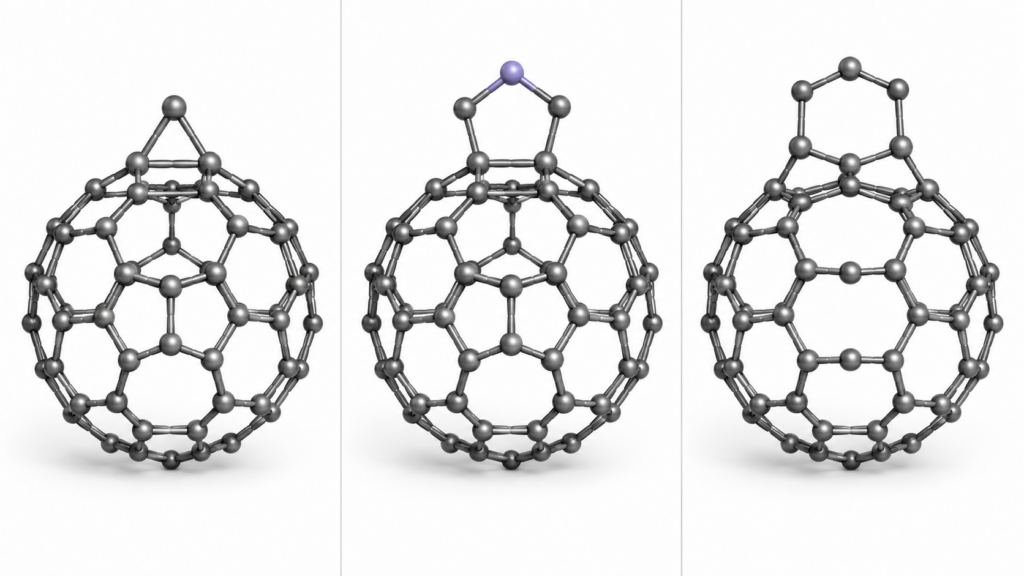
The Bingel reaction is among the most established routes to methanofullerenes. Bingel’s original 1993 report described cyclopropanation of C60 and C70 through a tandem process involving a stabilized halogenated carbon nucleophile.[2] In broad mechanistic terms, a nucleophilic carbon species adds to an electron-deficient C60 bond, followed by ring closure to form a three-membered ring attached across the cage.
The result is not simply “C60 with a side chain.” It is a cyclopropanated fullerene in which the bridge carbon can carry substituents derived from the active-methylene reagent. This architecture is useful because the substituents can be selected to provide ester groups, further coupling handles, polar functionality or molecular components intended for materials research. Methanofullerene chemistry also underlies historically important soluble fullerene acceptors, although a generic Bingel product should not be assumed to possess the device performance of a named derivative such as PCBM.
A Bingel-type route is particularly relevant when the target requires a carbon bridge bearing modular substituents or when cyclopropanated fullerene products fit the downstream molecular design. The reaction has also been extended to controlled multiple additions. That versatility brings an analytical burden: after the first addition, the symmetry of C60 is reduced, and subsequent additions can occur at nonequivalent sites.
A nominal “bis-adduct,” for example, may be a mixture of positional isomers unless the reaction design, tether, template or purification method imposes selectivity. Contemporary research continues to address this problem; a 2024 study demonstrated that even Bingel bis-functionalization may require deliberate control to obtain selected regioisomers.[3] For this reason, reporting only molecular mass or average addend count may conceal chemically important heterogeneity.
The Prato reaction functionalizes C60 through the 1,3-dipolar cycloaddition of an azomethine ylide. The foundational 1993 paper by Maggini, Scorrano and Prato established the synthesis and characterization of fullerene pyrrolidines by this approach.[4] The attached five-membered pyrrolidine ring distinguishes Prato products from the cyclopropane-containing products of a Bingel reaction.
One reason the Prato platform became widely used is its molecular-design flexibility. The precursors used to generate the azomethine ylide can introduce different substituents around the pyrrolidine ring, providing several positions from which solubilizing groups, recognition elements, chromophores or other molecular components may be incorporated. The reaction is therefore valuable when the target is not merely a more soluble C60, but a fullerene embedded in a deliberately constructed molecular architecture.
The label “fulleropyrrolidine” is still too broad for reproducible procurement or experimental comparison. Researchers should identify the substituents, addition number, isolated isomer where relevant, molecular formula and analytical basis for the assignment. If a biological or aqueous research program is contemplated, evidence from one fulleropyrrolidine cannot be transferred automatically to another derivative. Charge, aggregation, counterions, purity and attached groups can substantially change experimental behavior.
This distinction is especially important because fullerene functionalization is frequently discussed as a way to increase polarity or aqueous compatibility. Functionalization can enable such changes, but it does not guarantee water solubility. The outcome depends on the entire derivative structure and its behavior in the intended medium.
In a Diels–Alder reaction, C60 acts as a dienophile toward an appropriate conjugated diene. The [4+2] cycloaddition creates a six-membered ring fused to the fullerene framework. This route has been used to connect π-electron donors and other conjugated units to C60, making it relevant to research on molecular donor–acceptor systems and photoinduced electron transfer.[5]
Diels–Alder chemistry can offer a conceptually direct connection between a diene-containing component and the fullerene acceptor. However, feasibility and product stability depend strongly on the diene and molecular context. Some fullerene Diels–Alder additions can be reversible under suitable conditions. Multiple reactive sites also mean that excess reagent or prolonged conversion can produce additional adducts rather than a single, automatically defined monoadduct.
The route is therefore most compelling when the diene is already integral to the target architecture or when reversibility can be used deliberately. It should not be selected solely because Diels–Alder chemistry is synthetically familiar in conventional planar organic molecules.
The first decision is structural. If the target calls for a cyclopropane bridge with carbon-based substituents, a Bingel-type route is a natural candidate. If a substituted pyrrolidine ring provides the required attachment geometry, the Prato platform may be more appropriate. If the objective is to join C60 directly to a diene-containing conjugated component, Diels–Alder chemistry may provide the better conceptual match.
Monoaddition preserves more of the original cage conjugation and usually presents a simpler isomer problem. Multiple additions can introduce more functional groups, increase polarity or generate multivalent architectures, but they progressively reduce symmetry and create numerous possible addition patterns. Reviews of highly functionalized C60 show that obtaining a desired multiadduct can require carefully designed tethers, templates and substantial chromatographic separation.[6]
“Hexafunctionalized” can also be ambiguous. It may mean six reactions at the cage, six peripheral functional groups attached through fewer cage additions, or a statistical distribution centered around an average substitution level. Publications and specifications should state which meaning applies.
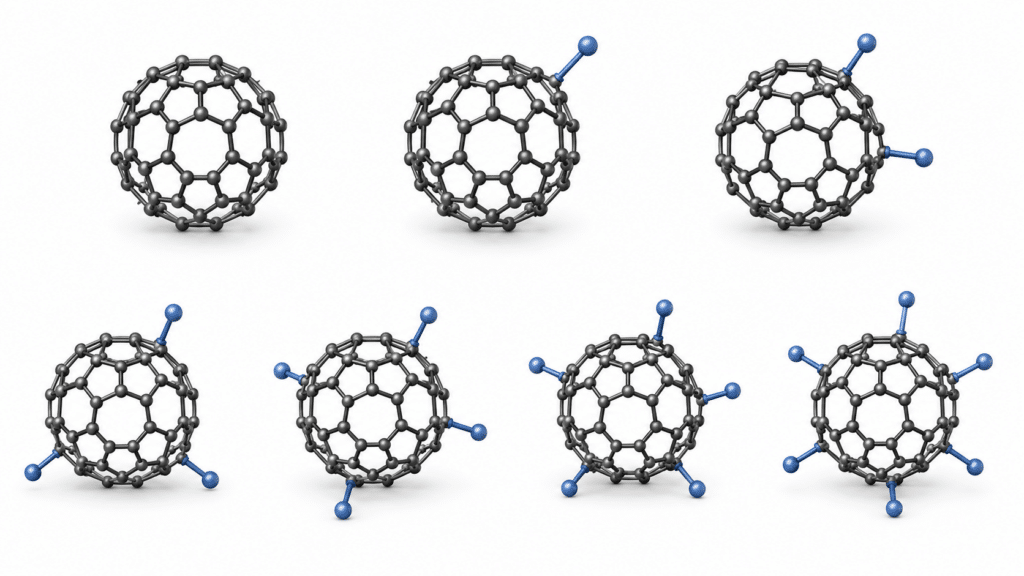
Covalent functionalization trades part of the pristine π-system for new chemical functionality. More addends do not automatically produce a better material. A derivative intended for solution processing may benefit from increased compatibility, while an electronic application may require careful preservation of electron-accepting behavior and control of molecular packing. The appropriate balance can only be assessed against the target experiment or device.
Reaction design should include a realistic plan for separating unreacted C60, the desired adduct, over-functionalized material and positional isomers. HPLC is often useful, but chromatographic purity does not by itself establish molecular structure. A robust assignment may combine chromatography with high-resolution mass spectrometry, NMR spectroscopy, UV–visible spectroscopy and, where needed, additional structural or elemental evidence.
Researchers unfamiliar with the limitations of chromatographic percentages can consult the guide to C60 HPLC purity analysis. The underlying principle applies equally to derivatives: a dominant peak is evidence produced by a specific method, not a universal certificate of identity.
A derivative synthesis starts with the actual composition of the C60 batch, not with the name printed on its container. Residual C70, higher fullerenes or pre-existing oxidized and functionalized species may generate additional reaction products. Insoluble particulate material can complicate concentration control and work-up. Trace elemental impurities may also matter in redox-sensitive, photochemical or catalyst-dependent systems, but their relevance should be evaluated through suitable elemental methods rather than an unqualified “metal-free” label.
The appropriate starting-material package depends on the project. Researchers may need chromatographic information, identity data, solvent or moisture information, elemental results, storage history or a retained sample from the same batch. For a detailed explanation of claim boundaries, see the article on qualifying C60 for precision synthesis.
A publication, quotation request or technical specification should avoid using “functionalized C60” as the complete identity. At minimum, record the cage, attached group or product class, degree of addition, known isomeric composition and characterization methods. IUPAC fullerene numbering becomes important when positional identity must be communicated unambiguously.[1]
For research procurement, it is also useful to separate starting-material requirements from desired derivative specifications. The Fullerene supplies pristine C60 as a research and industrial precursor; this does not imply that every derivative described in the literature is a standard stocked product or that a particular reaction outcome is guaranteed.
If your project uses C60 for Bingel, Prato, Diels–Alder or related derivative chemistry, contact The Fullerene with the planned reaction class, required starting purity, batch quantity and analytical requirements. XCT can confirm the documentation and material options available for evaluation.
The Bingel reaction produces a cyclopropanated methanofullerene, whereas the Prato reaction forms a fulleropyrrolidine through azomethine-ylide 1,3-dipolar cycloaddition. The attached ring structure and available substituent positions are therefore different.
Not automatically. Functionalization can introduce polar or ionic groups, but water solubility depends on the complete derivative structure, number of addends, counterions, aggregation, pH and medium.
The first addition lowers the symmetry of the cage and creates nonequivalent sites for later reactions. Subsequent additions can therefore produce positional isomers and mixtures with different addition numbers.
No. HPLC can separate and quantify detectable components under a defined method, but structural assignment normally requires complementary evidence such as mass spectrometry and NMR spectroscopy.
The necessary purity depends on the reaction and downstream analysis. Sensitive, mechanistic or isomer-selective work generally benefits from well-characterized starting material because fullerene-related impurities can produce additional products.
For B2B procurement of Fullerene C60 (Pure), 99.95% Purity, No metallic residue, buyers should confirm target purity, required quantity, application, destination country, COA, MSDS/SDS, packaging, storage conditions, and shipping requirements before requesting a formal quotation.
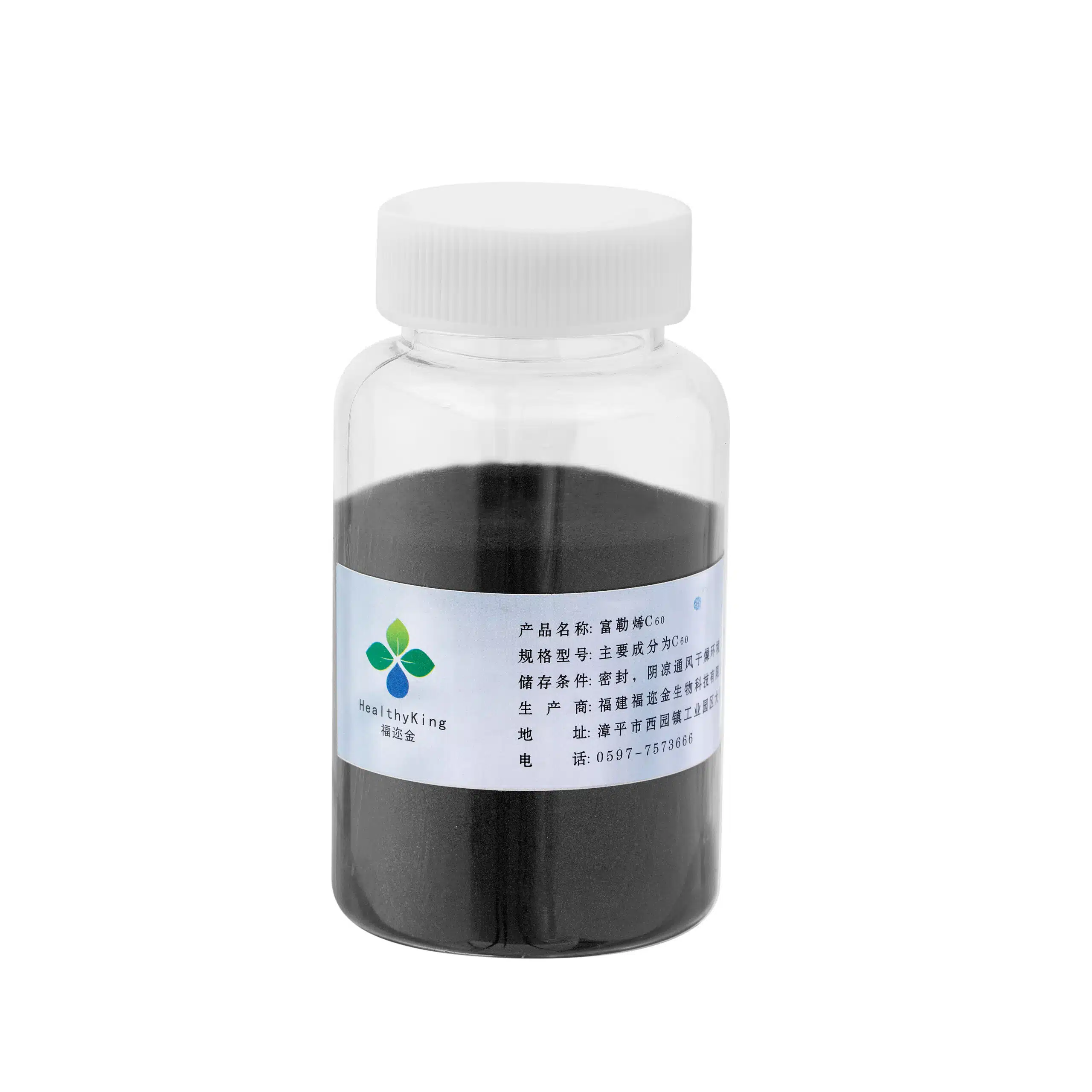
High-purity fullerene C60 is a highly refined nanomaterial designed specifically for the most demanding scientific and industrial applications. This ultra-pure form ensures…
Request product specifications, batch-specific COA, MSDS/SDS, sample availability, packaging details, and international shipping information before confirming your order.
Request DocumentsSubmit your product, purity, quantity, application, destination country, and documentation requirements. Our team will help confirm availability, COA, MSDS/SDS, packaging, and quotation details.