
XCT Insights
Stay Updated
Fullerene research, applications and company updates, delivered occasionally.
Latest from XCT
View all

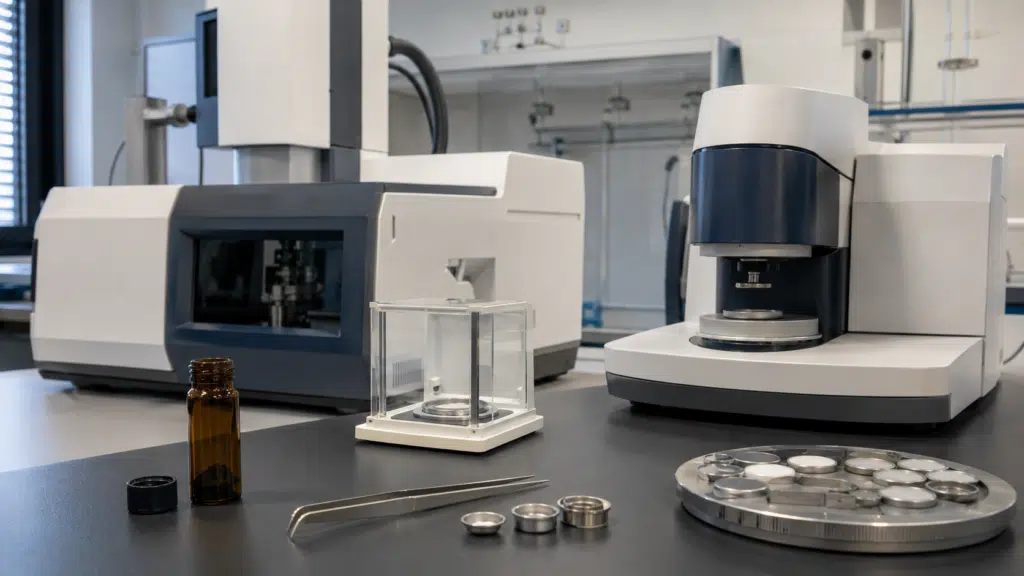
Thermogravimetric analysis and differential scanning calorimetry are widely used to investigate how fullerene C60 responds to controlled heating. These methods can reveal mass-loss events, oxidation behavior, volatile material, heat-flow changes and solid-state transitions relevant to drying, thermal processing and thin-film deposition.
The resulting curves are easy to overinterpret. A mass loss in C60 TGA is not automatically molecular decomposition: under an inert atmosphere, intact C60 can sublime and leave the sample pan. A DSC peak is not automatically a melting point: it may reflect a solid-state transition, oxidation, sublimation-related heat flow, baseline behavior or another process. The atmosphere, heating rate, sample mass and pan configuration all influence the result.
This guide explains what TGA, DTG and DSC measure, how to distinguish possible thermal events, which experimental details must accompany the data, and why complementary analysis is required before assigning a chemical identity to a mass-loss step.
Thermogravimetric analysis, abbreviated TGA, continuously measures sample mass while temperature or time follows a programmed profile in a controlled atmosphere. The primary output is normally a thermogravimetric or TG curve showing mass or mass percentage against temperature or time.
The derivative of that curve, commonly called DTG, displays the rate of mass change. A broad mass-loss region on a TG curve may produce one or several DTG peaks, helping the analyst recognize overlapping events. DTG does not identify the substances leaving the pan; it only shows when the mass-change rate is greatest.
General TGA mechanisms include desorption, evaporation, sublimation, decomposition, oxidation and reduction. Some processes produce mass loss, while reactions involving oxygen can initially produce mass gain. All are kinetic processes, meaning that the measured temperature depends partly on how quickly the experiment is run.1
For C60, TGA may be used to examine:
A TGA curve does not directly identify molecular C60. It must be interpreted alongside the sample history, atmosphere and other analytical evidence.
Differential scanning calorimetry measures the difference in heat flow required to maintain a sample and reference under the programmed temperature conditions. Thermal events may appear as endothermic or exothermic features, depending on the instrument convention and physical process.
DSC can detect events that produce little or no mass change. These may include solid-state ordering transitions, glass transitions in a matrix, crystallization, melting of another component or heat-capacity changes. TGA would not necessarily show such an event because the sample mass may remain constant.
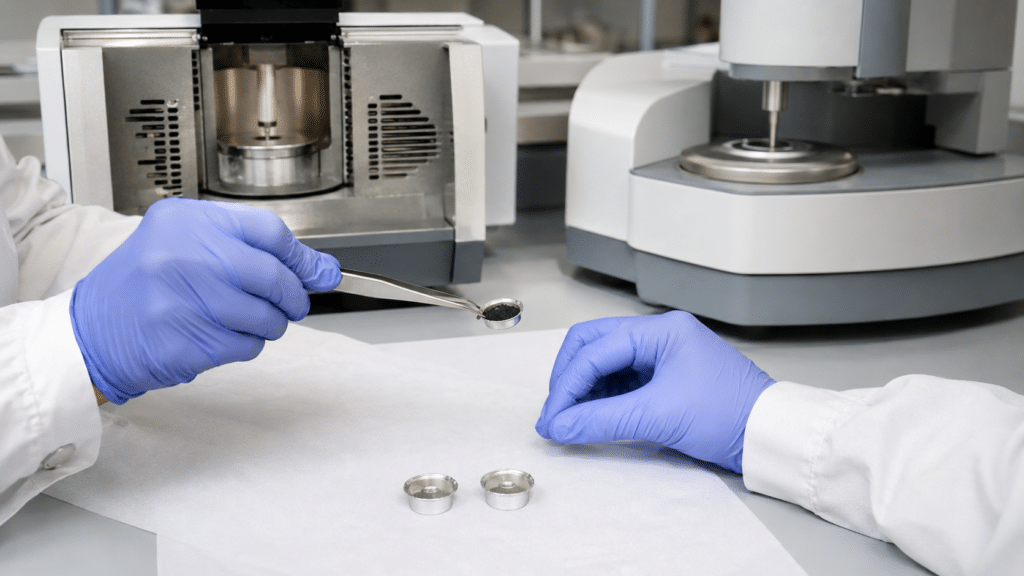
Conversely, TGA may show mass loss without explaining whether the process is endothermic or exothermic. Simultaneous TGA–DSC or TGA–DTA can help correlate heat flow with mass change under the same thermal program.1
DSC studies of fullerite C60 have examined its thermodynamic behavior and solid-state order–disorder transition.2 Such observations concern the specified crystalline material and measurement conditions. They should not be presented as though every C60 powder, film, solvate or composite must produce an identical DSC curve.
One of the most important issues in C60 TGA interpretation is the distinction between sublimation and decomposition.
Sublimation transfers a material directly from the solid phase to the gas phase. If intact C60 molecules leave an open TGA pan, the instrument records a decrease in mass even though the molecular cages have not necessarily decomposed inside the pan.
Decomposition means chemical bonds are broken and new species are formed. Both processes can create substantial mass loss, so the TG curve alone cannot always distinguish them.
Early thermal studies reported that C60 powder heated in inert gases could undergo substantial mass loss associated with sublimation. The reported temperature region depended on the experimental system and should not be treated as a universal fixed sublimation point.3
Several factors affect the apparent onset and rate:
A TGA result obtained at atmospheric pressure under nitrogen should not be used as a direct deposition temperature for a high-vacuum evaporator. Vacuum changes the mass-transfer environment, while deposition equipment measures source behavior and film formation under a different geometry.
The atmosphere is not merely an instrument setting. It can determine the chemical pathway.
Under a suitable inert purge, mass loss may be dominated by volatile release and sublimation over part of the thermal program. In air or oxygen, C60 can react with oxygen and eventually form gaseous oxidation products. Earlier work comparing C60 in oxygen, nitrogen and argon demonstrated substantially different thermal behavior between oxidizing and inert environments.3
Oxidation may involve more than a single immediate mass-loss step. Oxygen-containing species can form before later conversion into volatile products. Research using thermal and spectroscopic methods has investigated C60–oxygen reactions and their products.4
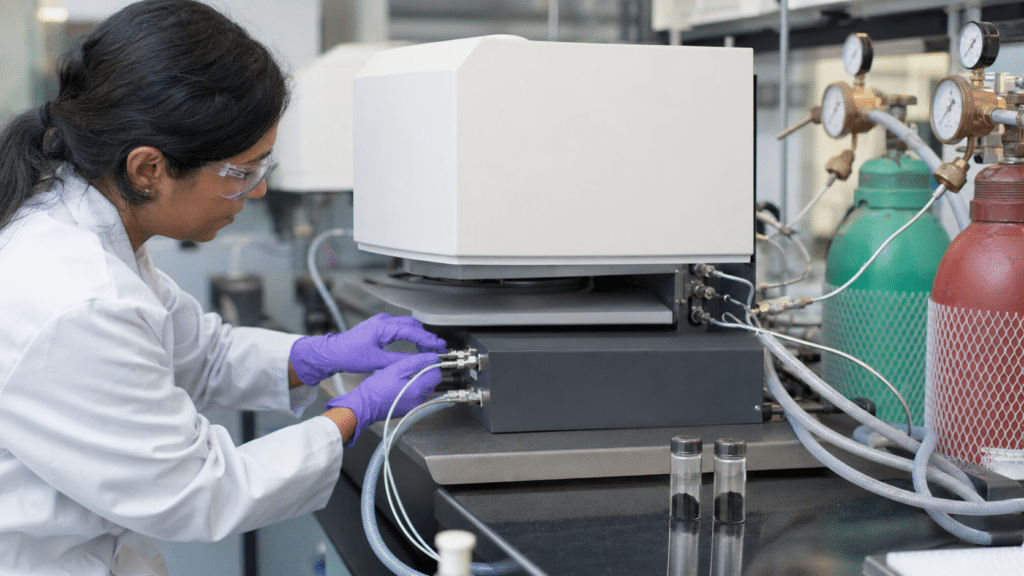
For this reason, phrases such as “C60 decomposes at X°C” are incomplete unless they define:
A laboratory comparing oxidative stability should use a controlled oxygen-containing atmosphere and verified flow conditions. A laboratory examining non-oxidative mass loss should confirm that the inert purge is not materially contaminated with oxygen.
A single thermal event can be described by several temperatures. The onset may be defined by a tangent-intersection method or a selected mass-loss threshold. The DTG peak is the point of maximum mass-loss rate. The endset is associated with completion of the event under the chosen analysis method.
These values are not interchangeable. An onset derived from a 1% mass-loss threshold can differ from a tangent onset. A DTG maximum will occur after mass loss has already begun.
Small changes in baseline selection can materially affect an onset calculated from a shallow mass-loss region. A report should therefore identify both the numerical criterion and the data-processing method rather than stating only a “decomposition temperature.”
When comparing batches or laboratories, the same evaluation method should be used. Otherwise, an apparent temperature difference may result from analysis settings rather than material behavior.
Thermal analysis is dynamic. When the heating rate increases, the furnace and sample move through the temperature range more quickly. Heat-transfer lag and reaction kinetics can shift an observed event toward a different apparent temperature.
A slower heating rate may improve the separation of overlapping processes but extends the analysis time. A faster rate can produce stronger signals in some experiments while reducing event resolution. Neither is inherently correct for every purpose.
Kinetic analysis requires more than fitting a single TGA curve. Robust non-isothermal kinetic studies generally use several heating rates and an appropriate model or model-free method. Even then, the calculated activation parameters describe the investigated pathway and experimental range; they are not universal guarantees of product lifetime.
If the purpose is routine batch comparison, a validated common method is usually more valuable than trying to extract kinetic constants from one run.
The amount and physical distribution of C60 in the pan affect heat and mass transfer. A thick powder layer can develop temperature or concentration gradients that are less significant in a thin, evenly distributed layer.
Sample mass should be large enough to provide a useful signal but small enough to avoid overloading the balance or creating poor thermal contact. The appropriate amount depends on the instrument, pan and method; it should not be copied blindly from an unrelated material.
Pan material and geometry must be chemically and thermally compatible with the experiment. Open pans allow evolved material to escape readily. A lid with a vent changes the transfer path. A hermetically sealed DSC pan can retain volatile material and develop pressure, making it unsuitable for some high-temperature programs.

For DSC comparisons, pan mass and crimping should be consistent between the sample and reference. For TGA, the pan should be clean and correctly tared. Contamination from a previous run can create residue or an unexpected oxidation event.
TA Instruments’ thermal-analysis guidance notes that pan type, purge gas, flow rate and heating rate can affect temperature calibration and data quality.1
A small mass loss at relatively low temperature may indicate adsorbed moisture, residual solvent, included solvent in a crystal structure or another volatile component. It should not automatically be labeled “water” or a specific solvent.
Pristine fullerene molecules are hydrophobic, but a commercial or laboratory sample can still contain surface-associated material or solvent from extraction, purification, recrystallization or handling. Fullerene crystals grown from solution may also retain solvent in ways that depend on preparation history.
The percentage mass loss alone cannot identify the volatile species. A value that happens to match a theoretical solvent stoichiometry is suggestive, not conclusive, unless supported by structural or evolved-gas evidence.
Headspace GC, residual-solvent analysis, TGA coupled with FTIR or mass spectrometry, and controlled drying experiments can help identify the origin of an early event.
TGA records what mass remains; evolved-gas analysis investigates what leaves.
A TGA can be coupled through an appropriate transfer line to FTIR spectroscopy or mass spectrometry. TGA–FTIR examines infrared-active gases, while TGA–MS detects gas-phase ions or fragments within the capabilities of the selected method. The transfer line must be managed carefully to reduce condensation, adsorption and time delay.
Coupling can help distinguish residual solvent from oxidation products or other volatile species. It does not make interpretation automatic. Reference spectra, fragmentation, overlapping signals, background gases and transfer efficiency still require consideration.
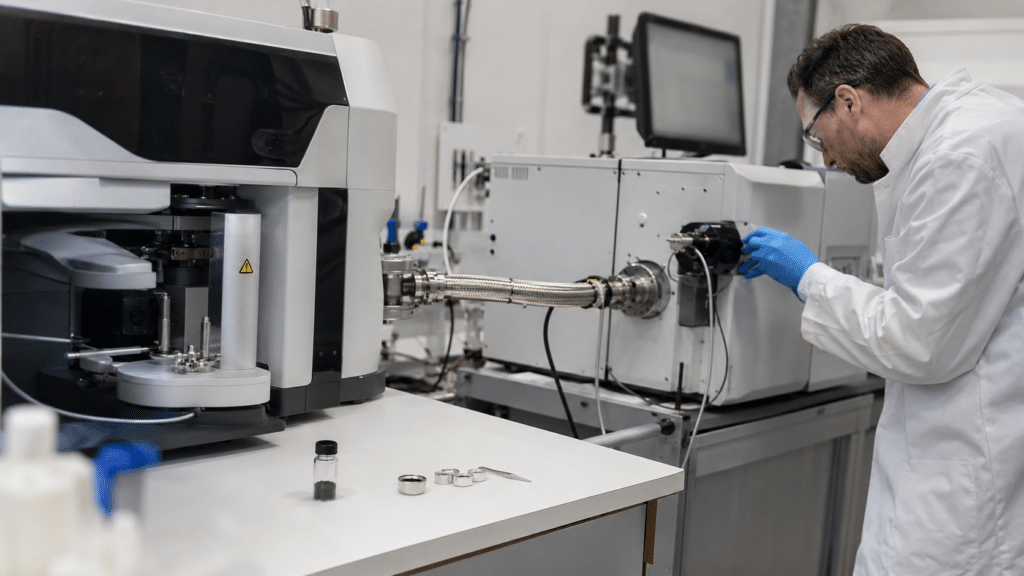
For C60, evolved-gas evidence is particularly valuable when deciding whether a mass-loss step represents intact sublimation, solvent release, cage degradation or oxidation. Collection and subsequent analysis of deposited material can provide further confirmation.
The mass remaining at the end of a TGA program may provide useful compositional evidence, but residue is method-dependent.
Under an inert atmosphere, a carbonaceous or inorganic residue may remain after volatile material has left. Under air, combustible carbon may be removed, leaving certain non-volatile inorganic components. Changing from inert gas to air near the end of a method is sometimes used to separate combustible and non-combustible fractions.
Residue does not automatically identify a metal, oxide or “ash” component. The analyst must know the final atmosphere and temperature and, when necessary, examine the residue using elemental analysis, microscopy or diffraction.
A result described as “zero residue” is also limited by the instrument’s mass resolution, baseline and reporting threshold. It should not be converted into an absolute claim that no inorganic impurity exists.
C60 TGA can reveal mass fractions associated with certain thermal events and may expose unusual volatile content or residue. It does not normally establish molecular C60 purity by itself.
C60, C70 and another thermally similar fullerene may overlap substantially in a TGA method. An organic impurity may sublime or oxidize within the same broad region. A sample can therefore show a clean-looking mass-loss profile while still containing a molecular impurity.
When the question is the proportion of separated fullerene components, C60 HPLC analysis is more directly aligned with the objective. Mass spectrometry, elemental analysis, residual-solvent testing, Raman spectroscopy and XRD address other aspects.
XCT’s C60 characterization guide explains why no single method describes every component of a fullerene powder.
A DSC peak indicates a change in heat flow. Assigning it to a particular phase transition requires supporting evidence.
C60 fullerite undergoes temperature-dependent changes in molecular orientation and crystal order. A thermal feature associated with this behavior may be studied using DSC, but XRD or another structural method is required to determine how the lattice changes.
Film morphology, crystal size, solvent inclusion, pressure history and functionalization can alter the thermal response. A transition observed in crystalline pristine C60 should not be assigned automatically to a derivative or composite containing C60.
When crystalline phase is the question, XCT’s guide to C60 XRD characterization provides the complementary structural boundary.
Thermal analysis can help identify unexpected volatile content and compare how materials behave during controlled heating. It cannot reproduce every condition inside a thermal evaporator.
A TGA furnace commonly operates under a flowing gas near atmospheric pressure, while vacuum deposition operates at much lower pressure and uses a source geometry designed to create molecular flux toward a substrate. Source temperature, ramp profile, crucible, deposition rate, chamber pressure and material loading all affect the process.
Consequently, a TGA onset should not be copied directly into an evaporator recipe. Process development should monitor the actual source, chamber and film. The article on thermal evaporation of C60 thin films addresses those deposition-specific controls.
A reproducible C60 thermal-analysis report should identify the material and physical form, sample mass, pan material and configuration, atmosphere, gas flow, heating rate, temperature range, isothermal segments, instrument model or measurement mode, calibration approach and data-analysis criterion.
It should state whether the reported temperature is an onset, DTG maximum, DSC peak or selected mass-loss threshold. When several events overlap, the fitting or separation procedure should be disclosed.
Repeat measurements and a suitable reference material help demonstrate instrument and method consistency. A comparison among samples is strongest when all samples are tested using the same preparation and thermal program.
C60 TGA and DSC are most useful when the analytical question is defined before the experiment. TGA can investigate mass stability, volatile release, sublimation, oxidation and residue. DSC can detect heat-flow events, including transitions that may produce little mass change. Simultaneous analysis and evolved-gas methods strengthen interpretation.
Researchers evaluating fullerene C60 material can share their intended heating environment, vacuum process, sample form and analytical objective with XCT. Final method validation and process qualification should remain tied to the customer’s actual instrument and application.
Submit a C60 technical requirement or contact XCT to discuss material needs for thermal analysis, vacuum deposition or advanced-material research.
No. C60 can sublime and leave an open sample pan without necessarily decomposing inside it. Oxidation, volatile release and chemical decomposition can also produce mass change, so the atmosphere and complementary evidence must be considered.
No. The observed temperature depends on the atmosphere, heating rate, sample mass, particle form, pan configuration, gas flow, pressure, calibration and the criterion used to define the event.
TGA measures sample mass as temperature or time changes, while DSC measures differences in heat flow. TGA detects processes involving mass change; DSC can also detect thermal events that produce little or no mass change.
Not by itself. TGA may reveal volatile content, unusual mass-loss events or residue, but it normally cannot quantify molecular C60 purity or distinguish every fullerene-related impurity. HPLC and complementary methods are required for those questions.
No. TGA and vacuum deposition use different pressure, source geometry, loading and mass-transfer conditions. TGA can inform process development, but the deposition recipe must be validated in the actual evaporator and film system.
For B2B procurement of Fullerene C60 (Pure), 99.95% Purity, No metallic residue, buyers should confirm target purity, required quantity, application, destination country, COA, MSDS/SDS, packaging, storage conditions, and shipping requirements before requesting a formal quotation.
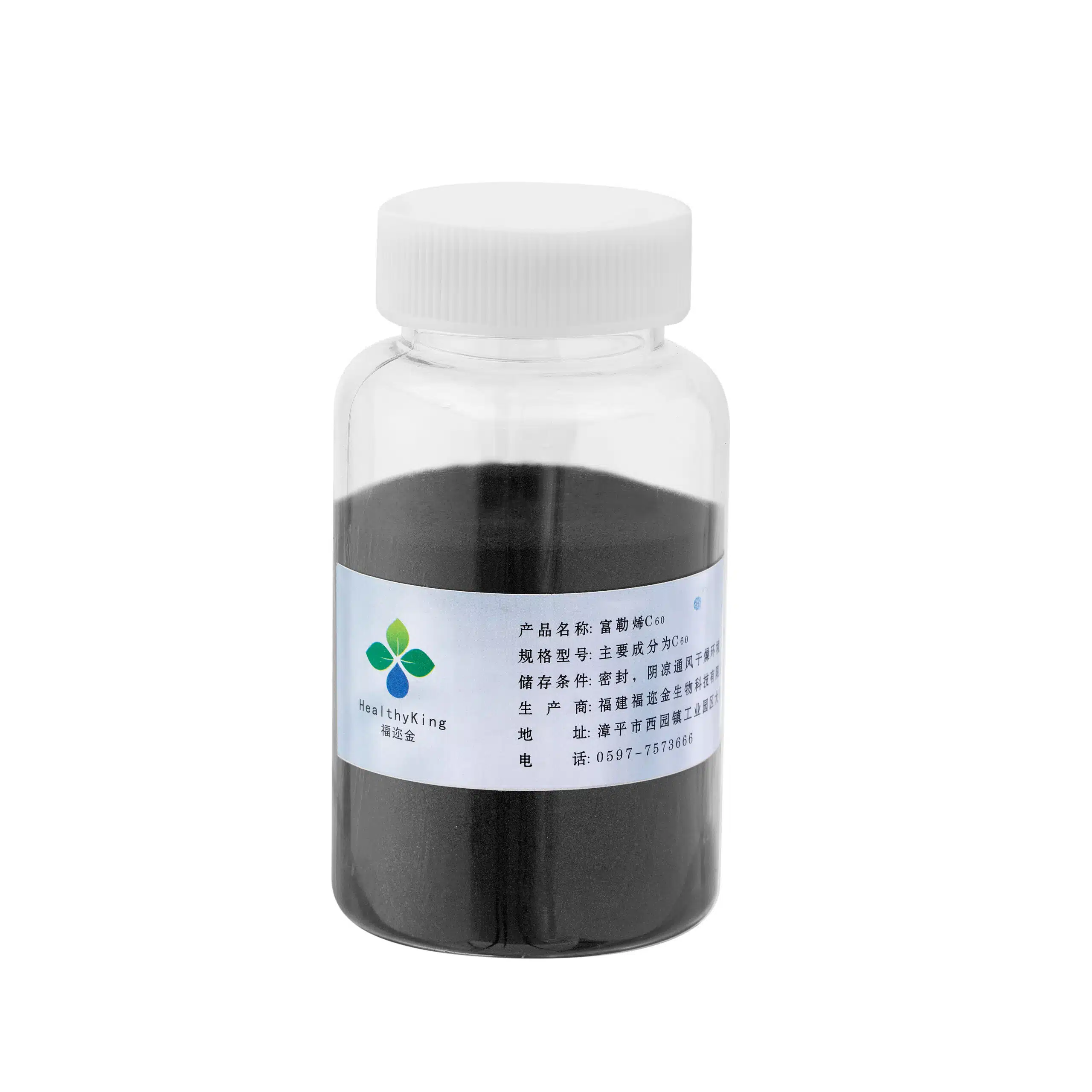
High-purity fullerene C60 is a highly refined nanomaterial designed specifically for the most demanding scientific and industrial applications. This ultra-pure form ensures…
Request product specifications, batch-specific COA, MSDS/SDS, sample availability, packaging details, and international shipping information before confirming your order.
Request DocumentsSubmit your product, purity, quantity, application, destination country, and documentation requirements. Our team will help confirm availability, COA, MSDS/SDS, packaging, and quotation details.