XCT Insights
Stay Updated
Fullerene research, applications and company updates, delivered occasionally.
Latest from XCT
View all
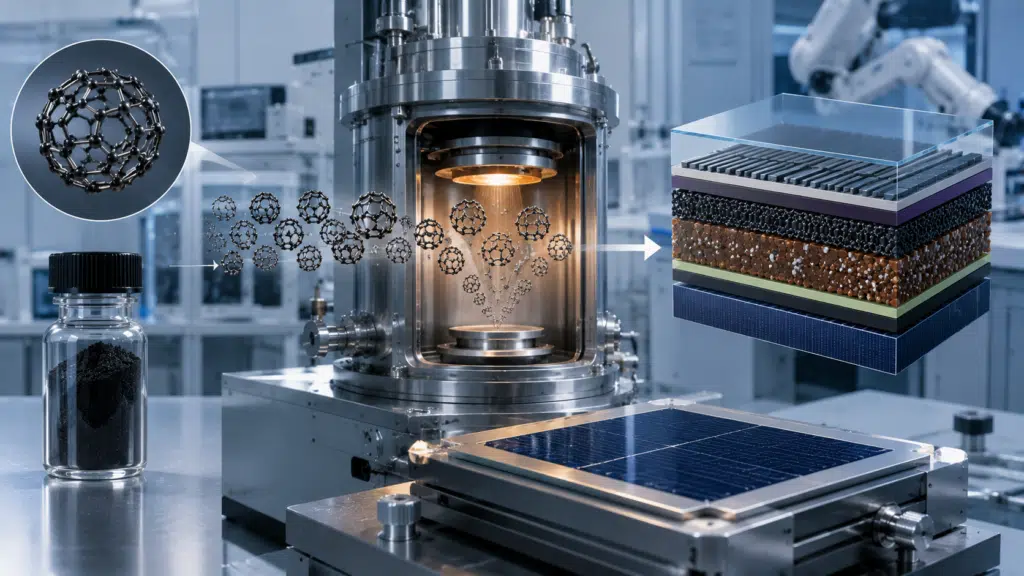
C60 is widely used as an electron-transport material in inverted perovskite solar cells and perovskite–silicon tandem research. As development moves from isolated laboratory cells toward larger devices, repeated deposition and pilot manufacturing, the sourcing question changes. Researchers no longer need only a bottle identified as high-purity C60; they need evidence that the material can be received, stored, evaporated and integrated reproducibly.
No raw material becomes “GW-ready” through a purity label, production-capacity statement or supplier designation alone. Qualification must connect the exact C60 material to the customer’s deposition equipment, device stack, process window, reliability program and change-control system. The practical objective is not abstract perfection. It is control of the material attributes that can alter yield, film formation, electrical performance or long-term manufacturing consistency.
“Photovoltaic grade,” “electronic grade” and “GW-ready” are useful only when they are tied to measurable requirements. They are not universal fullerene standards. Two manufacturers may use the same grade name while applying different chromatographic methods, impurity panels, sampling plans and release limits.
For a perovskite program, scale-up readiness should mean that the buyer has defined the material, analytical and processing attributes relevant to its own device. It should also mean that the supplier can reproduce the agreed material over multiple lots, disclose relevant production changes and support a realistic delivery plan.
This distinction becomes more important as device area increases. Artuk and colleagues reported a certified 28.9% efficiency for a perovskite–silicon tandem with a 60 cm2 active area in 2025.[1] That result demonstrates substantial progress in scalable interface and device design. It does not establish that every perovskite architecture, fullerene source or deposition line has reached commercial manufacturing maturity.
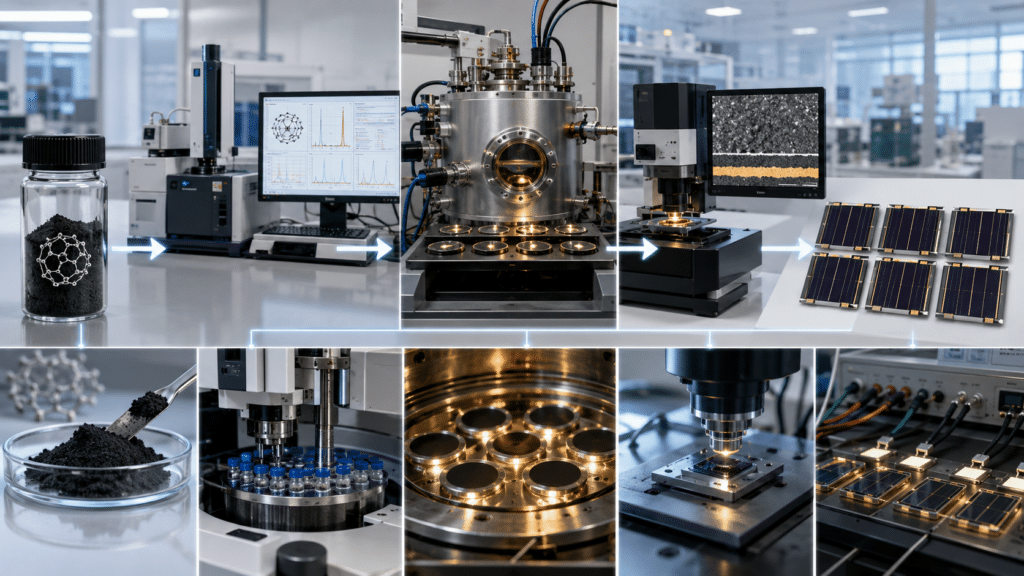
A laboratory efficiency record, pilot-line process and annual factory output are different forms of evidence. Buyers should require the evidence that matches the stage of their own program rather than treating a large-area research result as proof of an established supply chain.
In an inverted, or p–i–n, perovskite device, a C60 layer can accept and transport electrons toward the electron-selective contact while helping block holes. Thermally evaporated C60 can form a conformal molecular layer without exposing the underlying perovskite to a liquid processing solvent.
The performance of this layer is not determined by C60 alone. The perovskite surface, any passivation layer, C60 thickness, deposition rate, substrate temperature and upper contact all affect charge extraction and non-radiative recombination. Research has shown that the perovskite/C60 interface can itself remain a significant recombination site, which is why interlayers and surface treatments are actively studied.[2]
A supplier should therefore not promise that its C60 will automatically eliminate traps, prevent voltage loss or passivate every perovskite composition. Those are properties of a defined interface and device stack. The article on C60 electron-transport layers in perovskite–silicon tandems explains the device-level role in more detail.
Pristine C60 is a defined molecule consisting of sixty carbon atoms in a closed cage. An ordinary C60 raw-material specification should address the proportion of C60 relative to related fullerene components and other relevant impurities. It should not claim an “isomer ratio” for unfunctionalized C60.
C70 is also a defined pristine fullerene, although its lower symmetry creates several non-equivalent carbon environments. That structural feature becomes especially important during functionalization because an addend can attach at different positions.
PCBM introduces another material category. PC61BM is a functionalized C60 derivative, while PC71BM is based on C70 and can occur as a mixture of regioisomers. Bis-adducts and other multiply functionalized products may create still more structural possibilities.
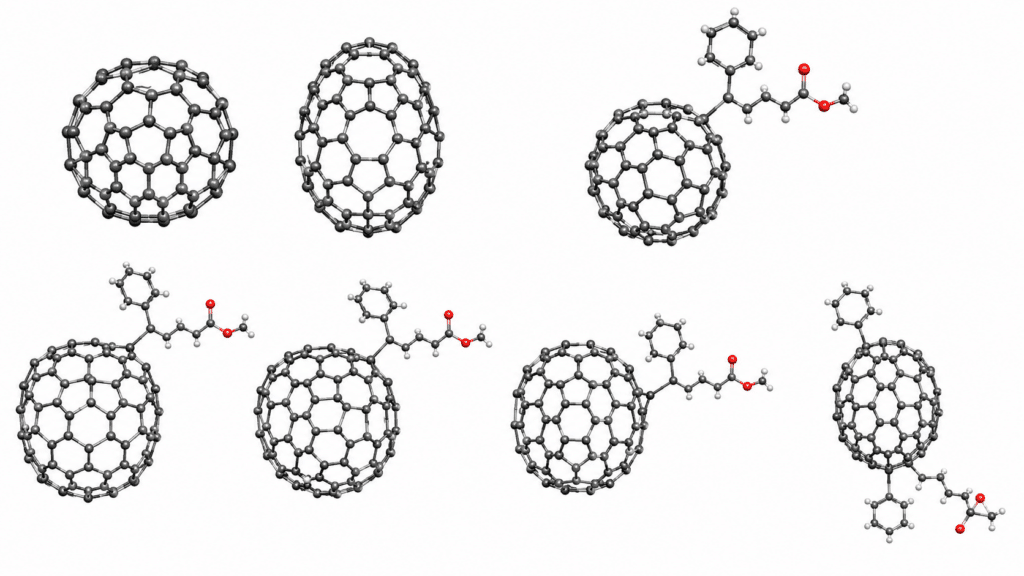
These distinctions matter because an article about thermally evaporated pristine C60 should not borrow blend-morphology or regioisomer conclusions from solution-processed PCBM derivatives. Pristine C60, C70, PC61BM and PC71BM need separate identities, analytical methods and application specifications.
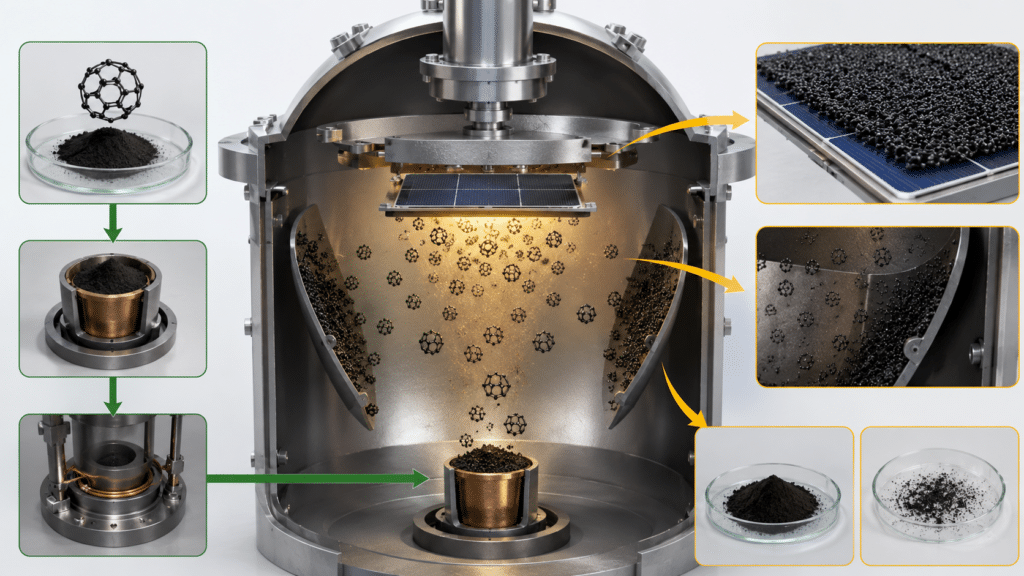
A C60 sample can meet an incoming chromatographic requirement yet behave differently after repeated heating. Source powder may compact, coalesce or change its effective surface area. Material may deposit on the crucible wall, while nonvolatile components can become concentrated in the remaining source.
Said and colleagues studied commercial C60 during repeated thermal evaporation and observed coalescence of an as-received source in their process. The resulting source behavior impaired repeatable deposition. Additional sublimation suppressed the failure in the system examined.[3]
The study provides an important qualification principle, but not a universal purchasing rule. It does not establish that every as-received C60 source will fail, that every sublimed source will pass or that one HPLC threshold predicts evaporation behavior. Crucible geometry, charge mass, heater configuration, pressure, deposition rate and reuse protocol remain part of the result.
A scale-up program should therefore evaluate the source through the intended number of thermal cycles. Useful observations include source appearance, pressure response, temperature or power required to maintain rate, deposition-rate stability, residual mass, spitting or particle generation and film uniformity.
The detailed guide to thermal evaporation of C60 thin films covers these process variables and their relationship to the finished layer.
A result such as 99.9% or 99.95% is meaningful only when the measurement basis is stated. HPLC can separate and quantify C60 relative to components that are soluble, detectable and resolved under the defined chromatographic method. The result may be reported as area percentage rather than a complete mass balance of the powder.
HPLC does not automatically quantify every residual solvent, selected element, insoluble carbonaceous particle or nonvolatile residue. It also does not demonstrate how the material will evaporate or how the deposited layer will perform.
The relevant specification depends on the identified failure modes. A process that repeatedly heats the same source may be sensitive to nonvolatile residue or source morphology. A device stack under investigation for metal-related contamination may require an element-specific method. A supplier change may require stronger molecular-identity and comparative processing data than a routine release lot.
For this reason, the highest nominal purity is not automatically the best-qualified material. A lower numerical grade supported by well-defined methods and proven application performance can provide more useful evidence than a higher percentage with an unclear denominator.
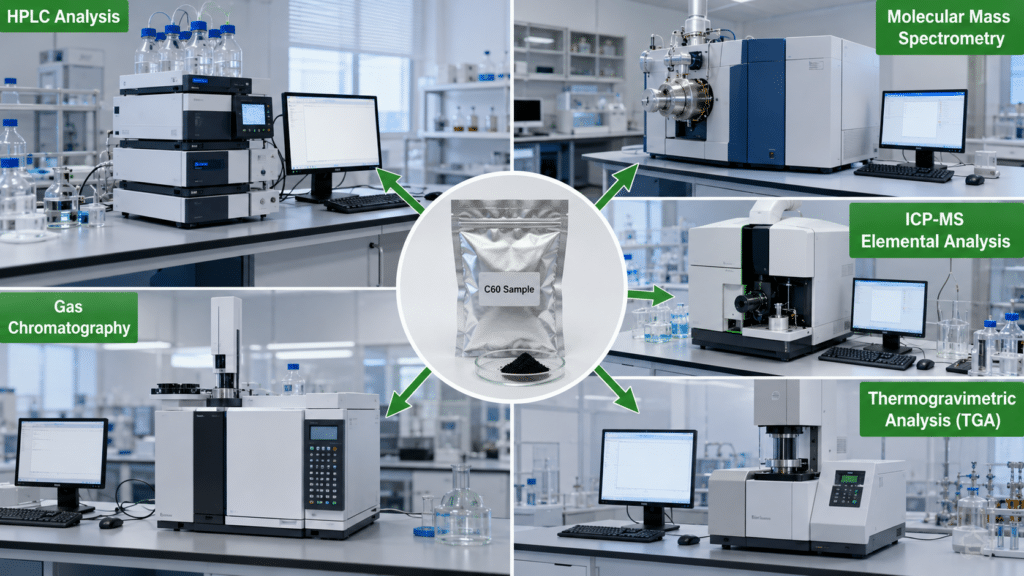
Analytical methods should be assigned to questions they can actually answer.
HPLC can examine C60 and chromatographically resolved fullerene-related components under a defined method. Molecular mass spectrometry can support identity by detecting the expected molecular ion and isotope pattern. Neither method independently proves the complete absence of metals.
ICP-MS or another validated elemental method may be used for specified elements. The sample-preparation and digestion procedure is important because incomplete dissolution can lead to misleading results. Any statement such as “below 0.1 ppm” must identify the tested lot, analyte, method and reporting limit.
Gas chromatography may address specified residual solvents, while thermogravimetric analysis can reveal mass-loss behavior under the stated atmosphere and heating program. These methods answer complementary questions; they are not interchangeable certificates of universal quality.
MALDI-TOF should not be described as proof that a C60 sample contains no metals, polymers or structural defects. Ionization response depends on the instrument and preparation, and components that ionize poorly may be absent from the spectrum even when present in the sample.
The guide to C60 characterization methods provides a fuller explanation of these boundaries.
Elemental contamination can be relevant to electronic materials, but it should not be converted into a universal statement that every trace metal produces the same deep-trap energy or permanently captures every electron.
The electronic effect of a contaminant depends on its chemical form, concentration, location and interaction with the C60 film, perovskite, electrode and other interfaces. An element present as an insoluble particle may not behave like the same element incorporated into a molecular complex or deposited at an active interface.
A defensible qualification program begins by identifying which elements could plausibly enter from feedstocks, reactors, purification equipment, containers or handling. The buyer and supplier can then agree on a relevant analyte panel and reporting limits. Device testing should determine whether observed concentrations correlate with film or electrical failures.
“Zero metal” should not be used unless zero is defined operationally. Analytical methods report results relative to detection or quantification limits; they do not demonstrate the absolute absence of every metal atom.
Batch consistency does not mean that two certificates display the same rounded purity percentage. It means that selected material attributes remain within justified limits and that the manufacturing process produces consistent application behavior.
Initial qualification should ordinarily examine several independent production lots rather than repeated samples from one container. The study can compare fullerene composition, relevant elemental and solvent results, thermal behavior, source handling, deposition-rate control, film uniformity and device distributions.
Sampling is part of the evidence. A large lot may require samples from more than one container or filling stage. Retained material can support investigations if a later deposition or device anomaly appears.
Device data should be assessed as distributions rather than only champion results. Median performance, spread, yield and identified failure modes are more informative for manufacturing than the best cell produced from each lot.
The acceptance limits should be based on actual process sensitivity where possible. Copying another laboratory’s purity limit without reproducing its equipment and device stack may create either unnecessary cost or inadequate control.
A qualified material can change even when its commercial product name remains the same. Relevant changes may include the fullerene-formation route, extraction solvent, chromatography conditions, sublimation procedure, drying, production equipment, packaging, manufacturing location or upstream feedstock.
The supply agreement should define which changes require prior notification and whether requalification is necessary. A change does not automatically mean the new material is inferior. It means the existing evidence may no longer cover the material received.
Buyers should also distinguish a temporary sample from routine production. A specially selected or additionally processed qualification batch is not representative unless the supplier can reproduce that preparation for normal orders.
IEC 62941 emphasizes the selection and control of materials and manufacturing processes as part of maintaining confidence in photovoltaic-module consistency.[4] Although the standard applies at module-manufacturing level rather than serving as a C60 specification, its change-control principle is directly relevant to critical incoming materials.
GW-scale electrical output does not translate directly into a fixed mass of C60. Material demand depends on the module architecture, active area per watt, C60 thickness, film density, deposition utilization, chamber geometry, source residue, process yield, maintenance losses and whether C60 is used in every product configuration.
A transparent estimate can begin with the coated area and nominal film:
Deposited C60 mass = coated area × film thickness × film density.
The purchased quantity will be higher than the mass incorporated into the finished device because a vacuum-deposition process may place material on masks, shields and chamber surfaces, retain material in the source or reject material during qualification and maintenance. The appropriate utilization factor must come from the intended equipment rather than a generic industry assumption.
This calculation should be separated from safety stock, pilot trials and yield losses. It should also be recalculated if device power density, layer thickness or deposition architecture changes. A supplier should not claim that a particular tonnage is required for one gigawatt without disclosing these inputs.
Packaging cannot create chemical purity, but it can preserve the qualified material state. Container composition, closure, headspace, light exposure, humidity control and repeated opening may matter depending on the internal process.
A pilot line should define how containers are received, quarantined, sampled and released. Material transferred to a deposition source should be protected from uncontrolled cross-contamination. Tools and crucibles need documented cleaning or replacement procedures.
Storage studies should reflect the intended duration and packaging rather than relying only on the chemical stability of the isolated C60 molecule. A change in powder morphology, adsorbed volatile content or handling history may affect source loading even when molecular C60 remains chemically intact.
Passing an incoming C60 specification does not demonstrate that a photovoltaic module will withstand outdoor operation. Moisture, heat, light, electrical bias, encapsulation, ion migration, mechanical stress and complete-stack interactions remain device and module questions.
The IEC 61215 series addresses design qualification and type approval for terrestrial photovoltaic modules, while IEC 61730 addresses module safety requirements.[5][6] These frameworks do not certify a C60 powder as “GW-ready,” and qualification test results are not a quantitative prediction of module lifetime.
Material qualification and module qualification should therefore be connected but kept distinct. A fullerene supplier can provide controlled starting material and relevant evidence. The device manufacturer remains responsible for showing that the complete stack, process and module meet the intended performance, reliability and safety requirements.
Terms such as “plant-based,” “green,” “carbon-neutral” and “low-energy” should not be inferred from the name of a feedstock or formation route. Fullerene production includes cage formation, soot collection, solvent extraction, separation, purification, drying and waste treatment.
Anctil and colleagues showed that separation, purification and functionalization can contribute substantially to the embodied energy of fullerene materials.[7] The values in that study belong to the modeled routes and assumptions; they should not be applied as current performance data for another manufacturer.
A present supplier claim requires a defined product, system boundary, energy and material inventory, allocation method and current production data. Renewable or biological feedstock alone does not establish product-level carbon neutrality.
A robust program begins by defining the exact material and intended process. For thermally evaporated pristine C60, the specification should not be copied from a solution-processed PCBM application.
This sequence turns “high-purity C60” from a marketing description into a controlled manufacturing input. It also allows specifications to evolve when process data show that an attribute is irrelevant, insufficiently controlled or more important than initially expected.
The Fullerene supplies defined C60 and C70 materials for scientific and industrial evaluation. Supported by a globally respected scientific research network, The Fullerene represents a leading level of fullerene products and technical capability in Asia.
XCT can discuss molecular identity, intended deposition route, purity basis, packaging and available analytical information. A raw material should be represented as suitable for a specific photovoltaic process only after the customer has completed the necessary evaporation, device and reliability qualification.
Share the intended device architecture, deposition method, source-reuse protocol, target material attributes and expected qualification volume with The Fullerene. XCT can discuss an appropriate C60 starting material and available supporting information without treating a grade label as a device-performance guarantee.
Discuss Your Perovskite C60 Requirement
Suitability requires more than a purity label. The material should meet defined analytical requirements and demonstrate repeatable source handling, deposition, film formation and device performance across relevant production lots.
No. Pristine C60 is one defined cage molecule. Regioisomer control becomes relevant for functionalized fullerene derivatives such as some C70-based adducts, not for unfunctionalized C60 itself.
No. HPLC can evaluate chromatographically resolved fullerene-related components under a defined method. Specified metals require an appropriate elemental method with validated sample preparation and stated reporting limits.
No. Repeated evaporation also depends on source morphology, nonvolatile material, crucible conditions, thermal history and the deposition system. It must be tested in the intended process.
No. Capacity must be distinguished from qualified, saleable output. Manufacturing readiness also requires multi-lot consistency, application validation, delivery evidence, change control and an agreed response to deviations.
For B2B procurement of Fullerene C60 (Pure), 99.95% Purity, No metallic residue, buyers should confirm target purity, required quantity, application, destination country, COA, MSDS/SDS, packaging, storage conditions, and shipping requirements before requesting a formal quotation.
High-purity fullerene C60 is a highly refined nanomaterial designed specifically for the most demanding scientific and industrial applications. This ultra-pure form ensures…
Request product specifications, batch-specific COA, MSDS/SDS, sample availability, packaging details, and international shipping information before confirming your order.
Request DocumentsSubmit your product, purity, quantity, application, destination country, and documentation requirements. Our team will help confirm availability, COA, MSDS/SDS, packaging, and quotation details.