XCT Insights
Stay Updated
Fullerene research, applications and company updates, delivered occasionally.
Latest from XCT
View all

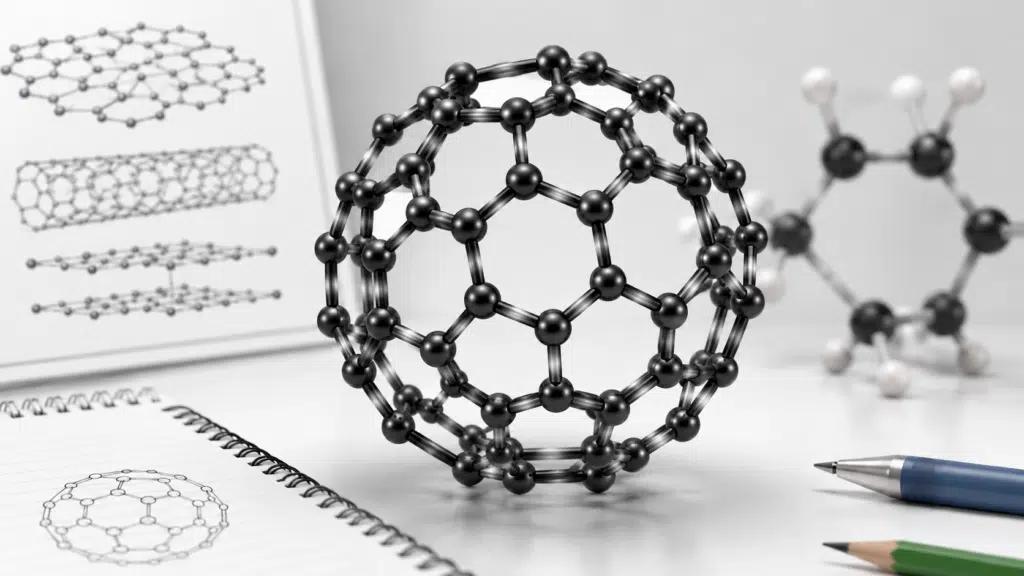
Buckminsterfullerene GCSE questions usually ask students to understand what buckminsterfullerene is, how its structure is different from diamond and graphite, and why its hollow molecular shape gives it unusual properties. The short answer is simple: buckminsterfullerene is a molecule made from 60 carbon atoms arranged in a hollow spherical cage.
Its chemical formula is C60, which is why it is also called Fullerene C60, Carbon 60, C60 fullerene, or simply C60. The molecule looks similar to a football because it is made from pentagons and hexagons joined together in a closed cage.
In GCSE Chemistry, buckminsterfullerene is usually studied as part of carbon allotropes. Carbon allotropes are different structural forms of carbon. Diamond, graphite, graphene, carbon nanotubes, and fullerenes are all made from carbon, but their atoms are arranged differently. That difference in structure gives each allotrope different properties.
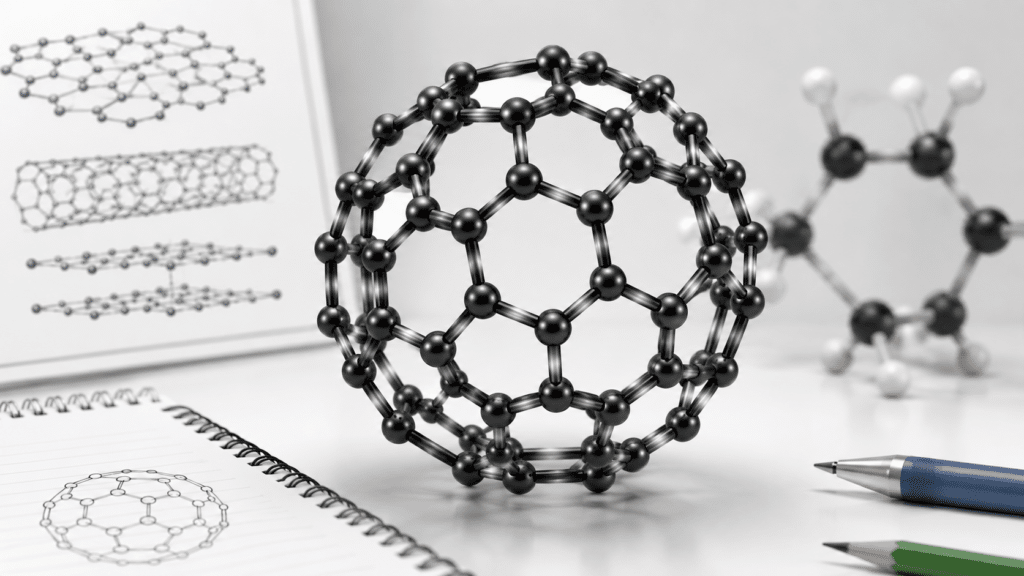
Buckminsterfullerene is a type of fullerene. A fullerene is a molecule made only from carbon atoms, arranged into a hollow shape. Fullerenes may form spheres, tubes, or other cage-like structures.
Buckminsterfullerene is the most famous fullerene. It contains exactly 60 carbon atoms, so its formula is C60. NIST lists buckminsterfullerene with the formula C60 and molecular weight 720.6420.[1]
The molecule is hollow, meaning there is empty space inside the carbon cage. It is not a giant covalent structure like diamond. It is also not made of flat layers like graphite. Instead, it exists as separate C60 molecules.
For GCSE purposes, the most important definition is:
Buckminsterfullerene is a hollow spherical molecule made from 60 carbon atoms.
Buckminsterfullerene is named after the architect Richard Buckminster Fuller. He designed geodesic domes, which are dome-like structures made from repeating geometric shapes. The C60 molecule has a similar geometric pattern, so scientists named it after him.
The molecule is also called a “buckyball” because of its ball-like shape. In exams, however, it is better to use the scientific name buckminsterfullerene or C60 unless the question uses the informal name.
The structure of buckminsterfullerene is the key GCSE idea. C60 has a closed cage structure made from carbon rings. It contains:
The structure is often compared with a football. A traditional football has pentagonal and hexagonal panels. C60 has a similar pattern, except that the corners are carbon atoms and the edges represent covalent bonds.
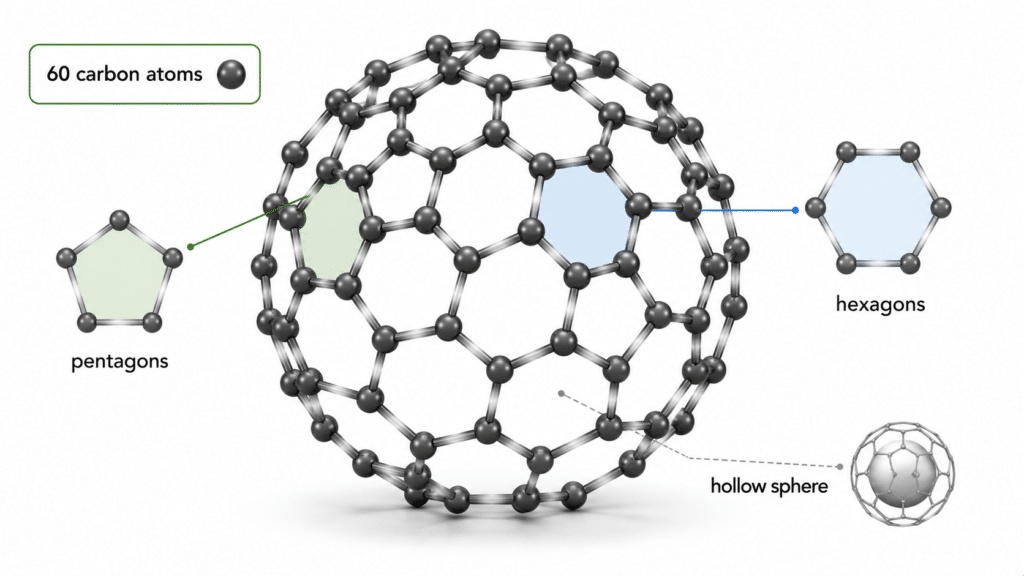
AQA describes fullerenes as molecules of carbon atoms with hollow shapes and notes that their structures are based on hexagonal rings of carbon atoms, although they may also contain rings with five or seven carbon atoms.[2] Buckminsterfullerene is the classic GCSE example because it has a clear spherical cage structure.
Yes. Buckminsterfullerene is an allotrope of carbon.
An allotrope is a different structural form of the same element in the same physical state. Diamond, graphite, graphene, carbon nanotubes, and fullerenes are all carbon allotropes because they are all made from carbon atoms, but the atoms are arranged in different ways.
| Carbon Allotrope | Structure | Key GCSE Property |
|---|---|---|
| Diamond | Giant 3D covalent lattice | Very hard and does not conduct electricity |
| Graphite | Layers of carbon atoms | Soft and conducts electricity |
| Graphene | Single layer of graphite | Very strong and conducts electricity |
| Carbon nanotube | Tube-shaped carbon structure | Strong and can conduct electricity |
| Buckminsterfullerene | Hollow C60 molecular cage | Small molecular carbon cage with nanoscale structure |
The key GCSE point is that different structures cause different properties. Buckminsterfullerene behaves differently from diamond and graphite because it consists of separate molecules rather than a giant covalent network.
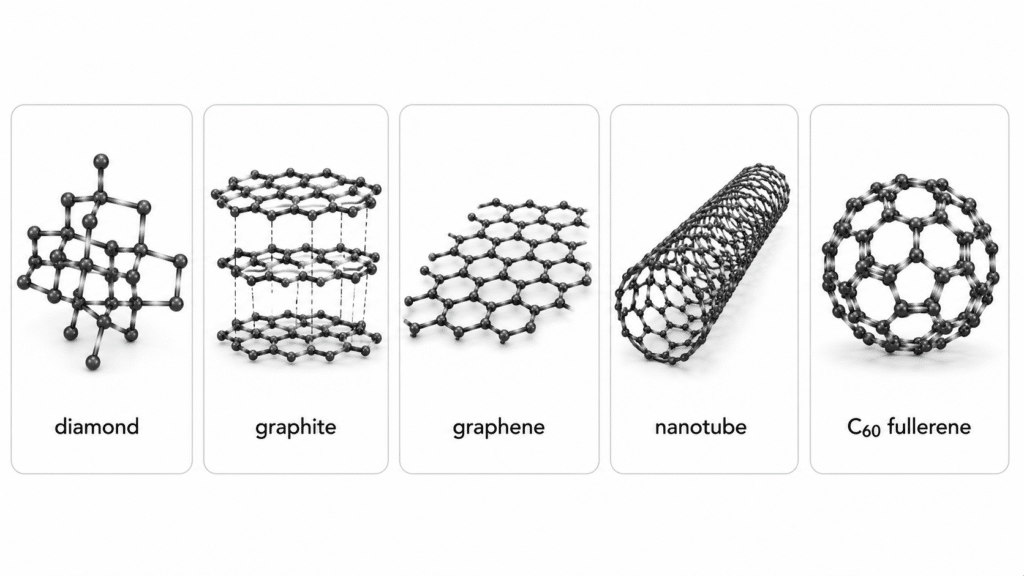
Diamond is a giant covalent structure. Each carbon atom in diamond is covalently bonded to four other carbon atoms. This creates a strong three-dimensional lattice. Because many strong covalent bonds must be broken to change the structure, diamond is extremely hard and has a very high melting point.
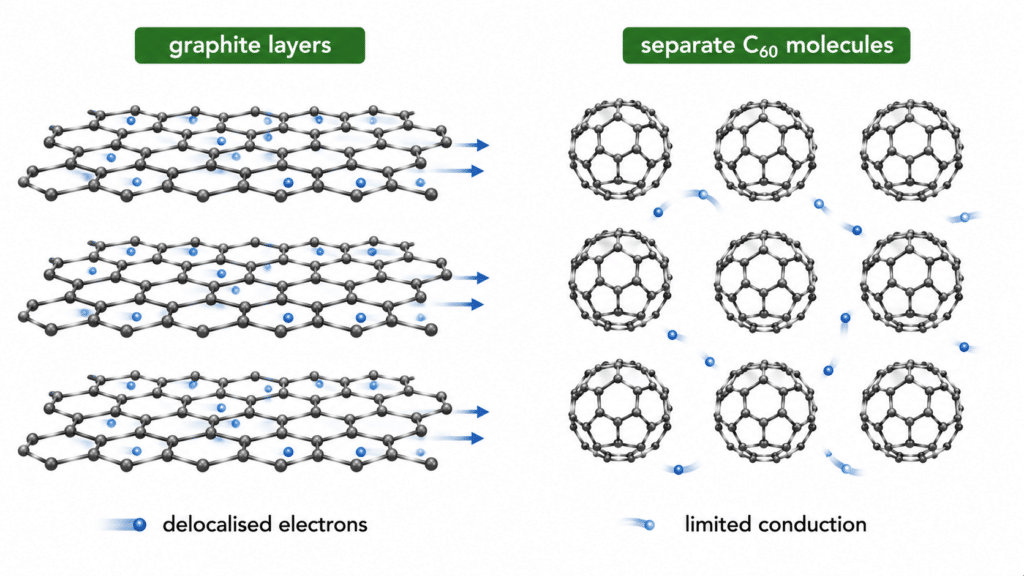
Buckminsterfullerene is different. Each C60 molecule is a separate molecular cage. The atoms inside one C60 molecule are joined by strong covalent bonds, but the separate C60 molecules are held together by weaker intermolecular forces.
This means buckminsterfullerene is not as hard as diamond. It also behaves more like a molecular substance than a giant lattice.
Graphite is made from layers of carbon atoms. In each layer, carbon atoms are covalently bonded in a hexagonal pattern. The layers can slide over each other, which is why graphite is soft and useful in pencils and lubricants.
Graphite also conducts electricity because it has delocalised electrons that can move along the layers.
Buckminsterfullerene does not have extended layers. Its carbon atoms form closed cages. Although electrons are present in the molecule, pure C60 does not conduct electricity like graphite because the molecules are separate and there is no continuous layer for electrons to move through easily.
GCSE questions often link the structure of buckminsterfullerene to its properties. The most important properties are its hollow shape, small molecular size, limited electrical conductivity, low density compared with many bulk materials, and ability to form useful derivatives.
Buckminsterfullerene has a hollow cage. This makes it different from diamond and graphite. The hollow structure is important in nanotechnology because scientists can study how molecules behave at very small scales.
C60 is a nanoscale molecule. Nanoparticles and nanomaterials are important in GCSE Chemistry because they have high surface area compared with larger particles and may show properties different from bulk materials.
Pure buckminsterfullerene is not a good electrical conductor. It does not have the same extended electron pathway as graphite or graphene. This is a useful exam contrast: graphite conducts electricity, but buckminsterfullerene is not normally treated as a good conductor at GCSE level.
Buckminsterfullerene is not soluble in water, but it can dissolve in some organic solvents. In research settings, C60 solutions may appear purple. GCSE students usually do not need detailed solvent data, but it is useful to know that C60 behaves differently from giant covalent carbon structures.
C60 can be chemically modified to form fullerene derivatives. This matters in advanced research because derivatives may have different solubility, electronic behavior, or compatibility with other materials. At GCSE level, it is enough to understand that fullerenes can be used as building blocks in nanotechnology.
GCSE exams may ask for possible uses of fullerenes. Students should remember that many fullerene uses are research-oriented rather than everyday mass-market applications.
Fullerenes have been investigated in drug delivery research because their hollow cage and chemical tunability make them interesting nanoscale structures. However, this should be described carefully. Buckminsterfullerene is not a medicine and should not be described as an approved treatment.
The spherical shape of C60 means it has been studied in lubricant and friction research. A simple GCSE explanation is that small spherical molecules may be investigated for reducing friction between surfaces. This does not mean C60 automatically improves every lubricant.
C60 is studied in organic electronics and photovoltaic research because it can accept electrons in certain molecular and thin-film systems. For example, C60 has been used as an electron-transport material in perovskite solar-cell research.[3]
Fullerenes may be studied in advanced materials, coatings, catalysts, and nanotechnology systems. Their small size and defined molecular structure make them useful for research into nanoscale materials.
For GCSE Chemistry, you do not need to know every research application of C60. You should focus on the structure-property links.
The most important points are:
Buckminsterfullerene is not a giant covalent structure like diamond or graphite. It is a molecular substance made of C60 molecules.
Buckminsterfullerene is C60, so it has 60 carbon atoms. C70 is a different fullerene called Fullerene C70.
Graphite conducts because it has delocalised electrons moving through layers. Buckminsterfullerene does not have the same continuous layered structure, so pure C60 is not a good conductor.
Graphene is a single layer of carbon atoms. Buckminsterfullerene is a hollow molecule. Both are carbon allotropes, but their structures and properties are different.
Some fullerenes are investigated in biomedical research, but GCSE answers should not claim that buckminsterfullerene cures disease or is an approved drug. A safer exam answer is that fullerenes may be used in drug delivery research.
Buckminsterfullerene is a hollow spherical molecule made from 60 carbon atoms. Its formula is C60. It is an allotrope of carbon and a member of the fullerene family. Its structure contains pentagons and hexagons, giving it a football-like shape.
It is different from diamond because diamond is a giant 3D covalent lattice. It is different from graphite because graphite has layers that conduct electricity. Buckminsterfullerene exists as separate molecules and is studied in nanotechnology, electronics, lubricants, and drug delivery research.
For GCSE exams, the most important idea is the link between structure and properties. If you remember that C60 is a hollow molecular carbon cage, most buckminsterfullerene questions become much easier.
Buckminsterfullerene is a molecule made from 60 carbon atoms arranged in a hollow spherical cage. It is a fullerene and an allotrope of carbon.
The formula of buckminsterfullerene is C60 because each molecule contains 60 carbon atoms.
Buckminsterfullerene has a hollow spherical shape. It is often compared with a football because it contains pentagons and hexagons.
No. Buckminsterfullerene is not a giant covalent structure. It is made of separate C60 molecules.
Yes. Buckminsterfullerene is an allotrope of carbon because it is a structural form of carbon.
Pure buckminsterfullerene is not a good electrical conductor because it does not have a continuous network of delocalised electrons like graphite or graphene.
Buckminsterfullerene and related fullerenes are studied in nanotechnology, drug delivery research, lubricants, electronics, solar-cell research, and advanced materials.
It is named after Richard Buckminster Fuller, whose geodesic dome designs resemble the geometric structure of the C60 molecule.
For students, buckminsterfullerene is an exam topic about carbon structure and properties. For researchers and industrial buyers, Fullerene C60 is also a real advanced carbon material used in nanotechnology, organic electronics, photovoltaic research, coatings, lubricants, and formulation studies.
If you need research-use Fullerene C60, you can review Fullerene C60 product information or submit your C60 requirement with target purity, quantity, application, destination country, and required documents.
[1] NIST Chemistry WebBook, “Buckminsterfullerene.” NIST lists buckminsterfullerene with formula C60 and molecular weight 720.6420. Source
[2] AQA, “GCSE Chemistry 8462: Bonding, structure, and the properties of matter.” AQA describes fullerenes as hollow molecules of carbon atoms and explains that their structures are based on carbon rings. Source
[3] Ahmed A. Said et al., “Sublimed C60 for efficient and repeatable perovskite-based solar cells,” Nature Communications, 2024. The paper describes thermally evaporated C60 as a widely used electron transport layer in state-of-the-art p-i-n perovskite-based solar cells. Source
[4] W. Krätschmer et al., “Solid C60: a new form of carbon,” Nature, 1990. The paper helped establish C60 as an isolable solid form of carbon. Source
[5] R. Taylor et al., “Isolation, separation and characterisation of the fullerenes C60 and C70,” Journal of the Chemical Society, Chemical Communications, 1990. The paper discusses pure C60 and C70 samples and their characterization. Source
For B2B procurement of Fullerene C60 (Pure), 99.95% Purity, No metallic residue, buyers should confirm target purity, required quantity, application, destination country, COA, MSDS/SDS, packaging, storage conditions, and shipping requirements before requesting a formal quotation.
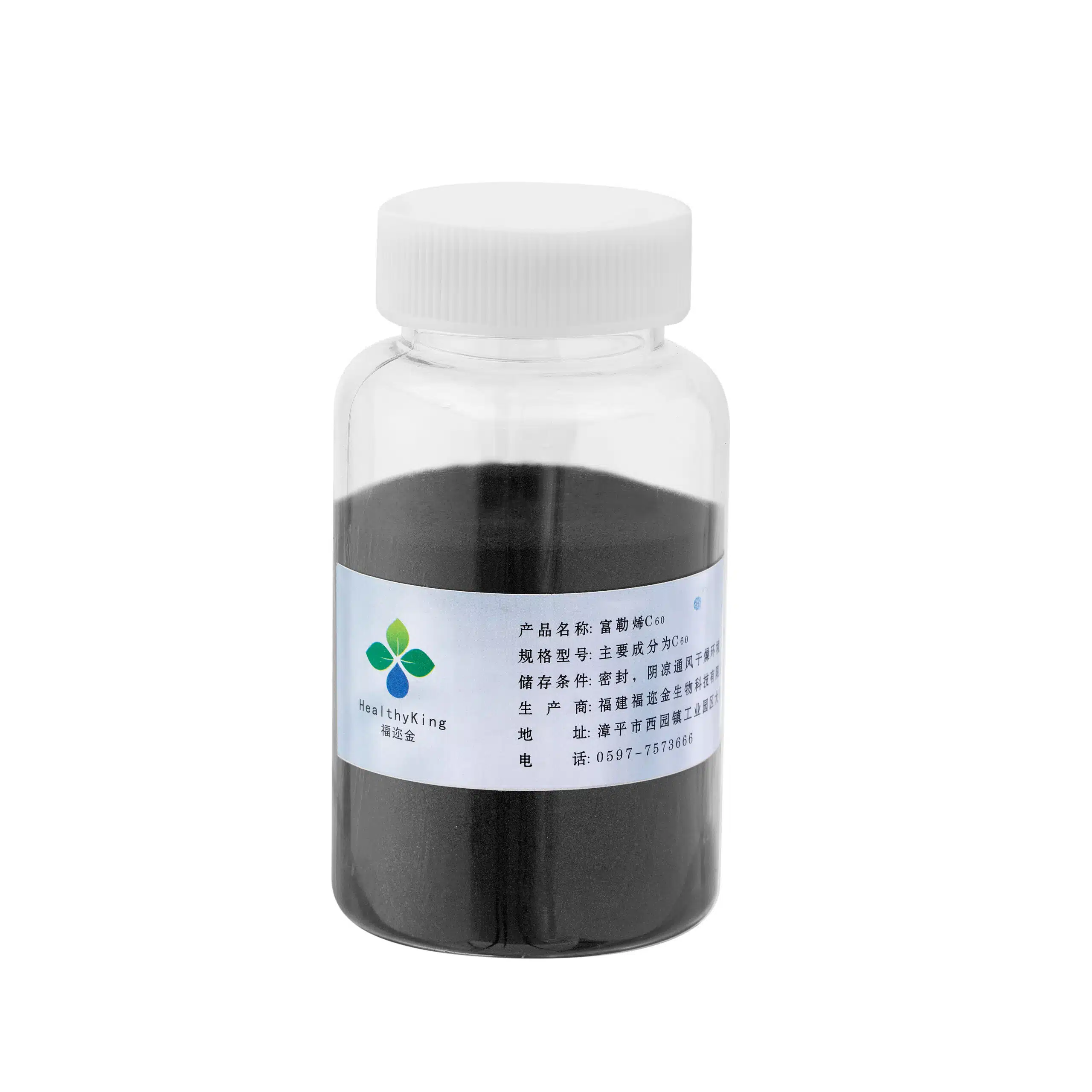
High-purity fullerene C60 is a highly refined nanomaterial designed specifically for the most demanding scientific and industrial applications. This ultra-pure form ensures…
Request product specifications, batch-specific COA, MSDS/SDS, sample availability, packaging details, and international shipping information before confirming your order.
Request DocumentsSubmit your product, purity, quantity, application, destination country, and documentation requirements. Our team will help confirm availability, COA, MSDS/SDS, packaging, and quotation details.