XCT Insights
Stay Updated
Fullerene research, applications and company updates, delivered occasionally.
Latest from XCT
View all
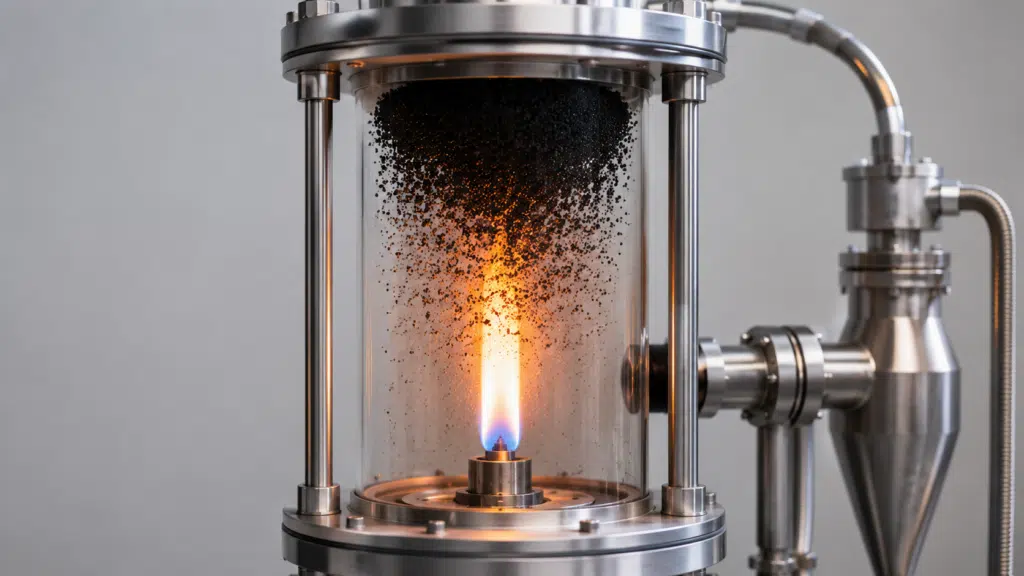
Continuous combustion is a steady combustion process in which fuel and oxidizer are fed into a reaction zone continuously, allowing the flame, heat release, and reaction environment to remain stable over time. In chemical engineering, this concept is widely used in systems such as turbines, burners, furnaces, reactors, and propulsion devices. In fullerene production, continuous combustion has a more specialized meaning: it refers to flame-based synthesis methods designed to generate carbon clusters, soot, and fullerene molecules such as C60 and C70 under controlled combustion conditions.
For readers in materials science, the key point is that continuous combustion is not simply “burning carbon.” In fullerene synthesis, the objective is not complete oxidation of carbon into carbon dioxide. The objective is to create a controlled high-temperature reaction environment where carbon-containing precursors can decompose, nucleate, grow, and form fullerene-containing soot. The fullerenes are then extracted and purified from that soot.
This distinction matters because fullerenes were historically produced mainly through methods such as arc discharge, laser ablation, and other high-energy carbon vaporization routes. Combustion synthesis changed the discussion by showing that fullerenes could also be produced from hydrocarbon flames under selected conditions.[1]
Today, continuous combustion is important because it connects fullerene chemistry with scalable chemical engineering. It helps explain why C60 and C70 production moved beyond purely laboratory-scale discovery methods and toward larger, more controllable production systems.
In a general engineering sense, continuous combustion means that reactants enter a combustion chamber continuously and products leave continuously. Once the system reaches stable operation, temperature, pressure, flow rate, flame structure, and heat release can be maintained within a target range.
This is different from a batch process. In a batch combustion or batch reaction system, material is loaded, reacted, stopped, removed, and then loaded again. In a continuous process, the system is designed to keep operating while feedstock and oxidizer are supplied and reaction products are collected.
Common examples of continuous combustion include gas turbine combustors, industrial burners, furnaces, and rocket or jet propulsion systems. These systems are not identical, but they share the same basic principle: continuous input, continuous reaction, and continuous output.
For fullerene synthesis, continuous combustion is adapted from this engineering idea. A carbon-containing precursor and oxidizer are introduced into a flame system. Under selected flame conditions, the process forms soot containing fullerenes. The reactor must be controlled carefully because complete combustion would destroy carbon structures, while poorly controlled pyrolysis may produce mostly amorphous soot, polycyclic aromatic hydrocarbons, or other carbonaceous material.
In fullerene synthesis, continuous combustion refers to using a controlled flame to produce fullerene-containing soot. The process usually involves a hydrocarbon or carbon-rich precursor, an oxidizer, and a reactor environment designed to favor fullerene formation rather than complete oxidation.
Early combustion studies showed that C60 and C70 could be produced in benzene-oxygen flames. A 1992 study reported production of C60 and C70 fullerenes in low-pressure benzene-oxygen flames, establishing flame chemistry as a viable fullerene formation route.[2] A later patent also described preparing fullerenes by burning carbon-containing compounds in a flame and collecting condensibles or soot containing fullerenes, with flame conditions selected to optimize yield and composition.[3]
The simplified mechanism can be understood in four stages.
First, the carbon precursor enters the flame. The precursor may be a hydrocarbon or another carbon-containing compound suitable for the specific combustion system.
Second, the precursor undergoes thermal decomposition and partial oxidation. This creates reactive carbon species, small carbon clusters, and aromatic intermediates under high-temperature flame conditions.
Third, carbon clusters grow and rearrange in the sooting region of the flame. Under suitable temperature, pressure, residence time, and chemical environment, some carbon clusters can close into fullerene cages rather than forming only disordered soot.
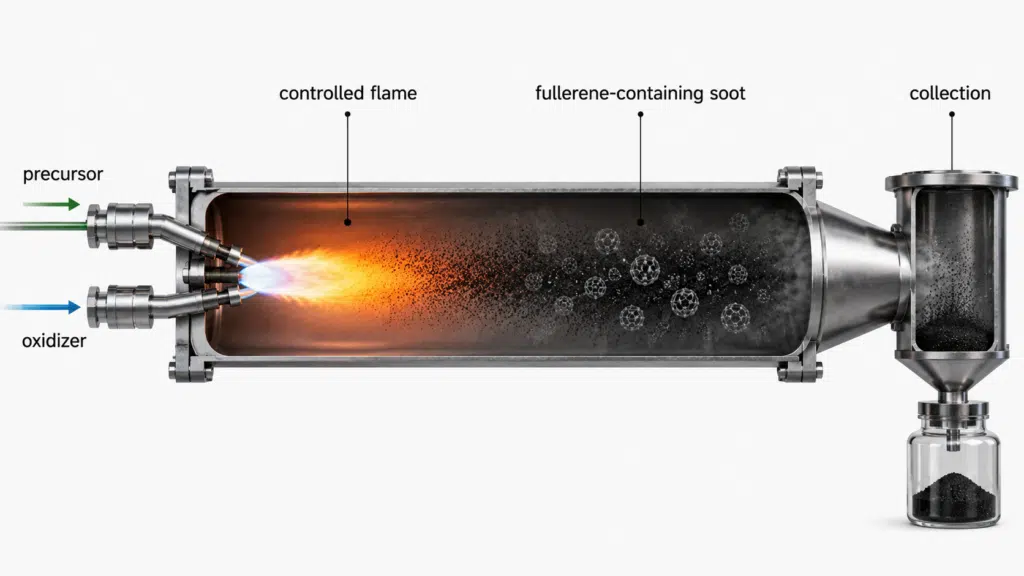
Fourth, fullerene-containing soot or condensibles are collected and processed. The C60, C70, and other fullerene components must then be extracted and separated from soot, higher fullerenes, and other carbon materials.
This is why continuous combustion for fullerenes should be described as controlled flame synthesis, not ordinary burning. The process must balance pyrolysis, oxidation, soot formation, cluster growth, and product collection.
The arc-discharge method is one of the classic fullerene production methods. It uses a high electric current between graphite electrodes, usually under an inert atmosphere, to vaporize carbon. The resulting carbon vapor condenses into soot that contains C60, C70, and other carbon species.
The electric arc method was crucial for early fullerene production. However, it is typically associated with batch or semi-batch operation, graphite electrode consumption, high electrical energy input, and downstream extraction and purification. Patents from the early fullerene era describe electric-arc routes for producing fullerene compounds by heating carbon material using an electrical arc between electrodes.[4]
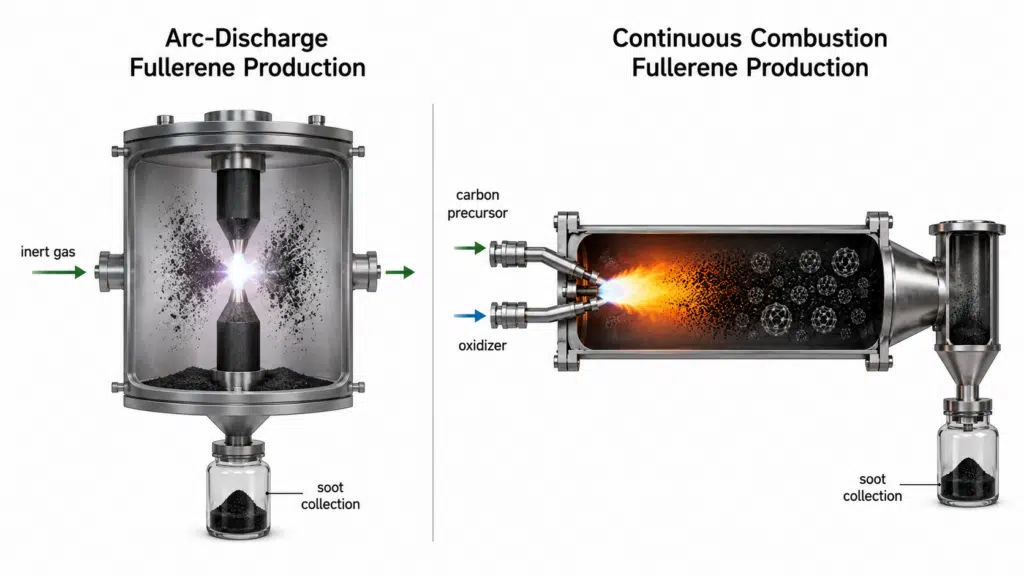
Continuous combustion differs in several important ways.
| Factor | Arc-Discharge Method | Continuous Combustion Method |
|---|---|---|
| Carbon source | Usually graphite electrodes | Carbon-containing fuel or precursor |
| Energy input | High electrical current | Combustion heat and controlled flame chemistry |
| Operation style | Often batch or semi-batch | Potentially continuous and scalable |
| Reaction environment | Arc plasma / carbon vaporization | Flame, pyrolysis, partial oxidation, soot formation |
| Product form | Fullerene-containing soot | Fullerene-containing soot or condensibles |
| Engineering focus | Electrode, current, chamber atmosphere | Flow rate, pressure, flame temperature, residence time |
The difference is not that one method produces pure C60 directly while the other does not. Both methods require downstream extraction and purification. The more important difference is process engineering. Continuous combustion offers a route toward continuous feed, continuous soot generation, and potentially easier scale-up compared with small batch arc systems.
At first glance, fullerene formation in a flame may seem counterintuitive. Combustion is often associated with complete oxidation, while fullerenes are precise carbon cage molecules. The explanation lies in flame chemistry and soot formation.
In fuel-rich or carefully controlled combustion conditions, not all carbon is converted immediately into carbon dioxide. Instead, hydrocarbon fragments, radicals, aromatic intermediates, and carbon clusters can form. These species may grow into soot particles. Under certain conditions, some carbon clusters can close into stable cage structures such as C60 and C70.
Patent and academic literature on combustion fullerene production emphasizes that flame conditions must be selected carefully. Factors such as fuel type, oxidizer ratio, pressure, flame temperature, residence time, dilution, and collection position can influence fullerene yield and composition.[3]
This is why continuous combustion is not merely a furnace. It is a reaction environment. Engineers must control the flame so that carbon clusters have the right conditions to form fullerene cages before they are destroyed, over-oxidized, or converted into less useful soot.
Continuous combustion matters because fullerene applications often require more than milligram-scale material. Organic electronics, photovoltaic research, lubricant additive research, coatings, advanced composites, and chemical distribution all need a more stable supply chain than early discovery-scale production could provide.
An electrochemical society conference paper on the evolution of fullerene production by combustion described the shift from kilogram-scale toward larger production and noted that the high cost and limited availability of fullerenes were major barriers to commercial application. The same paper described combustion as a continuous and scalable route compared with small-scale batch carbon arc production.[5]
This industrial significance is straightforward. If C60 and C70 remain expensive, limited, and inconsistent, many downstream applications stay in research mode. If production becomes more scalable and more consistent, fullerene materials become easier to evaluate in larger formulation, electronics, and advanced material programs.
That said, scale-up should not be confused with automatic purity. Larger production still requires extraction, separation, purification, testing, and batch documentation. Combustion can generate fullerene-containing soot efficiently, but C60 and C70 must still be isolated and characterized before use in sensitive applications.
Multi-stage combustion is a more specific process concept within the broader field of combustion synthesis. Instead of treating the flame as one uncontrolled reaction zone, multi-stage combustion can guide the precursor through different thermal and chemical regions. These zones may influence decomposition, carbon-cluster growth, fullerene cage closure, soot formation, and product collection.
Public biographical information from Xiamen University states that Professor Xie Suyuan invented multi-stage combustion equipment for the fullerene industry, which promoted the efficiency of fullerene production.[6] This is a useful source-backed statement, and it is safer than unsupported claims such as “the world’s first,” “zero pollution,” or “strict carbon neutrality” unless those claims are supported by patent documents, technical audits, or lifecycle analysis.
From a process viewpoint, multi-stage combustion may help engineers control residence time, temperature history, and reaction atmosphere more precisely than a simple flame. These factors are important because fullerene formation depends on the competition between carbon cluster growth, cage closure, soot growth, and oxidation.
For readers trying to understand continuous combustion, the essential point is this: the more controlled the combustion environment becomes, the more it resembles a chemical reactor rather than a simple burner.
Some fullerene industry materials describe a collaboration between Healthyking-related R&D activity and the research lineage of Professor Xie Suyuan, with continuous or multi-stage combustion used as part of industrial fullerene production. The scientifically supportable part is that combustion synthesis of fullerenes is a known field, multi-stage combustion equipment is publicly associated with Professor Xie’s fullerene industry work, and combustion methods have been studied and patented for fullerene production.[3][6]
However, stronger commercial claims require stronger evidence. Claims such as “world’s first successful production line,” “zero pollution,” “true carbon neutrality,” “tonnage scale,” or “plant-based precursor production” should be published only when supported by verifiable patent documents, plant technical records, third-party audits, lifecycle carbon accounting, or official corporate documentation.
For a professional B2B chemical website, the better approach is to separate verified science from company-specific claims.
Verified science: fullerenes can be produced through combustion routes; C60 and C70 have been reported in hydrocarbon flames; combustion methods can be continuous and scalable; multi-stage combustion equipment has been associated with fullerene industrialization research.
Company-specific claim area: the exact feedstock, production capacity, carbon accounting, emission profile, energy recovery system, and proprietary process details should be supported by internal documents or third-party verification before being stated as facts.
This approach protects credibility. It also makes the article more useful for technical readers who are comparing fullerene production methods rather than reading promotional claims.
Combustion-based fullerene production may offer engineering advantages over some small-scale arc-discharge routes, but environmental claims should be handled carefully. It is not enough to say that a process is “green” because it uses combustion or renewable feedstock.
Environmental performance depends on feedstock source, energy input, fullerene yield, purification method, solvent use, emissions control, waste handling, heat recovery, and product purity requirements. A 2011 study on the material and energy intensity of fullerene production showed that purification and processing can strongly influence the embodied energy of fullerene materials.[7]
This is why claims such as “carbon neutral,” “zero pollution,” or “zero toxic emissions” should not be used casually. To make those claims credibly, a producer should provide lifecycle assessment, energy-balance data, emissions data, waste-treatment records, and independent verification.
A safer and more accurate statement is that continuous combustion may support scalable fullerene production and may allow process-engineering improvements such as heat recovery, feedstock optimization, and continuous operation. Whether a specific facility is carbon neutral must be verified separately.
Continuous combustion matters because scalable production can make fullerene materials more accessible for research and industrial evaluation. C60 and C70 are studied in multiple fields, including new energy, electronics, advanced materials, lubricants, coatings, and biomedical research.
In new energy research, C60 and fullerene derivatives are studied in organic photovoltaics and perovskite solar cells as electron-accepting or electron-transporting materials. The availability of consistent C60 can help researchers conduct repeatable device studies, though material supply alone does not guarantee device efficiency.
In advanced materials and chemical engineering, fullerene materials are studied in polymer systems, coatings, composite materials, catalyst-related research, and surface modification. The suitability of C60 or C70 depends on purity, dispersion, solvent compatibility, formulation design, and test conditions.
In lubricant and coating research, C60 is explored for friction, wear, and surface-interaction studies. Performance claims should be tied to specific formulation and tribology tests rather than generalized.
In biomedical research, fullerenes and derivatives have been investigated in laboratory studies involving drug delivery models, photodynamic research, and oxidative stress-related systems. These are research contexts. They should not be described as approved therapies, medical products, or clinically proven materials unless specific regulatory and clinical evidence exists.
For buyers, continuous combustion is useful mainly as a production-background concept. It helps explain how C60 and C70 can be produced at larger scale than early arc-discharge routes. It also helps buyers understand why production method, purification method, and batch control may affect final material quality.
However, buyers should not evaluate fullerene material only by the production method. A combustion-produced C60 still needs quality confirmation. An arc-produced C60 also needs quality confirmation. The finished material should be judged by product identity, purity, test method, impurity profile when relevant, batch consistency, and application suitability.
In other words, continuous combustion can explain industrial scalability, but the buyer still needs a finished-product specification. This is especially important for electronics, photovoltaics, semiconductor research, biomedical research, and advanced formulations, where trace impurities and batch variation may matter.
Continuous combustion is a steady combustion process in which fuel and oxidizer are continuously supplied to maintain a stable reaction zone. In fullerene synthesis, it refers to controlled flame-based production of fullerene-containing soot from carbon-containing precursors.
In fullerene production, a carbon-containing precursor is burned or partially oxidized under controlled flame conditions. Carbon species form in the flame and may assemble into fullerene cages such as C60 and C70. The fullerene-containing soot is then collected, extracted, and purified.
No. Ordinary burning usually aims at complete combustion. Fullerene combustion synthesis uses carefully controlled flame conditions to support carbon-cluster formation and fullerene-containing soot generation.
Arc discharge uses high electrical current to vaporize graphite electrodes under an inert atmosphere. Continuous combustion uses flame chemistry and continuous feedstock flow. Both methods produce fullerene-containing soot that must be extracted and purified.
No. Combustion can produce soot or condensibles containing C60, C70, and other carbon materials. C60 still needs extraction, separation, purification, and quality testing.
Yes. Academic papers and patents have reported C60 and C70 production through hydrocarbon flames and combustion methods.[2][3]
No. Carbon neutrality depends on feedstock, energy input, emissions, purification, waste handling, and lifecycle accounting. A specific producer must support carbon-neutral claims with verifiable data.
It matters because continuous combustion can support scalable fullerene-containing soot production. This may help reduce supply limitations compared with small-scale batch routes, although final product quality still depends on purification and testing.
Need Fullerene C60 or Fullerene C70 for research, formulation, electronics, new energy materials, lubricants, coatings, or distribution?
Contact The Fullerene to discuss available fullerene materials, product specifications, sample availability, and application-oriented supply options.
Submit your fullerene requirement with product type, quantity, application, destination country, and required documentation.
[1] Ossila, “How are Fullerenes Made?” This source summarizes common fullerene production methods, including combustion, Huffman-Krätschmer, and microwave routes. Source
[2] J. B. Howard et al., “Production of C60 and C70 fullerenes in benzene-oxygen flames,” Journal of Physical Chemistry, 1992. This study reported C60 and C70 production in low-pressure benzene-oxygen flames. Source
[3] US Patent US5273729A, “Combustion method for producing fullerenes.” The patent describes preparing fullerenes by burning carbon-containing compounds in a flame and collecting condensibles or soot containing fullerenes. Source
[4] US Patent US5227038A, “Electric arc process for making fullerenes.” The patent describes fullerene production through heating carbon material using an electrical arc between electrodes. Source
[5] J. Michael Alford et al., “Evolution of Fullerene Production by Combustion: From Kilograms to Tons and More,” Electrochemical Society meeting paper. The paper discusses combustion as a continuous and scalable route compared with small-scale batch carbon arc production. Source
[6] Xiamen University, “Su-yuan Xie elected academician of Chinese Academy of Sciences.” The university profile states that Professor Xie invented multi-stage combustion equipment for the fullerene industry, promoting fullerene production efficiency. Source
[7] M. J. Eckelman et al., “Material and Energy Intensity of Fullerene Production,” Environmental Science & Technology, 2011. The study discusses how synthesis, purification, and processing influence the material and energy intensity of fullerene production. Source
Submit your product, purity, quantity, application, destination country, and documentation requirements. Our team will help confirm availability, COA, MSDS/SDS, packaging, and quotation details.