XCT Insights
Stay Updated
Fullerene research, applications and company updates, delivered occasionally.
Latest from XCT
View all

The history of materials science is inextricably linked to the manipulation of the element carbon. From the prehistoric use of charcoal to the industrial-age reliance on coal and the modern-day obsession with diamonds and graphite, carbon has consistently served as the backbone of human technological progress. However, the latter half of the 20th century marked the beginning of a new era—the carbon allotrope revolution. This period saw the development of engineered carbon forms that transcend their natural counterparts in every measurable metric of performance. Among these, carbon fiber and fullerenes stand as the two most impactful developments, representing a divergence in scale that spans from the macro-structural to the molecular.
Carbon fiber, essentially a macro-scale structural titan, has fundamentally altered the paradigms of aerospace, automotive, and civil engineering. It addresses the fundamental engineering question of how to maximize strength while minimizing mass, allowing for the construction of aircraft like the Boeing 787 Dreamliner and vehicles like the Lexus LFA. On the other end of the spatial spectrum lie the fullerenes—zero-dimensional (0D) nano-architectures that behave more like individual molecules than bulk materials. These geodesic cages, most notably Buckminsterfullerene ($C_{60}$), have introduced a new frontier in radical scavenging, photovoltaics, and even quantum computing.
The essence of this analysis lies in understanding why a single element can manifest as both a kilometer-long high-strength filament and a sub-nanometer spherical cage. This report provides a comprehensive scientific comparison of these two allotropes, exploring their fundamental chemistry, manufacturing complexity, and the emerging synergies that are defining the future of hybrid composite materials. By integrating insights from thermodynamics, structural mechanics, and molecular biology, we can discern the trajectory of carbon-based innovation in the 21st century.
To understand the divergence of carbon fiber and fullerenes, one must first address the foundational question: what makes carbon unique? Carbon’s position in the periodic table—specifically as the first element in Group 14—bestows upon it a set of electronic and geometric properties that no other element can replicate. This uniqueness is primarily defined by three overlapping chemical phenomena: tetravalency, orbital hybridization, and an unrivaled capacity for catenation.
The carbon atom possesses an atomic number of 6, with a ground-state electronic configuration of $1s^2 2s^2 2p^2$. This means there are four electrons in its outermost valence shell. To achieve a stable noble-gas configuration (following the octet rule), carbon seeks to form four covalent bonds. This tetravalency is the primary reason why carbon can act as a universal building block. Unlike metals, which form communal “pools” of electrons in metallic bonds, carbon forms localized, directional covalent bonds by sharing electron pairs with its neighbors. This directionality allows for the creation of precise three-dimensional geometries, which are essential for both the long-range order in carbon fibers and the discrete curvature in fullerenes.
The true versatility of carbon lies in orbital hybridization, where the $2s$ and $2p$ orbitals mix to form new hybrid orbitals. In the case of both carbon fiber and fullerenes, the dominant hybridization state is $sp^2$. In an $sp^2$ hybridized carbon atom, three of the four valence electrons are used to form strong $\sigma$ (sigma) bonds in a trigonal planar arrangement. These $\sigma$ bonds provide the primary structural integrity of the material. The fourth electron resides in an unhybridized $p$-orbital, perpendicular to the plane, forming a $\pi$ (pi) bond.
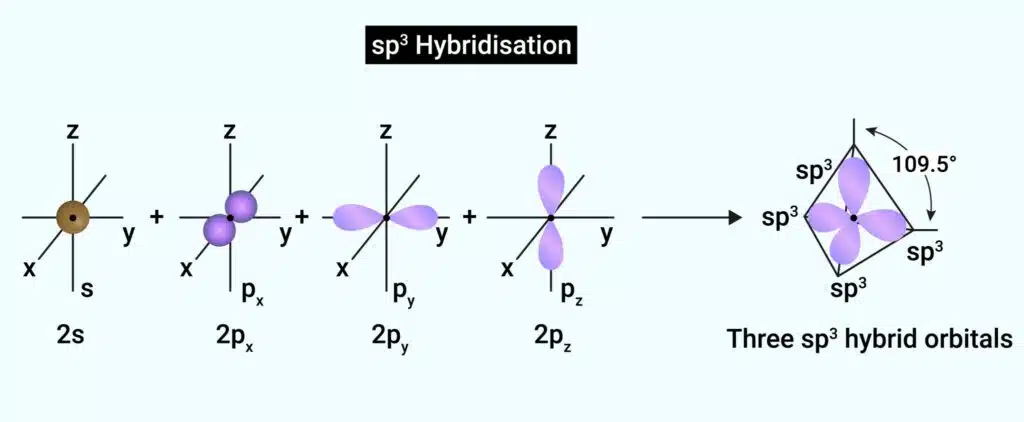
In graphitic systems, these $p$-orbitals overlap across many atoms, creating a delocalized $\pi$-system of electrons. This delocalization is responsible for the electrical conductivity and chemical reactivity observed in carbon materials. In carbon fiber, these planes are aligned along the fiber axis to provide high modulus. In fullerenes, the $sp^2$ bonds are “pyramidalized”—the curvature of the cage forces the atoms slightly out of the ideal plane, which increases the strain and gives fullerenes their unique electron-accepting properties.
Catenation is the ability of an element to form long, stable chains or rings by bonding with itself. Carbon exhibits this property to a degree that is unique in the periodic table. The $C-C$ bond energy is exceptionally high (approximately 348 kJ/mol), and the small size of the carbon atom allows for strong overlap of orbitals. While silicon also belongs to Group 14 and can form chains, the $Si-Si$ bond is significantly weaker (226 kJ/mol) and the $Si-O$ bond is much stronger, meaning silicon naturally tends to form network solids like sand ($SiO_2$) rather than the long-chain polymers or cages characteristic of carbon.
| Property | Carbon (C) | Silicon (Si) | Significance for Materials |
| Atomic Radius | ~77 pm | ~111 pm | Smaller size allows stronger orbital overlap in C |
| Bond Energy (Self) | 348 kJ/mol | 226 kJ/mol | High energy enables stable long chains in carbon fiber |
| Valency | 4 | 4 | Both are tetravalent building blocks |
| Oxide Phase | Gas ($CO_2$) | Solid ($SiO_2$) | Carbon cycles through life; Silicon forms rocks |
| Hybridization | $sp, sp^2, sp^3$ | Primarily $sp^3$ | Carbon’s $sp^2$ creates conductive/strong planes |
Through these properties, carbon defines the limits of what is possible in materials science. It is the only element that allows for the transition from the “disordered” turbostratic layers of a PAN-based fiber to the perfect symmetry of a $C_{60}$ molecule.
Carbon fiber is not a single material but a family of high-performance reinforcements. What are the properties of carbon that make it so desirable in fiber form? Primarily, it is the combination of low density (typically 1.7 to 2.0 g/cm$^3$) and an exceptionally high specific modulus. When we ask “what is carbon fibre,” we are referring to filaments that are 5–10 micrometers in diameter and composed of at least 90% carbon.
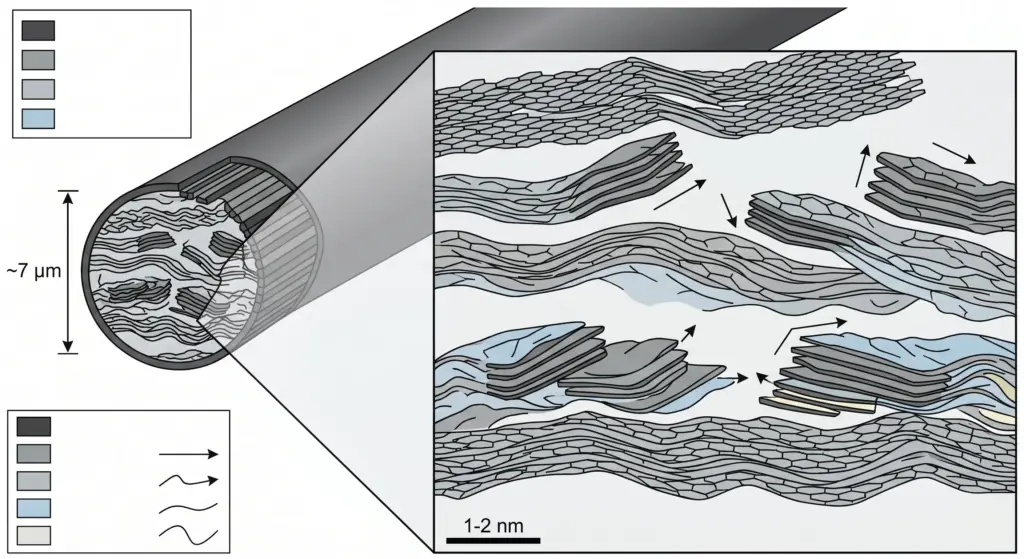
The final properties of a carbon fiber are largely dictated by its precursor—the starting material. While several precursors exist, polyacrylonitrile (PAN) and mesophase pitch dominate the global market.
1. PAN-Based Carbon Fiber: Strength from Disorder PAN-based fibers account for approximately 92% of global production. PAN is a long-chain synthetic polymer. The manufacturing process involves three thermal stages:
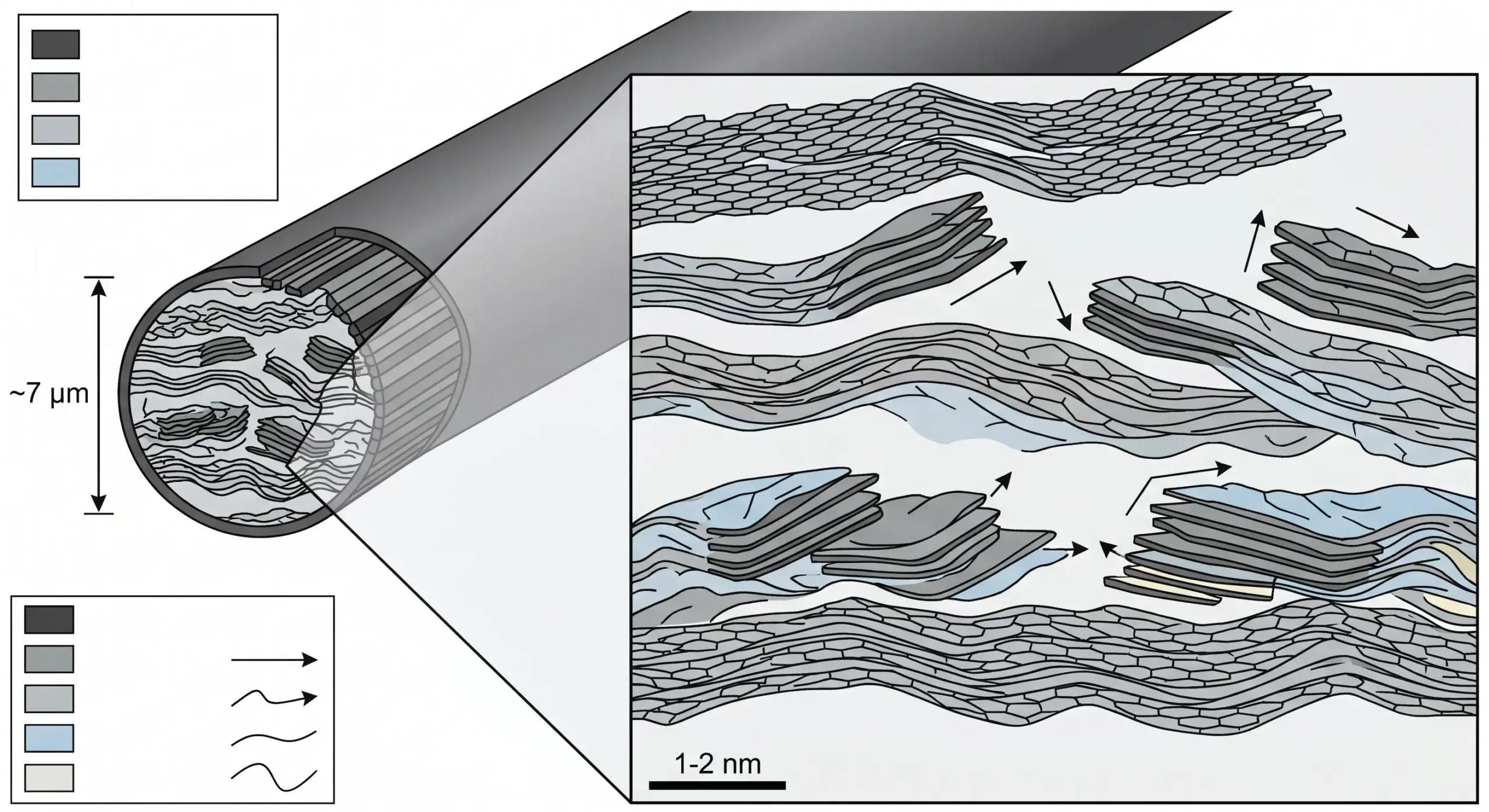
The resulting PAN fibers have a “turbostratic” structure—the graphitic layers are crumpled and intertwined. This “controlled disorder” is critical because it prevents microcracks from propagating through large crystals, giving PAN fibers their legendary tensile strength and damage tolerance.
2. Pitch-Based Carbon Fiber: Stiffness from Order Pitch-based fibers are derived from the distillation of coal or petroleum tar. When processed into a “mesophase” (liquid crystal) state, the aromatic molecules align themselves during the spinning process. Because the starting material is already rich in aromatic rings, the resulting fibers are much more crystalline. Pitch fibers can achieve ultra-high Young’s modulus (up to 800 GPa) and thermal conductivities that exceed that of copper. However, this highly ordered structure makes them more brittle and less tolerant of impact.
| Fiber Type | Tensile Strength | Modulus (Stiffness) | Best Application |
| PAN-Based | Excellent | Medium-High | Primary aircraft structures, car chassis |
| Pitch-Based | Moderate | Ultra-High | Satellite radiators, heat spreaders |
| Rayon-Based | Low | Low | Rocket nozzle heat shields (Ablatives) |
A common point of confusion for non-specialists is whether carbon fiber is a metal. Scientifically, carbon fiber is a non-metallic, inorganic solid. The distinction lies in the nature of the bond. In metals, electrons are delocalized in a non-directional sea, allowing atoms to slide past each other (ductility) and bonds to reform after deformation. In carbon fiber, the atoms are locked in rigid, directional covalent bonds. This makes the material “brittle”—it does not bend or yield like steel; instead, it remains perfectly elastic until it reaches its breaking point, at which it fails catastrophically. This is why carbon fiber components must be engineered with higher safety margins and sophisticated “failure-tolerant” designs.
The adoption of carbon fiber has transitioned from niche military projects to the backbone of modern transportation and energy. When analyzing carbon fiber structural components, the primary objective is “lightweighting”—reducing mass to improve fuel efficiency or range.
The Boeing 787 was the first commercial aircraft to use carbon fiber reinforced polymer (CFRP) for its primary structure, including the fuselage and wings. Before the 787, the Boeing 777 used only about 9% composites by weight. The 787 increased this to 50%.
What specific carbon fiber structural components are used in the 787?
The result of this material shift was an estimated 20% weight reduction compared to a conventional aluminum aircraft of the same size, contributing to a 20-25% increase in fuel efficiency.

In the automotive world, the Lexus LFA serves as a masterclass in carbon fiber construction. Approximately 65% of the LFA’s body mass is CFRP. Lexus engineers notably abandoned an initial aluminum design because they realized that an aluminum frame would be too heavy to meet their performance targets.
Lexus developed an in-house manufacturing process that included:
By using CFRP, the LFA achieved a kerb weight of only 1,480 kg, with a chassis that is significantly stiffer than its aluminum-framed competitors.
Carbon fiber is also the enabling material for modern wind turbines. As blades exceed 100 meters in length, fiberglass becomes too heavy and flexible. Carbon fiber spar caps provide the necessary stiffness to prevent the blades from striking the tower during high winds. In civil engineering, carbon fiber “wraps” are used to reinforce concrete columns in earthquake-prone zones, providing a non-corrosive alternative to steel jackets.
While carbon fiber dominates the macro-scale, fullerenes occupy the molecular frontier. Discovered in 1985 by Kroto, Smalley, and Curl, fullerenes are discrete, spherical or ellipsoidal carbon molecules. The most common form is $C_{60}$, also known as Buckminsterfullerene, which contains 60 carbon atoms arranged in a pattern of 20 hexagons and 12 pentagons—a truncated icosahedron.
Unlike carbon fiber, which is “grown” into filaments, fullerenes are synthesized from the vapor phase. The most common laboratory method is the arc discharge method, where an electrical arc is struck between two graphite electrodes in a helium atmosphere. The heat vaporizes the graphite, and as the carbon vapor cools, it spontaneously clusters into fullerene cages.
The resulting soot contains a complex mixture:
Extraction is typically performed using aromatic solvents like toluene or benzene. Since $C_{70}$ and higher fullerenes have higher boiling points and different electronic signatures, they are separated from $C_{60}$ using High-Performance Liquid Chromatography (HPLC) or fractional sublimation.
Fullerenes are renowned as the “radical sponge” of the chemical world. But what is the science behind this term? The $sp^2$ hybridized structure of $C_{60}$ features 30 conjugated carbon-carbon double bonds. Because the cage is curved, these double bonds are under strain and possess a high electron affinity (approximately 2.7 eV).
When $C_{60}$ encounters a free radical (a highly reactive molecule with an unpaired electron), the radical readily “adds” to the double bond on the fullerene surface. A single $C_{60}$ molecule can neutralize up to 34 methyl radicals or 15 benzyl radicals before its structure is compromised. Crucially, the process can be catalytic—certain fullerene derivatives can react with superoxides repeatedly without being consumed, making them hundreds of times more effective than traditional antioxidants like Vitamin E or C.
| Characteristic | Fullerene C60 | Fullerene C70 |
| Geometry | Spherical (Soccer Ball) | Prolate Spheroid (Rugby Ball) |
| Diameter | ~0.7 nm | ~0.71 nm $\times$ 0.79 nm |
| Symmetry | Very High ($I_h$) | High ($D_{5h}$) |
| Light Absorption | UV Region | Broader (Visible Range) |
| Solubility (TOL) | ~2.8 mg/mL | ~1.4 mg/mL |
| Primary Application | Antioxidants, Lubricants | Organic Photovoltaics (Solar) |
To the non-scientist, carbon fiber and fullerenes might seem related simply because they are both “carbon.” However, their technical properties reveal a profound divergence. Carbon fiber is an anisotropic material—its properties are directional. Fullerenes are isotropic molecules—their properties are the same in every direction.
Carbon fiber is chosen for its specific strength (strength/density). While its density is low, its axial modulus is extremely high. In contrast, fullerenes in their solid “fullerite” form are relatively soft crystals, held together by weak Van der Waals forces. However, the individual $C_{60}$ molecule is incredibly stiff; it is often cited as having a bulk modulus higher than that of diamond when compressed.
This is where the distinction between PAN and Pitch fiber becomes most apparent.

One of the most valuable “properties of carbon” in fiber form is its low or even negative coefficient of thermal expansion (CTE). When most materials are heated, they expand. Carbon fiber, due to its covalent bonding along the axis, actually shrinks slightly when heated. By combining carbon fiber with a resin that has a positive CTE, engineers can create a composite part with a CTE of exactly zero. This is essential for space telescopes and satellite structures where even a micrometer of expansion would ruin optical alignment.
| Metric | PAN Carbon Fiber | Pitch Carbon Fiber | Fullerene C60 |
| Tensile Strength | 3.5 – 7.0 GPa | 1.5 – 3.5 GPa | N/A (Molecular) |
| Young’s Modulus | 230 – 350 GPa | 500 – 800 GPa | ~15-20 GPa (Bulk) |
| Thermal Cond. | 10 – 20 W/mK | 500 – 800 W/mK | 0.4 W/mK |
| CTE (axial) | -0.1 to -1.0 $\times 10^{-6}/K$ | -1.5 to -2.0 $\times 10^{-6}/K$ | +6.2 $\times 10^{-6}/K$ |
| Electrical Res. | $15-20 \times 10^{-6} \Omega\cdot m$ | $1-5 \times 10^{-6} \Omega\cdot m$ | $10^{14} \Omega\cdot m$ (Insulator) |
Perhaps the most sensational use of the element carbon in recent years has been the application of $C_{60}$ in lifespan extension. This field is characterized by a high degree of controversy and a clash between two landmark studies: Baati et al. (2012) and Grohn et al. (2021).
In 2012, Tarek Baati and his team at the University of Paris-Sud conducted a study to test the chronic toxicity of $C_{60}$. They dissolved $C_{60}$ in extra virgin olive oil (EVOO) at a concentration of 0.8 mg/mL and administered it to Wistar rats. To their surprise, the rats receiving the $C_{60}$ lived an average of 90% longer than the control group—essentially doubling their lifespan. The study suggested that $C_{60}$ acts as a super-antioxidant that accumulates in the mitochondria and prevents the oxidative damage that drives aging.
The scientific community struggled to replicate these results. In 2021, a study by Grohn et al. found no lifespan extension in mice and reported that $C_{60}$ solutions could actually be toxic if they were exposed to light. Fullerenes are photo-reactive; when light hits a $C_{60}$ molecule, it can enter an excited state and transfer energy to oxygen, creating singlet oxygen—a highly toxic reactive oxygen species.
As of 2025, the European Scientific Committee on Consumer Safety (SCCS) has published an opinion (SCCS/1649/23) stating that they cannot conclude on the safety of fullerenes in cosmetics. The committee noted several “uncertainties and data gaps,” particularly regarding the potential for genotoxicity (damage to DNA) and the systemic accumulation of these nanoparticles in the liver and lungs. For consumers, the takeaway is clear: while $C_{60}$ is a potent antioxidant in controlled environments, its safety as a dietary supplement or skincare ingredient depends heavily on purity, concentration, and protection from light.
The most promising area of current research is not the competition between macro and nano carbon, but their synergy. Engineers are now incorporating fullerenes into carbon fiber reinforced polymers to create multi-scale composites.
The “achilles heel” of carbon fiber composites is the interface—the bond between the fiber and the resin matrix. Because carbon fibers are processed at high temperatures, their surface is chemically inert and “slippery”. This leads to weak Interfacial Shear Strength (IFSS).
By “grafting” fullerenes or other carbon nanomaterials onto the surface of the fiber, researchers can create a “rigid-soft” coating.
Recent studies have shown that adding just 0.5% weight of fullerene-based additives can increase the IFSS by over 180% and the overall tensile strength of the composite by 26%.
Perhaps the most “unique” application of fullerenes is in the field of quantum information processing. Endohedral fullerenes are cages that contain a single trapped atom, such as nitrogen ($N@C_{60}$). The carbon cage acts as a perfect Faraday shield, protecting the electron and nuclear spins of the inner atom from external electrical noise.
Researchers at Oxford and elsewhere have proposed using these molecules as qubits—the basic units of quantum computers. Because the $C_{60}$ cage is so stable, these qubits can maintain their “quantum state” (coherence) for incredibly long times—up to 440 microseconds at room temperature. This is significantly longer than many other molecular qubits, placing fullerenes at the heart of the next generation of portable quantum sensors and atomic clocks.
The journey of carbon from a simple fuel source to the pinnacle of nanotechnology illustrates the profound depth of materials science. Carbon fiber has matured into a structural titan, enabling the fuel-efficient aviation and the high-performance vehicles that define our era. It has proven that “what is carbon fibre” is a question with a multi-billion dollar answer, spanning the wings of the 787 to the chassis of the LFA.
Simultaneously, fullerenes have redefined the limits of chemistry. By acting as a “radical sponge,” these molecular cages offer a new paradigm for anti-aging and drug delivery, while their endohedral forms provide a pathway to room-temperature quantum computing. The “longevity controversy” serves as a reminder that with such potent chemical power comes the need for rigorous safety standards and clinical validation.
As we move toward a “sustainable carbon” future, the focus is shifting toward the circular economy. Technologies like pyrolysis and supercritical solvolysis are now capable of reclaiming high-quality carbon fiber from end-of-life aircraft and cars, reducing the environmental impact of virgin production. The future of carbon lies in this synergy—using the nano-scale intelligence of fullerenes to enhance the macro-scale strength of fibers, all while maintaining a sustainable cycle that respects the fundamental uniqueness of the element that makes life itself possible.
Carbon is unique because of its ability to form four stable covalent bonds (tetravalency) and its unrivaled capacity for catenation (forming long chains and rings). Its small atomic size and ability to undergo $sp, sp^2$, and $sp^3$ hybridization allow it to form materials as diverse as soft graphite, hard diamond, and spherical fullerenes.
No, carbon fiber is a non-metallic, inorganic solid. Unlike metals, which have communal “metallic bonds” and are ductile, carbon fiber is held together by directional covalent bonds. This gives it extreme stiffness and strength but also makes it a brittle material that does not yield or bend before it breaks.
In the Boeing 787, roughly 50% of the structure by weight is made of carbon fiber. This includes the major fuselage barrel sections, the wingbox, the tail (horizontal and vertical stabilizers), the doors, and the floor beams. This replaces traditional aluminum, reducing weight by 20%.
Fullerene $C_{60}$ has 30 conjugated double bonds and a high electron affinity. Because the molecule is curved, these bonds are under strain and react very quickly with free radicals. A single $C_{60}$ molecule can neutralize dozens of radicals, making it a highly efficient antioxidant.
Fullerenes are used because they can trap a single nitrogen or phosphorus atom inside their cage (endohedral fullerenes). The carbon cage protects the atom’s spin from external interference, allowing it to function as a “qubit” with long coherence times, which is essential for quantum calculations.
Submit your product, purity, quantity, application, destination country, and documentation requirements. Our team will help confirm availability, COA, MSDS/SDS, packaging, and quotation details.