XCT Insights
Stay Updated
Fullerene research, applications and company updates, delivered occasionally.
Latest from XCT
View all

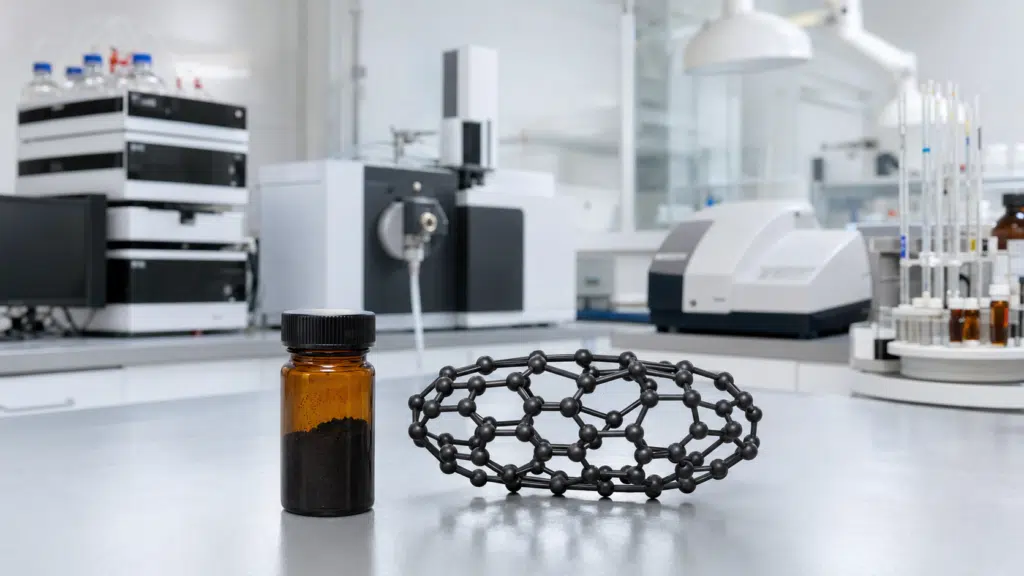
Fullerene C70 is a defined carbon-cage molecule, but a commercial C70 powder cannot be evaluated adequately by checking one peak or one reported percentage. The material has passed through formation, extraction, separation, purification, drying and packaging. Each stage can introduce a different analytical question: Is the isolated molecule really C70? Does the soluble fraction contain C60 or higher fullerenes? Are volatile processing residues present? Is the powder suitable for a particular optical, synthetic or thin-film experiment?
The first macroscopic isolation work on C60 and C70 used mass spectrometry and carbon-13 nuclear magnetic resonance spectroscopy to support the identities of the separated cages.[1] Modern quality evaluation can add HPLC, UV–visible spectroscopy and application-specific supporting methods. These techniques are complementary. They do not provide interchangeable definitions of purity.
This guide explains how laboratories and technical buyers can interpret the principal C70 characterization methods without expanding a method-specific result into an unsupported claim about the entire material.
Pristine C70 contains seventy carbon atoms and has an approximate molar mass of 840.77 g mol−1. Its commonly isolated cage has an elongated geometry and D5h symmetry. This structure is less symmetrical than the nearly spherical Ih cage of C60. The distinction affects molecular mass, electronic absorption, vibrational behavior and the number of symmetry-distinct carbon environments.
Under suitable solution-state carbon-13 NMR conditions, pristine C60 has one symmetry-equivalent carbon environment. C70 has five. That richer fingerprint makes C70 analytically distinctive, but it also means that data generated for C60 should not be copied into a C70 specification.
A C70 batch can also contain several classes of material that do not respond equally to one method. HPLC primarily represents components that dissolve, pass through the selected column and respond to the detector. Mass spectrometry supports molecular identity among species that ionize under the selected conditions. UV–Vis records optical response in a defined solution or film. NMR examines magnetic environments in a sufficiently concentrated, suitably prepared sample.
Residual solvents, selected elements, water, ash or insoluble carbonaceous material may require other methods. “C70 purity” should therefore be connected to the analytical method, sample preparation and calculation basis.
| Analytical question | Representative method | Evidence produced | What it does not prove alone |
|---|---|---|---|
| Which soluble fullerene components are represented? | HPLC | Separated peaks, retention behavior and method-defined relative or calibrated quantities | Total mass purity, residual solvent, metals, ash or insoluble matter |
| Is the optical response consistent with C70? | UV–Vis | Absorption pattern under defined solvent, concentration and instrument conditions | Unique structural identity or complete quantitative purity |
| Is a molecular species with the expected C70 mass present? | Mass spectrometry | Molecular-ion and isotope-distribution evidence | Bulk concentration of every impurity |
| Is the carbon environment consistent with the D5h C70 cage? | 13C NMR | Five symmetry-related carbon environments under appropriate conditions | Absence of all low-level contaminants or non-carbon residues |
| Are process-specific residues or material attributes controlled? | GC, ICP-MS, TGA, XRD or other supporting methods | Evidence targeted to volatile, elemental, thermal or solid-state questions | Universal fitness for every application |
High-performance liquid chromatography is central to fullerene separation because C60, C70 and higher fullerenes can interact differently with the stationary phase and mobile phase. Reversed-phase HPLC has been coupled with FTIR and UV–Vis detection to separate and identify C60 and C70.[2] Research with fullerene-selective stationary phases further demonstrates that column chemistry can change retention and resolution substantially.[3]
A C70 chromatogram is meaningful only with its method conditions. The report should identify the column or stationary phase, mobile phase, flow or gradient conditions, detector, detection wavelength where relevant, sample preparation and integration basis. A retention time copied from another laboratory is not a universal C70 constant.
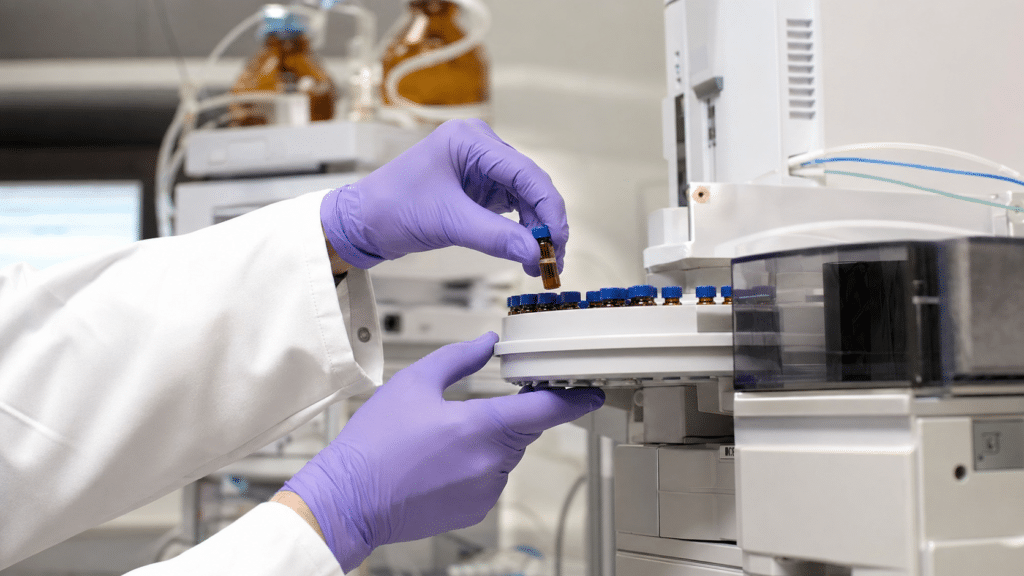
If area normalization is used, the reported percentage represents C70 detector response relative to the other integrated responses included in the calculation. It is not automatically identical to C70 mass fraction. Equal masses of C60 and C70 need not produce identical detector responses at every wavelength, and an undissolved or nonresponsive component may not appear in the calculation.
Peak shape also requires care. A dominant, visually sharp C70 peak is useful evidence, but it does not guarantee that no component co-elutes beneath it. Identity becomes stronger when retention is compared with an authentic reference under the same method or when HPLC is coupled with a spectroscopic or mass-selective detector.
For procurement, a claim such as “99.9% C70 by HPLC area” is more informative than an unqualified “99.9% pure.” The qualification states what was measured and avoids implying that the same number covers solvent, elemental and insoluble residues.
C70’s lower symmetry permits a richer set of electronic transitions than C60. Its solutions commonly show more pronounced absorption extending into the visible region. This feature makes UV–Vis useful for supporting identity, checking solution preparation and studying C70 in optical or electronic-material systems.
The spectrum is not independent of the experiment. Solvent environment can affect peak position, width and intensity, while concentration, aggregation, path length, baseline treatment and instrument configuration affect the recorded response. Comparative research has documented solvent-dependent electronic absorption behavior for C60 and C70.[4]
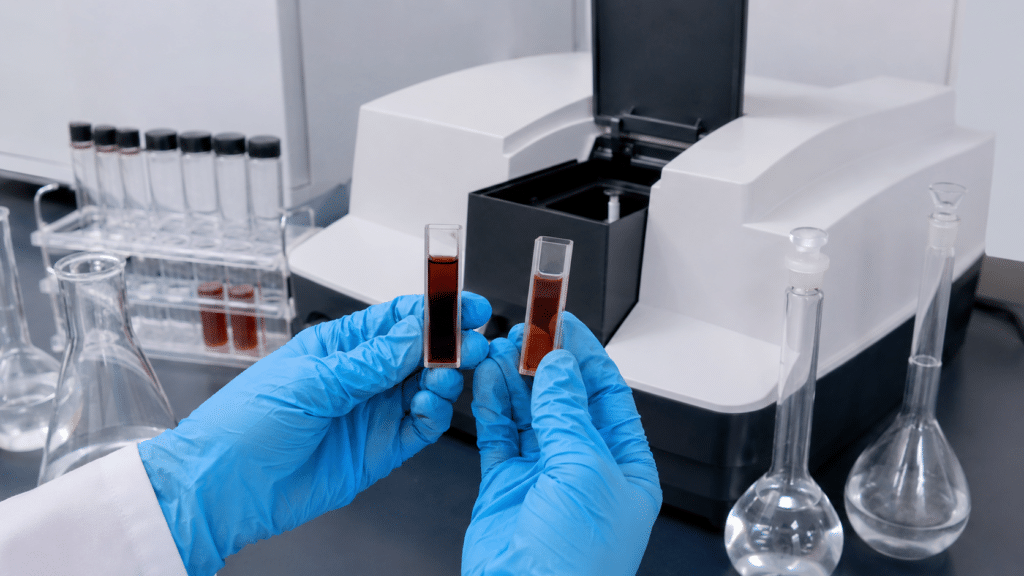
A laboratory should therefore record the solvent, concentration or preparation basis, cuvette path length, spectral range and relevant acquisition conditions. Comparison with a suitable reference spectrum should use compatible conditions. A reddish-brown solution may be visually consistent with C70, but color alone cannot confirm identity or quantify purity.
UV–Vis becomes especially useful when the analytical question concerns optical absorption in a defined solvent or processing formulation. It is less suitable as a standalone answer to whether a powder contains residual solvent, trace metals or insoluble particles.
Mass spectrometry provides direct evidence for molecular species according to mass-to-charge ratio. The intact C70 cage has a nominal molecular mass associated with seventy carbon atoms, clearly separating it from C60 and many higher fullerenes in an appropriate spectrum. The isotope distribution adds more evidence than a single nominal-mass label.
Mass spectrometry was part of the foundational characterization of isolated C70.[1] Modern laboratories may use laser-desorption, MALDI-compatible or other suitable approaches depending on the material and analytical objective. Ionization conditions should be selected carefully because fullerene ions can fragment, aggregate or respond differently from other molecular components.
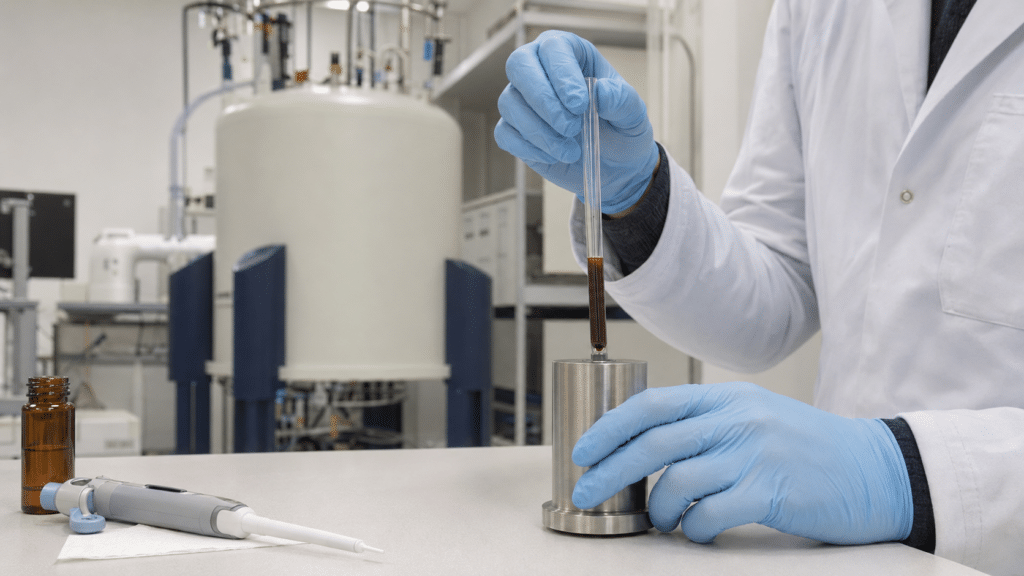
A strong C70 molecular-ion signal supports molecular identity. It does not automatically show that C70 accounts for the same percentage of the bulk powder. Signal intensity depends on ionization efficiency, instrument settings, sample preparation and matrix effects. A residual solvent may not be represented meaningfully in the same spectrum, while an inorganic residue may require an elemental method.
Mass spectrometry and HPLC therefore answer different parts of the same question. HPLC separates method-visible soluble components; mass spectrometry supports the molecular assignments of species that ionize. When coupled appropriately, LC-MS can reduce the risk of assigning a chromatographic peak solely from retention time.
Carbon-13 NMR is particularly informative for pristine C70 because the D5h cage contains five sets of symmetry-equivalent carbon atoms. A suitable spectrum is consequently expected to show five principal C70 carbon environments rather than the single environment associated with highly symmetrical pristine C60.
This feature made 13C NMR important in the early structural characterization of C70 and remains useful for distinguishing cage identity, investigating derivatives and detecting some fullerene-related components. Detailed work on C70 shows, however, that spectral interpretation is affected by solvent, temperature, molecular motion and computational treatment.[5]
NMR sample preparation can also be demanding. Pristine C70 requires a compatible deuterated solvent and sufficient dissolved material. Limited solubility, incomplete dissolution, aggregation or contamination by another fullerene can complicate acquisition. In one published C70 NMR study, a small C60 signal was detected in the investigated sample, illustrating how NMR may reveal information beyond the desired five-signal pattern.[5]
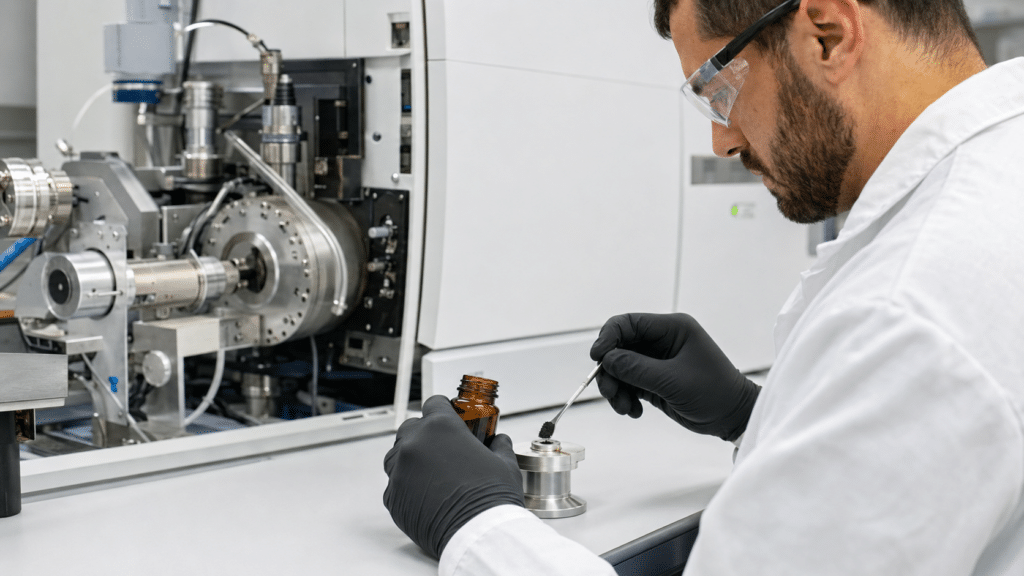
The observation of five C70 environments supports structural consistency. It does not prove the absence of every trace impurity. Minor components may fall below the method’s sensitivity, overlap with other signals or be invisible because they do not enter the prepared solution.
The principal four methods do not answer every material-quality question. The required additions should be selected from the application’s failure modes rather than applied as a ceremonial checklist.
Headspace GC or another suitable gas-chromatographic method may be relevant when volatile processing residues matter. ICP-MS, ICP-OES or another validated elemental technique may be appropriate when selected metals or other elements must be controlled. Thermogravimetric analysis can reveal mass changes during controlled heating, but a mass-loss event requires interpretation and is not automatically assignable to one substance.
Raman and FTIR spectroscopy can provide vibrational fingerprints. X-ray diffraction examines crystalline organization in the solid rather than proving molecular purity by itself. Karl Fischer titration or another validated moisture method may be appropriate if water content affects storage or processing.
The correct package differs by use. A synthetic chemistry laboratory may emphasize molecular identity and fullerene-related impurities. An optical laboratory may require controlled UV–Vis behavior. A thin-film team may add thermal and deposition-relevant testing. A distributor qualifying material for multiple customers may need broader documentation while avoiding the claim that one analytical package guarantees every downstream result.
A useful batch-specific Certificate of Analysis should connect every reported result to a method. If purity is stated by HPLC, the document should identify that basis. If a molecular-identity result is included, the technique and acceptance logic should be clear enough for the buyer to understand what was evaluated.
The absence of a test from a COA is not necessarily evidence of poor material. It means that the attribute is not established by that document. A buyer whose process is sensitive to residual solvent, selected elements, moisture or thermal behavior should ask whether relevant testing is available or arrange application-specific qualification.
Buyers should also distinguish a representative specification or sample COA from the document for the shipment being purchased. Batch traceability matters because the purpose of the COA is to describe the tested batch, not merely the general identity of C70.
Begin by defining the material correctly: pristine C70, a C70-rich fullerene fraction, a named C70 derivative or a formulation containing C70. These are not interchangeable analytical targets.
Next, define the failure mode. If contamination by C60 or higher fullerenes is critical, prioritize a suitable chromatographic method. If molecular identity is uncertain, combine chromatography with mass spectrometry or another orthogonal identity technique. If cage symmetry or derivative structure matters, consider NMR. If optical processing is central, use UV–Vis under conditions that represent the intended solvent system.
Finally, connect the laboratory evidence to the actual application. A C70 batch can be consistent with its molecular identity and still require additional qualification for a specific solvent, reaction, coating, thin film or device. Analytical documentation narrows uncertainty; it does not replace application testing.
Fullerene C70 is available for scientific and industrial evaluation in supported purity grades. Submit the intended application, target purity, quantity, destination and required analytical documentation through the quotation request page. XCT can discuss available batch documentation and sample requirements without treating one method-specific result as universal proof of application performance.
HPLC is commonly used to report the relative composition of soluble fullerene components. The result should identify the method and calculation basis, such as C70 percentage by HPLC area.
Yes. C70 and C60 have different molecular masses and isotope distributions, so a suitable mass-spectrometric method can support their molecular identification. It does not independently quantify every impurity in the bulk powder.
The commonly isolated D5h C70 cage contains five sets of symmetry-equivalent carbon atoms. Under suitable solution-state conditions, these produce five principal carbon-13 NMR environments.
No. UV–Vis can provide an optical fingerprint consistent with C70 under defined conditions, but solvent, concentration, aggregation and other absorbing components affect the spectrum. Orthogonal methods are needed for stronger identity and purity conclusions.
No. An HPLC area percentage represents detector response from components included under that chromatographic method. Residual solvents, selected elements, water and insoluble material may require separate tests.
For B2B procurement of Fullerene C70, 99.90% Purity, No metallic residue, buyers should confirm target purity, required quantity, application, destination country, COA, MSDS/SDS, packaging, storage conditions, and shipping requirements before requesting a formal quotation.

High-purity fullerene C70 is a nanomaterial composed of 70 carbon atoms, forming an elongated, rugby-ball-shaped structure. This molecule belongs to the fullerene…
Request product specifications, batch-specific COA, MSDS/SDS, sample availability, packaging details, and international shipping information before confirming your order.
Request DocumentsSubmit your product, purity, quantity, application, destination country, and documentation requirements. Our team will help confirm availability, COA, MSDS/SDS, packaging, and quotation details.