Latest News
Discover our company’s latest investments, strategie, and updates.
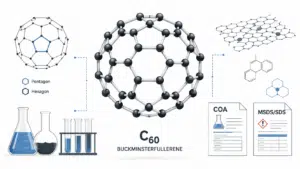
The buckminsterfullerene structure is one of the most recognizable molecular architectures in modern chemistry. Often described as a microscopic soccer ball, the C60 molecule is a closed carbon cage composed of exactly 60 carbon atoms arranged into pentagons and hexagons. This unusual buckyball structure changed how scientists understood carbon, molecular geometry, nanomaterials, and the boundary between chemistry and materials science.
To define buckminsterfullerene precisely: buckminsterfullerene is a molecular form of carbon with the formula C60, consisting of 60 carbon atoms arranged in a roughly spherical cage. It is also called Fullerene C60, Carbon 60, C60 fullerene, or the buckyball molecule. The name honors architect Richard Buckminster Fuller because the molecule resembles the geometry of geodesic domes associated with his architectural designs. [1]
The discovery of C60 was not just the identification of another carbon compound. It helped establish fullerenes as a new class of carbon allotropes alongside diamond, graphite, and later graphene-related materials. The 1996 Nobel Prize in Chemistry was awarded to Robert F. Curl Jr., Sir Harold W. Kroto, and Richard E. Smalley for the discovery of fullerenes. [2]
Today, carbon buckyballs are studied in nanotechnology, organic electronics, photovoltaic research, advanced materials, coatings, lubricants, biomedical research, and cosmetic formulation research. However, responsible technical writing should distinguish between research interest and verified commercial performance. The structure of C60 explains why the molecule attracts so much attention, but it does not mean every proposed application is mature, approved, or universally effective.
This guide explains the buckminsterfullerene structure from the molecular level upward: its geometry, bonding, physical properties, synthesis routes, purification, applications, space chemistry, and B2B material considerations for buyers evaluating Fullerene C60.
Buckminsterfullerene is the most famous member of the fullerene family. A fullerene is a molecule composed entirely of carbon atoms arranged into a hollow cage, tube, ellipsoid, or related closed structure. In the case of C60, the cage contains 60 carbon atoms.
The buckminsterfullerene structure is a discrete molecular structure. This is different from graphite, which forms extended sheets of carbon atoms, and diamond, which forms a continuous three-dimensional covalent network. C60 is a finite molecular cage, which is why it can dissolve in certain organic solvents and be purified as a molecular material.
For a quick definition, buckminsterfullerene can be described as follows:
| Item | Description |
|---|---|
| Common name | Buckminsterfullerene |
| Other names | Fullerene C60, Carbon 60, C60 fullerene, buckyball molecule |
| Formula | C60 |
| Molecular weight | 720.67 g/mol |
| CAS number | 99685-96-8 |
| Structure type | Closed spherical carbon cage |
| Geometric model | Truncated icosahedron |
| Visual comparison | Soccer-ball-like cage of pentagons and hexagons |
This molecular identity is important for both science and procurement. Buyers looking for C60 should confirm the product name, CAS number, formula, purity grade, COA, MSDS/SDS, packaging, and storage recommendations before placing an order.
The exact geometry of the buckminsterfullerene structure is known as a truncated icosahedron. This is the same general pattern seen in a classic soccer ball: a network of hexagons and pentagons arranged to close into a near-spherical shape.
The C60 buckyball structure contains:
Every carbon atom in the buckyball molecule sits at a vertex where one pentagon and two hexagons meet. This highly ordered arrangement gives the molecule its exceptional symmetry and its instantly recognizable cage-like appearance.
The presence of exactly 12 pentagons is not decorative. It is necessary for closing the cage. If carbon atoms formed only hexagons, the structure would tend toward a flat sheet similar to graphene. The pentagons introduce curvature, allowing the carbon network to bend into a closed molecular sphere. [3]
A simple way to understand the geometry is through Euler’s polyhedron formula:
V − E + F = 2
For the C60 cage, V = 60 vertices, E = 90 edges, and F = 32 faces. The result is 60 − 90 + 32 = 2, confirming that the arrangement is a closed polyhedral cage.
The stability of the buckminsterfullerene structure comes from a combination of symmetry, carbon bonding, and cage closure. C60 is not simply a random cluster of carbon atoms. It is a highly organized molecular architecture that balances curvature and bonding strain in a stable closed form.
The molecule belongs to the icosahedral symmetry group, often described as Ih symmetry. In practical terms, this means the C60 cage has many symmetry operations and a highly regular molecular shape. This symmetry helps explain why the molecule was so striking when first identified and why it remains a central teaching example in nanochemistry.
However, the buckyball structure is not perfectly equivalent to a flat aromatic carbon sheet. Its carbon atoms are forced into curvature, which affects orbital alignment, bond character, and reactivity. This is one reason C60 can behave as an electron-accepting molecule in organic electronics and photovoltaic research.
Within the buckminsterfullerene structure, not all carbon-carbon bonds are identical. The molecule has two main bond environments:
| Bond Type | Location | Typical Description | Importance |
|---|---|---|---|
| 6:6 bonds | Between two hexagons | Shorter, more double-bond-like | Often more reactive in addition chemistry |
| 6:5 bonds | Between a hexagon and a pentagon | Longer, more single-bond-like | Helps define cage geometry and strain distribution |
The 6:6 bonds are commonly described as having greater double-bond character, while the 6:5 bonds have more single-bond character. This bond differentiation affects how C60 reacts with other molecules and helps explain why fullerene chemistry often focuses on controlled functionalization of the cage.
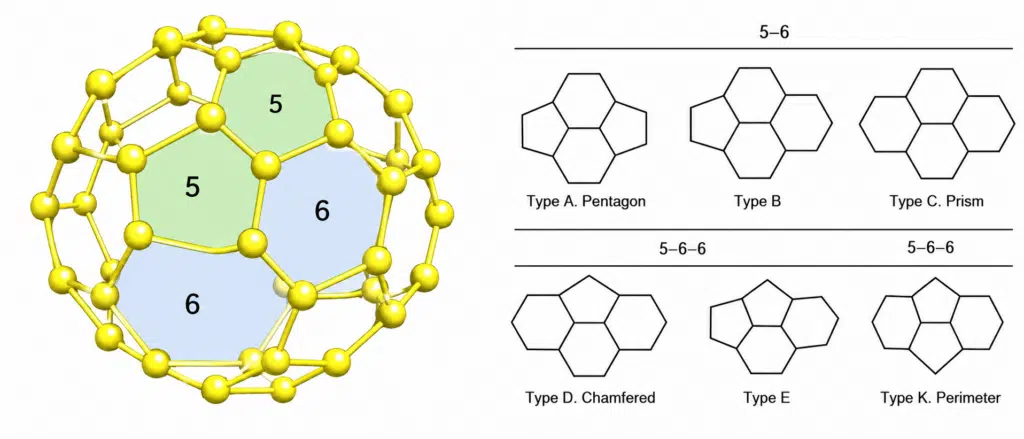
For researchers and industrial buyers, this is more than theoretical chemistry. Functionalized fullerenes, fullerene derivatives, and fullerene-based materials often depend on how the cage reacts at specific bond sites.
Carbon atoms in C60 are often described as mostly sp2-like, but the curvature of the cage prevents them from being as planar as the carbon atoms in graphite or graphene. The curved cage creates a degree of pyramidalization, meaning the bonding orbitals bend away from ideal flat sp2 geometry.
This curved bonding environment helps explain several properties of the buckyball molecule:
C60 is sometimes described in simplified sources as aromatic, but this can be misleading. The molecule has a conjugated carbon framework, yet electron delocalization is influenced by curvature and bond localization. A more accurate description is that C60 is a curved conjugated carbon cage with strong electron-accepting behavior.
The physical properties of carbon buckyballs are closely related to the molecular cage structure. Unlike diamond or graphite, purified C60 can behave as a molecular solid and can dissolve in certain organic solvents.
For commercial and research use, Fullerene C60 is typically supplied as a fine powder or as yellow-brown to black crystals with metallic luster. It is insoluble in water but can be dissolved in aromatic solvents such as toluene and chlorobenzene, or in non-aromatic solvents such as carbon disulfide. Toluene solutions of purified C60 are often purple to reddish-purple depending on concentration. [4]
Key buyer-relevant physical details include:
| Property | Buyer-Relevant Note |
|---|---|
| Appearance | Usually fine powder or yellow-brown to black crystals with metallic luster |
| Water solubility | Insoluble in water |
| Organic solvent behavior | Typically dissolved in toluene, chlorobenzene, or carbon disulfide |
| Storage | Store sealed, cool, dry, and away from light |
| Handling | Review MSDS/SDS and follow laboratory safety procedures |
These properties matter because C60 is used in research and industrial contexts where solvent choice, storage condition, light exposure, and documentation can affect downstream testing.
The discovery of the buckyball molecule is one of the defining stories in modern carbon chemistry. In 1985, researchers investigating carbon clusters generated by laser vaporization observed unusually stable clusters containing 60 carbon atoms. The result was the proposal of a closed cage structure: C60 buckminsterfullerene.
The Nobel Prize organization describes the discovery as a major breakthrough in understanding carbon. The 1996 Nobel Prize in Chemistry was awarded jointly to Robert F. Curl Jr., Sir Harold W. Kroto, and Richard E. Smalley for their discovery of fullerenes. [2]
This discovery opened a new field of fullerene chemistry. It also changed how scientists viewed carbon: not only as extended solids such as graphite and diamond, but also as discrete molecular cages with precise nanoscale structures.
Early C60 experiments used laser vaporization of graphite. While this method was important for discovery, it produced only very small amounts of fullerene material. Larger-scale fullerene research became more practical after methods such as arc discharge and combustion-based approaches made fullerene-containing soot available in greater quantities.
In the arc discharge method, a strong electrical current passes between graphite electrodes in an inert atmosphere. Carbon vapor condenses into soot that may contain C60, C70, higher fullerenes, and other carbon materials. The fullerene fraction must then be extracted and purified.
Combustion-based synthesis is another important route for fullerene production. In any production method, the key challenge is not simply forming carbon soot. The key challenge is separating and purifying specific fullerene molecules such as C60 and C70 with consistent quality.
Purification often involves solvent extraction and chromatographic separation. Buyers should confirm the test method used to determine purity, such as HPLC or another appropriate analytical method. They should also request batch-specific COA and MSDS/SDS before ordering C60 for research, formulation, electronics, photovoltaics, coatings, or other industrial studies.
This article avoids unsupported claims about production capacity, environmental status, carbon neutrality, or “world-first” manufacturing unless such claims are independently verified. For B2B procurement, the more useful focus is product identity, purity, documentation, packaging, storage, and batch consistency.
The buckminsterfullerene structure matters because the shape and electronic behavior of the C60 cage influence how the molecule interacts with light, electrons, solvents, surfaces, and other molecules. Applications should be described carefully: C60 is widely studied, but performance depends on purity, formulation, processing method, testing conditions, and the specific system.
Because C60 can accept electrons, it has been studied in organic electronics, molecular electronics, thin-film devices, and semiconductor-related research. In these systems, the buckyball structure is relevant because the cage can participate in charge transfer and electron-transport behavior.
However, C60 should not be described as a universal semiconductor material or as a replacement for silicon. It is better described as a carbon nanomaterial studied in organic electronics and advanced material systems, where purity and batch consistency may be important.
Fullerene C60, Fullerene C70, and fullerene derivatives have been studied in organic photovoltaics, perovskite solar cells, electron transport layers, and energy material systems. In photovoltaic research, fullerene-based materials are valued for electron-accepting and electron-transport-related behavior. [5]
This does not mean C60 guarantees improved solar cell efficiency. It means C60 and related fullerene materials remain relevant research materials for controlled studies in organic electronics and solar material systems.
Carbon buckyballs are studied in lubricant and coating formulation research because their nanoscale geometry, surface interaction, and carbon cage structure may be relevant to friction, wear, and advanced coating systems.
Responsible application writing should use phrases such as “studied as a lubricant additive,” “explored for anti-wear behavior,” or “used in formulation research.” It should not claim that C60 eliminates all wear, improves every oil, or guarantees engine protection.
C60 and fullerene derivatives have been investigated in biomedical research, including drug delivery concepts, photodynamic research, oxidative stress models, and nanomedicine-related studies. These topics should remain research-oriented.
This article does not claim that buckminsterfullerene treats disease, cures cancer, prevents aging, is approved for human use, or is safe for human consumption. Biomedical use depends on chemical modification, formulation, exposure route, toxicology, regulatory review, and intended application. [6]
Fullerene C60 is also studied in cosmetic formulation research and antioxidant-related material systems. This should not be converted into unsupported anti-aging or skincare performance claims. Cosmetic developers should confirm regulatory status, ingredient requirements, safety documentation, formulation compatibility, and local rules in the target market.
The buckyball molecule is not only a laboratory discovery. NASA’s Jet Propulsion Laboratory reported in 2010 that astronomers using the Spitzer Space Telescope detected buckyballs in space for the first time. The molecules were identified in the planetary nebula Tc 1, showing that C60 can exist in cosmic environments. [7]
This discovery is important because the original search for carbon clusters was partly connected to questions in interstellar chemistry. Finding C60 in space showed that the buckminsterfullerene structure is not only a synthetic laboratory curiosity but also a stable molecular form of carbon under certain astrophysical conditions.
The buckyball structure is easier to understand when compared with other carbon allotropes. All are made of carbon, but their atomic arrangement creates very different behavior.
| Carbon Form | Structure | Key Difference |
|---|---|---|
| Diamond | Three-dimensional sp3 covalent network | Extremely hard extended solid |
| Graphite | Layered sp2 carbon sheets | Conductive layered solid with weak interlayer forces |
| Graphene | Single-layer sp2 carbon sheet | Two-dimensional carbon material |
| Buckminsterfullerene C60 | Closed molecular cage of 60 carbon atoms | Discrete molecular carbon cage soluble in selected organic solvents |
| Carbon nanotubes | Cylindrical carbon structures | One-dimensional tubular nanomaterials |
This comparison explains why C60 occupies a unique position in carbon nanomaterials. It is molecular rather than bulk, curved rather than flat, and chemically tunable through fullerene functionalization.
A structure-focused article should still help readers who may be evaluating C60 as a research or industrial material. For B2B buyers, the buckminsterfullerene structure explains why C60 is interesting, but procurement decisions require quality and documentation review.
Important buyer checks include:
For standard Fullerene C60 products, purity options may include 99.00%, 99.50%, 99.90%, and 99.95%, depending on current availability and order requirements. Buyers should select purity according to application requirements rather than assuming the highest purity is always necessary.
For B2B fullerene procurement, quality should be evaluated through clear specifications, batch-specific COA, MSDS/SDS, packaging information, storage recommendations, and supplier communication. Buyers should confirm the target purity, test method, batch number, destination-country requirements, and application needs before placing a sample or bulk order.
The buckminsterfullerene structure is a closed spherical carbon cage made of 60 carbon atoms. Its geometry is a truncated icosahedron composed of 20 hexagons and 12 pentagons.
To define buckminsterfullerene, it is a molecular carbon allotrope with the formula C60. It is also known as Fullerene C60, Carbon 60, and the buckyball molecule.
A buckyball structure is a closed cage-like carbon structure resembling a soccer ball. In the case of C60, it contains 60 carbon atoms arranged into 12 pentagons and 20 hexagons.
C60 is called a buckyball molecule because its structure resembles the geodesic dome architecture associated with Richard Buckminster Fuller.
Carbon buckyballs are studied in nanotechnology, organic electronics, photovoltaic research, coatings, lubricants, biomedical research, cosmetic formulation research, and advanced materials. Applications should be described in research-oriented terms unless commercial performance or regulatory status is independently verified.
Yes. Buckminsterfullerene commonly refers to Fullerene C60, a molecule composed of 60 carbon atoms arranged in a closed spherical cage.
Fullerene C60 is insoluble in water. It is typically dissolved in organic solvents such as toluene, chlorobenzene, or carbon disulfide.
Buyers should request batch-specific COA, MSDS/SDS, product specification, purity information, packaging details, and storage recommendations before ordering Fullerene C60.
Need high-purity Fullerene C60 for research, formulation, electronics, photovoltaic research, lubricants, coatings, or advanced material development?
Contact The Fullerene to request product specifications, available purity options, batch-specific COA, MSDS/SDS, sample availability, packaging details, and international shipping support.