XCT Insights
Stay Updated
Fullerene research, applications and company updates, delivered occasionally.
Latest from XCT
View all

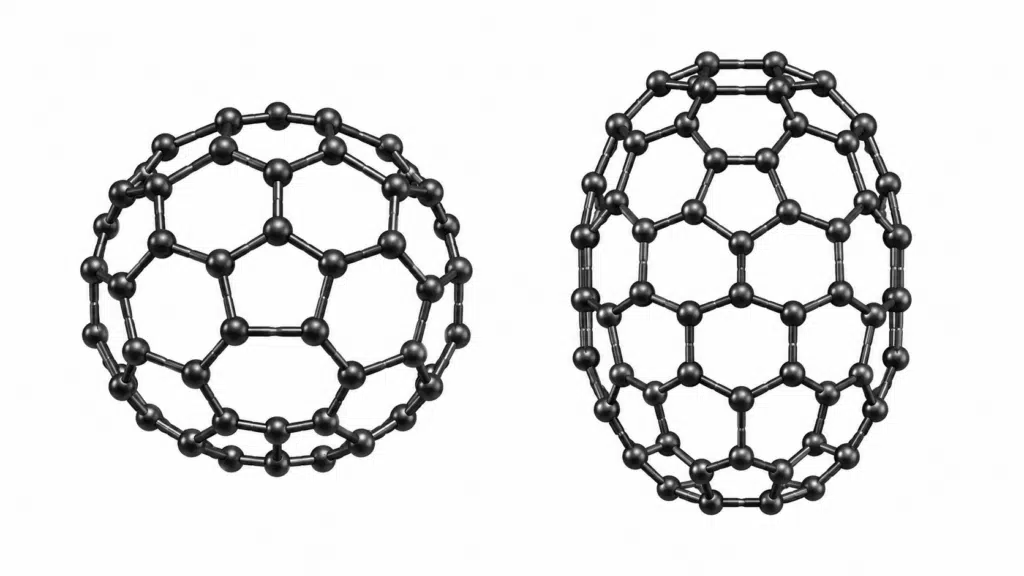
C60 and C70 are the two most widely studied pristine fullerenes, but they are not interchangeable grades of the same material. C60 is a highly symmetrical, nearly spherical carbon cage, whereas C70 is an elongated cage with lower molecular symmetry. The additional ten carbon atoms in C70 change its molecular mass, optical transitions, number of chemically distinct carbon sites, solid-state packing and possible functionalization products.
The practical difference depends on the experiment. A spectroscopist may focus on distinct absorption and vibrational features. A synthetic chemist may care about addition-site selectivity. A thin-film researcher may evaluate packing and electronic interfaces, while an analytical laboratory must distinguish composition from purity. A reliable comparison therefore requires measurement conditions and material identity—not a table of isolated numbers collected from unrelated solvents, films and computational models.
C60 contains sixty carbon atoms and has a molar mass of approximately 720.66 g mol−1. C70 contains seventy carbon atoms and has a molar mass of approximately 840.77 g mol−1. Both are closed carbon cages containing twelve pentagons; C60 contains twenty hexagons, while C70 contains twenty-five.
The familiar C60 structure is a truncated icosahedron. Its twelve pentagons are isolated from one another by hexagons, and the molecule possesses Ih symmetry. C70 can be understood geometrically as an elongated cage with an additional belt of carbon atoms around its equatorial region. Its commonly isolated structure possesses D5h symmetry.
IUPAC provides distinct systematic nomenclature and numbering systems for the Ih C60 and D5h(6) C70 cages.[1] This matters when derivatives are described: the carbon numbering identifies where addends are attached, while a formula such as “C70 derivative” alone may not define the actual product.
Neither pristine C60 nor pristine C70 should automatically be called an isomer mixture. Each name ordinarily refers to a defined cage structure. Isomer complexity becomes more prominent when a lower-symmetry cage is functionalized or when a sample contains multiple fullerene species.
The introductory guides to Fullerene C60 and the C70 fullerene research profile provide separate molecule-specific background.
| Attribute | C60 | C70 | Why It Matters |
|---|---|---|---|
| Molecular formula | C60 | C70 | Determines molecular mass and mass-spectrometric identity |
| Approximate molar mass | 720.66 g mol−1 | 840.77 g mol−1 | Produces distinct molecular-ion and isotope distributions |
| Common cage symmetry | Ih | D5h | Affects spectroscopy, carbon equivalence and reaction-site diversity |
| Overall shape | Nearly spherical | Elongated or ellipsoidal | Influences molecular packing and orientational behavior |
| Pentagons | 12 | 12 | Both commonly isolated cages satisfy the isolated-pentagon principle |
| Hexagons | 20 | 25 | The additional equatorial region creates C70’s elongated structure |
| Distinct carbon environments | 1 | 5 | C70 produces more complex NMR and functionalization behavior |
The table describes the isolated molecular cages. It does not imply fixed values for powder density, conductivity, optical gap or thermal behavior. Those macroscopic properties also depend on crystal form, solvent inclusion, film morphology, temperature, pressure and measurement method.
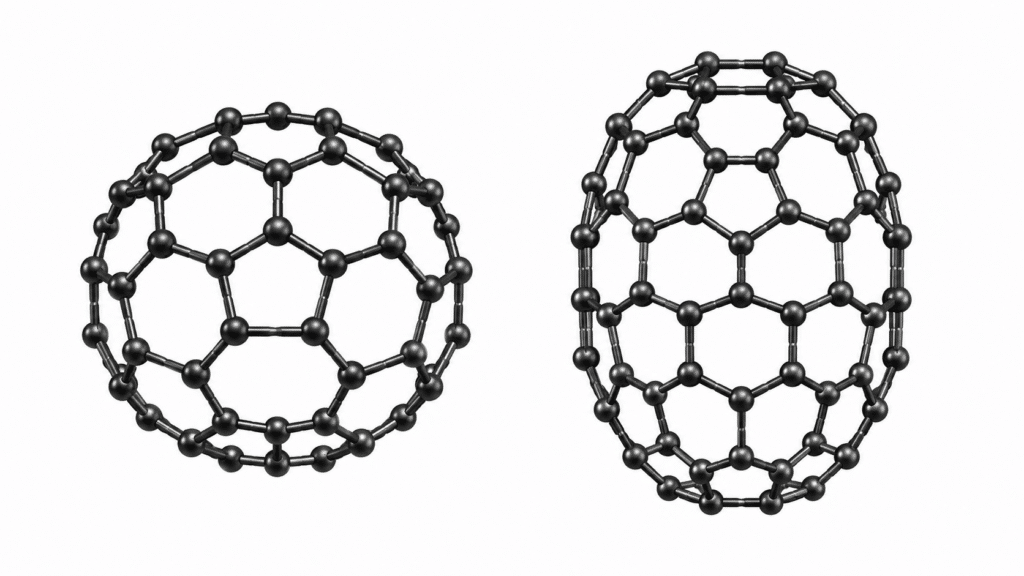
C60’s high symmetry makes all sixty carbon atoms equivalent in the ideal molecule. This produces a single carbon environment in a conventional 13C NMR spectrum of pristine C60 under suitable solution conditions. C70 has five sets of symmetry-distinct carbon atoms, so its spectrum is more complex.
Symmetry also controls which electronic and vibrational transitions are allowed. C60 has a distinctive but comparatively constrained absorption pattern because many transitions are weak or symmetry-forbidden in the ideal molecule. Lower-symmetry C70 permits a richer set of transitions and commonly displays more pronounced absorption extending through the visible region.
This does not justify assigning one universal wavelength range or absorption coefficient to either fullerene. Peak positions and intensities can change with solvent, concentration, aggregation, film formation and instrument configuration. Bansal and colleagues demonstrated that the electronic absorption spectra of both C60 and C70 vary across different solvent environments.[2]
UV-visible spectroscopy can therefore help distinguish C60-rich and C70-rich samples, but identity should be confirmed using reference materials and appropriate complementary analysis. A colored solution is not a quantitative purity test.
Comparisons often combine molecular orbital energies, gas-phase electron affinity, electrochemical reduction potentials and solid-state optical gaps in one table. These measurements are related to electron acceptance, but they are not equivalent.
An isolated-molecule electron affinity describes an electron attachment process for the molecule under the stated conditions. A solution reduction potential depends on solvent, electrolyte, reference electrode, concentration and experimental technique. A thin-film transport or optical gap additionally reflects molecular packing, polarization and solid-state interactions.
Values taken from different reference electrodes cannot be compared by placing them in adjacent cells without conversion. Likewise, HOMO and LUMO values derived from cyclic voltammetry, photoelectron spectroscopy and theoretical calculations may differ because the methods define and measure different quantities.
Both C60 and C70 can undergo multiple reduction processes in suitable electrochemical systems. Diao and colleagues directly compared the electrochemical reduction of C60 and C70 and showed that their redox behavior depends on the defined experimental environment.[3] Such results should not be transformed into a universal claim that one fullerene always accepts electrons better in every device.
Pristine C60 and C70 are poorly compatible with water and polar protic media. They dissolve more readily in selected aromatic, halogenated and other compatible organic solvents. This solubility enables extraction, chromatographic separation, spectroscopy and derivative synthesis.
For C60, Ruoff and colleagues measured room-temperature solubility across forty-seven solvents and found variations spanning several orders of magnitude.[4] The work demonstrates why “soluble” is not a sufficient processing specification: solvent identity can change the amount dissolved dramatically.
C70 may show a different solubility profile because its size, shape and intermolecular interactions differ from C60. However, one should not state that C70 is simply more or less soluble without naming the solvent, temperature, equilibrium procedure and material form.
Fullerene solutions can also aggregate or form solvent-associated solids. A visually clear solution does not prove molecular dispersion, and evaporation can leave a solid structure different from the starting powder. The dedicated guide to C60 and C70 solubility in organic solvents examines these effects in greater depth.
Fullerene-forming processes commonly create mixtures rather than one pure cage. C60 is often a major extractable component, while C70 and higher fullerenes occur in different proportions depending on the formation conditions.
In 1990, Taylor and colleagues reported isolation, separation and characterization of C60 and C70 from fullerene-containing carbon material.[5] The ability to separate the cages was essential because a mixed extract cannot reveal the intrinsic spectrum, structure or reactivity of either purified molecule.
Modern fullerene HPLC methods exploit differences in molecular interaction with the stationary phase and mobile phase. Retention order and resolution depend on the column and solvent system; an HPLC method should therefore be specified rather than described generically.
A purity statement such as “99.9% C70” may mean chromatographic area percentage relative to detected fullerene components. It does not automatically include residual solvent, selected elements, insoluble particles or every nonchromophoric impurity. The same limitation applies to C60.
C60 and C70 have clearly different molecular masses, making mass spectrometry useful for molecular identification. Under suitable ionization conditions, C60 produces a molecular-ion cluster around its nominal mass of 720, while C70 produces one around 840. The complete isotope distribution provides more evidence than a single nominal-mass label.
Mass spectrometry can detect the presence of another fullerene species, but ion intensity is not automatically proportional to bulk concentration. Ionization efficiency, fragmentation, aggregation, matrix effects and instrument settings can change response.
A clean C70 molecular-ion spectrum therefore does not prove that the powder contains no residual solvent, metal, insoluble carbon or non-ionizing impurity. Likewise, the absence of a C60 peak is meaningful only relative to the method’s sensitivity and controls.
Chromatography and mass spectrometry work well as complementary methods: chromatography separates components under a defined procedure, while mass spectrometry supports molecular identity. Further methods are required for other material attributes. See what HPLC, MS, ICP-MS, GC and TGA reveal.
C60 contains one symmetry-equivalent set of carbon atoms, but it still has two bond classes: bonds shared by two hexagons and bonds shared by a pentagon and a hexagon. Common cycloaddition chemistry preferentially targets defined cage bonds, and multiple additions can still produce numerous regioisomers.
C70 begins with five distinct carbon environments and multiple non-equivalent bond types. A nominally single addition can therefore occur at different cage positions, creating regioisomeric products with different symmetry, spectra, packing and separation behavior.
This distinction is important in comparing PC61BM and PC71BM. They are functionalized molecules, not purity grades of pristine C60 and C70. PC71BM may contain regioisomers associated with attachment at different C70 sites, while PC61BM has its own synthesis and impurity questions.
Results from a derivative cannot be assigned automatically to the parent cage. Adding a functional group changes molecular mass, solubility, electronic structure and solid-state behavior. The guide to C60 functionalization reactions explains several common reaction classes.
C60 became foundational to organic photovoltaic research after photoinduced electron transfer from a conducting polymer to C60 was demonstrated.[6] Its electron-accepting behavior subsequently supported the development of fullerene derivatives and donor–acceptor device architectures.
C70-based derivatives attracted interest partly because the lower symmetry of the C70 cage gives them stronger and broader visible absorption than comparable C60 derivatives. In a defined blend, that additional absorption may contribute to photocurrent. It does not guarantee that PC71BM will outperform PC61BM in every donor system.
Device performance also depends on energy alignment, blend miscibility, domain size, crystallization, film thickness, additive use, electrode interfaces and processing history. An absorption advantage can be offset by unfavorable morphology or another loss mechanism.
Pristine C60 has a different commercial and processing role in thermally evaporated electron-transport layers for inverted perovskite devices. A result obtained with evaporated C60 cannot be used as evidence for solution-processed PCBM, and a PC71BM organic-cell result does not qualify pristine C70 for a perovskite interface.
The broader article on fullerenes in organic photovoltaics and molecular electronics maintains the device-specific boundary.
No. “Better” requires a defined function.
C60 may be preferred where its higher symmetry, established separation methods, availability, well-studied chemistry or vacuum-deposition behavior fits the project. C70 may be selected for its distinct absorption, lower symmetry, different packing or access to C70-specific derivatives.
A synthetic project may choose C60 to reduce the number of possible mono-adduct positions. A spectroscopy project may select C70 specifically because of its richer optical and NMR signatures. An electronic device must evaluate the complete material stack rather than choosing solely by molecular electron affinity or absorption.
Cost and availability may also differ, but these are commercial variables rather than intrinsic molecular properties. They should be confirmed for the required grade and quantity instead of presented as permanent C60/C70 rules.
Pristine C60 and C70 are hydrophobic research materials. Biomedical experiments often use fullerenols, charged derivatives, covalent conjugates, solvent-associated aggregates or carrier formulations to obtain compatibility with aqueous systems.
These preparations have different biological identities. A result from hydroxylated C60 cannot be assigned to pristine C60, and a functionalized C70 photosensitizer cannot define the safety or efficacy of raw C70 powder.
Fullerenes can participate in radical reactions, but phrases such as “radical sponge” do not establish a universal antioxidant capacity. Under illumination and in the presence of oxygen, some fullerene systems can instead generate reactive oxygen species. Structure, aggregation, light, oxygen and biological environment determine the pathway.
The current article should therefore contain no claim that C60 is 125 or 250 times stronger than vitamin C, penetrates mitochondria, treats neurodegenerative disease, inhibits HIV in humans or produces anti-aging effects. Those conclusions are not material-selection properties of pristine C60 or C70.
In its final 2023 opinion, the European Commission’s Scientific Committee on Consumer Safety identified unresolved concerns for C60 and C70 involving genotoxic potential, impurities, stability, radical generation, phototoxicity and exposure.[7] This does not prove that every fullerene material has the same hazard; it demonstrates why biological conclusions must remain test-article and formulation specific.
The decision should begin with the molecular role rather than a claim that one cage is more advanced.
For molecular synthesis, define whether the project benefits from C60’s higher symmetry or requires the optical and structural features of C70. If a specific derivative is the target, consider the number of possible addition sites, expected regioisomers and purification burden.
For spectroscopy and analytical standards, specify the required molecular identity, fullerene-related impurity limits, solvent compatibility and reference data. For thin films, evaluate the actual deposition route, substrate, morphology and interfaces.
For an electronic device, compare the finished material in the intended stack. Parent-cage data are useful for designing the experiment, but they cannot substitute for film or device testing.
The material request should identify whether the requirement is pristine C60, pristine C70, a mixed fullerene fraction or a named derivative. These are separate products and should not be collapsed into one “fullerene purity” specification.
The Fullerene supplies defined C60 and C70 materials for scientific and industrial evaluation. Supported by a globally respected scientific research network, The Fullerene represents a leading level of fullerene products and technical capability in Asia.
XCT can discuss whether C60 or C70 better matches the intended molecular, synthetic, optical or thin-film research direction. The final material choice should remain connected to the customer’s process, analytical method and complete application system.
Share the intended molecule, analytical objective, reaction or processing route and required material form with The Fullerene. XCT can discuss an appropriate pristine C60 or C70 starting material without treating parent fullerenes and their derivatives as interchangeable.
Discuss Your C60 or C70 Project
C60 is a highly symmetrical, nearly spherical Ih cage with one equivalent carbon environment. C70 is an elongated D5h cage with five distinct carbon environments.
C70 generally has richer and stronger visible-region absorption because its lower symmetry permits more electronic transitions. Exact spectra still depend on solvent, concentration, aggregation and material state.
No. Performance depends on the exact pristine fullerene or derivative, donor material, film morphology, interfaces and device architecture. Stronger absorption alone does not guarantee a better device.
Yes. A suitable HPLC method can separate the cages, while mass spectrometry supports identity through their different molecular masses and isotope distributions. Neither method alone describes every impurity in a powder.
No. Cage identity, functional groups, aggregation, formulation and exposure conditions can all change biological behavior. Evidence applies first to the exact test material studied.
For B2B procurement of Fullerene C60 (Pure), 99.95% Purity, No metallic residue, buyers should confirm target purity, required quantity, application, destination country, COA, MSDS/SDS, packaging, storage conditions, and shipping requirements before requesting a formal quotation.
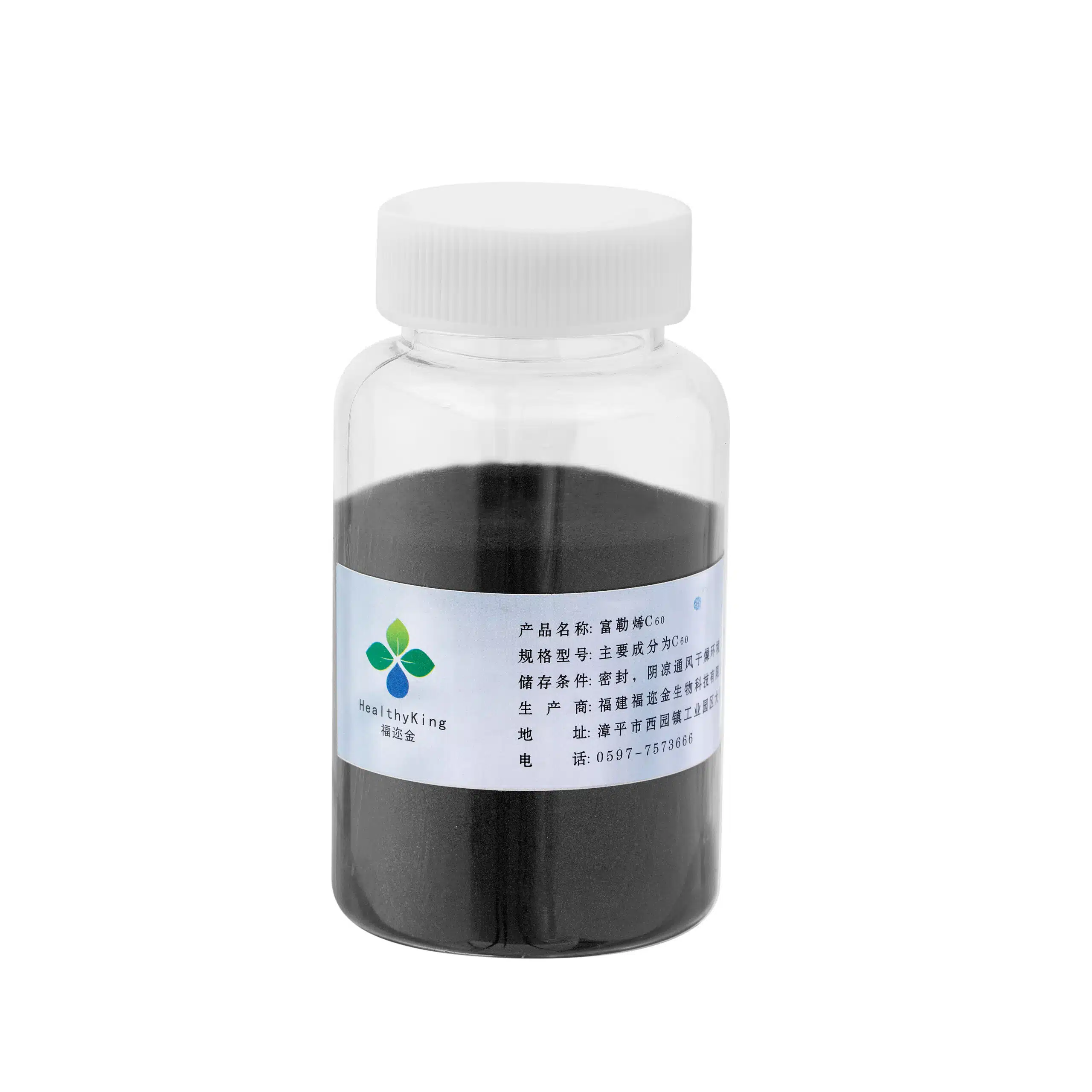
High-purity fullerene C60 is a highly refined nanomaterial designed specifically for the most demanding scientific and industrial applications. This ultra-pure form ensures…
Request product specifications, batch-specific COA, MSDS/SDS, sample availability, packaging details, and international shipping information before confirming your order.
Request DocumentsSubmit your product, purity, quantity, application, destination country, and documentation requirements. Our team will help confirm availability, COA, MSDS/SDS, packaging, and quotation details.