



1. Introduction: The Clinical Breakthrough in Oncological Skin Care
In radiotherapy, maintaining the structural integrity of the cutaneous barrier represents a persistent clinical challenge. Up to 90% of oncology patients undergoing radiation therapy (RT) develop some form of skin injury, with many experiencing progressive tissue degradation, erythema, and moist desquamation. Historically, treatment has been limited to basic hydration therapies, such as trolamine emulsions, which support surface-level wound healing but fail to address the underlying cellular damage.
A landmark clinical breakthrough reported in the ASCO Post (April 2026) has shifted this paradigm. A randomized, double-blind Phase II trial conducted at West China Hospital, Sichuan University, evaluated the efficacy of a fullerene-containing cream against standard trolamine cream in 132 patients undergoing intensive radiotherapy for head and neck cancer.
The results were statistically staggering: patients applying fullerene cream three times daily experienced a dramatic reduction in Grade $\ge$ 2 acute radiation dermatitis (ARD)—dropping from 83.3% in the trolamine group to just 34.8% in the fullerene cohort. Furthermore, Grade $\ge$ 3 ARD plummeted from 40.9% to 6.1%, while the median duration of severe skin symptoms was cut in half, from 28 days down to 14 days.
This clinical triumph has established carbon nanostructures as a highly potent class of acute radiation dermatitis topical treatment. However, formulating topicals for compromised, broken skin introduces a strict regulatory and physiological constraint: the absolute requirement for zero heavy metal contamination.
2. The Science of Fullerene-Mediated Radioprotection
Ionizing radiation destroys cancer cells but simultaneously triggers a massive, localized cascade of reactive oxygen species (ROS) and reactive nitrogen species (RNS) in healthy epidermal and dermal layers. These free radicals—primarily hydroxyl radicals, singlet oxygen, and superoxides—attack cellular lipids, proteins, and nuclear DNA, initiating inflammatory cascades that culminate in cell death and tissue necrosis.
Traditional antioxidants, such as Vitamin C or Vitamin E, act sacrificially; they neutralize radicals in a strict 1:1 ratio and are rapidly consumed, leaving the skin vulnerable during prolonged radiation exposure.
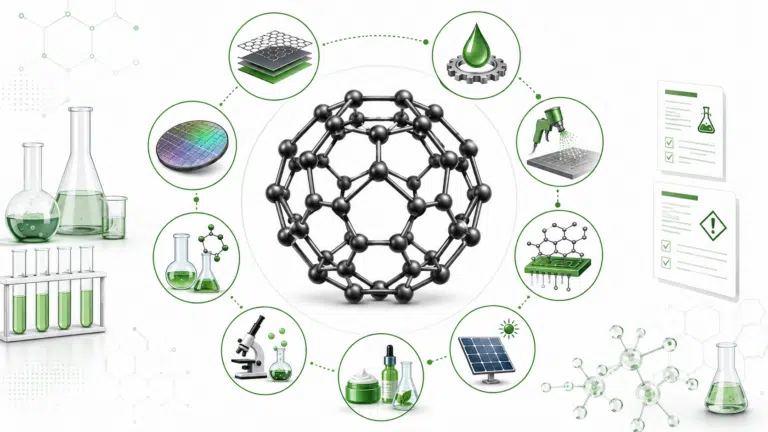
The fullerene antioxidant skincare formulation operates on an entirely different physical scale. Carbon 60 (C60) functions as a catalytic “radical sponge”. Thanks to its unique hollow-cage structure and highly conjugated $\pi$-electron system, a single C60 molecule can continuously coordinate, localize, and neutralize dozens of free radicals simultaneously without undergoing structural degradation.
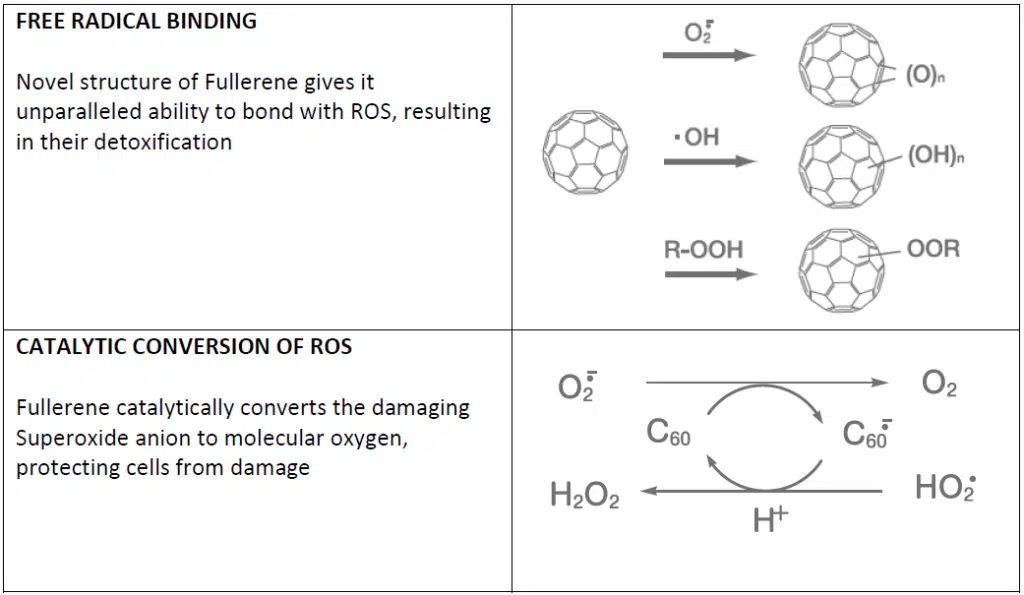
When functionalized into water-soluble derivatives, such as polyhydroxylated fullerenols ($C_{60}(OH)_{24}$), these nanostructures easily disperse into topical creams. Preclinical studies show that fullerenols protect human keratinocytes from radiation-induced apoptosis, prevent lipid peroxidation of cell membranes, and promote rapid tissue regeneration and hair follicle preservation after high-dose ionizing radiation.
3. The Broken Skin Problem: Why Zero Metal Residue is a Regulatory Mandate
While the therapeutic benefits of fullerenes are clear, their application on irradiated skin introduces a critical safety threshold. Acute radiation dermatitis often results in physical breakdown of the skin barrier, exposing the vascularized dermis and basal cell layers. On intact skin, large molecules face high penetration barriers; however, on compromised or broken skin, the transdermal absorption of any topical ingredient increases exponentially.
This structural vulnerability is why the European Commission’s Scientific Committee on Consumer Safety (SCCS) and the International Council for Harmonisation (ICH) maintain a strict “red line” regarding impurities in topicals. Under the ICH Q3D elemental impurities guidelines, when a topical product is applied to skin with substantial disruption of the basal cell layer of the epidermis, standard cutaneous Permitted Daily Exposure (PDE) limits no longer apply. Instead, the product must meet the far more stringent parenteral (intravenous) safety limits.
This reclassification is critical for transition metals like Nickel (Ni) and Cobalt (Co). Both are classified as Class 2A impurities due to their high toxicological risk and potential to cause severe contact sensitization and allergic dermatitis. Under parenteral limits, the maximum allowable exposure for Nickel is capped at an ultra-low 20 µg/day, and Cobalt is restricted to 5 µg/day.
For clinical formulators, any trace metal residue from synthesis can lead to batch rejection, localized skin irritation, or systemic heavy metal absorption, making zero heavy metal residue fullerenes the absolute standard for oncological skincare.
4. Sourcing High-Purity Precursors: The Carbonsphere & Healthyking Standard
The traditional method for manufacturing C60 is the carbon arc-discharge process, which vaporizes solid graphite rods under extreme currents. To stabilize the plasma arc and enhance fullerene yields, manufacturers routinely impregnate the graphite anodes with transition metal catalysts, such as nickel, cobalt, and iron. Consequently, the raw fullerene soot is highly contaminated with heavy metals. Even after multi-stage solvent extractions and acid-washing, trace ppm-level metal residues remain structurally bound to the carbon cages, presenting a major risk of catalyst poisoning and clinical toxicity.
To completely bypass this risk, advanced B2B formulators rely on the Healthyking Continuous Combustion Method. This green, patented technology replaces solid graphite with plant-derived, carbon-neutral liquid hydrocarbons, continuously pyrolyzing them in a low-pressure, oxygen-starved laminar flame. Because the carbon atoms self-assemble into icosahedral cages entirely in the gas phase without the introduction of any transition metals, the resulting fullerene is intrinsically free from heavy metal contamination at the molecular level.
Through an exclusive global trade partnership, Carbonsphere delivers this premium medical grade fullerene c60 to the global pharmaceutical and cosmetic industries. Boasting a verified purity of 99.95%, Carbonsphere’s material is subjected to rigorous high-performance liquid chromatography (HPLC) and matrix-assisted laser desorption/ionization time-of-flight (MALDI-TOF) mass spectrometry. This ensures absolute batch-to-batch consistency and guarantees a precursor that easily satisfies the strict regulatory demands of medical-grade oncological topicals.
FAQ
Why is trolamine cream less effective than fullerene cream for radiation dermatitis?
Trolamine is a traditional topical emulsion designed primarily to hydrate the skin and support basic wound healing. It does not possess antioxidant properties. Fullerene cream, on the other hand, acts as a highly potent, catalytic free-radical scavenger, directly intercepting and neutralizing the massive wave of radiation-induced ROS before they can destroy epidermal cells.
How do transition metals like nickel and cobalt contaminate traditional C60?
In traditional arc-discharge synthesis, transition metals (Ni, Co, Fe) are intentionally blended into the graphite electrodes to act as catalysts for fullerene formation. These metals remain associated with the carbon soot and are extremely difficult to remove, often leaving trace contaminants that can cause skin sensitization and deactivation of downstream formulations.
What is the specific role of the SCCS and ICH Q3D in fullerene cosmetics?
The European Commission’s SCCS and the ICH Q3D guidelines regulate the safety of nanomaterials and elemental impurities in consumer and pharmaceutical products. Because radiation-damaged skin lacks a functional epidermal barrier, regulatory agencies mandate that topicals applied to broken skin must comply with ultra-strict parenteral (injectable) safety limits, prohibiting any significant trace metal residues.
Can C60 creams be used on open wounds resulting from radiotherapy?
Yes, but only if the formulation utilizes pharmaceutical-grade, zero heavy metal residue fullerenes (such as those supplied by Carbonsphere and processed via the Healthyking continuous combustion method). Standard cosmetic-grade fullerenes may contain residual toluene solvents or heavy metals that could cause severe irritation or systemic toxicity when absorbed through open wounds.
References
Carbonsphere Nanomaterial Technical Specifications & Purity Guidelines. (2026). Xiamen Carbonsphere Trading Co., Ltd. / Healthyking Joint Research Report.
Liu, Y., et al. (2026). Efficacy of Fullerene Cream vs. Trolamine Cream in Preventing Acute Radiation Dermatitis in Head and Neck Cancer Patients: A Randomized Phase II Trial. Journal of Clinical Oncology / ASCO Post.
Saitoh, Y., et al. (2011). Super-highly hydroxylated fullerene derivative protects human keratinocytes from UV-induced cell injuries together with the decreases in intracellular ROS generation and DNA damages. Journal of Photochemistry and Photobiology B: Biology, 102(1), 69-76.
European Commission Scientific Committee on Consumer Safety (SCCS). (2023). Opinion on the safety of Fullerenes, Hydroxylated Fullerenes and hydrated forms of Hydroxylated Fullerenes in cosmetic products.
International Council for Harmonisation (ICH). (2024). Guideline Q3D(R2) on Elemental Impurities.