
XCT Insights
Stay Updated
Fullerene research, applications and company updates, delivered occasionally.
Latest from XCT
View all
Trace metal control can matter when Fullerene C60 is used in catalyst-sensitive synthesis, thin-film research or other processes in which small changes in raw-material composition complicate interpretation. The practical question, however, is not whether a product is described as “metal-free.” It is which elements were measured, how the sample was prepared, what analytical method was used, and whether the reporting limits are suitable for the downstream process.
A production route that does not intentionally use a metal catalyst may reduce one potential source of contamination, but it does not establish the elemental composition of a finished batch. Feedstocks, electrodes, reactors, collection systems, purification media, grinding tools, transfer equipment and packaging can all contribute material during production and handling.
This guide explains how laboratories and industrial R&D teams can build a risk-based specification for trace metal impurities in Fullerene C60 without treating every detected element as a catalyst poison or converting a process description into an unsupported purity claim.
“Metal-free” is not a complete analytical specification. Depending on the supplier or research context, it may mean:
These meanings are not interchangeable. “No metal catalyst used” describes a process input. “Nickel below a stated reporting limit by ICP-MS” describes an analytical result for a particular sample. A buyer qualifying C60 should ask for the second type of information when elemental composition affects the planned work.
The target element list must also be explicit. A report covering nickel, cobalt and palladium does not establish the absence of iron, copper, chromium, sodium, calcium or other elements. The relevant list depends on the manufacturing route, equipment, purification process and downstream application.
Several chemically different materials can be described loosely as “metal associated with fullerene.” They should be separated before analytical results are interpreted.
An ICP-MS result after complete digestion may quantify selected elements in the submitted material, but it does not by itself establish how those elements were chemically bound. Conversely, molecular mass spectrometry may support the identity of a particular metal–fullerene species but is not automatically a quantitative measurement of total elemental contamination.
This distinction matters because an intentionally synthesized metal–fullerene research material is not an impure version of pristine C60. It is a different target material requiring its own identity, composition and analytical plan.
Potential contamination sources should be mapped across the complete production and handling chain rather than attributed to a route name alone.
Carbon feedstocks, electrodes, reactor hardware and collection surfaces can introduce different elemental backgrounds. Arc-discharge, combustion and other formation routes each have process-specific contamination risks, but none should be assumed to produce a fixed metal profile without batch data.
Solvents, chromatographic media, pumps, valves, filters and reusable vessels may contribute inorganic residues. Purification can remove one impurity class while introducing another, so fullerene-species purity and total elemental composition should be treated as separate questions.
Grinding, sieving, blending and transfer operations increase contact with tools and environmental surfaces. Stainless-steel equipment may make iron, chromium or nickel relevant to a risk assessment, while glass, ceramic or polymer components introduce different possible backgrounds.
A useful supplier investigation therefore asks where the material contacted metal-bearing equipment, whether dedicated or shared equipment was used, and how representative samples were collected.
IUPAC describes catalyst decay as a decrease in conversion with time under otherwise constant conditions.[1] Catalyst poisoning is one possible cause of deactivation, but it is not the only one. Fouling, sintering, phase changes, loss of active material and changes in the reaction environment can also reduce activity.
Whether a trace species behaves as a poison depends on the catalyst, oxidation state, ligands, solvent, reactants, temperature and concentration. Some compounds bind strongly to active sites; others may be chemically inactive, act as promoters or have no measurable effect at the concentration present. It is therefore inaccurate to state that every trace transition metal in C60 will poison palladium, platinum, ruthenium or another catalyst.
For a C60 functionalization or derivative-synthesis program, the laboratory should begin with the actual reaction. If the process uses a sensitive homogeneous catalyst, define which elements or inorganic species could interfere with that catalytic cycle. Then compare matched C60 batches or spike the suspected impurity into a controlled experiment. Reaction conversion, selectivity, catalyst loading, induction time and reproducibility provide more direct evidence than a general statement about “metal-free” material.
The U.S. Department of Energy describes catalysts as materials that accelerate reactions or allow them to proceed under less severe conditions without being consumed in the overall reaction.[2] Protecting that function requires process-specific evidence, not a universal prohibited-metal list copied from an unrelated catalytic system.
Material purity can influence organic semiconductor experiments, but “impurity” is a broad category. Residual solvents, oxygen, water, fullerene derivatives, degradation products, counterions, particles and metals can affect film formation or electrical measurements through different mechanisms.
Research on small-molecule organic semiconductors has shown that purification history can materially change measured material and device properties.[3] This supports careful impurity control, but it does not establish that every device loss originates from trace metals.
If two C60 batches produce different device results, the investigation should compare more than elemental data. Relevant variables can include fullerene-species composition, residual solvent, water exposure, sublimation history, deposition rate, film thickness, substrate preparation, interfacial layers and device encapsulation.
Trace-element analysis is most useful when it is connected to a controlled device comparison. Matched deposition conditions and replicate devices can show whether a batch difference is reproducible. Additional surface or film analysis can then investigate whether the suspected impurity is present in the deposited layer and whether it correlates with the electrical response.
| Method | Primary question | Useful output | Important boundary |
|---|---|---|---|
| ICP-MS | Which selected elements are present after suitable sample preparation? | Element-specific concentration with method reporting limits | Accuracy depends on digestion, blanks, calibration and matrix control |
| ICP-OES | Which elements are present at concentrations appropriate for optical-emission measurement? | Multi-element concentration data | Typically less sensitive than ICP-MS for many ultra-trace requirements |
| HPLC | What soluble fullerene components are resolved under the selected conditions? | Relative chromatographic composition | Does not establish total elemental impurity content |
| Molecular mass spectrometry | Which molecular ions or fullerene species are detected? | Molecular-mass and isotope-pattern evidence | Not automatically quantitative for total metals |
| XPS | What elements and chemical states are present near the surface? | Surface-sensitive elemental and chemical-state information | Does not represent bulk concentration without a suitable sampling model |
| Device or reaction test | Does the batch behave differently in the intended process? | Conversion, selectivity, film or device response | Does not identify the impurity without complementary analysis |
ICP-MS is widely used for trace and ultra-trace elemental analysis, including industrial chemicals and semiconductor-related materials.[4] It is not simply a matter of placing C60 powder in an instrument. The sample must be introduced in a form compatible with the method, and the laboratory must demonstrate that the preparation recovered the target elements without introducing significant contamination.
For carbon-rich samples, matrix effects and incomplete digestion require particular attention. Instrument and method literature recommends contamination control, high-purity reagents, suitable blanks and sample-preparation procedures matched to the material.[5]
Further method-specific context is available in XCT’s guide to C60 characterization methods.
A result such as “metal-free” or “zero metals” is less informative than a structured analytical report. For each target element, the reader should be able to identify:
“Not detected” means that the measured signal did not meet the laboratory’s defined detection or reporting criterion under that method. It does not mean that the element is absent at every possible concentration.
Likewise, a supplier result applies first to the tested sample. Buyers with highly sensitive processes may use independent incoming analysis or periodic verification to determine whether the supplier data remain representative of received lots.
A practical specification begins with the process failure that the team is trying to prevent.
Identify the catalyst, ligands, reaction conditions and known interferents. Select target elements based on the reaction chemistry and contamination history. If the sensitivity threshold is unknown, use controlled spiking or matched-batch studies before establishing a purchasing limit.
Define whether C60 will be solution processed, thermally evaporated or used as a precursor. Connect raw-material analysis to film and device controls. A metal result is meaningful only when deposition history, layer thickness and device architecture are also controlled.
A broader screening list may be appropriate at the start. Once the experiment identifies which variables materially affect the outcome, the specification can be narrowed to the measurements that support reproducibility.
This risk-based approach prevents two opposite errors: accepting an undefined “metal-free” label, and imposing an expensive ultra-trace specification that has no demonstrated relationship to the application.
Production-route information can help identify likely contamination sources and guide the analytical plan. A route that does not intentionally use a metal catalyst may reduce catalyst-derived contamination risk. It does not remove possible contributions from feedstocks, reactor materials, extraction systems or handling equipment.
Similarly, material produced through arc discharge should not automatically be described as contaminated. The electrode composition, apparatus, collection method and purification history determine the actual risk. Compare routes through representative batch data rather than categorical claims.
XCT’s separate guide to verifying metal-free Fullerene C60 examines the analytical meaning of the term in greater detail.
For an overview of synthesis, purification and batch controls, see the C60 supply-chain quality-control guide.
If your project uses C60 in catalyst-sensitive synthesis or optoelectronic research, send XCT the intended process, required quantity, target purity, elements of concern and required reporting limits. XCT can review the available material and batch documentation against the stated research requirement without treating a production-route label as a universal performance guarantee.
Submit your Fullerene C60 requirement.
No. “Metal-free” may describe a production route or a result for selected elements. A meaningful specification names the tested elements, analytical method, units and reporting limits.
No. HPLC can separate and compare soluble fullerene components under defined chromatographic conditions, but elemental methods such as ICP-MS or ICP-OES are needed to assess selected trace metals.
No. Whether an element or compound inhibits a catalyst depends on its chemical form, concentration, catalyst system, ligands, reactants, solvent and operating conditions. The risk should be evaluated for the actual reaction.
No. Avoiding an intentionally added metal catalyst removes one possible source, but feedstocks, equipment, purification media, handling and packaging can introduce other elemental impurities.
The buyer should define the target elements, required reporting limits, application, material form and quantity, then review the supplier’s sampling, preparation and analytical methods. Independent incoming verification may be appropriate for sensitive processes.
For B2B procurement of Fullerene C60 (Pure), 99.95% Purity, No metallic residue, buyers should confirm target purity, required quantity, application, destination country, COA, MSDS/SDS, packaging, storage conditions, and shipping requirements before requesting a formal quotation.
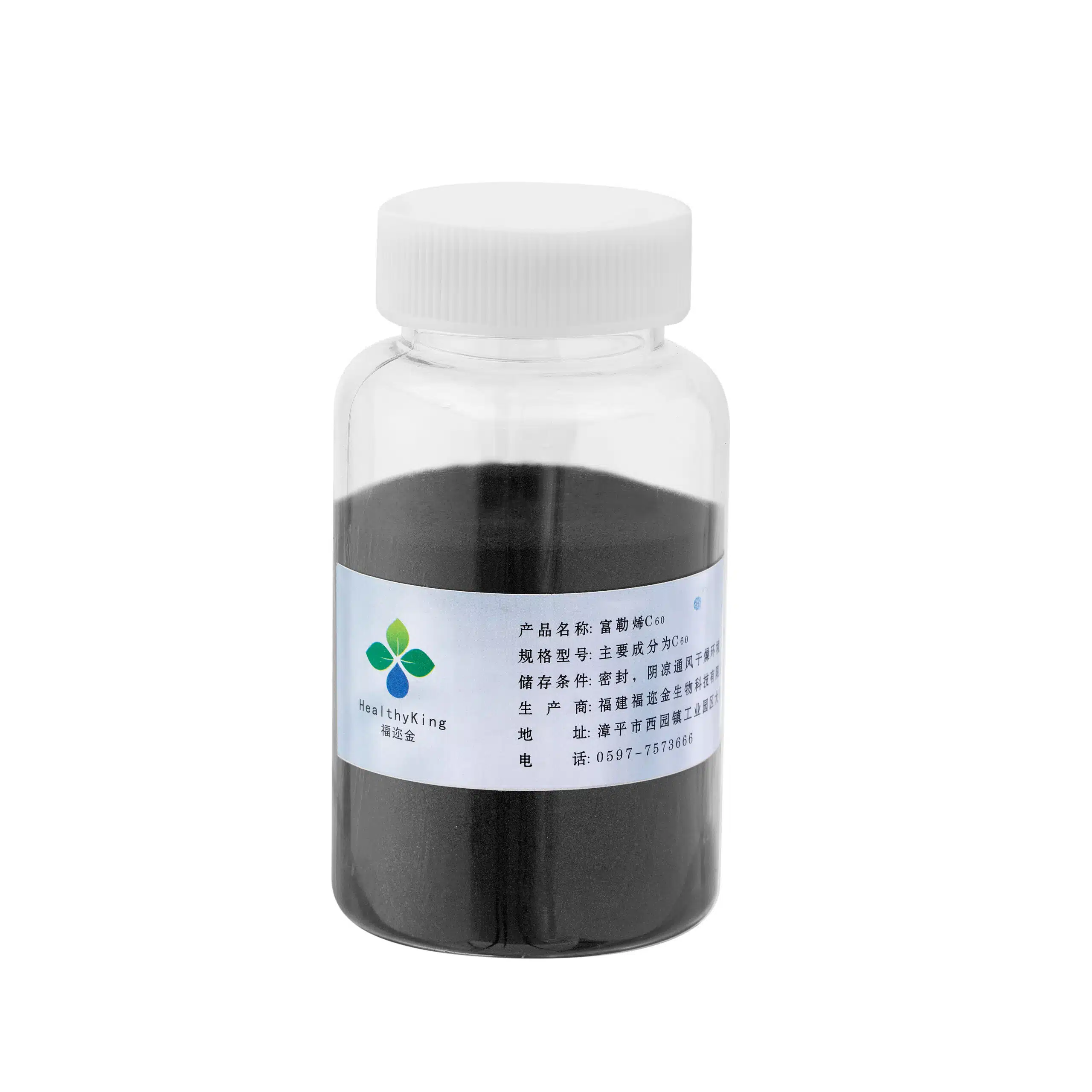
High-purity fullerene C60 is a highly refined nanomaterial designed specifically for the most demanding scientific and industrial applications. This ultra-pure form ensures…
Request product specifications, batch-specific COA, MSDS/SDS, sample availability, packaging details, and international shipping information before confirming your order.
Request DocumentsSubmit your product, purity, quantity, application, destination country, and documentation requirements. Our team will help confirm availability, COA, MSDS/SDS, packaging, and quotation details.